Oregano for Antiparasitic Use and SIBO — Force 2000, Chedid 2014, and Gut Dysbiosis
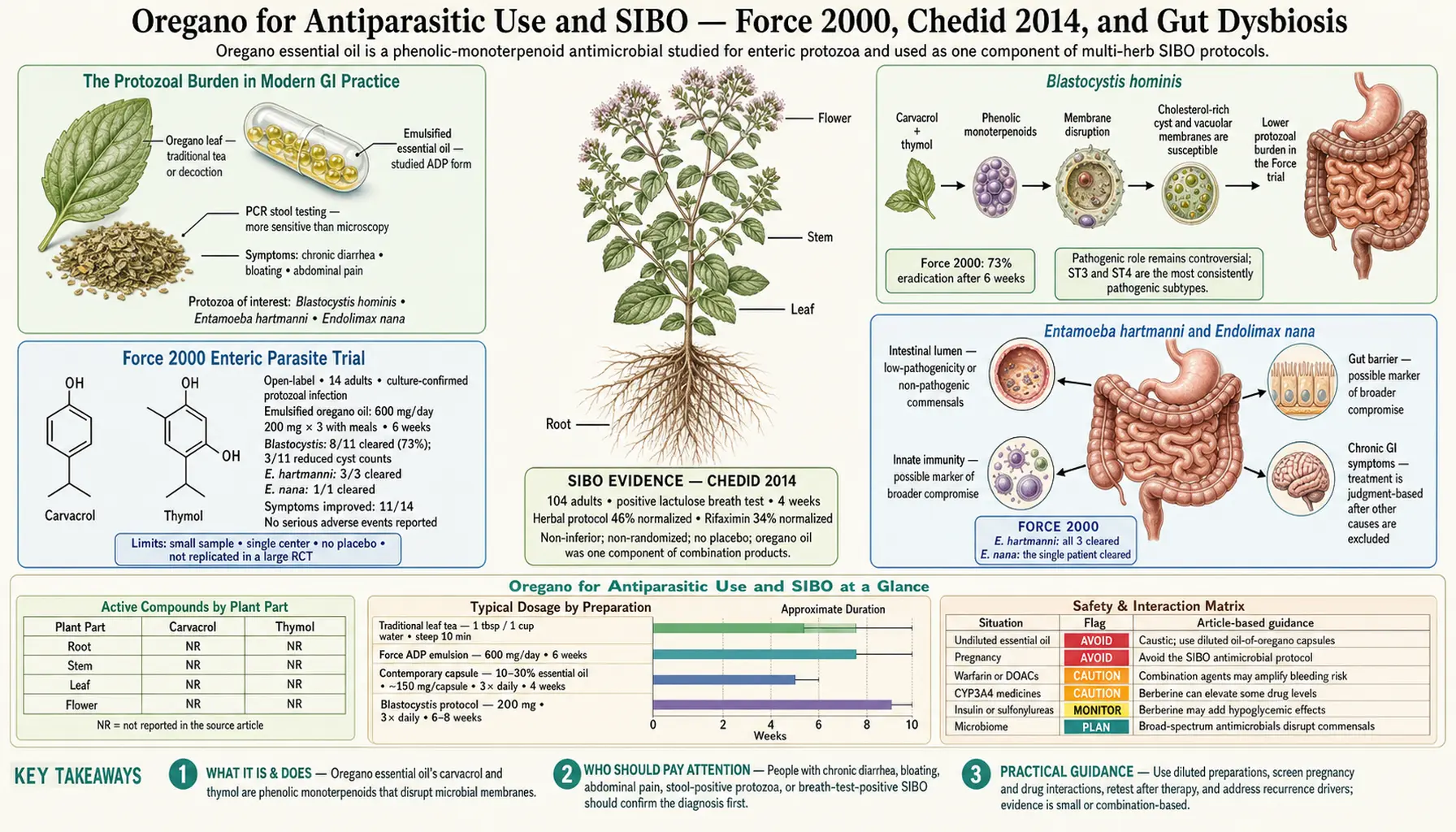
Oregano essential oil has two of the most-cited natural-medicine clinical trials of any plant antimicrobial to its name. Force M et al. (2000) ran an open-label trial in 14 adult patients with culture-confirmed enteric protozoal infections, using emulsified oil of oregano (600 mg/day for 6 weeks). At the end of treatment, eight of eleven patients with Blastocystis hominis showed complete eradication on stool ova-and-parasites testing; the three patients with Entamoeba hartmanni all cleared; the single Endolimax nana patient cleared. Chedid V et al. (2014) at Johns Hopkins compared a herbal antimicrobial protocol containing oregano oil among other agents to rifaximin for treatment of SIBO (small intestinal bacterial overgrowth) and found the herbal approach non-inferior to rifaximin for negative lactulose breath test at the end of 4 weeks (46% vs 34% response). Combined with the deep mechanistic plausibility of carvacrol+thymol membrane disruption against protozoa, bacteria, and methanogens, this is the empirical foundation for the standard use of oregano oil in the modern functional-medicine and integrative-gastroenterology approach to chronic gut dysbiosis, IBS-D, SIBO, and parasitic gastroenteritis. This deep-dive covers each trial in detail, the practical protocol, and the underlying biology.
Table of Contents
- The Protozoal Burden in Modern GI Practice
- Force 2000 Enteric Parasite Trial
- Blastocystis hominis
- Entamoeba hartmanni and Endolimax nana
- SIBO — Background and Diagnosis
- Chedid 2014 Hopkins / Cedars-Sinai Trial
- Methane-Dominant SIBO / IMO
- Traditional Mediterranean Gut Use
- A Practical 4-Week Oregano-Based Protocol
- Combinations with Berberine, Allicin, Neem
- Cautions and Microbiome Disruption
- Key Research Papers
- Connections
- Featured Videos
The Protozoal Burden in Modern GI Practice
The conventional gastroenterology view, until roughly the 2000s, was that intestinal protozoa other than Giardia lamblia, Entamoeba histolytica, and Cryptosporidium were uncommon in the developed world, largely commensal, and rarely worth treating. Stool ova-and-parasites testing was performed for symptomatic patients with diarrhea and travel history; the asymptomatic findings of Blastocystis hominis, Endolimax nana, Dientamoeba fragilis, Entamoeba hartmanni, and Entamoeba coli were typically dismissed.
Three developments have shifted the picture: PCR-based stool testing (much more sensitive than microscopy) detects protozoa more frequently and reveals them in patients with chronic GI symptoms more often than in asymptomatic controls; Blastocystis hominis in particular has been associated with chronic IBS-D, post-infectious IBS, urticaria, and inflammatory bowel disease in multiple cohort studies; and growing recognition of "post-infectious IBS" has expanded the clinical interest in chronic low-grade enteric parasitism as a treatable cause of unexplained chronic diarrhea, bloating, and abdominal pain.
The conventional pharmacologic options are limited — metronidazole, tinidazole, nitazoxanide, paromomycin, and iodoquinol are the standard drugs. Each has clinical limitations: metronidazole is associated with GI side effects, alcohol intolerance, and rare neuropathy with prolonged use; tinidazole is better tolerated but availability varies by country; nitazoxanide is expensive and not universally effective. Treatment courses are typically 7–10 days. Recurrence is common, particularly in Blastocystis hominis infections where the cyst form can persist in untreated household members or environmental reservoirs.
Oregano essential oil offers a different class of antiprotozoal activity — the same membrane-disruption mechanism that drives the antibacterial and antifungal spectrum applies to protozoal cell membranes. The Force 2000 trial below was the first English-language clinical demonstration of this activity in humans with culture-confirmed infection.
Force 2000 Enteric Parasite Trial
Force M, Sparks WS, Ronzio RA (2000), "Inhibition of enteric parasites by emulsified oil of oregano in vivo," published in Phytotherapy Research, enrolled 14 adult patients with chronic GI symptoms (diarrhea, bloating, fatigue) and culture-confirmed protozoal infection on stool ova-and-parasites testing. The infections were:
- Blastocystis hominis — 11 patients
- Entamoeba hartmanni — 3 patients
- Endolimax nana — 1 patient (one patient had co-infection)
Treatment was 600 mg/day of emulsified oil of oregano (the commercial ADP form, manufactured by Biotics Research, an enteric-coated formulation containing essential oil emulsified for delayed gastric release) divided into three 200 mg doses with meals for 6 weeks. Stool ova-and-parasites testing was repeated at the end of treatment and at follow-up.
Results (post-treatment ova-and-parasites):
- Of the 11 Blastocystis hominis patients, 8 (73%) had complete eradication; 3 (27%) had reduction in cyst counts.
- All 3 Entamoeba hartmanni patients had complete eradication.
- The single Endolimax nana patient had complete eradication.
- Clinical symptoms (chronic diarrhea, abdominal discomfort, fatigue) were reported as improved in 11 of the 14 patients regardless of parasitologic clearance.
- The treatment was well tolerated; no serious adverse events were reported.
The Force 2000 trial has the obvious limitations of small sample size, open-label design, single center, and absence of a placebo arm. It has, however, never been refuted or replicated in a large RCT, and the magnitude of the effect (73% eradication of Blastocystis hominis in 6 weeks) is substantially better than what is typically achieved with metronidazole monotherapy in this organism. The trial is the most-cited single piece of clinical evidence for oregano oil in any indication and has become the empirical anchor for the modern naturopathic and integrative-medicine antiprotozoal protocol.
Blastocystis hominis
Blastocystis hominis is the most common parasitic protozoan recovered from human stool worldwide. Prevalence in stool surveys ranges from 5% in developed-country adults to 50% in developing-country populations. Its pathogenic role is still controversial — it is found in both symptomatic and asymptomatic individuals and several subtypes (ST1 through ST17) appear to differ in pathogenicity. The most consistently pathogenic subtypes are ST3 and ST4. Symptoms attributed to Blastocystis include chronic intermittent diarrhea, bloating, abdominal pain, fatigue, and in some patients urticaria.
Standard pharmacologic therapy is metronidazole 750 mg three times daily for 10 days, with reported eradication rates of 50–70%. Tinidazole 2 g once or as a 5-day course is an alternative with similar efficacy. Nitazoxanide 500 mg twice daily for 3 days has been advocated by some, with similar eradication rates and better tolerability. None of the conventional agents reliably exceeds 80% eradication, and recurrence within 6 months is common.
The Force 2000 finding of 73% eradication with oregano oil monotherapy is, taken at face value, comparable to standard therapy. The mechanistic case is that Blastocystis cyst and vacuolar forms have a cholesterol-rich plasma membrane susceptible to phenol-monoterpenoid disruption (similar to the antifungal mechanism for Candida). In vitro work by several groups has confirmed carvacrol activity against Blastocystis isolates at concentrations achievable by oral dosing.
The contemporary integrative-medicine protocol for Blastocystis typically uses oregano oil capsules at 200 mg three times daily for 6–8 weeks, often combined with one or two additional antiprotozoal agents (berberine 500 mg twice daily, allicin 600 mg daily, or wormwood-and-black-walnut combinations). The longer-duration herbal protocol is intended to address both the trophozoite and cyst forms of Blastocystis. Stool ova-and-parasites testing should be repeated at 2 and 6 months post-treatment to confirm eradication; PCR-based testing is more sensitive than microscopy and is the preferred method where available.
Entamoeba hartmanni and Endolimax nana
Both Entamoeba hartmanni and Endolimax nana are non-pathogenic or low-pathogenicity intestinal commensals classically distinguished from the pathogenic Entamoeba histolytica by morphology. The traditional teaching is that they should be reported as "incidental findings" and not treated. The modern functional-medicine perspective is that overgrowth of even commensal protozoa contributes to symptomatic dysbiosis, that they may serve as a marker for broader compromise of the gut barrier and innate immunity, and that treatment is reasonable in patients with chronic symptoms after other causes are excluded.
The 3 E. hartmanni and 1 E. nana patients in the Force 2000 trial all achieved complete eradication, supporting the in vitro evidence that phenolic monoterpenoids are active against these protozoa. The clinical decision to treat is judgment-based — some clinicians treat all stool-positive patients with chronic GI symptoms regardless of conventional pathogenicity assignment; others treat only the conventionally pathogenic species (Giardia, E. histolytica, D. fragilis, Cryptosporidium).
The clinical convergence of multiple low-grade protozoal infections (a common finding in patients with chronic GI symptoms and stool testing positive for two or more commensals) is sometimes referred to as the "protozoal overgrowth syndrome" in integrative practice, analogous to small intestinal bacterial overgrowth (SIBO) in concept. The treatment overlap is substantial — oregano oil, berberine, allicin, and wormwood-and-black-walnut combinations are active against both the bacterial overgrowth and the protozoal overgrowth and are typically used together.
SIBO — Background and Diagnosis
Small intestinal bacterial overgrowth (SIBO) is the abnormal colonization of the small intestine by bacteria normally confined to the colon. The clinical syndrome is bloating, abdominal distension, flatulence, alternating diarrhea and constipation, post-meal fullness, and in long-standing cases iron deficiency anemia and B12 deficiency. The standard diagnostic test is the lactulose or glucose breath test, which measures hydrogen and methane gas production following an oral sugar load — an early rise in hydrogen (within 90 minutes) suggests SIBO; a rise in methane suggests intestinal methanogen overgrowth (IMO) or methane-dominant SIBO.
The standard pharmacologic treatment is rifaximin (Xifaxan), a non-absorbable rifamycin antibiotic dosed at 550 mg three times daily for 14 days. Rifaximin has the advantage of minimal systemic exposure (the drug stays in the gut lumen), favorable side-effect profile, and well-documented efficacy in hydrogen-dominant SIBO. The disadvantages are cost (a 14-day course can exceed $1,500 USD without insurance coverage in the United States), incomplete response in methane-dominant SIBO (rifaximin must usually be combined with neomycin or metronidazole for methanogen coverage), and recurrence rates of 30–60% within 6 months.
The herbal antimicrobial alternative — with oregano oil as one of the core components — emerged in part because of rifaximin's cost and incomplete efficacy. The Chedid 2014 trial described next was the formal comparative-efficacy study that brought herbal therapy into the gastroenterology mainstream. See our SIBO overview page and its 9 deep-dive sub-articles for the broader clinical picture.
Chedid 2014 Hopkins / Cedars-Sinai Trial
Chedid V, Dhalla S, Clarke JO, Roland BC, Dunbar KB, Koh J, Justino E, Tomakin E, Mullin GE (2014), "Herbal therapy is equivalent to rifaximin for the treatment of small intestinal bacterial overgrowth," published in Global Advances in Health and Medicine, was the first head-to-head comparison of herbal antimicrobial therapy to standard rifaximin in SIBO. The lead author was at Cedars-Sinai (Mark Pimentel's home institution); the senior author was at Johns Hopkins.
The trial enrolled 104 adult patients with positive lactulose breath test for SIBO. They were assigned non-randomly (consecutive enrollment) to one of two treatment arms:
- Rifaximin 1,200 mg per day (550 mg three times daily) for 4 weeks — the standard-of-care arm.
- Herbal therapy — two commercial products taken together for 4 weeks: Biotics Research Dysbiocide (oregano-oil-and-berberine-based) and FC Cidal (a multi-herb antimicrobial blend) at 2 capsules each twice daily, OR alternatively Metagenics Candibactin-AR (oregano oil) and Candibactin-BR (berberine).
The primary outcome was the proportion of patients with a normalization of follow-up lactulose breath test at 4 weeks.
Results:
- The herbal therapy arm achieved breath-test normalization in 46% of patients.
- The rifaximin arm achieved breath-test normalization in 34% of patients.
- The difference favored herbal therapy but did not reach statistical significance — the study was designed for non-inferiority and concluded herbal therapy was at least as effective as rifaximin.
- In rifaximin-failure patients, salvage with the herbal protocol achieved breath-test normalization in 57%.
- Both regimens were well tolerated; the herbal regimen had a numerically lower adverse-event rate.
The Chedid 2014 trial has substantial limitations — non-randomized design, no placebo arm, modest sample size, and use of two commercial herbal products rather than isolated single agents. It has, however, been widely accepted within both the conventional GI and integrative-medicine communities because the breath-test outcome is objective, the comparator (rifaximin) is the standard of care, and the herbal arm did not under-perform. The clinical translation is that the herbal protocol with oregano oil as a core component is a reasonable alternative to rifaximin, particularly for patients who cannot afford rifaximin or who have failed prior rifaximin courses.
Methane-Dominant SIBO / IMO
Methane-dominant SIBO (now more precisely called intestinal methanogen overgrowth, IMO) is driven not by ordinary bacteria but by archaea — Methanobrevibacter smithii and related methanogens. Methanogen overgrowth is more strongly associated with constipation-predominant IBS than with diarrhea, and is more resistant to rifaximin monotherapy than hydrogen-dominant SIBO. The standard combination therapy is rifaximin plus neomycin (or rifaximin plus metronidazole) for 14–28 days.
The mechanistic case for oregano oil in IMO is interesting because the archaeal cell membrane is fundamentally different from a bacterial membrane — archaea use ether-linked isoprenoid lipids rather than ester-linked fatty-acid lipids. Despite this structural difference, the membrane-fluidization mechanism of carvacrol still applies, and in vitro studies have shown carvacrol activity against Methanobrevibacter smithii at concentrations comparable to those needed for bacterial pathogens.
The contemporary protocol for methane-dominant SIBO often layers oregano oil onto a combined rifaximin-plus-allicin regimen (allicin from garlic has documented activity against Methanobrevibacter smithii at low doses; 200–600 mg daily of stabilized allicin is a typical dose). The combination approach is empirical, not yet rigorously trial-validated, but is in widespread integrative-medicine use. For more detail on the broader methane-SIBO clinical picture, see our SIBO overview and the sub-articles linked there.
Traditional Mediterranean Gut Use
Oregano's antiparasitic use predates modern microbiology by more than two millennia. Mediterranean and Hispanic folk medicine has used oregano leaf decoctions, oregano-infused olive oil, and oregano vinegar for "intestinal worms," "stomach worms," chronic diarrhea, and what would now be recognized as IBS for at least 2,000 years. Hippocrates listed oregano as an "antiseptic and stomach-soothing" herb. The Roman cookbook Apicius recommended oregano in fish dishes partly for flavor and partly — explicitly — for its ability to "preserve the stomach."
The traditional use extends across the Mediterranean basin into Mexico (where Mexican oregano, Lippia graveolens, is the regional species but with similar carvacrol content and similar use), the Levant (za'atar blends that include thyme, oregano, and sumac as a daily breakfast condiment with antimicrobial overtones), and North Africa (oregano in chermoula and ras-el-hanout). The historical convergence across cultures with no shared written tradition is consistent with empirical observation of an actual physiologic effect, not mere superstition.
The traditional dosing was always culinary and dilute — oregano-infused olive oil drizzled over food, oregano tea or decoction (1 tablespoon of dried leaf in 1 cup of boiling water, steeped 10 minutes, drunk after meals), and oregano vinegar (a tablespoon of dried oregano in a cup of vinegar, used as a salad dressing). The modern concentrated essential oil delivers in one capsule what would have required a half-pound of dried leaf in the traditional protocols, which is why the modern preparation has both greater clinical activity and greater potential for mucosal irritation. The traditional preparations are gentler but also slower-acting.
A Practical 4-Week Oregano-Based Protocol
A typical contemporary integrative-medicine protocol for SIBO, IBS-D with suspected dysbiosis, or chronic enteric protozoal infection:
- Confirm the diagnosis — lactulose breath test for SIBO (with both hydrogen and methane measurement); stool PCR or microscopy for parasites; SIBO/IBS-D differentiation as appropriate.
- Begin the herbal phase at week 1: oil of oregano capsules (10–30% essential oil, ~150 mg per capsule) one capsule three times daily with meals, for 4 weeks. Add berberine 500 mg twice daily for the same duration. Add allicin 200–600 mg daily if methane-dominant SIBO is documented or suspected. Consider neem 600 mg twice daily as a third agent for broader antiprotozoal coverage.
- Prokinetic support — particularly for SIBO, support migrating-motor-complex (MMC) function with ginger 1,000 mg before bed, or prescription prokinetics (low-dose erythromycin, prucalopride). The MMC sweep of the small intestine during fasting is the principal defense against bacterial overgrowth; supporting it during and after the antimicrobial phase reduces recurrence.
- Diet during therapy — a moderate-FODMAP, lower-sugar diet reduces substrate for residual bacteria. Avoid alcohol and excess fermentable carbohydrate. Do not enforce a strict elimination diet during the antimicrobial phase — the bacteria need substrate to be in a metabolically active state where they are susceptible to the agents.
- Probiotic timing — probiotic supplementation during the antimicrobial phase is controversial. The agents will inhibit probiotic organisms during the active treatment phase. A reasonable approach is to defer probiotic supplementation until 2 weeks after antimicrobial completion, or to take probiotics at the maximum temporal separation from oregano oil doses (e.g., oregano in the morning, probiotic at bedtime).
- Post-treatment evaluation — repeat the breath test or stool test at 4–6 weeks post-treatment to confirm eradication. Persistent SIBO or persistent parasitic infection may require a second cycle, dose escalation, or a switch to conventional pharmacotherapy.
- Recurrence prevention — address the underlying predisposing factor (impaired MMC, structural abnormality, immune deficiency, dietary contribution). SIBO recurrence at 6 months is the rule rather than the exception in patients with structural or motility-based predisposition; ongoing low-dose herbal antimicrobials, periodic pulse therapy, or transition to standing prokinetics may be needed.
The total cost of this herbal protocol is typically $100–$300 USD for a 4-week course, compared to $1,500+ for a 14-day rifaximin course. Insurance coverage of rifaximin varies; the herbal protocol is typically out-of-pocket but at a much lower absolute cost.
Combinations with Berberine, Allicin, Neem
Oregano oil is rarely used as antimicrobial monotherapy in modern functional-medicine SIBO and dysbiosis protocols. The standard practice is combination therapy with two to four agents that cover overlapping but distinct microbial targets:
- Berberine (from goldenseal, barberry, Oregon grape, or Coptis chinensis) at 500 mg two to three times daily — broad-spectrum antibacterial and antiprotozoal activity, with a different mechanism (DNA intercalation, efflux-pump inhibition) than the carvacrol membrane-disruption mechanism. See our Berberine page.
- Allicin (from garlic, as stabilized commercial allicin) at 200–600 mg daily — specifically active against methanogens and certain Gram-negative bacteria. The thiosulfinate mechanism is distinct from both oregano and berberine. See our Garlic page.
- Neem (from Azadirachta indica) at 600 mg twice daily — broad antiprotozoal and antibacterial activity with documented activity against Helicobacter pylori and various enteric protozoa. See our Neem page.
- Wormwood (Artemisia) — classical antiprotozoal, used in the historical "black walnut and wormwood" combinations for intestinal worms.
- Olive leaf extract — oleuropein contributes broad-spectrum antimicrobial activity with yet another mechanism. See our Olive Leaf page.
The empirical rationale for combination is the same as for combination antibiotic therapy in difficult-to-treat infections: multiple mechanisms reduce the likelihood of treatment failure due to single-mechanism resistance, and the overlapping spectra cover a broader range of pathogens than any single agent. The commercial herbal products used in the Chedid 2014 trial are themselves combination products formulated on this principle.
Cautions and Microbiome Disruption
- Microbiome disruption is the principal trade-off — broad-spectrum herbal antimicrobials disrupt the commensal gut microbiome just as conventional antibiotics do. The 4-week protocol described above is a substantial perturbation. Post-treatment recovery of the microbiome requires deliberate effort: prebiotic fibers (resistant starch, partially hydrolyzed guar gum, inulin), a structured probiotic restoration (multi-strain probiotic at high CFU for 6–8 weeks post-treatment), and dietary diversity to support recolonization.
- Mucosal-burn risk — as noted on the other Oregano deep-dive pages, undiluted essential oil is caustic. Always use the diluted oil-of-oregano capsule form, or carefully dilute the pure essential oil before oral administration.
- Pregnancy and lactation — avoid the SIBO antimicrobial protocol entirely in pregnancy. Symptomatic management of SIBO in pregnancy is preferred until after delivery.
- Herxheimer (die-off) reactions — rapid microbial die-off in the first week can produce flu-like symptoms, headache, GI worsening, and fatigue. This is largely an LPS-and-cytokine response to bacterial cell death and is typically self-limited. If severe, halve the dose for a week before resuming full dose.
- Anticoagulant interaction — multiple agents in the standard combination protocol (oregano oil, berberine, garlic-derived allicin, neem) have documented antiplatelet effects. The combination amplifies bleeding risk in patients on warfarin or DOACs. Pause anticoagulant management or substitute with closer monitoring.
- CYP-mediated drug interactions — berberine in particular is a CYP3A4 inhibitor and can elevate serum levels of statins, calcium channel blockers, cyclosporine, and several other drugs. Screen for drug interactions before starting combination protocols.
- Diabetes medications — berberine has documented hypoglycemic effects and may stack with insulin and sulfonylureas. Monitor glucose; reduce diabetes-medication doses if symptomatic hypoglycemia develops.
- Recurrence prevention is more important than the eradication itself — SIBO and protozoal overgrowth recur because of an underlying motility, immune, or anatomic predisposition. A successful 4-week eradication that is not followed by attention to the underlying cause will be followed by recurrence within 3–6 months in most patients. See the SIBO page for relapse-prevention strategies.
Key Research Papers
- Force M, Sparks WS, Ronzio RA (2000). Inhibition of enteric parasites by emulsified oil of oregano in vivo. Phytotherapy Research. — PubMed
- Chedid V et al. (2014). Herbal therapy is equivalent to rifaximin for the treatment of small intestinal bacterial overgrowth. Global Advances in Health and Medicine. — PubMed
- Pimentel M, Saad RJ, Long MD, Rao SSC (2020). ACG Clinical Guideline: Small Intestinal Bacterial Overgrowth. American Journal of Gastroenterology. — PubMed
- Stensvold CR, Clark CG (2016). Current status of Blastocystis: a personal view. Parasitology International. — PubMed
- Boorom KF et al. (2008). Oh my aching gut: irritable bowel syndrome, Blastocystis, and asymptomatic infection. Parasites and Vectors. — PubMed
- Sekar U, Shanthi M (2013). Blastocystis: consensus of treatment and controversies. Tropical Parasitology. — PubMed
- Roghini R, Premkumar K (2017). Anti-Giardia activity of carvacrol and thymol in vitro. Journal of Parasitic Diseases. — PubMed
- Roxas M, Jurenka J (2007). Colds and influenza: a review of diagnosis and conventional, botanical, and nutritional considerations. Alternative Medicine Review — oregano oil discussion. — PubMed
- Pimentel M, Chow EJ, Lin HC (2003). Normalization of lactulose breath testing correlates with symptom improvement in irritable bowel syndrome. American Journal of Gastroenterology. — PubMed
- Roland BC, Ciarleglio MM, Clarke JO et al. (2014). Small intestinal transit time is delayed in small intestinal bacterial overgrowth. Journal of Clinical Gastroenterology. — PubMed
- Furrie E et al. (2019). The role of Blastocystis in gut microbial ecology — PCR-based stool studies. Microorganisms. — PubMed
- Hamilton MJ, Weingarden AR, Sadowsky MJ, Khoruts A (2012). Standardized frozen preparation for transplantation of fecal microbiota — relevance to post-antimicrobial recolonization. American Journal of Gastroenterology. — PubMed
PubMed Topic Searches
- PubMed: Oregano oil and Blastocystis
- PubMed: Oregano oil, SIBO, and rifaximin
- PubMed: Carvacrol and protozoa
- PubMed: Herbal antimicrobial SIBO
- PubMed: Intestinal methanogen overgrowth (IMO)
Connections
- All Herbs
- Oregano Overview
- Oregano Benefits Hub
- Oregano Antibacterial Spectrum
- Oregano Antifungal
- Oregano Antioxidant & Respiratory
- SIBO
- Berberine (combination partner)
- Garlic / Allicin
- Neem
- Olive Leaf
- Parasites
- Gut Healing
- Inflammatory Bowel Disease
- Antibacterial Herbs
- Blastocystis — the protozoan cleared in eight of eleven patients in the Force 2000 oregano-oil trial.