Blastocystis



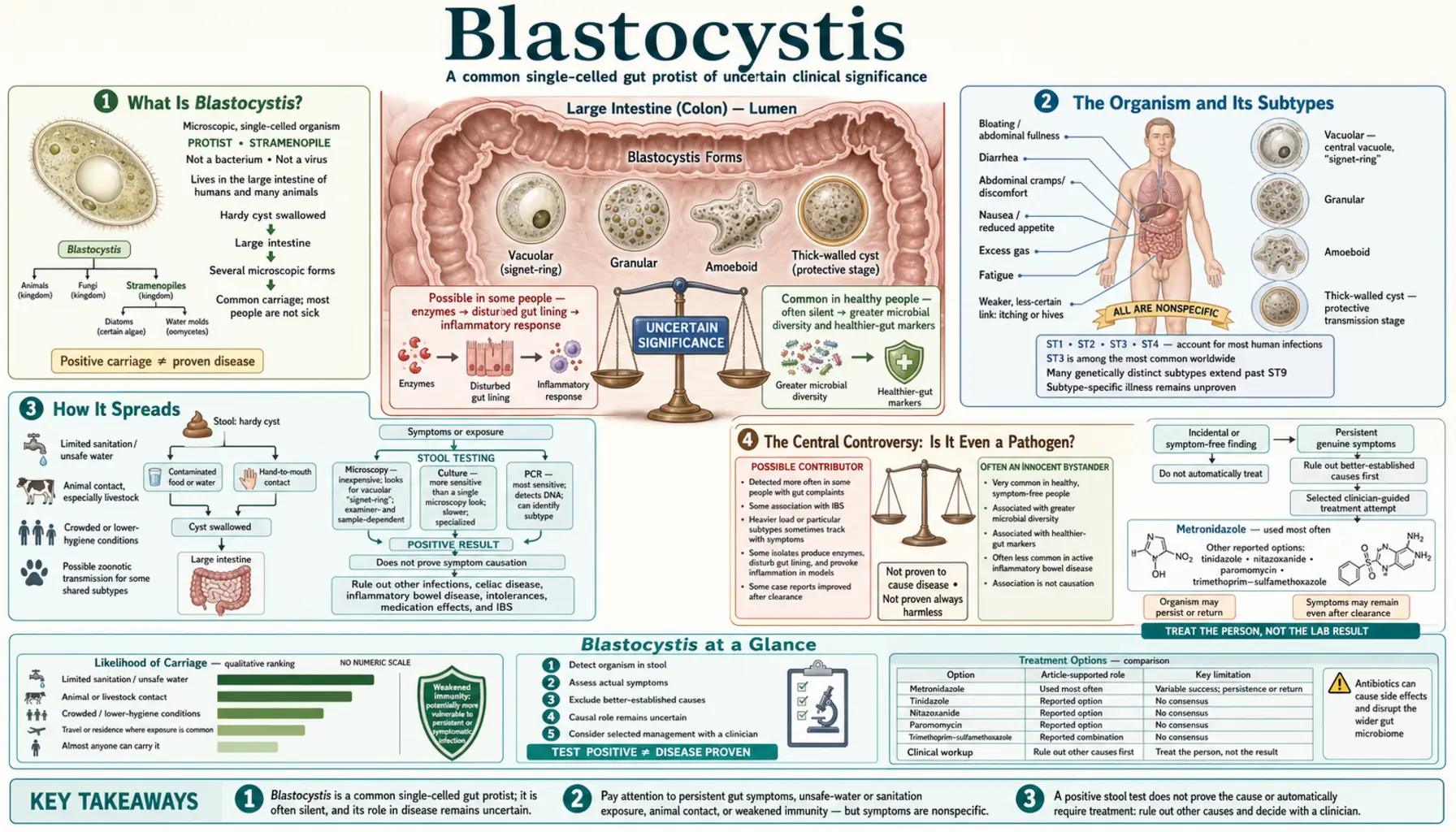
Blastocystis is one of the most common organisms found living in the human gut — and one of the most genuinely puzzling. It is a single-celled microbe that turns up in the stool of a very large fraction of healthy people worldwide, many of whom feel perfectly fine and never knew it was there. For more than a century, scientists have argued about a deceptively simple question: is Blastocystis actually a cause of illness, or is it usually just a harmless passenger — perhaps even a normal part of a healthy gut? That debate is not settled, and this page will not pretend otherwise. Below you will find what Blastocystis is, how it spreads, an honest look at both sides of the controversy over whether it makes people sick, what symptoms have been blamed on it, how it is found in the lab, and the tricky question of whether — and when — it should be treated at all.
Table of Contents
1. What Is Blastocystis?
Blastocystis (often written Blastocystis hominis in older reports, or simply Blastocystis sp. today) is a microscopic, single-celled organism that lives in the large intestine of humans and a great many animals. It is not a bacterium and not a virus. It is a protist — a broad category of complex single-celled life — and, more precisely, a stramenopile, placing it in the same distant branch of the tree of life as certain algae and water molds rather than alongside the classic gut parasites. That unusual pedigree took researchers decades to sort out, and it is part of why Blastocystis has always been hard to categorize.
What makes Blastocystis remarkable is how ordinary it is. It is among the most frequently detected organisms in human stool anywhere in the world. Depending on the population and the test used, it is found in a substantial minority of people in wealthy countries and in the majority of people in many lower-income regions. Crucially, most of those people are not sick. A microbe this common in healthy human beings does not fit the usual picture of a parasite, and that tension — a "parasite" that lives quietly in millions of well people — sits at the heart of everything that follows on this page.
2. The Organism and Its Subtypes
Blastocystis is a shape-shifter. Under the microscope it appears in several different forms, and the same organism can look quite different from one sample to the next. The form most often recognized is the vacuolar form, a round cell dominated by a large central vacuole that pushes the rest of the cell contents out to a thin rim — the classic "signet-ring" appearance. Others describe granular, amoeboid, and thick-walled cyst forms. The cyst is the tough, protective stage thought to survive outside the body and pass the organism from one host to the next. This variability is one reason Blastocystis was misidentified for years — early observers mistook it for a harmless yeast, a fungus, or fecal debris.
The bigger modern insight is genetic diversity. What we casually call "Blastocystis" is really a cluster of many genetically distinct subtypes, labeled ST1, ST2, ST3, ST4 and onward — well past ST9, with new subtypes still being described. These subtypes are different enough that some researchers treat them almost as separate species. In humans, a handful (especially ST1, ST2, ST3, and ST4) account for most infections, with ST3 among the most common worldwide.
Why does this matter? Because the subtypes may not all behave the same way. A recurring idea in the research is that the disagreement over whether Blastocystis causes disease might partly reflect the fact that studies lumped very different subtypes together. Perhaps some subtypes are more likely to irritate the gut while others are entirely benign. This is a genuinely promising line of inquiry — but it remains unproven. No subtype has been convincingly established as a reliable troublemaker, and results from different parts of the world often conflict.
3. How It Spreads
Blastocystis spreads by the fecal-oral route: the hardy cyst form is passed in stool, and infection follows when those cysts are swallowed — typically in contaminated food or water, or by hand-to-mouth contact where hygiene and sanitation are limited. In this respect it travels much like other intestinal organisms such as Giardia.
Its worldwide footprint is enormous. Blastocystis is found on every inhabited continent, and prevalence tends to rise where clean water and sanitation are harder to come by — in some communities the great majority of people carry it. It is also encountered in many animals, including farm animals and pets, and some subtypes are shared between people and animals, raising the possibility of animal-to-human (zoonotic) transmission in certain settings. Contact with livestock and untreated water are among the exposures repeatedly linked to carrying it.
The practical takeaway is simple: Blastocystis is spread by the same everyday routes as other gut microbes, and because it is so common and so often silent, most people who carry it have no idea when or where they picked it up. There is usually no dramatic exposure to point to.
4. The Central Controversy: Is It Even a Pathogen?
This is the honest heart of the page. More than a century after Blastocystis was first described, scientists still do not agree on whether it causes disease. Both of the positions below are held by serious researchers, and the truth may well be "it depends."
The case that it can cause symptoms. Blastocystis is detected more often in some people with gut complaints than in people without them, and it appears somewhat more frequently in patients diagnosed with irritable bowel syndrome (IBS). Some studies report that heavier loads of the organism, or particular subtypes, track with symptoms such as bloating and diarrhea. Laboratory work has shown that certain Blastocystis isolates can produce enzymes, disturb the gut lining, and provoke inflammatory responses in cell and animal models. Case reports describe people whose long-standing gut symptoms improved after the organism was cleared. Taken together, this is why many clinicians are unwilling to dismiss it entirely.
The case that it is often an innocent bystander. The single most powerful argument against calling Blastocystis a pathogen is its sheer commonness in healthy, symptom-free people. If a microbe lives peacefully in a large share of the well population, finding it in a sick person proves very little on its own — it may simply be there by coincidence. Large studies using modern DNA methods have gone further and found Blastocystis to be a normal, even favorable, member of the gut microbiome: its presence has been associated with greater microbial diversity and with markers of a healthier gut, and it is often less common in people with active inflammatory bowel disease. From this angle, Blastocystis looks less like an invader and more like a resident that tends to accompany a rich, stable gut community.
Why the studies disagree. Several honest complications keep this question open. Association is not causation — finding the organism alongside symptoms does not prove it caused them. People with gut symptoms get their stool tested more often, so the organism is found more in them partly because they are looked at more. Studies used different populations, different subtypes, and different detection methods, which makes results hard to compare. And no one has produced the clinching evidence a true pathogen usually demands: consistent, reproducible proof that clearing Blastocystis reliably relieves symptoms better than a placebo.
The fair summary: Blastocystis is not proven to cause disease, and it is not proven to be always harmless. It is best understood as an organism of uncertain significance — frequently a harmless or even beneficial resident, possibly a contributor to symptoms in some people or with some subtypes, and not something to overclaim in either direction.
5. Symptoms Attributed to It
When people are symptomatic and Blastocystis is found, the complaints most often blamed on it are gastrointestinal:
- Bloating and a sense of abdominal fullness.
- Diarrhea, sometimes alternating with normal or hard stools.
- Abdominal cramps or discomfort.
- Nausea and reduced appetite.
- Excess gas (flatulence).
- Fatigue.
- Skin complaints in some reports — itching or hives (urticaria) — though this link is weaker and less certain.
The essential caveat cannot be stated too strongly: every one of these symptoms is nonspecific. Bloating, diarrhea, cramping, and fatigue are among the most common complaints in all of medicine and have countless possible causes — diet, stress, IBS, other infections, food intolerances, and more. None of them is unique to Blastocystis, and none of them proves Blastocystis is the culprit. A person can have both Blastocystis and, say, ordinary IBS, with the organism playing no role at all. This is exactly why a positive test, on its own, settles nothing.
6. Who Is More Likely to Have It?
The honest headline is that almost anyone can carry Blastocystis — it is that common. Carriage is more likely with exposures that increase contact with the fecal-oral route: living in or traveling to areas with limited sanitation and unsafe water, contact with animals (especially livestock), and crowded or lower-hygiene living conditions. In much of the world it is simply a near-universal part of the gut's microbial furniture.
Whether carriage translates into trouble is a separate question, and here the evidence is thinner. The group most often flagged as potentially more vulnerable to actual illness is people with weakened immune systems — for example, those on immune-suppressing treatment or with advanced immune disease — in whom some reports describe more persistent or symptomatic infection. Even so, this remains an area of clinical judgment rather than settled fact. For the average healthy person, carrying Blastocystis is best regarded as common and usually inconsequential.
7. Diagnosis
Blastocystis is identified by examining the stool. Several methods are used, each with limitations:
- Stool microscopy (ova-and-parasite exam). A technician looks for the organism — classically the round, vacuolar "signet-ring" form — under the microscope. It is inexpensive but depends heavily on the examiner's skill and on the organism being present in the sample that day.
- Stool culture. Growing the organism in the lab can be more sensitive than a single glance under the microscope, but it is slower and is mainly used in research and specialized settings.
- PCR (DNA testing). Molecular methods detect Blastocystis DNA, are the most sensitive approach, and are the tool that can identify which subtype is present. They are increasingly used, especially in research.
Now the point that matters most, and that no test can solve: finding Blastocystis does not prove it is causing symptoms. Because the organism lives in so many healthy people, a positive result is expected in a large slice of the general population. When someone has gut symptoms and Blastocystis shows up, the responsible next step is not to declare the mystery solved but to rule out the many other, more established causes first — other infections, celiac disease, inflammatory bowel disease, lactose or other intolerances, medication effects, and IBS. A more sensitive test simply finds a common organism more often; it does not make that organism more guilty.
8. Treatment: To Treat or Not to Treat
This is the most practical — and most honest — part of the page, because the uncertainty about whether Blastocystis is a pathogen flows directly into uncertainty about whether to treat it. There is no consensus. A widely cited medical review even carried the frank title "Blastocystis: to treat or not to treat…" — a fair summary of where the field stands.
Several drugs have been tried against it. Metronidazole is the one used most often; other reported options include tinidazole, nitazoxanide, paromomycin, and the combination trimethoprim–sulfamethoxazole. But two stubborn problems recur:
- Treatment often does not work well. The organism frequently persists or comes back after a course of medication, and reported cure rates vary widely between studies. Clearing it — and keeping it cleared — can be surprisingly difficult.
- Even when it clears, symptoms may not. Because the organism is so often an innocent bystander, eliminating it does not reliably fix the person's complaints — which points back to some other, unaddressed cause.
For these reasons, many experts do not automatically treat Blastocystis, particularly when it is found by chance in someone without symptoms, or when symptoms are present but other, better-established causes have not yet been excluded. The reasonable, honest approach that emerges from the literature is to treat the person, not the lab result: work up and manage the actual symptoms, rule out other causes thoroughly, and reserve an attempt at clearing Blastocystis for selected cases where genuine symptoms persist after everything else has been addressed. Automatically trying to "eradicate" a very common gut organism because it appeared on a test is exactly the reflex most specialists caution against — and antibiotics carry their own costs, from side effects to disruption of the wider gut microbiome. Any treatment decision should be made with a clinician who knows the whole picture.
9. Prevention
Because Blastocystis spreads by the fecal-oral route, the same sensible measures that limit other gut infections apply — even though, given how common and how often harmless it is, "prevention" here is less urgent than it is for clearly dangerous parasites. Practical steps include:
- Good hand hygiene — washing hands with soap and water after using the toilet, after handling animals, and before preparing or eating food.
- Safe drinking water — using treated, filtered, or boiled water where the water supply may be unsafe, such as when traveling.
- Food safety — washing fruits and vegetables and observing normal food-hygiene precautions, especially in areas with limited sanitation.
These habits are worth keeping for general health regardless of Blastocystis. But it is worth being realistic: the organism is so widespread that avoiding it entirely is neither practical nor, for most people, necessary.
10. The Honest Bottom Line
Blastocystis is a very common gut organism of uncertain significance. It lives quietly in a large share of healthy people and may often be a harmless — or even beneficial — member of the normal gut community. In some people, or with some subtypes, it might contribute to symptoms such as bloating and diarrhea, but that has never been convincingly proven, and the symptoms blamed on it are nonspecific and have many other causes.
The single most useful thing to remember is this: a positive Blastocystis test does not, by itself, explain a person's symptoms, and it does not automatically call for treatment. The wise course is to take real symptoms seriously, rule out the many better-established causes first, and resist the temptation to over-treat a common organism just because it showed up on a lab report. In the words of the researchers who study it most closely, Blastocystis is best approached with humility — treat the person, not the result.
Key Research Papers
Peer-reviewed reviews and studies on Blastocystis — deliberately drawn from both sides of the pathogenicity debate, plus its biology, diagnosis, and the "to treat or not" question. Journal names appear as plain text; the year/volume/pages link opens the full citation via DOI.
- Tan KSW. New Insights on Classification, Identification, and Clinical Relevance of Blastocystis spp. Clinical Microbiology Reviews. 2008;21(4):639–665. — The landmark review of the organism's biology, forms, and disputed clinical role. — doi:10.1128/CMR.00022-08
- Stensvold CR, Clark CG. Current Status of Blastocystis: A Personal View. Parasitology International. 2016;65(6):763–771. — A candid overview by leading researchers of what is and isn't known. — doi:10.1016/j.parint.2016.05.015
- Scanlan PD, Stensvold CR, Rajilić-Stojanović M, et al. The Microbial Eukaryote Blastocystis Is a Prevalent and Diverse Member of the Healthy Human Gut Microbiota. FEMS Microbiology Ecology. 2014;90(1):326–330. — Key evidence for the "common commensal / normal microbiome" view. — doi:10.1111/1574-6941.12396
- Andersen LO, Stensvold CR. Blastocystis in Health and Disease: Are We Moving from a Clinical to a Public Health Perspective? Journal of Clinical Microbiology. 2016;54(3):524–528. — Reframes Blastocystis in light of microbiome data. — doi:10.1128/JCM.02520-15
- Coyle CM, Varughese J, Weiss LM, Tanowitz HB. Blastocystis: To Treat or Not to Treat… Clinical Infectious Diseases. 2012;54(1):105–110. — The clinician's dilemma over management, stated plainly in the title. — doi:10.1093/cid/cir810
- Roberts T, Stark D, Harkness J, Ellis J. Update on the Pathogenic Potential and Treatment Options for Blastocystis sp. Gut Pathogens. 2014;6:17. — Weighs the evidence for pathogenicity and reviews drug options and treatment failure. — doi:10.1186/1757-4749-6-17
- Boorom KF, Smith H, Nimri L, et al. Oh My Aching Gut: Irritable Bowel Syndrome, Blastocystis, and Asymptomatic Infection. Parasites & Vectors. 2008;1(1):40. — Argues the case for a link to IBS-like illness. — doi:10.1186/1756-3305-1-40
- Poirier P, Wawrzyniak I, Vivarès CP, Delbac F, El Alaoui H. New Insights into Blastocystis spp.: A Potential Link with Irritable Bowel Syndrome. PLoS Pathogens. 2012;8(3):e1002545. — Reviews mechanisms that could tie the organism to IBS. — doi:10.1371/journal.ppat.1002545
- Tito RY, Chaffron S, Caenepeel C, et al. Population-Level Analysis of Blastocystis Subtype Prevalence and Variation in the Human Gut Microbiota. Gut. 2019;68(7):1180–1189. — Large study linking carriage to a healthier, more diverse microbiome. — doi:10.1136/gutjnl-2018-316106
- Chabé M, Lokmer A, Ségurel L. Gut Protozoa: Friends or Foes of the Human Gut Microbiota? Trends in Parasitology. 2017;33(12):925–934. — Reappraises common gut protozoa, including Blastocystis, as possible commensals. — doi:10.1016/j.pt.2017.08.005
- Stensvold CR, van der Giezen M. Associations between Gut Microbiota and Common Luminal Intestinal Parasites. Trends in Parasitology. 2018;34(5):369–377. — How Blastocystis fits within the wider gut ecosystem. — doi:10.1016/j.pt.2018.02.004
- El Safadi D, Gaayeb L, Meloni D, et al. Children of Senegal River Basin Show the Highest Prevalence of Blastocystis sp. Ever Observed Worldwide. BMC Infectious Diseases. 2014;14:164. — Illustrates how common carriage can be where sanitation is limited. — doi:10.1186/1471-2334-14-164
PubMed Topic Searches
Each link opens a live PubMed query so results stay current as new papers are indexed.
Connections
- All Parasites
- Giardia
- Cryptosporidium
- Entamoeba
- Cyclospora
- Gastroenterology
- Irritable Bowel Syndrome
- SIBO
- Chronic Diarrhea
- Infectious Disease
- Gut Healing
- All Conditions
- Oregano Oil: Antiparasitic and SIBO — the Force 2000 emulsified oregano-oil trial and its eradication rates.