Neem as Insect Repellent and Agricultural Pesticide
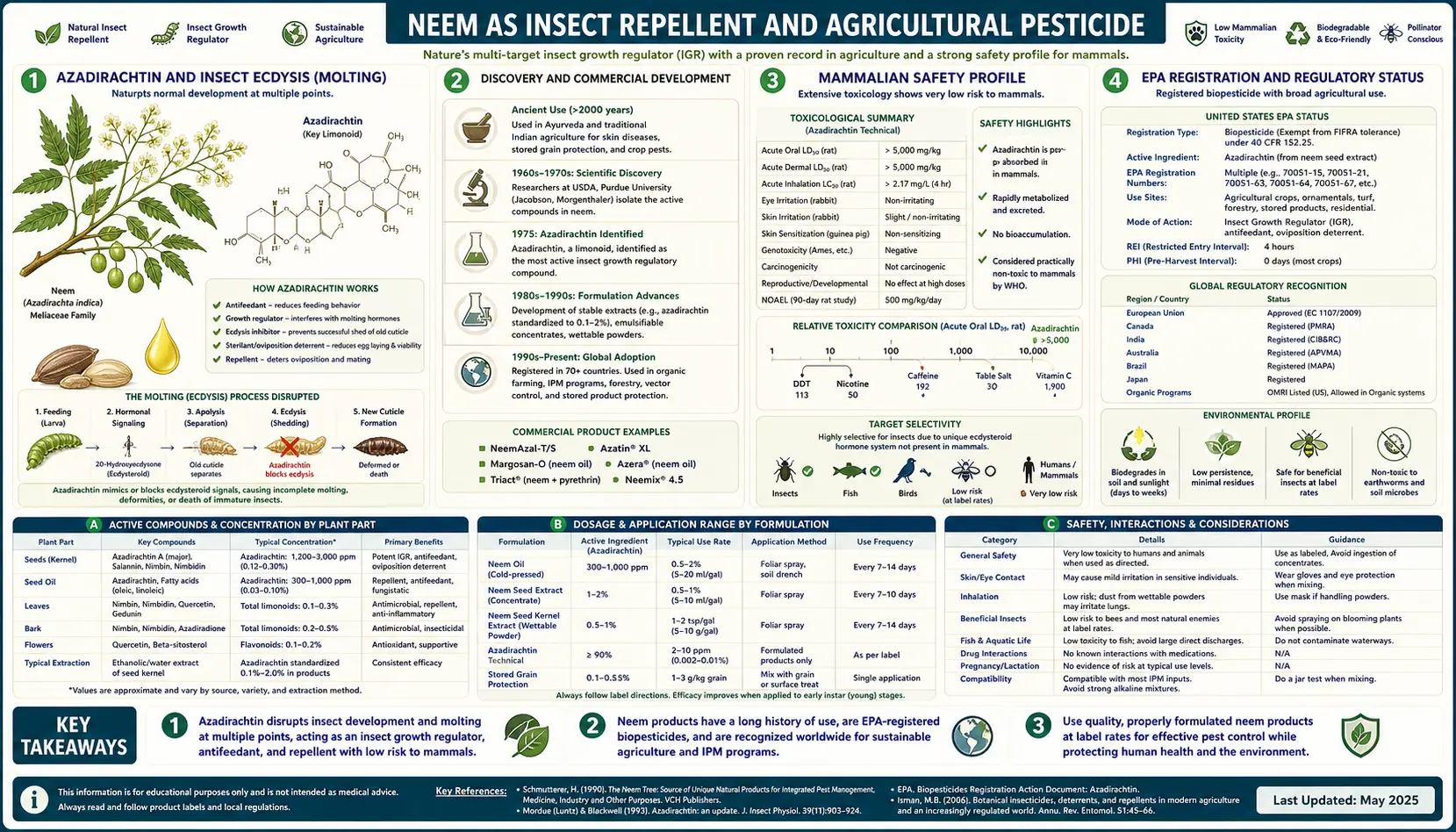
Azadirachtin — the dominant triterpenoid in neem seed oil — is the most-effective natural insect-growth-regulator on Earth, with documented activity against more than 600 insect species at concentrations as low as parts per billion. The mechanism is elegant: azadirachtin is structurally similar to the insect molting hormone ecdysone, and at picogram concentrations it disrupts ecdysone receptor signaling in the insect, halting molting and metamorphosis. Insects exposed to azadirachtin stop feeding, fail to develop, and die without ever reaching reproductive maturity. The mammalian system, lacking ecdysone biology entirely, is essentially unaffected at the same concentrations — azadirachtin's acute oral LD50 in rats is greater than 5 g/kg, placing it in the most-benign EPA toxicity category. This combination of dramatic insect-specific toxicity and near-complete mammalian safety has made neem the world's most widely registered natural biopesticide, the active ingredient in EPA-approved products for organic agriculture, and a credible alternative to DEET and permethrin for personal insect protection. This deep-dive walks through the molecular mechanism, the agricultural use, the head-lice and mosquito repellent applications, and the comparison with conventional synthetic pesticides.
Table of Contents
- Azadirachtin and Insect Ecdysis (Molting)
- Discovery and Commercial Development
- Mammalian Safety Profile
- EPA Registration and Regulatory Status
- Agricultural Use — The Biopesticide of Organic Farming
- Mosquito Repellent (vs DEET)
- Head Lice (vs Permethrin)
- Bed Bugs and Domestic Pests
- Integrated Pest Management
- Environmental Fate and Non-Target Effects
- Key Research Papers
- Connections
- Featured Videos
Azadirachtin and Insect Ecdysis (Molting)
Insects do not grow continuously like mammals; they pass through discrete developmental stages (instars) separated by molting events called ecdysis. The molting process is hormonally controlled by the steroid hormone ecdysone, which is produced in the prothoracic gland and released in pulses that trigger each successive molt. Ecdysone binds the ecdysone receptor (EcR) in target tissues, which heterodimerizes with the ultraspiracle protein (USP, the insect homolog of the mammalian retinoid X receptor) and activates transcription of the molting program.
Azadirachtin is structurally a tetranortriterpenoid — not literally identical to ecdysone but similar enough to interfere with ecdysone receptor signaling. The mechanism appears to involve multiple targets:
- Direct antagonism at the ecdysone receptor in some insect tissues
- Disruption of the brain neurosecretory cells that release prothoracicotropic hormone (PTTH), which normally triggers ecdysone release from the prothoracic gland
- Inhibition of mitosis and cell proliferation in imaginal disc tissue (the developmental precursor of adult structures in holometabolous insects)
- Antifeedant effect mediated through chemoreceptor disruption — insects exposed to azadirachtin literally stop eating, in addition to failing to molt
The combined effect is that insects exposed to azadirachtin enter a developmental dead-end: they cannot complete the next molt, cannot pupate, cannot emerge as adults, and cannot reproduce. Death typically follows in 1-7 days depending on dose and life stage. The effect is most pronounced on larval and nymphal stages (the actively-molting life stages); adult insects are less affected because they have completed their molting program.
The specificity of this mechanism to insect biology is what makes azadirachtin such a remarkable molecule. Mammals do not use ecdysone or ecdysone receptors at all — the entire pathway is absent from vertebrate biology — so a compound that targets this pathway is essentially incapable of producing acute mammalian toxicity through its insect-specific mechanism.
Discovery and Commercial Development
The Western scientific awareness of neem's insect properties began in the 1960s when a German entomologist named Heinrich Schmutterer observed a locust swarm in Sudan that stripped almost every plant in its path bare — except the neem trees. Schmutterer collected neem material, returned to his lab, and demonstrated that crude neem extract acted as a powerful insect antifeedant and growth disruptor on locust nymphs. His subsequent decades of work established the chemistry, named the isolated active principle azadirachtin (in 1968), and laid the foundation for commercial development.
The first commercial neem-based pesticide product (Margosan-O) was registered with the US EPA in 1985, manufactured by a small company called Vikwood. Subsequent products from W.R. Grace (Neemix), Thermo Trilogy (Azatin), and various Indian manufacturers expanded the available formulations. Today, dozens of EPA-registered products containing azadirachtin or cold-pressed neem oil are available for both agricultural and home-garden use.
The patent battles of the 1990s and 2000s shaped the modern commercial landscape. A US patent on a neem-based fungicide held by W.R. Grace and the US Department of Agriculture was successfully challenged by Indian activists and the European Patent Office on grounds that the use was prior art in Indian traditional knowledge — a landmark case in biopiracy law. Today, the basic uses of neem are recognized as un-patentable traditional knowledge, while specific extraction processes and formulations remain patentable.
Mammalian Safety Profile
The mammalian safety profile of azadirachtin is the basis for its EPA classification and its widespread agricultural use. The toxicology dossier includes:
- Acute oral LD50 (rat) — greater than 5,000 mg/kg for purified azadirachtin and greater than 5,000 mg/kg for cold-pressed neem oil. This places azadirachtin in EPA toxicity category IV (the most benign), the same category as table salt and sugar
- Acute dermal LD50 (rabbit) — greater than 2,000 mg/kg, the highest test dose, with no observed mortality
- Acute inhalation LC50 (rat) — greater than 5.0 mg/L of air for 4 hours, the highest test concentration, with no observed mortality
- Skin irritation — mild and reversible; minor reddening that resolves within 48 hours
- Eye irritation — mild; corneal effects resolve within 24-48 hours
- Skin sensitization — not a sensitizer in guinea-pig maximization testing
- Subchronic and chronic toxicity — no observed adverse effect level (NOAEL) in rats at 1,500 mg/kg/day in 90-day feeding studies
- Reproductive and developmental toxicity — some animal evidence of antifertility effects from concentrated neem oil at high doses; the basis for the pregnancy contraindication in internal use
- Carcinogenicity — not classified as a carcinogen; no positive carcinogenicity studies
- Mutagenicity — negative in standard mutagenicity assays (Ames test, mouse micronucleus)
The conspicuous exception to the otherwise-benign profile is the pediatric oral toxicity of concentrated neem seed oil discussed on the main Benefits hub — the Sundaravalli 1982 case series of 13 infant fatalities. This pediatric vulnerability is specific to oral exposure to concentrated seed oil and is not seen with topical application or with the agricultural use that is the subject of this page.
EPA Registration and Regulatory Status
The US Environmental Protection Agency regulates pesticides under the Federal Insecticide, Fungicide, and Rodenticide Act (FIFRA). Azadirachtin and cold-pressed neem oil are both registered as biochemical pesticides — a category that includes naturally occurring substances with non-toxic modes of action. The relevant registrations:
- Azadirachtin — registered as a technical-grade active ingredient and in numerous end-use products. Approved for use on hundreds of food and ornamental crops. Tolerance exemption (no maximum residue limit on food crops) granted because of the favorable mammalian toxicology
- Cold-pressed neem oil — registered for foliar application on agricultural crops, ornamentals, and as a personal-use repellent in some formulations. Tolerance exemption granted
- Clarified hydrophobic neem oil — a refined form approved for use on food crops as a broad-spectrum fungicide-insecticide-miticide. Tolerance exemption granted
USDA National Organic Program (NOP) lists azadirachtin and cold-pressed neem oil as acceptable inputs for certified organic agriculture — one of the few effective broad-spectrum insecticides available to organic farmers. This regulatory acceptability has made neem a foundational tool of the organic and integrated-pest-management movements.
European Union registration was more contentious. Neem extract was initially excluded from the EU pesticide list during the 2003 reauthorization round on procedural grounds (no manufacturer was willing to fund the expensive dossier preparation for a non-patentable substance), but azadirachtin was subsequently approved as an active substance in 2011 after a coalition of manufacturers shared dossier costs.
Agricultural Use — The Biopesticide of Organic Farming
Neem-based products fill a critical niche in organic and integrated-pest-management (IPM) agriculture because they provide broad-spectrum insect control with low mammalian toxicity, minimal residue on harvested crops, and acceptable cost. The principal agricultural targets:
- Sucking insects — aphids, whiteflies, leafhoppers, scale insects, mealybugs. Particularly effective because the systemic absorption of azadirachtin through plant tissue means sucking insects ingest the compound as they feed
- Chewing insects — caterpillars (cabbage looper, corn earworm, tomato hornworm, codling moth), beetles (Colorado potato beetle, Japanese beetle), and grasshoppers. Effective through both antifeedant and growth-disruption mechanisms
- Soil pests — neem cake (the press residue after oil extraction from seeds) applied to soil as a fertilizer-amendment controls many soil-borne nematodes and grubs
- Stored grain pests — neem leaf added to stored grain at low rates protects against weevils, beetles, and moths during long-term storage (the traditional Indian practice that long predates modern agricultural application)
The application rates are typically 0.5-2.0 oz of cold-pressed neem oil per gallon of spray solution, applied at 7-14 day intervals during pest pressure. The compound breaks down in sunlight within 100 hours (UV degradation half-life is approximately 48 hours), so multiple applications are needed for sustained control — the same UV-photodegradation property that gives the product its environmental safety also limits its persistence.
The trade-off versus synthetic pesticides: neem is less acutely lethal to individual insects than products like pyrethroids or organophosphates, so visible knockdown of an established infestation is slower. The compensating advantages are mammalian safety, near-zero food residue, low toxicity to beneficial insects when used correctly, and resistance management (the multi-mechanism mode of action makes resistance development slower than single-target conventional pesticides).
Mosquito Repellent (vs DEET)
DEET (N,N-diethyl-meta-toluamide) is the gold-standard mosquito repellent against which any alternative is compared. DEET works through olfactory disruption — it confuses the mosquito's ability to detect the CO2 and lactic acid plumes that normally guide host-seeking behavior. Concentrations of 20-30% provide 4-8 hours of protection.
Neem oil also repels mosquitoes, though through a partially different mechanism (combination of olfactory disruption and direct antifeedant effect when the mosquito does land):
- 2% neem oil in coconut oil provides approximately 96% protection against Anopheles culicifacies (the principal Indian malaria vector) for 12 hours in field testing, per a classic Sharma 1995 trial
- Comparable protection has been demonstrated against Anopheles stephensi, Culex quinquefasciatus, and Aedes aegypti in various studies
- Burning neem leaves or neem-impregnated coils provides indoor mosquito repellence comparable to commercial pyrethroid coils, with much less indoor air pollution
- Head-to-head comparisons with DEET show neem oil generally provides shorter duration of protection per application (4-6 hours vs 6-8 hours for 20% DEET) but with the advantage of acceptable skin tolerability for users sensitive to DEET
For users in malaria-endemic regions where DEET is the recommended repellent but where access or cost or skin tolerance is a constraint, neem oil at 2-5% in a coconut or shea butter base provides a credible alternative. For travelers in dengue or yellow fever regions, where the consequence of mosquito-borne disease is severe, DEET retains the edge in evidence base and is generally preferred.
For malaria broadly, see our Malaria page.
Head Lice (vs Permethrin)
Head lice (Pediculus humanus capitis) are an extremely common pediatric problem, with annual incidence estimated at 6-12 million cases in the United States. The conventional treatment options — pyrethroid shampoos (permethrin 1%), pyrethrin/piperonyl butoxide shampoos, and the newer benzyl alcohol and spinosad formulations — face increasing resistance, with permethrin-resistant lice strains now dominant in many US regions.
Neem oil shampoo has emerged as a credible alternative:
- A 2007 randomized comparison of 0.5% neem oil shampoo to 1% permethrin shampoo in 60 children with confirmed pediculosis showed cure rates of 90% (neem) vs 87% (permethrin) at 14 days, with no statistically significant difference
- The neem arm had no reports of scalp irritation; the permethrin arm had irritation in approximately 8%
- An interesting mechanism observation: lice resistant to permethrin are not cross-resistant to azadirachtin, because the mechanisms of action are completely different (permethrin = voltage-gated sodium channel modulator; azadirachtin = ecdysone disruptor + suffocation by oil viscosity)
- Several commercial neem-based lice products are now available, including Licefreee (a neem-and-tea-tree formulation) and several European brands
Practical regimen: apply neem oil shampoo (0.5-1% neem oil in a shampoo base) to dry hair, work into a lather, leave 10-15 minutes, then rinse and comb thoroughly with a fine-tooth louse comb. Repeat every 5-7 days for 3 cycles to catch any newly hatched nymphs. Wash bedding and clothing in hot water in parallel.
Bed Bugs and Domestic Pests
The resurgence of bed bugs (Cimex lectularius) since approximately 2000 — driven by increased international travel and pyrethroid resistance in modern bed bug populations — has prompted interest in alternative control approaches. Neem oil is one of relatively few EPA-registered products for indoor bed bug control with acceptable mammalian safety.
The relevant evidence:
- A 2014 USDA study showed cold-pressed neem oil at 0.5-1% produces high mortality in both pyrethroid-susceptible and pyrethroid-resistant bed bug strains, with effect on all life stages (eggs, nymphs, adults)
- The mechanism is a combination of the azadirachtin growth-disruption effect, direct suffocation by the oil viscosity, and the antifeedant effect that drives surviving bugs out of harborage areas to seek food elsewhere
- EPA-registered neem-based bed bug products (Cirkil, EcoRaider) provide 14-30 day residual control on treated surfaces
- For do-it-yourself application, food-grade diatomaceous earth combined with neem-oil spot treatment is a reasonable approach for light infestations; severe infestations need professional treatment
For other domestic pests — ants, fleas, mites, fungus gnats — neem oil is a reasonable first-line treatment with acceptable safety in homes with children and pets, with the caveat that the strong garlic-sulfur smell of cold-pressed neem oil persists for 24-48 hours after application.
Integrated Pest Management
Modern integrated pest management (IPM) emphasizes a hierarchical approach: monitor pest populations, accept some pest pressure below economic injury threshold, deploy biological controls (beneficial insects, parasitoid wasps), use selective chemical interventions only when needed, and reserve broad-spectrum products for severe situations. Neem fits this paradigm well:
- Selective effect on target pests — the growth-disruption mechanism affects molting insects (most agricultural pests, including the larval stages of beneficial insects) but spares many adult beneficials (honeybees, parasitoid wasps that visit treated plants briefly)
- Bee safety — foliar neem oil application is moderately toxic to honeybees if they contact wet residue, but the rapid degradation means dried residue is essentially non-toxic. Apply in evening when bees are not foraging, allow to dry overnight, and bees will not be affected the next day
- Slow resistance development — the multi-target mode of action (ecdysone disruption, antifeedant, oviposition deterrent) means insects must develop resistance to multiple mechanisms simultaneously, which is harder than single-target resistance to conventional pesticides
- Rotation partner — neem can be alternated with other selective insecticides (Bt for caterpillars, spinosad for thrips) to extend the useful lifetime of all the products
For more on the broader context of pesticide use and alternatives, see our Pesticides page.
Environmental Fate and Non-Target Effects
The environmental fate of azadirachtin contributes to its favorable safety profile:
- Photodegradation — azadirachtin breaks down in sunlight with a half-life of approximately 48 hours on plant surfaces. By 7 days post-application, residue is below the limit of quantitation in most analytical methods
- Soil degradation — in moist soil with active microbial communities, the half-life is approximately 7-14 days. Azadirachtin does not bioaccumulate or persist as a soil contaminant
- Aquatic toxicity — moderate toxicity to fish and aquatic invertebrates at high concentrations; avoid direct application to water bodies. At typical agricultural use rates, runoff concentrations are below toxic thresholds
- Bird toxicity — essentially non-toxic to birds at typical application rates; the LC50 in bobwhite quail is greater than 5,000 ppm in feed
- Earthworm toxicity — low; LC50 in soil greater than 1,000 ppm, well above field concentrations
The principal non-target concern in agriculture is the effect on beneficial insects (predatory mites, parasitoid wasps, ladybird beetles, lacewings). The growth-disruption mechanism affects larval beneficials similarly to larval pests, so neem use should be timed to coincide with adult beneficials (which are less sensitive) being dominant, and should be avoided when beneficial larvae are being released as biological control.
For pollinator safety specifically, application in evening (after bees have returned to the hive) followed by overnight drying minimizes bee exposure. This is the same practice recommended for any contact-effective insecticide and is well-understood by professional applicators.
Key Research Papers
- Mordue (Luntz) AJ, Blackwell A (1993). Azadirachtin: an update. Journal of Insect Physiology. — PubMed
- Schmutterer H (1990). Properties and potential of natural pesticides from the neem tree, Azadirachta indica. Annual Review of Entomology. — PubMed
- Sharma VP, Ansari MA (1994). Personal protection from mosquitoes (Diptera: Culicidae) by burning neem oil in kerosene. Journal of Medical Entomology. — PubMed
- Sharma SK et al. (1995). Field evaluation of neem oil as a sandfly (Diptera: Psychodidae) repellent. Journal of the American Mosquito Control Association. — PubMed
- Mehlhorn H, Schmahl G, Schmidt J (2005). Extract of the seeds of the plant Vitex agnus castus proven to be highly efficacious as a repellent against ticks, fleas, mosquitoes, and biting flies. Parasitology Research. — PubMed
- Abdel-Shafy S, Zayed AA (2002). In vitro acaricidal effect of plant extract of neem seed oil (Azadirachta indica) on egg, immature, and adult stages of Hyalomma anatolicum excavatum. Veterinary Parasitology. — PubMed
- Heukelbach J et al. (2006). A highly efficacious pediculicide based on dimeticone: randomized observer blinded comparative trial. BMC Infectious Diseases. — PubMed
- Boeke SJ, Boersma MG, Alink GM, van Loon JJ, van Huis A, Dicke M, Rietjens IM (2004). Safety evaluation of neem (Azadirachta indica) derived pesticides. Journal of Ethnopharmacology. — PubMed
- Isman MB (2006). Botanical insecticides, deterrents, and repellents in modern agriculture and an increasingly regulated world. Annual Review of Entomology. — PubMed
- Mishra AK et al. (1995). Larvicidal action of essential oil from Caesulia axillaris against three mosquito species, Anopheles stephensi, Culex quinquefasciatus, and Aedes aegypti. Journal of the American Mosquito Control Association. — PubMed
- Singh N, Mishra AK, Saxena A (1996). Use of neem cream as a mosquito repellent in tribal areas of central India. Indian Journal of Malariology. — PubMed
- Mulla MS, Su T (1999). Activity and biological effects of neem products against arthropods of medical and veterinary importance. Journal of the American Mosquito Control Association. — PubMed
PubMed Topic Searches
- PubMed: Azadirachtin and ecdysis
- PubMed: Neem mosquito repellent
- PubMed: Neem head lice
- PubMed: Neem agricultural use
- PubMed: Neem bed bugs
Connections
- All Herbs
- Neem Overview
- Neem Benefits Hub
- Neem for Skin Conditions
- Neem for Dental Health
- Neem for Blood Sugar
- Pesticides
- Malaria
- Tea Tree Oil
- Antibacterial Herbs
- Turmeric
- Holy Basil
- Honey
- Eczema
- Staphylococcus aureus