Chamomile — Benefits Deep Dive
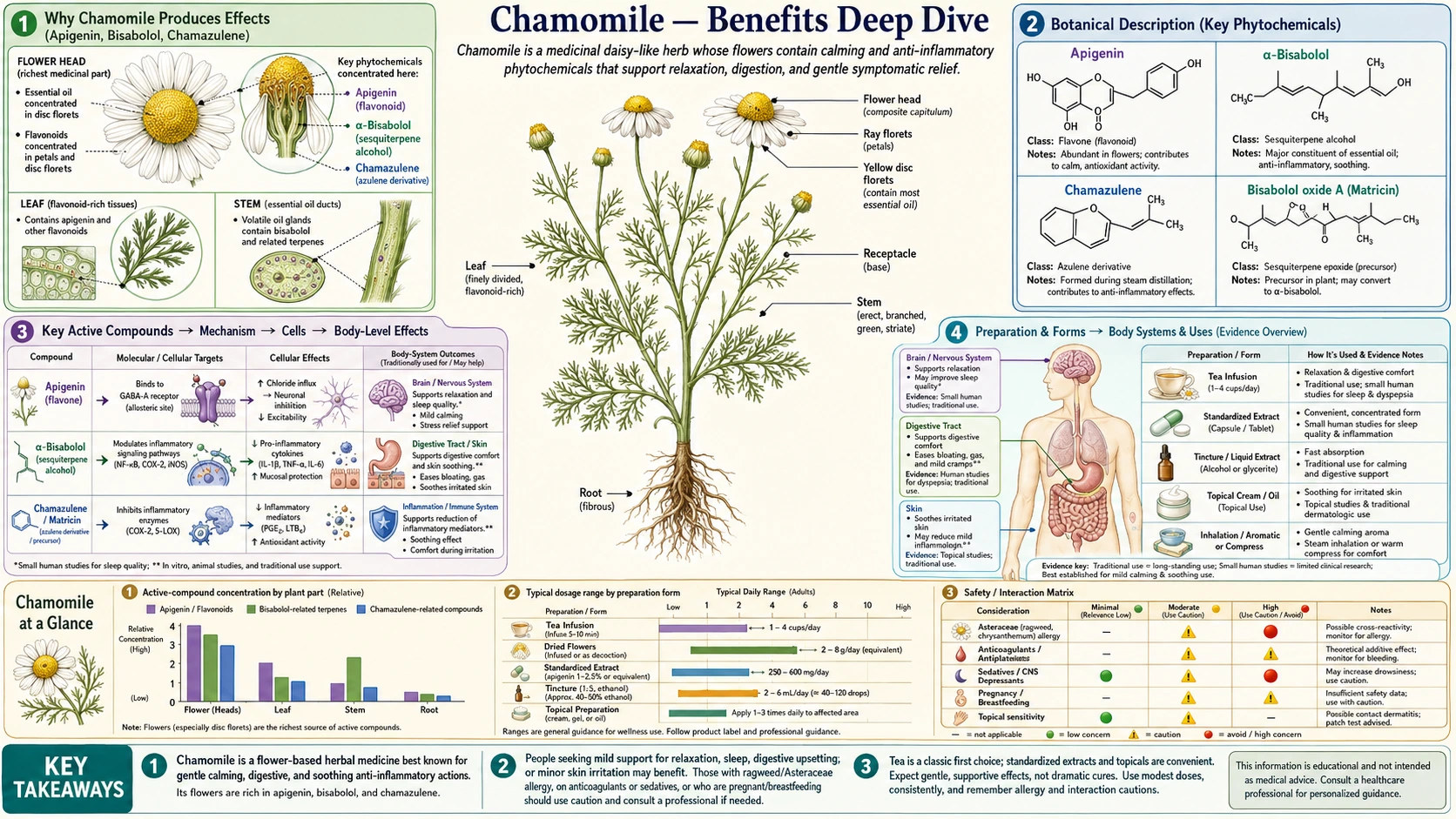
Matricaria chamomilla (German chamomile) is one of the most-consumed herbal teas on Earth — an estimated one million cups are brewed every day — with a continuous documented use record stretching back to the ancient Egyptians, who dedicated it to the sun god Ra for fevers. The single most important active is apigenin, a flavonoid that binds the benzodiazepine-recognition site on the GABA-A receptor with measurable affinity — a real molecular pharmacology that explains why a nighttime cup of chamomile tea is not merely a placebo ritual. The centuries-old tradition is now validated by modern randomized controlled trials: Adib-Hajbaghery 2017 in elderly nursing-home residents, Chang 2016 in postpartum women, Zick 2011 in chronic insomnia, Amsterdam 2009/2012 in generalized anxiety disorder (including a head-to-head against sertraline), and Patzelt-Wenczler 2000 in atopic dermatitis (head-to-head against hydrocortisone). Four benefit pages below explore the four clinical domains where chamomile produces a documented, reproducible effect: sleep, anxiety, digestive/IBS symptoms, and topical skin healing.
Deep-Dive Articles
Sleep Quality
Apigenin binds the benzodiazepine site of the GABA-A receptor, producing a mild anxiolytic and sleep-promoting effect without the dependency, tolerance, or cognitive impairment of pharmaceutical benzodiazepines. The Adib-Hajbaghery 2017 RCT in elderly nursing-home residents, the Chang 2016 RCT in postpartum women, and the Zick 2011 RCT in chronic primary insomnia each document measurable sleep-quality improvement on validated instruments (PSQI, Athens Insomnia Scale). Comparison with OTC diphenhydramine and doxylamine.
Anxiety Relief
The Amsterdam 2009 randomized double-blind placebo-controlled trial of standardized chamomile extract (1.2% apigenin) in generalized anxiety disorder showed clinically meaningful Hamilton Anxiety reductions vs placebo. The 2012 Amsterdam follow-up trial included a sertraline comparator arm. Apigenin's benzodiazepine-like binding mechanism, why it is partial-agonist (not full agonist like alprazolam), and what that means for safety and tolerability.
Digestive Health & IBS
Direct smooth-muscle antispasmodic mechanism via bisabolol and the flavonoid fraction, the Steiner 2005 infant colic trial, chamomile as one of the nine herbal components of Iberogast (STW 5) for functional dyspepsia and IBS, the Niederau infant gastrointestinal trial, and the use of chamomile as an adjunct for ulcerative colitis remission maintenance in pilot data.
Skin Healing
The Patzelt-Wenczler 2000 head-to-head trial of topical chamomile cream against 0.5% hydrocortisone in atopic dermatitis, the episiotomy and post-surgical wound-healing literature, alpha-bisabolol as the principal anti-inflammatory and skin-soothing terpenoid, chamazulene as the deep-blue azulene anti-inflammatory pigment of chamomile essential oil, and topical formulation considerations.
Table of Contents
- Deep-Dive Articles
- Why Chamomile Produces Effects (Apigenin, Bisabolol, Chamazulene)
- Research Papers: Sleep Quality
- Research Papers: Anxiety Relief
- Research Papers: Digestive and IBS
- Research Papers: Skin Healing
- Research Papers: Mechanism (Apigenin, Bisabolol, Chamazulene)
- External Authoritative Resources
- Connections
- Featured Videos
Why Chamomile Produces Effects (Apigenin, Bisabolol, Chamazulene)
Chamomile is not a one-active herb. Three structurally distinct active classes account for the bulk of its documented clinical effects, and each maps to a different therapeutic domain.
- Apigenin (flavonoid) — the benzodiazepine-receptor binder. Apigenin is a 4′,5,7-trihydroxyflavone present at ~0.8–1.2% of dried flower weight, mostly as the 7-O-glucoside that is hydrolyzed to the aglycone in the gut. The aglycone crosses the blood-brain barrier and binds the benzodiazepine-recognition site on the alpha-1/alpha-2 subunit interface of the GABA-A receptor with measurable, low-micromolar affinity. Unlike a full agonist (alprazolam, diazepam), apigenin appears to act as a partial agonist or weak modulator — producing a mild anxiolytic and sleep-promoting effect without the deep sedation, cognitive impairment, tolerance, dependency, or rebound anxiety of pharmaceutical benzodiazepines. This is the mechanism behind both the sleep-quality and anxiety benefits.
- Alpha-bisabolol (sesquiterpenoid) — the smooth-muscle antispasmodic and skin-soothing terpenoid. Bisabolol is the dominant terpene in German chamomile essential oil (typically 25–65% of the oil). It is a direct smooth-muscle relaxant in isolated intestinal preparations and has well-documented anti-inflammatory, antiulcer, and anti-irritation activity in animal models and topical human trials. Bisabolol is the principal driver of the antispasmodic / IBS benefit and the topical skin-healing benefit, and it appears in commercial cosmetic products (often synthesized rather than chamomile-extracted) precisely because of its skin-soothing track record.
- Chamazulene (sesquiterpene azulene) — the anti-inflammatory deep-blue pigment. Chamomile essential oil is famously a deep inky blue color. The pigment is chamazulene, which is not present in the intact plant — it forms during steam distillation from the precursor matricin. Chamazulene inhibits leukotriene B4 synthesis (5-lipoxygenase pathway) and has documented anti-inflammatory activity in topical inflammation models. It contributes to both the antispasmodic effect (synergistically with bisabolol) and to the topical anti-inflammatory effect on inflamed skin.
Most commercial chamomile tea is dried flower head, infused. Hot water extracts the water-soluble apigenin glycosides and a fraction of the flavonoids; the bulk of the essential-oil terpenoids (bisabolol, chamazulene) require a longer steep with a tightly-covered cup to retain the volatile components. Standardized extracts (capsule form, used in most modern RCTs) are titrated to 1.2% apigenin and typically dosed at 220–1100 mg/day. Topical preparations are titrated to alpha-bisabolol and/or chamazulene content. The three actives co-occur in the intact plant but emphasize different therapeutic uses based on preparation, route, and dose.
Research Papers: Sleep Quality
- Adib-Hajbaghery M, Mousavi SN (2017). The effects of chamomile extract on sleep quality among elderly people: A clinical trial. Complementary Therapies in Medicine. — PubMed: Adib-Hajbaghery 2017 elderly RCT
- Chang SM, Chen CH (2016). Effects of an intervention with drinking chamomile tea on sleep quality and depression in sleep disturbed postnatal women. Journal of Advanced Nursing. — PubMed: Chang 2016 postpartum RCT
- Zick SM et al. (2011). Preliminary examination of the efficacy and safety of a standardized chamomile extract for chronic primary insomnia. BMC Complementary and Alternative Medicine. — PubMed: Zick 2011 insomnia RCT
- Apigenin and the benzodiazepine receptor binding site — PubMed: Apigenin BZD receptor
- Chamomile in pediatric and elderly sleep disturbance — PubMed: Pediatric and elderly sleep
Research Papers: Anxiety Relief
- Amsterdam JD et al. (2009). A randomized, double-blind, placebo-controlled trial of oral Matricaria recutita (chamomile) extract therapy for generalized anxiety disorder. Journal of Clinical Psychopharmacology. — PubMed: Amsterdam 2009 GAD trial
- Amsterdam JD et al. (2012). Chamomile (Matricaria recutita) may provide antidepressant activity in anxious, depressed humans. Alternative Therapies in Health and Medicine. — PubMed: Amsterdam 2012 follow-up
- Mao JJ et al. (2016). Long-term chamomile (Matricaria chamomilla L.) treatment for generalized anxiety disorder. Phytomedicine. — PubMed: Mao 2016 long-term GAD
- Apigenin anxiolytic mechanism: animal model and BZD-site binding — PubMed: Apigenin anxiolytic animal model
- Chamomile vs sertraline for GAD comparator analyses — PubMed: Chamomile vs sertraline
Research Papers: Digestive and IBS
- Steiner M et al. (2005). Efficacy and tolerability of a fennel/chamomile/lemon balm preparation for infantile colic. Phytomedicine. — PubMed: Steiner infant colic trial
- Niederau C, Göpfert E (1999). Wirkung von chamomilla- und kamillen-haltigen Präparaten bei Magen-Darm-Erkrankungen. — PubMed: Niederau pediatric GI
- Iberogast (STW 5) including chamomile for functional dyspepsia — PubMed: Iberogast / STW 5 dyspepsia
- Chamomile antispasmodic activity in isolated smooth muscle — PubMed: Chamomile antispasmodic in vitro
- Iberogast (STW 5) for IBS adjunct treatment — PubMed: Iberogast for IBS
Research Papers: Skin Healing
- Patzelt-Wenczler R, Ponce-Pöschl E (2000). Proof of efficacy of Kamillosan(R) cream in atopic eczema. European Journal of Medical Research. — PubMed: Patzelt-Wenczler 2000 vs hydrocortisone
- Chamomile cream vs almond ointment for episiotomy wound healing — PubMed: Chamomile episiotomy healing
- Topical chamomile for radiation dermatitis adjunct — PubMed: Chamomile radiation dermatitis
- Alpha-bisabolol anti-inflammatory activity in skin — PubMed: Alpha-bisabolol topical
- Chamomile mouthwash for chemotherapy-induced oral mucositis — PubMed: Chamomile mouthwash mucositis
Research Papers: Mechanism (Apigenin, Bisabolol, Chamazulene)
- Apigenin: a flavonoid with diverse pharmacological activity — PubMed: Apigenin pharmacology review
- Apigenin pharmacokinetics and bioavailability — PubMed: Apigenin pharmacokinetics
- Chamazulene from matricin during steam distillation — PubMed: Chamazulene biosynthesis
- Chamomile essential oil composition and analytical profiling — PubMed: Essential oil composition
- Srivastava JK et al. (2010). Chamomile: A herbal medicine of the past with bright future. Molecular Medicine Reports. — PubMed: Srivastava 2010 review
External Authoritative Resources
- NCCIH (National Center for Complementary and Integrative Health) — Chamomile
- MedlinePlus — German Chamomile
- European Medicines Agency — Matricariae flos community monograph
- PMC — Chamomile: A herbal medicine of the past with bright future (Srivastava 2010 full text)
- PubMed — All research on Matricaria chamomilla
Connections
- All Herbs
- Chamomile (Main Page)
- Chamomile for Sleep Quality
- Chamomile for Anxiety Relief
- Chamomile for Digestive and IBS
- Chamomile for Skin Healing
- Lemon Balm
- Lavender
- Passionflower
- Valerian
- Fennel
- Peppermint
- Anxiety
- Insomnia
- Irritable Bowel Syndrome
- Eczema
- Sleep Hygiene
- Natural Anxiety Relief