Social Anxiety Disorder
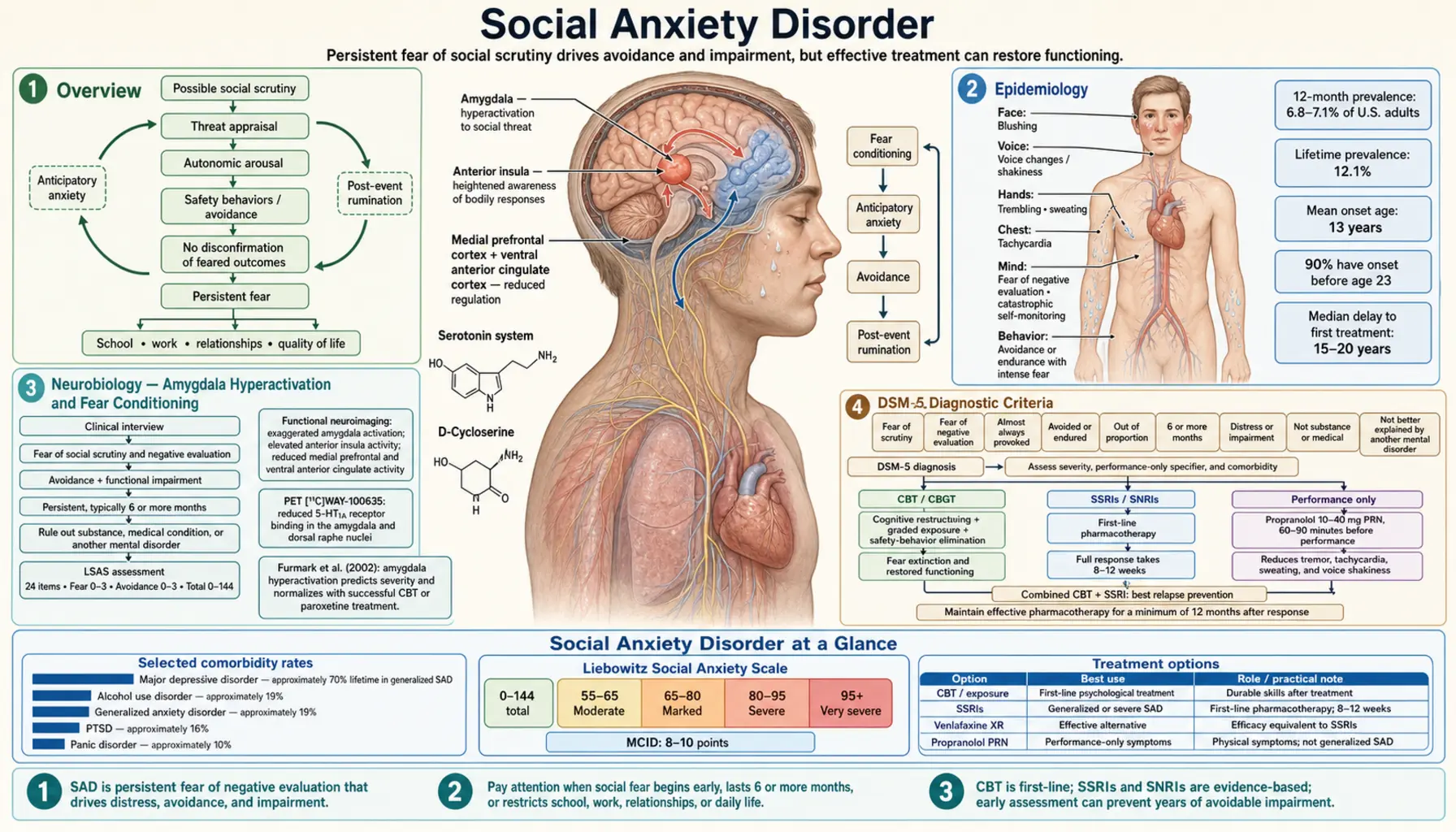
- Overview
- Epidemiology
- Neurobiology — Amygdala Hyperactivation and Fear Conditioning
- DSM-5 Diagnostic Criteria
- Performance Subtype vs. Generalized Social Anxiety
- Liebowitz Social Anxiety Scale (LSAS)
- Cognitive-Behavioral Therapy — CBT and CBGT
- Pharmacotherapy — SSRIs, SNRIs, and Beta-Blockers
- Early Intervention and Social Skills Training
- Co-occurring Disorders and Complications
- Research Papers
- References
- Connections
Overview
Social Anxiety Disorder (SAD), formerly called social phobia, is the most common anxiety disorder and the third most common mental disorder overall, with a 12-month prevalence of approximately 7% and a lifetime prevalence of approximately 12% in the United States. It is characterized by an intense, persistent fear of social or performance situations in which the person may be scrutinized by others, along with fear that they will act in a way that is embarrassing or humiliating.
The disorder causes marked distress and functional impairment — avoidance of social situations, limited career advancement, restricted relationships, and significant reduction in quality of life. Despite its prevalence and impact, SAD remains deeply underdiagnosed. The median delay from symptom onset to first treatment is 15–20 years, driven by shame, self-dismissal ("I'm just shy"), and lack of clinician recognition.
Effective treatments exist and work well. Cognitive-Behavioral Therapy (CBT) is the first-line psychological intervention, SSRIs and SNRIs are evidence-based pharmacological options, and combined treatment is often superior to either alone. With appropriate care, the majority of patients achieve substantial symptom reduction and restored functioning.
Epidemiology
Social Anxiety Disorder is one of the most prevalent psychiatric conditions worldwide, though its true burden is frequently underestimated because sufferers rarely identify themselves as ill.
- 12-month prevalence: 6.8–7.1% of U.S. adults (Kessler et al., NCS-R, 2005)
- Lifetime prevalence: 12.1% — one of the highest of any anxiety disorder
- Gender: Female > male in community samples (roughly 2:1 ratio); male > female in clinical samples, as men are more likely to present with performance anxiety and seek treatment for it
- Age of onset: Typically adolescence; mean onset age 13 years; peak onset 8–15 years; 90% have onset before age 23 — making SAD one of the earliest-onset anxiety disorders
- Course: Chronic and persistent without treatment; most individuals suffer for decades before receiving help
- Ranking: The National Comorbidity Survey found SAD is the 3rd most common psychiatric disorder overall, after major depression and alcohol use disorder
- Cultural variation: Prevalence is generally lower in East Asian cultures, where a related condition called taijin kyofusho (fear of offending or embarrassing others, rather than oneself) is the predominant cultural variant; prevalence is higher in Western individualistic societies
- Socioeconomic impact: SAD is associated with lower educational attainment, underemployment, reduced income, restricted social networks, and higher rates of welfare dependency — the functional toll extends far beyond discomfort in social situations
Neurobiology — Amygdala Hyperactivation and Fear Conditioning
Advances in functional neuroimaging have revealed a well-characterized neural circuit underlying Social Anxiety Disorder, centered on threat appraisal, fear conditioning, and impaired prefrontal regulation.
Amygdala Hyperactivation
The most consistent finding in functional neuroimaging studies of SAD is exaggerated amygdala activation in response to social threat stimuli — angry or contemptuous faces, public speaking scenarios, and the experience of being observed while performing. The basolateral nucleus of the amygdala is particularly implicated. Furmark et al. (2002) demonstrated that amygdala hyperactivation predicts SAD severity and, critically, normalizes with successful CBT or paroxetine treatment — confirming the amygdala as a treatment-sensitive biomarker as well as a pathophysiological hub.
Fear Conditioning
The core psychological mechanism of SAD is fear conditioning. During early social threat experiences — humiliation, public embarrassment, bullying — the amygdala and anterior insula form conditioned fear associations between social situations and threat. These associations generalize broadly through the prefrontal cortex's failure to inhibit amygdala responses. Behaviorally, this manifests as anticipatory anxiety before social situations (sometimes more intense than the situation itself) and post-event rumination, where perceived social failures are replayed and re-evaluated negatively.
Anterior Insula Hyperactivation
The anterior insula, the brain's interoceptive awareness hub, shows elevated activity in SAD. This reflects the patient's acute awareness of their own physiological responses — blushing, trembling, sweating, voice changes — which are then catastrophically misinterpreted as visible and mortifying to observers. In reality, these symptoms are rarely as noticeable to others as the patient believes.
Prefrontal Cortex Hypoactivation
Reduced activity in the medial prefrontal cortex and ventral anterior cingulate cortex — regions responsible for emotion regulation, extinction of fear memories, and cognitive reappraisal — means that once the amygdala sounds the alarm, the PFC cannot effectively dampen the response. This explains why rational reassurance ("nothing bad actually happened") fails to relieve anticipatory anxiety: the inhibitory circuit is underpowered.
Serotonin System
Reduced serotonergic transmission is a consistent finding in SAD, consistent with SSRI efficacy. PET imaging with [11C]WAY-100635 shows reduced 5-HT1A receptor binding in the amygdala and dorsal raphe nuclei. The short allele of the serotonin transporter promoter polymorphism (5-HTTLPR) is associated with amygdala hyperreactivity and elevated SAD risk, providing a molecular link between genetic predisposition and neural phenotype.
Dopamine System
The performance anxiety subtype may involve greater dopaminergic dysfunction. Tiihonen et al. found reduced dopamine transporter (DAT) density in the striatum in social phobia, implicating reward circuitry deficits that manifest as impaired enjoyment of social interaction and reduced social motivation. This partially explains why dopaminergic agents (e.g., bupropion) can benefit patients with prominent performance or motivation deficits.
Cortisol and the HPA Axis
Patients with SAD show elevated salivary cortisol in response to social evaluative stress compared to controls. In chronic, long-standing SAD, some studies find blunted cortisol reactivity — reflecting HPA axis dysregulation following years of sustained anxiety exposure. This is analogous to the cortisol blunting seen in PTSD.
Oxytocin
Intranasal oxytocin reduces amygdala reactivity to social threat stimuli and improves social cognition in healthy subjects and SAD patients. Studies investigating oxytocin as an adjunct to exposure therapy are underway, based on the hypothesis that it may facilitate extinction of socially conditioned fear.
DSM-5 Diagnostic Criteria
The DSM-5 diagnosis of Social Anxiety Disorder (300.23) requires all of the following:
- Marked fear or anxiety about one or more social situations in which the individual is exposed to possible scrutiny by others. Examples include social interactions (conversations, meeting unfamiliar people), being observed (eating, drinking), and performing in front of others (giving a speech).
- The person fears that they will act in a way that will be humiliating or embarrassing, or that they will show anxiety symptoms (e.g., blushing, trembling) that will be negatively evaluated by others.
- The social situations almost always provoke fear or anxiety. Note: in children, this may be expressed as crying, tantrums, freezing, clinging, or failure to speak.
- The social situations are avoided or endured with intense fear or anxiety.
- The fear or anxiety is out of proportion to the actual threat posed by the social situation and to the sociocultural context.
- The fear, anxiety, or avoidance is persistent, typically lasting 6 or more months.
- The fear, anxiety, or avoidance causes clinically significant distress or impairment in social, occupational, or other important areas of functioning.
- The fear, anxiety, or avoidance is not attributable to the physiological effects of a substance or another medical condition.
- The fear, anxiety, or avoidance is not better explained by the symptoms of another mental disorder.
Specifier: "Performance only" — fear is restricted to speaking or performing in public.
Differential Diagnosis
- Specific phobia: Fear triggered by a non-social object or situation (e.g., heights, animals)
- Agoraphobia: Fear of situations where escape is difficult or help unavailable — not specifically fear of negative evaluation
- Major depressive disorder with social withdrawal: Social avoidance is secondary to low mood, not fear of scrutiny
- Body dysmorphic disorder: Fear of social situations is driven by perceived physical defect rather than general negative evaluation
- Autism spectrum disorder: Social difficulties due to skills deficits and communication differences, not fear of negative evaluation per se
- Avoidant personality disorder (AvPD): Considered by many researchers to occupy the severe end of the generalized SAD spectrum; differentiation is often dimensional rather than categorical
- Selective mutism in children: An extreme expression of social anxiety where a child speaks in some settings but not others (typically school)
DSM-5 dropped the DSM-IV requirement that at least one feared situation involve a stranger, and eliminated the "generalized vs. discrete" subtype distinction in favor of the "performance only" specifier.
Performance Subtype vs. Generalized Social Anxiety
Clinically, patients with SAD fall into two broad groups with meaningfully different presentations, treatment responses, and prognoses.
Performance-Only Subtype (DSM-5 Specifier)
Fear is restricted to formal performance situations — public speaking, musical recitals, athletic competitions, professional presentations, or acting. These individuals are typically high-functioning in other social domains: they can converse normally, maintain relationships, and navigate most everyday interactions without difficulty. Estimated to represent 30–40% of SAD cases. Key clinical features:
- Often do not present for treatment because impairment is situationally bounded
- Respond well to as-needed (PRN) beta-blockers — propranolol 10–40 mg taken 60–90 minutes before performance addresses the physical symptoms (tremor, tachycardia, voice shakiness) that create a performance-disrupting feedback loop
- CBT is effective and typically requires a shorter course than generalized SAD
- Generally better prognosis; full remission achievable
Generalized SAD (Majority)
Fear spans multiple social situations — conversations, dating, parties, meetings, phone calls, eating or writing in front of others, asserting needs, returning items at a store. Functional impairment is pervasive and extends across career, relationships, and daily activities. Key clinical features:
- Higher comorbidity rates: depression, alcohol use disorder, other anxiety disorders
- Often meets criteria for avoidant personality disorder — considered by many researchers to be on a spectrum with generalized SAD rather than a categorically separate condition
- Requires SSRI/SNRI plus CBGT for optimal outcomes; monotherapy with either is less effective
- Longer treatment course, slower response, higher relapse rates after medication discontinuation
- PRN beta-blockers alone are ineffective — the core problem is cognitive/emotional appraisal, not peripheral physical symptoms
Liebowitz Social Anxiety Scale (LSAS)
The Liebowitz Social Anxiety Scale was developed by Michael Liebowitz in 1987 and has become the dominant outcome measure for pharmacotherapy trials of SAD. It is available in both a clinician-administered format (LSAS) and a validated self-report version (LSAS-SR) with equivalent psychometric properties.
Structure
The LSAS contains 24 items covering social situations relevant to SAD. Each item is rated independently on two dimensions:
- Fear: 0 = None, 1 = Mild, 2 = Moderate, 3 = Severe
- Avoidance: 0 = Never (0%), 1 = Occasionally (1–33%), 2 = Often (33–67%), 3 = Usually (67–100%)
Two subscales: 13 Performance items (public speaking, eating in public, writing in front of others) and 11 Social Interaction items (conversations, dating, attending parties, asserting disagreement).
Scoring Interpretation
- Total score range: 0–144
- 55–65: Moderate social anxiety disorder
- 65–80: Marked social anxiety disorder
- 80–95: Severe social anxiety disorder
- 95+: Very severe social anxiety disorder
- Minimum clinically important difference (MCID): 8–10 points — the threshold for a "meaningful" treatment response
Clinical Use
The LSAS was used as the primary outcome measure in the pivotal paroxetine and sertraline registration trials that led to FDA approval for SAD. It reliably distinguishes SAD severity from subclinical social discomfort and tracks treatment response across both psychological and pharmacological interventions.
Other Validated Scales
- Social Phobia and Anxiety Inventory (SPAI): 45-item self-report; broader coverage including cognitive and somatic symptoms
- Social Interaction Anxiety Scale (SIAS): Specifically measures fear of social interaction situations (complements the LSAS social subscale)
- Brief Fear of Negative Evaluation Scale (BFNES): 12-item measure of the core cognitive concern — fear of negative evaluation by others
Cognitive-Behavioral Therapy — CBT and CBGT
CBT is the gold-standard first-line psychological treatment for SAD, with effect sizes comparable to SSRIs and superior durability after treatment ends. Multiple well-designed RCTs support individual CBT, group CBT (CBGT), and internet-delivered CBT (iCBT).
Core CBT Components
- Psychoeducation: Understanding the cognitive model — how threat appraisal triggers physiological responses, which drive avoidance behaviors, which prevent disconfirmation of feared outcomes and maintain the disorder in a self-perpetuating loop
- Cognitive restructuring: Identifying and systematically challenging catastrophic thoughts about social evaluation ("Everyone noticed my voice shaking"; "They think I'm boring/stupid/weird") using Socratic questioning, probability estimation, and behavioral experiments that test predictions against reality
- Exposure therapy: Graded exposure hierarchy — deliberately entering feared social situations in a planned, structured way, with elimination of safety behaviors that short-circuit the learning process
- Safety behavior elimination: Safety behaviors (avoiding eye contact, over-rehearsing scripts, speaking rapidly to end conversations, holding a drink to hide hand tremor, sitting at the back) reduce short-term anxiety but prevent disconfirmation of feared outcomes and maintain the disorder. Eliminating them is often as important as the exposure itself
- Attentional retraining: Shifting from self-focused monitoring ("How am I coming across? Can they see me blushing?") to external/task-focused attention — a fundamental cognitive shift that reduces the self-consciousness feeding the anxiety spiral
- Post-event processing reduction: Structured strategies to interrupt rumination — the tendency to replay social encounters and catalog perceived failures long after the event
CBGT — Cognitive-Behavioral Group Therapy
Heimberg et al.'s manualized 12-session group format is the most widely studied treatment protocol for SAD. The group format provides a natural in-vivo exposure environment and peer feedback that individual therapy cannot replicate. Participants share experiences of social anxiety, practice exposures within the group, and receive reality-testing feedback from peers who understand the experience firsthand. The Heimberg et al. (1998) RCT demonstrated CBGT was superior to a credible placebo control and comparable to phenelzine — historically considered the most effective pharmacotherapy for SAD.
Clark et al. Individual CBT (Oxford Model)
David Clark's Oxford group individual CBT protocol emphasizes video feedback (using video recordings to correct distorted self-images), detailed attention to safety behaviors, and in-session behavioral experiments. In direct comparisons, Clark's individual CBT has shown efficacy comparable or superior to CBGT, and may be particularly effective in severely avoidant patients for whom the group setting itself is a major barrier.
D-Cycloserine (DCS) Augmentation
D-Cycloserine, a partial NMDA receptor agonist at the glycine binding site, enhances fear extinction learning and has been investigated as an augmentation agent taken before exposure sessions. Results in SAD RCTs have been mixed — some studies show accelerated early-session gains but no difference in final outcomes. It remains an investigational strategy rather than standard care.
Acceptance and Commitment Therapy (ACT)
ACT for SAD emphasizes accepting anxiety as a normal human experience rather than fighting it, identifying personal values, and taking action aligned with values despite fear. Evidence supports ACT as an effective alternative when patients have difficulty with cognitive restructuring, and it may offer better relapse prevention than CBT alone by reducing experiential avoidance at a deeper level.
Internet-Delivered CBT (iCBT)
Multiple RCTs demonstrate that internet-delivered CBT programs — structured self-guided modules with or without therapist support — produce clinically significant reductions in SAD symptoms. iCBT is particularly important given that treatment-seeking shame is one of the major barriers to SAD care, and the median untreated period of 15–20 years reflects avoidance of seeking help as much as lack of clinician recognition.
Pharmacotherapy — SSRIs, SNRIs, and Beta-Blockers
Pharmacotherapy is effective for SAD and is indicated when CBT is unavailable, when symptoms are severe enough to prevent engagement with therapy, or as combination treatment for optimal outcomes.
SSRIs — First-Line Pharmacotherapy
Selective serotonin reuptake inhibitors are the recommended first-line medications for SAD, with three agents carrying FDA approval:
- Paroxetine (Paxil): First SSRI FDA-approved for SAD (1999); standard dose 20–60 mg/day. Large registration trials demonstrated superiority to placebo on LSAS total score and Clinical Global Impression scales. Note: paroxetine has a significant discontinuation syndrome — taper slowly.
- Sertraline (Zoloft): FDA-approved for SAD; 50–200 mg/day. Well-tolerated, no discontinuation syndrome issues. Widely used as first choice.
- Fluvoxamine extended release (Luvox CR): FDA-approved; 100–300 mg/day.
Response rate for SSRIs: 50–60% of patients achieve meaningful improvement. Full response takes 8–12 weeks — patients and clinicians should not abandon a trial prematurely. Meta-analyses (Stein et al., 2004) confirm consistent superiority over placebo across SSRI trials in SAD.
SNRIs — Effective Alternative
- Venlafaxine XR (Effexor XR): FDA-approved for SAD; 75–225 mg/day; efficacy equivalent to SSRIs; particularly useful when comorbid depression or pain is present. Requires blood pressure monitoring at higher doses.
- Duloxetine (Cymbalta): Evidence supports efficacy but not FDA-approved specifically for SAD; useful in patients with comorbid depression or generalized anxiety.
Beta-Blockers — Performance Anxiety
Beta-adrenergic blockers are highly effective for the physical symptoms of performance anxiety but are not useful for generalized SAD:
- Propranolol 10–40 mg PRN: Taken 60–90 minutes before a performance situation; reduces tremor, tachycardia, sweating, and voice shakiness — the physical symptoms that create a disruptive performance feedback loop. Avoid in asthma, COPD, bradycardia, and hypotension.
- Atenolol 50–100 mg PRN: Less lipid-soluble than propranolol, less CNS penetration; may cause fewer cognitive side effects but evidence base is smaller.
- Important limitation: Beta-blockers do not address the central cognitive/emotional component of fear — they are not effective for generalized SAD, where the anxiety is driven by cognitive appraisal and anticipation, not merely peripheral sympathetic activation.
Benzodiazepines — Short-Term Adjunct Only
Benzodiazepines (clonazepam 0.5–2 mg, alprazolam) are acutely effective but are not recommended for regular ongoing use in SAD due to tolerance development, dependence risk, cognitive impairment, and rebound anxiety. Clonazepam can be appropriate as a short-term bridge while awaiting SSRI onset in severely symptomatic patients, but should be tapered once the SSRI is effective.
MAOIs — Historically Most Effective, Rarely Used
Phenelzine — an irreversible monoamine oxidase inhibitor — was historically considered the most effective pharmacotherapy for generalized SAD (Gelernter et al., 1991; Heimberg et al., 1998). However, the requirement for strict tyramine dietary restrictions, multiple dangerous drug interactions, and the availability of safer alternatives mean MAOIs are now reserved for refractory SAD cases that have failed multiple SSRI/SNRI trials and CBT.
Second-Line Agents
- Pregabalin (Lyrica): Evidence supports efficacy in SAD, particularly for anticipatory anxiety in social situations; 150–600 mg/day; second-line option
- Gabapentin: Similar mechanism to pregabalin; some RCT evidence; off-label use
- Buspirone: Modest evidence; often used as augmentation
Treatment Duration and Relapse Prevention
Guideline recommendation: maintain effective pharmacotherapy for a minimum of 12 months after response before attempting discontinuation. Relapse rates after SSRI discontinuation alone are approximately 50% within the first year. Combined CBT plus SSRI provides the best relapse prevention — CBT equips patients with skills that persist after medication ends, whereas medication-only responders lose protection when the drug is stopped.
Early Intervention and Social Skills Training
Given that SAD typically onset in childhood or early adolescence and carries a chronic course without treatment, early identification and intervention are critical public health priorities.
School-Based Prevention Programs
The FRIENDS program (cognitive-behavioral skills for children and adolescents) has demonstrated reduction in anxiety symptoms and incidence in school-based RCTs. Universal and targeted prevention programs that teach children cognitive coping skills and approach behaviors — rather than accommodation and avoidance — can interrupt the developmental trajectory toward SAD. Parent education is a key component: parental accommodation of avoidance (allowing a child to skip social situations) maintains and worsens the disorder.
Social Skills Training (SST)
Structured social skills training teaches specific conversational skills, assertiveness, how to initiate and maintain friendships, and how to navigate conflict. SST is particularly beneficial in SAD patients who have genuine skills deficits — not just performance anxiety — and is often integrated within CBGT programs. Important caveat: SST is less effective when the core problem is evaluation apprehension rather than skills deficit. Many SAD patients have perfectly adequate social skills; their abilities are blocked by fear, not absent. Accurate assessment determines whether SST or exposure-focused CBT is the primary need.
Interpersonal Therapy (IPT)
IPT addresses SAD through the lens of role transitions (e.g., leaving home, career changes) and interpersonal disputes as maintaining factors. An emerging evidence base supports IPT as an effective alternative for patients who do not respond to or prefer not to undergo CBT.
Developmental Considerations
The earlier the age of onset, the longer the duration of untreated illness and the more pervasive the developmental impact — disrupted peer relationships during adolescence, educational underachievement, missed opportunities for the normal development of social competence. Recognition at the pediatric level is essential. Selective mutism in children — speaking normally in some settings but completely unable to speak in others (typically school) — is treated as an extreme developmental presentation of social anxiety requiring behavioral exposure and parent-guided gradual approach.
Co-occurring Disorders and Complications
SAD rarely occurs in isolation. Comorbidity is the rule, not the exception, and the presence of co-occurring conditions significantly affects treatment planning, prognosis, and complexity.
Major Depressive Disorder
The most important comorbidity: approximately 70% lifetime comorbidity with generalized SAD. Critically, SAD almost always precedes depression — social isolation, occupational failure, and relationship difficulty driven by SAD create the conditions for secondary major depression. When present together, depression worsens prognosis and treatment outcomes. Treating SAD without addressing depression (and vice versa) is insufficient; both require direct attention.
Alcohol Use Disorder
Approximately 19% comorbidity rate. Alcohol is commonly used as anxiolytic "liquid courage" before or during social situations — a powerful negative reinforcement cycle. SAD is often the primary, unrecognized driver of problematic alcohol use. In clinical settings treating alcohol use disorder, screening for underlying SAD is essential; untreated SAD dramatically increases relapse risk for alcohol problems.
Other Anxiety Disorders
- Generalized anxiety disorder (GAD): ~19% comorbidity; often co-occurs given shared neurobiological vulnerabilities
- PTSD: ~16% comorbidity; social withdrawal and fear of negative evaluation can overlap; trauma history should always be assessed
- Panic disorder: ~10% comorbidity; some patients develop agoraphobia partly driven by fear of having a panic attack in social situations and being observed
Avoidant Personality Disorder (AvPD)
Many researchers regard avoidant personality disorder as a severe end-of-spectrum presentation of generalized SAD rather than a categorically distinct diagnosis. Both involve pervasive fear of negative evaluation and social avoidance; AvPD is distinguished by deeper avoidance of intimacy and self-concept as fundamentally socially inadequate. Patients meeting criteria for both diagnoses require longer CBT courses and have lower remission rates — but response to treatment is still substantial and meaningful.
Selective Mutism
In children, selective mutism — the inability to speak in specific social situations despite normal speech in others — is classified separately in DSM-5 but is now understood as an extreme presentation of childhood social anxiety. Behavioral exposure, gradual approach hierarchies, and parental guidance are the primary interventions.
Research Papers
Search PubMed for the latest peer-reviewed research on Social Anxiety Disorder:
- Social anxiety disorder prevalence epidemiology
- Social phobia CBT cognitive behavioral therapy
- Social anxiety disorder SSRI paroxetine sertraline
- CBGT Heimberg social anxiety group therapy
- Social anxiety amygdala fear neuroimaging
- Liebowitz Social Anxiety Scale LSAS
- Social anxiety disorder venlafaxine SNRI
- Performance anxiety beta-blocker propranolol
- Social anxiety disorder comorbid depression alcohol
- CBT exposure therapy social phobia
- Social anxiety avoidant personality disorder
- Social skills training social anxiety intervention
References
- Search PubMed
- Search PubMed
- Search PubMed
- Search PubMed
- Search PubMed
- Search PubMed
- Search PubMed
- Search PubMed
- Search PubMed
- Search PubMed
- Search PubMed
Connections
- Psychiatry
- Anxiety Disorders
- Depression
- PTSD
- OCD
- Narcissistic Personality Disorder
- Seasonal Affective Disorder
- Borderline Personality Disorder
- Panic Disorder
- Avoidant Personality Disorder
- Substance Use Disorder
- ADHD
- Schizophrenia