Aromatherapy
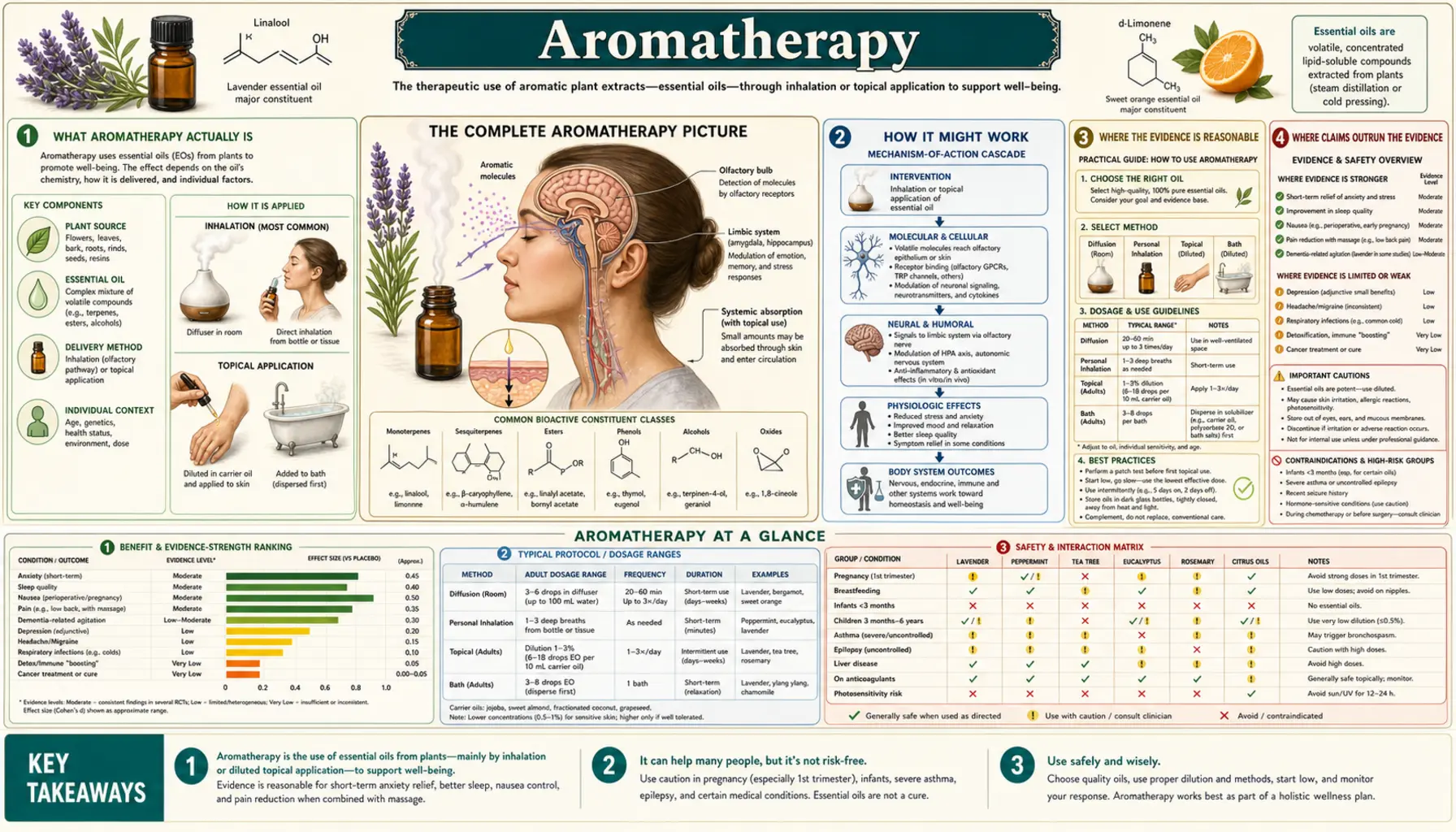
Aromatherapy is the practice of using fragrant plant oils — called essential oils — to support relaxation, mood, and comfort. In most cases the oil is inhaled (from a diffuser, a few drops on a tissue, or steam) or applied to the skin diluted during a massage. It is not the same thing as swallowing oils, and it is best understood as a gentle, pleasant complement to ordinary self-care rather than a medicine. This page tries to be honest: aromatherapy has some real, measurable benefits for things like anxiety, short-term stress, sleep, and nausea, and it is used as supportive care in hospices and maternity wards. But essential oils do not cure infections, cancer, or any serious disease, and they carry genuine safety risks — they are highly concentrated, they can irritate skin, they are dangerous if swallowed (especially by children), and some are toxic to pets. Below, we walk through what aromatherapy is, where the evidence is reasonable, where marketing claims run far past the science, the best-studied oils, and — importantly — how to use it safely.
Table of Contents
- What Aromatherapy Actually Is
- How It Might Work
- Where the Evidence Is Reasonable
- Where Claims Outrun the Evidence
- The Best-Studied Oils and Their Uses
- How Aromatherapy Is Used
- Safety — Please Read This First
- Who Should Be Extra Careful
- The Honest Bottom Line
- Research Papers
- Connections
- Featured Videos
What Aromatherapy Actually Is
Essential oils are the concentrated, aromatic parts of plants — the substances that give lavender, peppermint, or a lemon peel their distinctive smell. They are pressed or steam-distilled from flowers, leaves, bark, or rind, and it takes a large amount of plant material to make a small bottle. That is why they are so strong: a single drop can hold the scent of a whole handful of the plant.
Aromatherapy uses these oils in two main ways:
- Inhalation (aromatic use) — drops in a diffuser that releases scent into the air, a few drops on a tissue or cotton ball, or steam from a bowl of hot water. You breathe the fragrance; you do not take the oil into your body in any meaningful amount.
- Topical use (applied to skin) — a few drops of essential oil mixed into a larger amount of a neutral carrier oil (such as jojoba, sweet almond, or coconut oil) and then massaged into the skin. The dilution matters enormously, as the safety section explains.
Here is a point worth being very clear about: aromatherapy is not the same as ingesting essential oils. Swallowing essential oils is a different and far riskier practice that is not recommended for home use, and nothing on this page endorses it. When people talk about aromatherapy for wellbeing, they almost always mean smelling the oil or having it massaged into the skin in a properly diluted form.
How It Might Work
There are a few plausible, overlapping reasons aromatherapy can make people feel better — and it helps to separate them, because they are not equally mysterious.
The scent-to-emotion pathway
Smell is wired unusually directly into the brain. Odor signals travel from the nose to the olfactory bulb and then to the limbic system — the network involved in emotion and memory — without first passing through the “thinking” filters that vision and hearing go through. That is why a particular smell can instantly bring back a memory or shift your mood. Aromatherapy leans on this pathway: a calming scent may nudge the nervous system toward relaxation.
Real chemistry, in some cases
It is not only about association. Some essential-oil components do have measurable effects. Lavender oil compounds (linalool and linalyl acetate) have been shown in laboratory and clinical work to influence the nervous system in a calming direction, which is part of why lavender is the most-studied oil for anxiety.
The relaxation and human-touch components
When aromatherapy is delivered through massage — as it often is in hospitals and hospices — a good deal of the benefit almost certainly comes from the massage itself: slowing down, being cared for, and the calming effect of touch. The warm bath, the quiet room, and the ritual of taking time for yourself all contribute. This does not make the benefit “fake.” Feeling calmer and sleeping better are real outcomes. But it does mean we should be honest that the scent is one ingredient in a larger, soothing experience.
Where the Evidence Is Reasonable
Aromatherapy has been studied in hundreds of small trials. The research is uneven — many studies are small, short, and hard to “blind” (you can tell when a room smells of lavender) — so we should hold the findings loosely. Still, some signals show up repeatedly, and they are worth taking seriously as modest effects.
Anxiety and everyday stress
This is aromatherapy's strongest area. Lavender, in particular, has repeatedly reduced measures of anxiety in clinical settings. A special standardized oral lavender-oil capsule called Silexan has performed comparably to conventional anti-anxiety medicines in generalized anxiety disorder trials — though note that Silexan is a swallowed, pharmaceutical-grade preparation studied under medical supervision, not the same as diffusing lavender at home. Inhaled lavender has also lowered anxiety in stressful situations like waiting for a medical procedure.
Short-term and procedural anxiety
Some of the cleaner results come from hospitals: patients about to have an IV line placed, dental work, or minor surgery report less anxiety (and sometimes less pain) when lavender is inhaled beforehand. These are brief, specific, measurable moments — a good fit for a gentle intervention.
Sleep
Reviews of lavender and sleep find that it modestly improves how people rate their sleep quality, especially in people who are mildly anxious or in stressful environments like hospital wards. The effect is real but gentle — think “helped me wind down,” not “cured my insomnia.”
Nausea
Aromatherapy is used for nausea, particularly after surgery. Inhaling peppermint or ginger aromas, or even simply doing slow controlled breathing, can take the edge off queasiness for some people. A Cochrane review found the evidence mixed and mostly low-quality, but the practice is cheap, quick, and low-risk, which is why many recovery rooms still offer it.
Supportive care in cancer, palliative, and labor settings
In cancer centers, hospices, and maternity wards, aromatherapy massage is offered to improve quality of life — to ease anxiety, improve mood, and provide comfort. This is the honest framing used by the clinicians who provide it: it is supportive care, meant to help people feel better and more cared for. It is not a treatment for the cancer or a way to speed up labor. Within that modest goal, patients often value it, and it carries little risk when done by trained staff.
Where Claims Outrun the Evidence
Essential oils are surrounded by big promises, and a lot of them are simply not true. Being clear about this is part of using aromatherapy responsibly.
- Essential oils do not cure infections. Some oils (like tea tree) do kill microbes in a laboratory dish, and tea tree has modest evidence for certain topical skin uses. But diffusing an oil into the air does not treat a lung infection, a urinary infection, or strep throat. Bacterial infections need appropriate medical treatment.
- Essential oils do not cure cancer. There is no credible evidence that any essential oil, inhaled or applied, treats or shrinks a tumor. Aromatherapy's honest role in cancer care is comfort and quality of life alongside real treatment — nothing more.
- Aromatherapy is not a substitute for medical care. Inhaling an oil is not a replacement for antibiotics, insulin, chemotherapy, mental-health treatment, or any prescribed therapy. Delaying real treatment in favor of oils can cause serious harm.
- “Natural” does not mean “harmless.” Essential oils are potent chemical mixtures. As the safety section explains, they can burn skin, trigger allergies, poison children, and harm pets. Natural origin says nothing about safety.
- Beware of internal-use and MLM claims. Marketing that urges you to swallow oils, put them in water, or use them to “detox” or replace medicine is going well past the evidence and into risky territory.
None of this means aromatherapy is worthless. It means we should match the claim to the evidence: relaxation and minor symptom relief, yes; curing disease, no.
The Best-Studied Oils and Their Uses
A handful of oils account for most of the reasonable evidence. Here are the ones worth knowing, with an honest note on what they are actually good for.
Lavender — anxiety and sleep
The workhorse of aromatherapy. Lavender is the best-studied oil for calming anxiety, easing pre-procedure nerves, and gently improving sleep quality. Its effects are modest but show up consistently. If you try one oil for relaxation, this is the evidence-backed choice.
Peppermint — nausea and tension headache
Inhaled peppermint is a common, low-risk option for queasiness, including after surgery. Diluted peppermint oil rubbed on the temples has some evidence for easing tension-type headaches. (Peppermint tea and enteric-coated peppermint capsules are separately used for digestive complaints — that is a different, oral use, not aromatherapy.)
Tea tree — topical antimicrobial for skin
Tea tree (Melaleuca alternifolia) oil has genuine antimicrobial activity and modest evidence for topical skin uses such as mild acne and minor fungal problems, always well diluted. It is a skin-surface use, not something to inhale for internal infection, and it should never be swallowed — ingested tea tree oil is toxic.
Eucalyptus — a feeling of clearer breathing
The brisk, cooling scent of eucalyptus (and its component eucalyptol) is a traditional inhalation for nasal and chest congestion — the same idea behind many chest rubs and steam inhalations. It can make breathing feel clearer and more comfortable when you have a cold. It does not cure the infection, and eucalyptus oil is especially dangerous if a child swallows it.
How Aromatherapy Is Used
If you want to try aromatherapy safely, the methods are simple and the amounts are small.
- Diffusion — a few drops in a water diffuser scents a room. Run it for short sessions (say 30–60 minutes) rather than continuously, in a ventilated space, and not in a small closed room where a baby or pet cannot leave.
- Direct inhalation — one or two drops on a tissue or cotton ball, held a little away from the nose. This is the most controllable method.
- Steam inhalation — a drop or two in a bowl of hot (not boiling-in-your-face) water, eyes closed. Skip this for young children.
- Diluted topical / massage — essential oil mixed into a carrier oil before it touches skin. A common everyday guideline for adults is roughly a 1–3% dilution (about 6–18 drops of essential oil per ounce / 30 mL of carrier oil), and even more dilute for sensitive skin, faces, or older adults and children. When in doubt, use less.
Two habits make all of it safer: always dilute before skin contact, and always patch-test a new oil on a small area first and wait 24 hours to check for a reaction.
Safety — Please Read This First
This is the most important section on the page. Essential oils are pleasant, but because they are so concentrated they deserve real respect. Please take these seriously.
They can irritate skin and cause allergic reactions
Undiluted essential oil on skin can cause burning, redness, and rashes, and repeated exposure can bring on new allergies over time. Never apply essential oils neat (undiluted) to the skin — always mix into a carrier oil first — and patch-test anything new. If a reaction appears, wash the area with a carrier oil (not water alone) and stop use.
Citrus oils can cause photosensitivity
Several citrus oils — especially bergamot, and also lemon, lime, and grapefruit — make skin far more sensitive to sunlight. Applying them and then going into the sun can cause serious burns and long-lasting dark patches. If you use citrus oils on skin, keep that skin out of the sun for at least 12–24 hours.
They are dangerous if swallowed — keep them away from children
Essential oils are a genuine poisoning hazard, and young children are the most at risk. A small swallowed amount of a strong oil (eucalyptus, tea tree, wintergreen, camphor, clove, and others) can cause serious harm — seizures, breathing trouble, or worse. Store all oils tightly capped, up high, and out of children's reach, treat them like any household chemical, and never let a child play with the bottles. If a child swallows essential oil, contact poison control or emergency services right away.
They can be toxic to pets — cats especially
This one surprises people. Many essential oils are toxic to pets, and cats are particularly vulnerable because their livers cannot process certain oil compounds well. Oils like tea tree, eucalyptus, citrus, pine, cinnamon, and wintergreen can poison cats and dogs through skin contact, licking, or even a heavily used diffuser in a closed room. Never apply essential oils to a pet, keep bottles away from them, and if you diffuse, do it in a ventilated space the animal can freely leave. When in doubt, ask a veterinarian.
Some oils have debated hormonal (endocrine) effects
There is an ongoing scientific debate about whether repeated topical use of lavender and tea tree oils may have weak hormone-like (endocrine) effects. A small number of reports linked their use to breast tissue growth in young boys that resolved when the oils were stopped. The evidence is limited and contested, but it is a reasonable caution, particularly for regular use on children.
The simplest safety rules
- Never put undiluted oils on skin.
- Never swallow essential oils or put them in your body at home.
- Keep them away from children and pets, stored high and capped.
- Dilute, patch-test, ventilate, and use small amounts for short sessions.
- Stop and seek help if you have a reaction, and get medical advice before using oils in pregnancy or with a health condition.
Who Should Be Extra Careful
Aromatherapy is low-risk for most healthy adults using it sensibly, but some people should be more cautious — or check with a professional first.
- Babies and young children. Their airways and skin are more sensitive, and they are the group most often poisoned by swallowing oils. Use minimal, well-diluted, child-safe oils only with guidance, and never diffuse strong oils around infants.
- Pregnancy and breastfeeding. Evidence is limited; some oils are traditionally avoided in pregnancy. Aromatherapy is offered in labor for comfort, but it is worth checking with your midwife or doctor about which oils and methods are appropriate.
- Asthma and respiratory conditions. Strong scents and diffusers can trigger coughing, wheezing, or an asthma flare in some people. Start cautiously and stop if breathing worsens.
- Sensitive skin, allergies, or eczema. Higher chance of skin reactions — dilute more and patch-test.
- People with epilepsy or seizure disorders. A few oils (such as camphor, rosemary, and eucalyptus in large amounts) are best avoided; ask a professional.
- Households with pets. As above — cats especially. Factor your animals into any diffuser use.
The Honest Bottom Line
Aromatherapy is a pleasant, generally low-risk complementary practice that can genuinely help with relaxation, everyday stress and anxiety, winding down for sleep, and easing minor symptoms like nausea — when the oils are used safely. It has an accepted, honest role as supportive care in cancer centers, hospices, and maternity wards, where the goal is comfort and quality of life.
What it is not is a treatment for disease. Essential oils do not cure infections, cancer, or any serious illness, and inhaling them is never a substitute for proper medical care. And because they are so concentrated, they must be handled with care: diluted before touching skin, never swallowed, and kept well away from children and pets. Used with those honest expectations and sensible precautions, aromatherapy can be a small, soothing part of taking care of yourself. Used as a replacement for medicine, it can do real harm.
Research Papers
- Woelk H, Schläfke S. A multi-center, double-blind, randomised study of the Lavender oil preparation Silexan in comparison to Lorazepam for generalized anxiety disorder. Phytomedicine. 2010;17(2):94–99. doi:10.1016/j.phymed.2009.10.006 — oral lavender preparation matched a standard anti-anxiety drug for generalized anxiety.
- Kasper S, Gastpar M, Müller WE, Volz HP, Möller HJ, Schläfke S. Lavender oil preparation Silexan is effective in generalized anxiety disorder – a randomized, double-blind comparison to placebo and paroxetine. Int J Neuropsychopharmacol. 2014;17(6):859–869. doi:10.1017/S1461145714000017 — larger placebo-controlled trial supporting a real anti-anxiety effect.
- Perry R, Terry R, Watson LK, Ernst E. Is lavender an anxiolytic drug? A systematic review of randomised clinical trials. Phytomedicine. 2012;19(8–9):825–835. doi:10.1016/j.phymed.2012.02.013 — found promising but methodologically mixed evidence for lavender easing anxiety.
- Fismer KL, Pilkington K. Lavender and sleep: A systematic review of the evidence. Eur J Integr Med. 2012;4(4):e436–e447. doi:10.1016/j.eujim.2012.08.001 — modest improvements in self-rated sleep quality, with caveats about study quality.
- Hines S, Steels E, Chang A, Gibbons K. Aromatherapy for treatment of postoperative nausea and vomiting. Cochrane Database Syst Rev. 2018;(3):CD007598. doi:10.1002/14651858.CD007598.pub3 — mixed, mostly low-quality evidence; aromatherapy may modestly help post-surgical nausea.
- Lakhan SE, Sheafer H, Tepper D. The Effectiveness of Aromatherapy in Reducing Pain: A Systematic Review and Meta-Analysis. Pain Res Treat. 2016;2016:8158693. doi:10.1155/2016/8158693 — found a small overall reduction in pain scores, strongest for certain acute and gynecological pain.
- Smith CA, Collins CT, Crowther CA. Aromatherapy for pain management in labour. Cochrane Database Syst Rev. 2011;(7):CD009215. doi:10.1002/14651858.CD009215 — too little evidence to confirm labor-pain relief; used mainly for comfort and support.
- Koulivand PH, Khaleghi Ghadiri M, Gorji A. Lavender and the Nervous System. Evid Based Complement Alternat Med. 2013;2013:681304. doi:10.1155/2013/681304 — reviews the plausible calming mechanisms of lavender compounds on the nervous system.
- Karaman T, Karaman S, Dogru S, Tapar H, Sahin A, Suren M. Evaluating the efficacy of lavender aromatherapy on peripheral venous cannulation pain and anxiety: A prospective, randomized study. Complement Ther Clin Pract. 2016;23:64–68. doi:10.1016/j.ctcp.2016.03.008 — inhaled lavender reduced anxiety and pain during IV needle placement.
- Carson CF, Hammer KA, Riley TV. Melaleuca alternifolia (Tea Tree) Oil: a Review of Antimicrobial and Other Medicinal Properties. Clin Microbiol Rev. 2006;19(1):50–62. doi:10.1128/CMR.19.1.50-62.2006 — documents tea tree's real antimicrobial activity for topical skin uses (not internal infection).
- Henley DV, Lipson N, Korach KS, Bloch CA. Prepubertal Gynecomastia Linked to Lavender and Tea Tree Oils. N Engl J Med. 2007;356(5):479–485. doi:10.1056/NEJMoa064725 — the report behind the debated hormone-like (endocrine) safety concern for these two oils.
- Genovese AG, McLean MK, Khan SA. Adverse reactions from essential oil-containing natural flea products exempted from EPA regulations in dogs and cats. J Vet Emerg Crit Care. 2012;22(4):470–475. doi:10.1111/j.1476-4431.2012.00780.x — documents essential-oil poisoning in pets, with cats especially affected.
Connections
- All Remedies
- Lavender
- Peppermint
- Eucalyptus
- Tea Tree
- Chamomile
- Massage
- Stress Management
- Meditation
- Lavender for Sleep Quality
- Lavender for Skin Healing and Burns — the burn incident that gave aromatherapy its name, and the wound-healing trial evidence.
- Rosemary for Cognitive Function and Memory — the Moss Northumbria trials on inhaled rosemary and prospective memory.
- Discussed in depth on these pages: Marjoram for Sleep, Mood and Pain