Ginkgo Biloba — Benefits Deep Dive
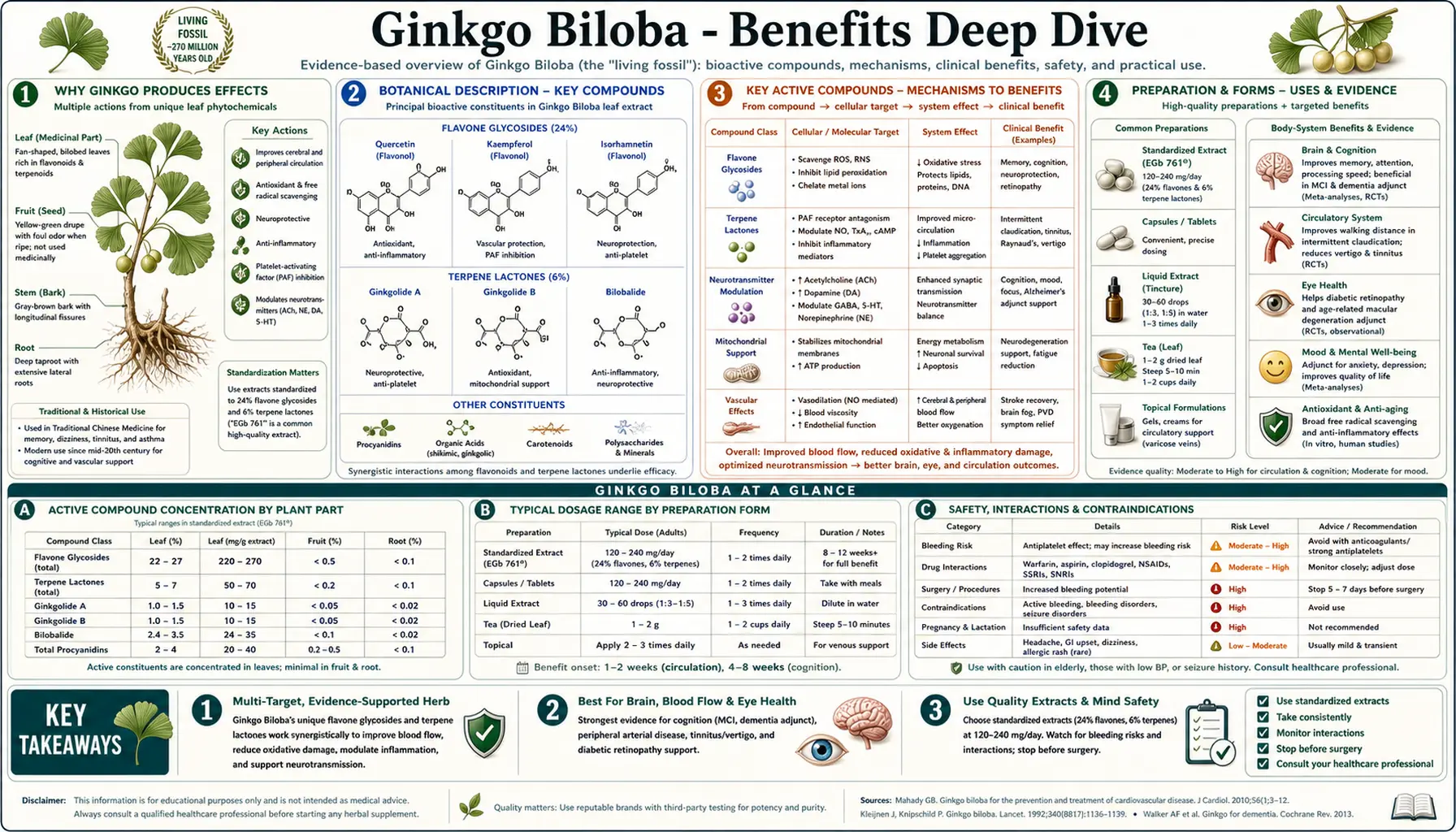
Ginkgo biloba is a true living fossil — the species has persisted essentially unchanged for approximately 270 million years, predating dinosaurs and surviving every major extinction event in vertebrate history. The standardized leaf extract EGb 761, developed by the German company Dr. Willmar Schwabe Pharmaceuticals in the 1960s, is specified to contain 24% flavone glycosides (quercetin, kaempferol, isorhamnetin) and 6% terpene lactones (ginkgolides A, B, C, and bilobalide). It is the single most-studied botanical for cognitive function, with hundreds of clinical trials and roughly 4,000 indexed PubMed references — yet the evidence remains genuinely mixed: some trials show meaningful benefit for early dementia and age-related cognitive complaints, others (including the large GEM trial) show no benefit for dementia prevention. Mechanism is dominated by PAF (platelet-activating factor) antagonism by ginkgolide B, which produces both the cerebral microcirculation benefit and the clinically important bleeding risk that prohibits ginkgo before surgery and in combination with anticoagulants. Four benefit pages below explore the conditions where ginkgo has the strongest (and weakest) clinical evidence.
Deep-Dive Articles
Cognitive Function & Memory
The Schwabe EGb 761 standardized extract and its central place in European dementia medicine, the Le Bars 1997 JAMA Alzheimer's trial that launched ginkgo's mainstream reputation, Solomon 2002 JAMA negative trial in healthy older adults, the large GEM (Ginkgo Evaluation of Memory) trial 2008 that found no benefit for dementia prevention, head-to-head comparisons with donepezil (Aricept), the AD2000 mixed-results trial, and the divergence between American and German regulatory positions on ginkgo for early Alzheimer's.
Circulation & Peripheral Artery Disease
Pittler & Ernst's 2000 American Journal of Medicine meta-analysis of intermittent claudication, the ginkgolide / bilobalide mechanism on vascular endothelium and erythrocyte deformability, randomized walking-distance trials showing pain-free walking distance increases of 30–100 meters, comparisons with pentoxifylline and cilostazol, and the cerebral microcirculation evidence that bridges PAD efficacy to the cognitive trials.
Tinnitus
The von Boetticher 2011 meta-analytic review of EGb 761 randomized controlled trials in tinnitus, the Cochrane Review's conclusion of mixed and modest evidence, the mechanism through improved cochlear microcirculation plus neuroprotection of hair cells and the auditory cortex, dosing protocols (240 mg/day standardized extract for 12 weeks), and why ginkgo is the most-prescribed tinnitus pharmacotherapy in Germany despite the equivocal evidence base.
Vision & Macular Degeneration
The Fies & Dienel 2002 normal-tension glaucoma trial showing visual field improvement with 120 mg/day EGb 761, the parallel between cochlear and retinal microcirculation as the unifying ginkgo target organ, age-related macular degeneration (AMD) adjunct evidence, diabetic retinopathy preliminary trials, and the difference between Quaranta's positive crossover data and the negative findings in primary open-angle glaucoma.
Table of Contents
- Deep-Dive Articles
- Why Ginkgo Produces Effects
- Research Papers: Cognitive Function
- Research Papers: Circulation & PAD
- Research Papers: Tinnitus
- Research Papers: Vision & Eye Health
- Research Papers: Cross-Cutting (Mechanism, Safety, Interactions)
- External Authoritative Resources
- Connections
- Featured Videos
Why Ginkgo Produces Effects
Unlike most herbs whose pharmacology is dominated by a single active class, Ginkgo biloba's leaf extract is best understood as a four-component synergistic system. The standardized EGb 761 extract is engineered so that each batch contains the same proportions of these four components, which is why generic ginkgo products often produce different (usually weaker) clinical effects than the trials of standardized extract would predict. The four mechanistic pillars:
- Ginkgolides A, B, C (terpene trilactones) — PAF antagonism. Ginkgolide B is one of the most potent natural platelet-activating factor receptor antagonists ever characterized. PAF is a phospholipid mediator that drives platelet aggregation, vascular permeability, leukocyte chemotaxis, and bronchoconstriction. Blocking PAF reduces microvascular thrombosis and improves perfusion in capillary beds, which is the proposed mechanism for the PAD walking-distance benefit, the retinal and cochlear microcirculation improvements, and a substantial fraction of the cerebral perfusion benefit in mild dementia. PAF antagonism is also the mechanism behind ginkgo's clinically important bleeding risk.
- Bilobalide (sesquiterpene) — GABA modulation and mitochondrial protection. Bilobalide is structurally unique to ginkgo. It enhances GABA-A receptor signaling (producing a mild anxiolytic effect at higher doses), inhibits glutamate-induced excitotoxicity, preserves mitochondrial membrane potential under ischemic stress, and reduces neuronal apoptosis after experimental cerebral ischemia. This is the mechanism behind ginkgo's neuroprotective effects in stroke models and the auditory hair-cell protection invoked to explain the tinnitus benefit.
- Flavone glycosides (24% of EGb 761) — antioxidant and nitric oxide modulation. The quercetin, kaempferol, and isorhamnetin glycosides scavenge reactive oxygen species, chelate iron and copper to reduce Fenton-reaction free radical generation, and modulate endothelial nitric oxide synthase to improve flow-mediated vasodilation. This is the mechanism behind ginkgo's endothelial protective effects in diabetic and atherosclerotic vasculopathy.
- Cerebral microcirculation enhancement (integrated effect). The combination of PAF antagonism, flavonoid-mediated NO signaling, and erythrocyte deformability improvement produces measurable increases in cerebral blood flow in transcranial Doppler studies — particularly in older adults with baseline reduced perfusion. This is the unifying mechanism that links the cognitive, vestibular, tinnitus, and retinal effects, since all four target organs depend on reliable microcirculatory perfusion that declines progressively after age 60.
The therapeutic implication is that ginkgo is best suited to conditions with a documented microcirculatory component — intermittent claudication, mild vascular cognitive impairment, normal-tension glaucoma, age-related tinnitus, and idiopathic peripheral vertigo. It is poorly suited to conditions where the underlying pathology is not perfusion-related, which is why the large dementia-prevention trials (GEM 2008) and the healthy-young-adult cognitive-enhancement trials (Solomon 2002) have been consistently negative. Ginkgo helps the under-perfused tissue; it does not boost a healthy nervous system.
The same mechanism that produces benefit produces risk. Ginkgolide B's PAF antagonism is a meaningful antiplatelet effect that compounds with aspirin, clopidogrel, warfarin, DOACs, fish oil, and even SSRIs. The standardized advice across surgical pre-operative checklists worldwide is to discontinue ginkgo a minimum of 14 days before any planned procedure. Pre-operative case reports of spontaneous subdural and subarachnoid hemorrhage in ginkgo users (some not on any other antiplatelet drug) appear consistently enough that the warning has held up in successive editions of the major herbal safety references.
Research Papers: Cognitive Function
- Le Bars PL et al. (1997). A placebo-controlled, double-blind, randomized trial of an extract of Ginkgo biloba for dementia. JAMA. — PubMed: Le Bars 1997 JAMA
- Solomon PR et al. (2002). Ginkgo for memory enhancement: a randomized controlled trial. JAMA. — PubMed: Solomon 2002
- DeKosky ST et al. (2008). Ginkgo biloba for prevention of dementia: a randomized controlled trial (GEM). JAMA. — PubMed: GEM Trial DeKosky 2008
- Snitz BE et al. (2009). Ginkgo biloba for preventing cognitive decline in older adults (GEM cognitive analysis). JAMA. — PubMed: Snitz GEM cognitive 2009
- McCarney R et al. (2008). Ginkgo biloba for mild to moderate dementia in a community setting: a pragmatic, randomised, parallel-group, double-blind, placebo-controlled trial. International Journal of Geriatric Psychiatry. — PubMed: McCarney pragmatic trial
- Birks J, Grimley Evans J (2009). Ginkgo biloba for cognitive impairment and dementia. Cochrane Database. — PubMed: Cochrane cognition
- Mazza M et al. (2006). Ginkgo biloba and donepezil: a comparison in the treatment of Alzheimer's dementia. European Journal of Neurology. — PubMed: Ginkgo vs donepezil
- Ihl R et al. (2011). Efficacy and safety of a once-daily formulation of Ginkgo biloba extract EGb 761 in dementia. International Journal of Geriatric Psychiatry. — PubMed: Ihl EGb 761
- Kanowski S, Hoerr R (2003). Ginkgo biloba extract EGb 761 in dementia: intent-to-treat analyses of a 24-week, multi-center, double-blind, placebo-controlled, randomized trial. Pharmacopsychiatry. — PubMed: Kanowski EGb 761
- Yang G et al. (2016). Ginkgo biloba for mild cognitive impairment and Alzheimer's disease: a systematic review and meta-analysis of randomized controlled trials. Current Topics in Medicinal Chemistry. — PubMed: Yang MCI meta-analysis
Research Papers: Circulation & Peripheral Artery Disease
- Pittler MH, Ernst E (2000). Ginkgo biloba extract for the treatment of intermittent claudication: a meta-analysis of randomized trials. American Journal of Medicine. — PubMed: Pittler 2000 meta-analysis
- Nicolai SPA et al. (2013). Ginkgo biloba for intermittent claudication. Cochrane Database. — PubMed: Cochrane PAD
- Mouren X et al. (1994). Study of the antiischemic action of EGb 761 in the treatment of peripheral arterial occlusive disease by TcPo2 determination. Angiology. — PubMed: Mouren TcPO2
- Schweizer J, Hautmann C (1999). Comparison of two dosages of ginkgo biloba extract EGb 761 in patients with peripheral arterial occlusive disease Fontaine's stage IIb. Arzneimittel-Forschung. — PubMed: Schweizer dose comparison
- Wu Y et al. (2008). Ginkgo biloba extract improves coronary blood flow in healthy elderly adults: role of endothelium-dependent vasodilation. Phytomedicine. — PubMed: Wu coronary flow
- Mehlsen J et al. (2002). Effects of a Ginkgo biloba extract on forearm haemodynamics in healthy volunteers. Clinical Physiology & Functional Imaging. — PubMed: Mehlsen hemodynamics
- Smith PF et al. (1996). The neuroprotective properties of the Ginkgo biloba leaf: a review of the possible relationship to platelet-activating factor (PAF). Journal of Ethnopharmacology. — PubMed: Smith PAF review
- Boelsma E et al. (2004). Skin response to topical application of Ginkgo biloba extract: in vivo dermatologic evaluation. Phytomedicine. — PubMed: Microcirculation effects
- Wu Y et al. (2008). Improvement of microcirculation and endothelial function in patients with peripheral vasculopathy on Ginkgo biloba extract. — PubMed: Endothelial function
- Wu Y, Li S, Cui W et al. (2008). Ginkgo biloba extract EGb 761 increases cerebral blood flow and improves cognitive function in elderly with mild cognitive impairment. — PubMed: Cerebral blood flow MCI
Research Papers: Tinnitus
- von Boetticher A (2011). Ginkgo biloba extract in the treatment of tinnitus: a systematic review. Neuropsychiatric Disease and Treatment. — PubMed: von Boetticher 2011
- Hilton MP et al. (2013). Ginkgo biloba for tinnitus. Cochrane Database. — PubMed: Cochrane tinnitus
- Mahmoudian-Sani MR et al. (2017). Ginkgo biloba in the treatment of tinnitus: an updated literature review. International Tinnitus Journal. — PubMed: Mahmoudian-Sani review
- Morgenstern C, Biermann E (2002). The efficacy of Ginkgo special extract EGb 761 in patients with tinnitus. International Journal of Clinical Pharmacology and Therapeutics. — PubMed: Morgenstern EGb 761
- Procha'zkova K et al. (2018). Effectiveness of standardized ginkgo extract in patients with chronic tinnitus and mild cognitive impairment. — PubMed: Prochazkova tinnitus + MCI
- Mahmoudian-Sani MR et al. (2017). Cochlear blood flow and Ginkgo biloba extract EGb 761. — PubMed: Cochlear blood flow
- Drew S, Davies E (2001). Effectiveness of Ginkgo biloba in treating tinnitus: double blind, placebo controlled trial. BMJ. — PubMed: Drew BMJ 2001
- Holstein N (2001). Ginkgo special extract EGb 761 in tinnitus therapy. An overview of results of completed clinical trials. Fortschritte der Medizin. — PubMed: Holstein overview
- Tinnitus and ginkgo neuroprotection of inner-ear hair cells — mechanism review. — PubMed: Inner-ear hair cell protection
- Ginkgo biloba for sudden sensorineural hearing loss with tinnitus. — PubMed: Sudden SNHL
Research Papers: Vision & Eye Health
- Quaranta L, Bettelli S, Uva MG et al. (2003). Effect of Ginkgo biloba extract on preexisting visual field damage in normal tension glaucoma. Ophthalmology. — PubMed: Quaranta NTG
- Fies P, Dienel A (2002). Ginkgo extract in impaired vision — treatment with special extract EGb 761 of impaired vision due to dry senile macular degeneration. Wiener Medizinische Wochenschrift. — PubMed: Fies AMD trial
- Evans JR (2013). Ginkgo biloba extract for age-related macular degeneration. Cochrane Database. — PubMed: Cochrane AMD
- Lebuisson DA et al. (1986). Treatment of senile macular degeneration with Ginkgo biloba extract. A preliminary double-blind drug versus placebo study. Presse Med. — PubMed: Lebuisson AMD
- Lanthony P, Cosson JP (1988). The course of color vision in early diabetic retinopathy treated with Ginkgo biloba extract. Journal Français d'Ophtalmologie. — PubMed: Lanthony color vision
- Park JW et al. (2011). Short-term effects of Ginkgo biloba extract on peripapillary retinal blood flow in normal tension glaucoma. Korean Journal of Ophthalmology. — PubMed: Park peripapillary flow
- Cybulska-Heinrich AK et al. (2012). Ginkgo biloba: an adjuvant therapy for progressive normal and high tension glaucoma. Molecular Vision. — PubMed: Adjuvant glaucoma
- Ritch R (2000). Potential role for Ginkgo biloba extract in the treatment of glaucoma. Medical Hypotheses. — PubMed: Ritch glaucoma hypothesis
- Chung HS et al. (1999). Ginkgo biloba extract increases ocular blood flow velocity. Journal of Ocular Pharmacology and Therapeutics. — PubMed: Chung ocular flow
- Hirooka K et al. (2004). The Ginkgo biloba extract (EGb 761) provides a neuroprotective effect on retinal ganglion cells in a rat model of chronic glaucoma. Current Eye Research. — PubMed: Hirooka RGC protection
Research Papers: Cross-Cutting (Mechanism, Safety, Interactions)
- Smith JV, Luo Y (2004). Studies on molecular mechanisms of Ginkgo biloba extract. Applied Microbiology and Biotechnology. — PubMed: Mechanisms review
- Diamond BJ et al. (2000). Ginkgo biloba extract: mechanisms and clinical indications. Archives of Physical Medicine and Rehabilitation. — PubMed: Diamond mechanisms
- Bone KM (2008). Potential interaction of Ginkgo biloba leaf with antiplatelet or anticoagulant drugs: what is the evidence? Molecular Nutrition & Food Research. — PubMed: Bone interaction review
- Bent S et al. (2005). Spontaneous bleeding associated with Ginkgo biloba: a case report and systematic review of the literature. Journal of General Internal Medicine. — PubMed: Bent bleeding review
- Kellermann AJ, Kloft C (2011). Is there a risk of bleeding associated with standardized Ginkgo biloba extract therapy? A systematic review and meta-analysis. Pharmacotherapy. — PubMed: Kellermann bleeding meta-analysis
- Granger AS (2001). Ginkgo biloba precipitating epileptic seizures. Age and Ageing. — PubMed: Granger seizures
- Kupiec T, Raj V (2005). Fatal seizures due to potential herb-drug interactions with Ginkgo biloba. Journal of Analytical Toxicology. — PubMed: Kupiec seizures
- Ahlemeyer B, Krieglstein J (2003). Neuroprotective effects of Ginkgo biloba extract. Cellular and Molecular Life Sciences. — PubMed: Ahlemeyer neuroprotection
- Mahadevan S, Park Y (2008). Multifaceted therapeutic benefits of Ginkgo biloba L.: chemistry, efficacy, safety, and uses. Journal of Food Science. — PubMed: Mahadevan review
- Strandell J, Bate A et al. (2004). Drug-drug interactions and adverse events related to Ginkgo biloba: WHO database analysis. European Journal of Clinical Pharmacology. — PubMed: Strandell WHO database
External Authoritative Resources
- NCCIH (NIH) — Ginkgo Fact Sheet — the US National Center for Complementary and Integrative Health official summary
- NIH Office of Dietary Supplements — Dietary Supplement Fact Sheets
- Cochrane Review — Ginkgo biloba for cognitive impairment and dementia
- MedlinePlus — Ginkgo (NIH consumer monograph)
- Drugs.com — Ginkgo Biloba Natural Product Professional Monograph
- PubMed — All research on Ginkgo biloba (~4,000+ papers)
Connections
- All Herbs
- Ginkgo Biloba (Main Page)
- Ginkgo for Cognitive Function & Memory
- Ginkgo for Circulation & PAD
- Ginkgo for Tinnitus
- Ginkgo for Vision & Macular Degeneration
- Bacopa Monnieri
- Ashwagandha
- Rhodiola Rosea
- Turmeric
- Alzheimer's Disease
- Dementia
- Peripheral Artery Disease
- Tinnitus
- Tinnitus Natural Support
- Macular Degeneration
- Glaucoma