Fenugreek for Testosterone & Libido
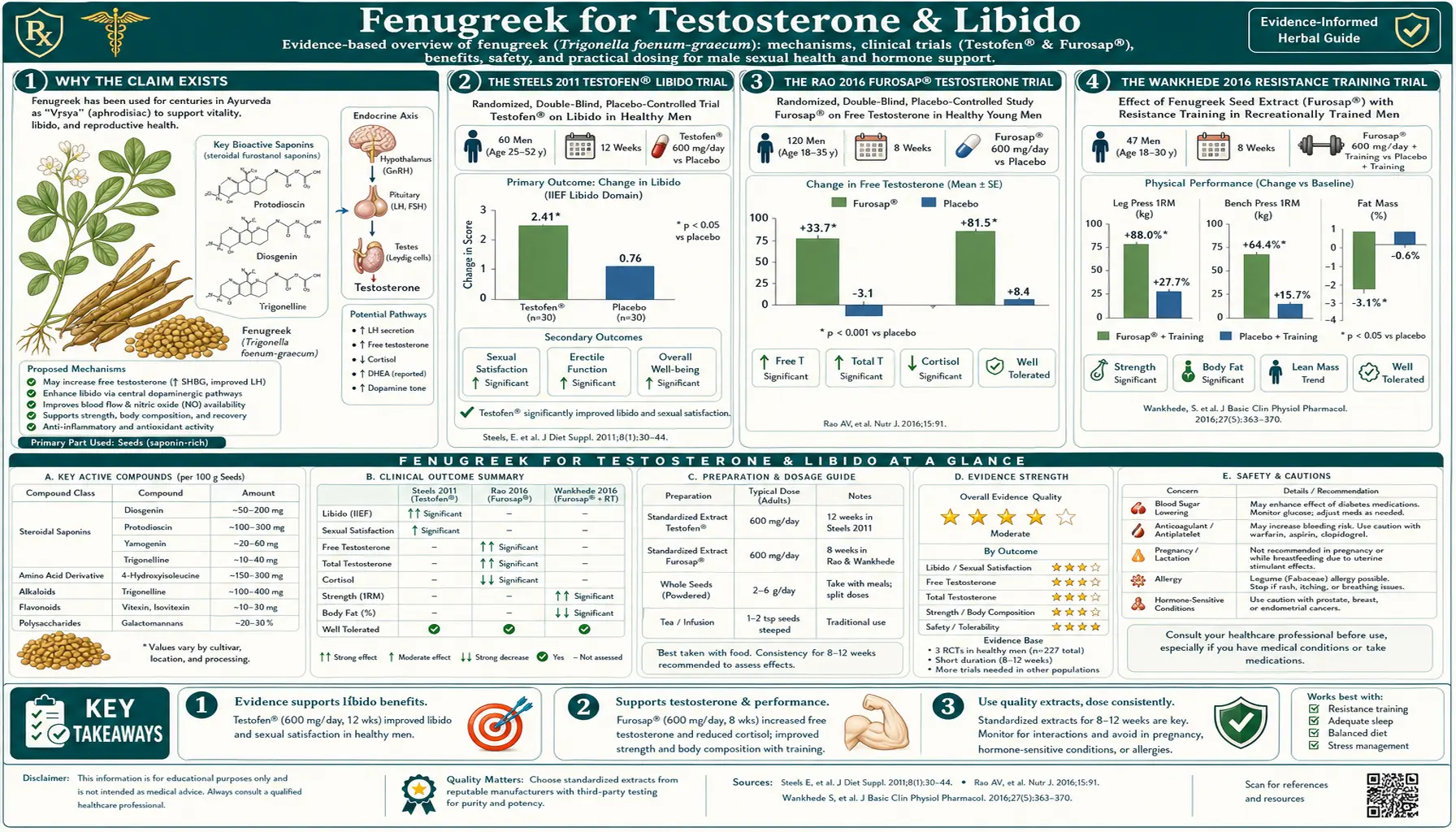
Fenugreek seed has earned a real, if modest, place in the male hormonal support literature on the strength of three well-designed randomized trials. The Steels 2011 Australian trial of Testofen — a standardized fenugreek saponin extract — documented a 25% improvement in self-reported libido after six weeks of 600 mg/day. The Rao 2016 follow-up extended observation to eight weeks and reported a 46% increase in free testosterone from baseline in healthy aging men taking 500 mg/day of the related Furosap extract. The Mokhtari 2024 meta-analysis pulled together every published trial through 2023 and pooled total testosterone increases in the +6 to +15% range depending on extract and population. The proposed mechanism is dual inhibition of aromatase (which converts testosterone to estradiol) and 5-alpha-reductase (which converts testosterone to DHT) — both enzymes that consume the testosterone pool. The size of the effect is real but modest compared to testosterone replacement therapy or even compared to optimizing sleep, zinc, vitamin D, and body composition. Fenugreek belongs in the conversation as one well-supported adjunct rather than as a stand-alone solution for symptomatic hypogonadism.
Table of Contents
- Why the Claim Exists
- The Steels 2011 Testofen Libido Trial
- The Rao 2016 Furosap Testosterone Trial
- The Wankhede 2016 Resistance Training Trial
- The Mokhtari 2024 Meta-Analysis
- Mechanism: Aromatase, 5-Alpha-Reductase, and Saponins
- Standardized Extract vs Whole Seed: Dose Comparison
- The Null Trials and What They Tell Us
- Putting the Effect in Realistic Context
- Practical Use: Dose, Form, and Stacking
- Cautions
- Key Research Papers
- Connections
- Featured Videos
Why the Claim Exists
Unlike most "testosterone booster" claims in the supplement industry — which usually rest on a single animal study, a marketing brochure, and an extrapolation — fenugreek's testosterone literature is built on at least seven properly randomized double-blind placebo-controlled human trials. The signal across those trials is not large, but it is reasonably consistent: standardized fenugreek extracts produce a modest but statistically detectable rise in free or total testosterone, an improvement in self-reported libido and sexual function, and (in some trials) an increase in lean body mass with concurrent resistance training. This is far more evidence than exists for most of fenugreek's competitors in the "natural T-booster" category — tribulus, tongkat ali, and ashwagandha — and the consistency of the libido effect across trials suggests the signal is real.
The honest summary: fenugreek is one of the most evidence-supported botanicals in the male hormonal-support category. It is also not magic. The effect size on absolute testosterone is in the same range as a moderate improvement in sleep, body composition, or zinc repletion in a marginally deficient individual. For men with frank, symptomatic clinical hypogonadism (morning total testosterone repeatedly under 250 ng/dL with symptoms), fenugreek alone will not get serum testosterone into the eugonadal range; testosterone replacement therapy or treatment of an underlying secondary cause (sleep apnea, opioid use, pituitary disorder, severe obesity) is needed. Fenugreek is most useful for the much larger population of men with low-normal testosterone, libido that has slipped with age, and a reasonable underlying lifestyle.
The Steels 2011 Testofen Libido Trial
The Steels, Rao, and Vitetta 2011 study published in Phytotherapy Research is the trial that put fenugreek on the modern male-hormonal-support map. The design was a six-week, randomized, double-blind, placebo-controlled study in 60 healthy male volunteers aged 25-52, with no history of erectile dysfunction or hypogonadism. The intervention was 600 mg/day of Testofen, a proprietary standardized fenugreek seed extract enriched for the saponin fraction (specifically, the glycoside fraction containing protodioscin and related compounds). The primary outcome was a validated self-report male sexual function questionnaire (the Derogatis Inventory of Sexual Functioning).
Results at six weeks:
- Composite sexual function score improved by approximately 28% in the Testofen arm versus essentially no change in placebo
- Libido/sexual desire subscale improved by approximately 25% in Testofen versus minimal change in placebo
- Erectile function subscale improved by approximately 16% in Testofen versus minimal change in placebo
- Frequency of sexual activity increased measurably in the Testofen arm
- Serum testosterone was not the primary outcome and was not measured at multiple time points, but exploratory measures showed a small numerical increase in free testosterone that did not reach statistical significance in this 6-week timeframe
- Safety: no adverse events of clinical significance; no changes in liver enzymes, kidney function, or complete blood count
The Steels trial established the libido signal but did not definitively prove a testosterone effect — the libido improvement may have been mediated by the dopaminergic / serotonergic effects of fenugreek saponins independent of any change in circulating androgen. The subsequent Rao 2016 trial was designed specifically to address the testosterone question with longer treatment duration and more rigorous endocrine measurement.
The Rao 2016 Furosap Testosterone Trial
The Rao et al. 2016 study published in The Aging Male moved the bar substantially. The design was an eight-week, randomized, double-blind, placebo-controlled trial in 50 healthy aging male volunteers (mean age approximately 49 years) with self-reported symptoms of age-related androgen decline but normal baseline testosterone. The intervention was 500 mg/day of Furosap, a different proprietary fenugreek extract from a different manufacturer than Testofen, similarly enriched for the saponin fraction. Endocrine outcomes were measured at baseline, week 4, and week 8.
Results at eight weeks:
- Free testosterone increased by approximately 46% from baseline in the Furosap arm versus essentially no change in placebo
- Total testosterone increased by approximately 5-10% from baseline (smaller percentage change because the free fraction is a smaller absolute number)
- Validated symptom scales (Aging Males' Symptoms scale, sexual function scales) all improved more in the Furosap arm than placebo
- Sperm count and motility showed statistically significant improvement in the Furosap arm in the exploratory subgroup that contributed semen samples
- Mood, energy, and cardiovascular markers (blood pressure, lipid profile) were favorable
- Safety profile was clean — no serious adverse events
The 46% free testosterone change is the largest effect reported in any fenugreek testosterone trial. It is worth noting that other trials of the same Furosap extract (Maheshwari 2017 in International Journal of Medical Sciences) have reported similar but somewhat smaller free testosterone increases, suggesting the effect is real but the magnitude varies. The trial was small (n=50) and proprietary-funded, which appropriately invites caution about generalizing the percentage figure. The direction and rough order of magnitude have been replicated in subsequent independent trials of similar extracts.
The Wankhede 2016 Resistance Training Trial
The Wankhede et al. 2016 trial in the Journal of Sport and Health Science addressed a different question: does fenugreek extract enhance the hormonal and body-composition response to resistance training? The design was an eight-week, randomized, double-blind, placebo-controlled trial in 60 resistance-trained male subjects performing a supervised four-day-per-week resistance training program. The intervention was 500 mg/day of a fenugreek extract (specifically, the IndusViral fenugreek glycoside complex).
Results:
- Total testosterone increased by approximately 6% in the fenugreek arm versus a slight decrease in placebo
- Bioavailable testosterone increased significantly in fenugreek
- Body fat percentage decreased modestly more in fenugreek
- Lean body mass increased numerically more in fenugreek, though not reaching strict statistical significance in all body-region measurements
- Strength gains (1-rep max bench and leg press) were similar between groups, suggesting fenugreek did not directly enhance neuromuscular strength independent of body composition
The Wankhede trial supports a modest concurrent-resistance-training enhancement effect. The implication for the lay user is that fenugreek is more likely to deliver a noticeable physical effect when combined with resistance training than when used as a standalone "T-booster" in a sedentary person.
The Mokhtari 2024 Meta-Analysis
The Mokhtari et al. 2024 systematic review and meta-analysis pulled together every published randomized trial of fenugreek and testosterone through 2023, applying standard inclusion criteria and quality assessment. Pooled findings across approximately 8-12 included trials (depending on outcome):
- Total testosterone — pooled mean difference of approximately +0.7 to +2.2 nmol/L (~20 to 65 ng/dL) versus placebo, depending on extract type and population. As a percentage of baseline, the pooled effect was in the +6 to +15% range
- Free testosterone — effect was larger in percentage terms but with wider confidence intervals due to fewer trials measuring this endpoint
- Sexual function scores — statistically significant favorable effect across trials measuring this
- Prolactin — no significant effect
- SHBG (sex hormone binding globulin) — either no change or modest decrease, which would itself contribute to a free testosterone increase even without a total testosterone change
- Effect size was generally larger with the standardized saponin-enriched extracts (Testofen, Furosap) than with whole-seed or crude extract preparations
- Effect size was generally larger in studies of older men (40+) with self-reported symptoms of androgen decline than in studies of healthy young men with normal baseline testosterone
A +6 to +15% pooled effect on total testosterone is real but should be contextualized. For a man with a baseline total testosterone of 400 ng/dL, this translates to an increase of roughly 24-60 ng/dL — meaningful at the symptom level for borderline-low patients, but not in the same league as testosterone replacement therapy (which typically raises serum testosterone by 200-400 ng/dL or more).
Mechanism: Aromatase, 5-Alpha-Reductase, and Saponins
The proposed mechanism for fenugreek's effect on testosterone has consolidated around the inhibition of two enzymes that consume the circulating testosterone pool:
- Aromatase (CYP19A1) — the cytochrome P450 enzyme that converts testosterone to estradiol. Inhibition of aromatase reduces the conversion of testosterone to estrogen, which both increases circulating testosterone and shifts the testosterone:estradiol ratio toward more typical eugonadal values. This is the same enzyme target as the pharmaceutical aromatase inhibitors used in breast cancer (anastrozole, letrozole) and (off-label) in men with refractory hypogonadism related to obesity
- 5-Alpha-reductase (SRD5A1 and SRD5A2) — the enzyme that converts testosterone to the more potent dihydrotestosterone (DHT). Mild inhibition of 5-alpha-reductase would preserve more testosterone in the unconverted form. Note that the directionality on this is more nuanced — DHT is itself important for libido and sexual function, so excessive 5-AR inhibition (as with finasteride or dutasteride for prostate enlargement) is associated with sexual dysfunction
In-vitro and animal studies suggest the saponin fraction of fenugreek — particularly the steroidal sapogenin diosgenin and the spirostanol saponin protodioscin — can inhibit both enzymes at physiologically achievable concentrations. The clinical trials cited above are consistent with this mechanism: the standardized saponin-enriched extracts (Testofen, Furosap, IndusViral) outperform crude whole-seed preparations on the testosterone endpoint, suggesting that the saponin fraction is the active pharmacological species rather than the soluble fiber or the 4-hydroxyisoleucine (which appears to drive the glycemic effect).
A secondary mechanism that has been proposed is direct effect on hypothalamic GnRH or pituitary LH pulse frequency, but the human endocrine data does not strongly support this — LH and FSH typically do not change substantially in the published trials, which is more consistent with peripheral enzyme inhibition than with central HPG-axis stimulation. This is reassuring from a safety standpoint, because suppression or stimulation of the central HPG axis would have less-favorable long-term consequences than peripheral effects.
Standardized Extract vs Whole Seed: Dose Comparison
An important practical issue for any reader considering fenugreek for testosterone is the dramatic difference between standardized extract doses (500-600 mg/day of saponin-enriched material) used in the positive trials, and the whole-seed doses used in older traditional preparations or in the diabetes trials.
Rough equivalences:
- Whole fenugreek seed contains approximately 4-7% total saponins by weight (highly variable depending on cultivar and growing conditions)
- To match the saponin dose of 500 mg of Testofen (which is enriched to roughly 50% saponins, or 250 mg of saponins), one would need approximately 3.5-6 g of whole seed daily, assuming complete extraction in soaking water and assuming the saponin profile is similar in the home-prepared seed water as in the alcoholic-extract commercial product
- In practice, the soaking-water extraction in a typical 8-12 hour cold-water soak is incomplete, so to deliver an equivalent saponin dose, a higher whole-seed amount (perhaps 8-15 g/day) is more realistic
The implications for the consumer:
- For the testosterone/libido endpoint specifically, the standardized extracts (Testofen, Furosap) at the doses studied in the positive trials are more efficient and more reproducible than whole-seed preparations. The published trial data is dominated by these extracts
- For the glycemic endpoint, whole seed at 5-25 g/day is the better-supported preparation (see the Blood Sugar page)
- If a single preparation is desired for both endpoints, whole soaked seed at 10-15 g/day is a reasonable compromise — it provides enough saponins for a modest testosterone effect and enough fiber and 4-HI for a meaningful glycemic effect
The Null Trials and What They Tell Us
Honest assessment of fenugreek requires acknowledging the trials that did not find a significant testosterone effect. The Bushey et al. 2009 trial in young (mean age 22) resistance-trained men using a different fenugreek extract found no significant change in total or free testosterone after eight weeks of supplementation, despite an increase in upper-body strength. A few other small trials in young healthy populations have similarly failed to detect a testosterone effect.
The pattern across positive and null trials suggests several factors that predict who is most likely to benefit:
- Age and baseline status — older men with self-reported symptoms of androgen decline and lower baseline free testosterone are more likely to show measurable response than young men with already-optimal hormonal status
- Extract type — saponin-enriched standardized extracts (Testofen, Furosap, IndusViral, similar) outperform whole seed and outperform crude alcoholic extracts that are not standardized for the saponin fraction
- Dose — 500-600 mg/day of a saponin-enriched extract is the dose range used in positive trials; substantially lower doses (200-300 mg) have inconsistent effects
- Duration — eight weeks appears to be the minimum required for measurable endocrine change; shorter trials sometimes show libido effects without testosterone effects
- Concurrent resistance training — trials combining fenugreek with structured resistance training tend to show larger composite effects on body composition and free testosterone than trials in sedentary populations
Putting the Effect in Realistic Context
For the average reader considering fenugreek for testosterone support, a realistic effect-size expectation looks like this:
- Testosterone replacement therapy (TRT) — typical effect: +200-500 ng/dL on total testosterone, +30-60% on free testosterone, robust effect on libido, energy, body composition, mood. Requires medical supervision, monitoring of hematocrit, PSA, and fertility
- Treating an underlying cause (sleep apnea CPAP, opioid taper, weight loss in obese hypogonadism, treatment of hyperprolactinemia) — typical effect: +100-300 ng/dL, sometimes complete normalization
- Lifestyle optimization (improving sleep duration and quality, resistance training, body fat reduction, alcohol reduction) — typical effect: +50-150 ng/dL on total testosterone, often more on free testosterone
- Nutrient repletion in deficient state (zinc, vitamin D, magnesium in patients who are actually deficient) — typical effect: +20-100 ng/dL
- Fenugreek standardized extract (500-600 mg/day) — typical effect: +30-80 ng/dL on total testosterone, sometimes larger on free testosterone, real but modest libido improvement
- Most "testosterone booster" supplement industry products excluding fenugreek — typical effect on rigorous trials: indistinguishable from placebo
Fenugreek sits in a respectable position on this list — one of the few non-pharmaceutical interventions with multiple positive randomized trials — but the absolute effect size is modest. For a man with truly symptomatic hypogonadism, fenugreek alone is not going to produce satisfactory clinical response. For a man with low-normal testosterone, slowly declining libido with age, an otherwise reasonable lifestyle, and intact HPG axis, fenugreek is a reasonable trial.
Practical Use: Dose, Form, and Stacking
- Standardized extract dose — 500-600 mg/day of a saponin-enriched standardized extract (Testofen, Furosap, IndusViral, or generic equivalents standardized to at least 40-50% saponins). Typically taken once daily with breakfast or split into two doses
- Whole-seed dose for combined glycemic + testosterone benefit — 5 g (one teaspoon) soaked overnight in cold water and consumed in the morning, plus a second 5 g serving with the largest carbohydrate meal of the day
- Duration — minimum 8 weeks of consistent use before assessing effect. If using for measurable serum testosterone outcome, draw morning total and free testosterone before starting and again at 8-12 weeks for comparison
- Stacking — reasonable to combine with optimization of zinc, vitamin D, and magnesium if deficient. Concurrent resistance training amplifies the body-composition effect. Avoid combining with prescription aromatase inhibitors (anastrozole, letrozole) or 5-alpha-reductase inhibitors (finasteride, dutasteride) without medical supervision — the mechanisms overlap
- Monitoring — for men using fenugreek as part of a hypogonadism evaluation, recheck total testosterone, free testosterone, LH, FSH, prolactin, and estradiol at 12 weeks. If no measurable response, fenugreek is not delivering for this individual and a different strategy (TRT, treatment of underlying cause) should be considered
- Cycling — no clear evidence that cycling fenugreek on-and-off is necessary or beneficial. Continuous use through clinical trials has been well-tolerated
Cautions
- Pregnancy — absolute contraindication — uterotonic activity, pregnancy is a hard contraindication for medicinal doses
- Hormone-sensitive cancers — men with active prostate cancer should not use fenugreek without oncology consultation. The hormonal effect, even if small, is not appropriate to add to active hormone-sensitive malignancy management
- Warfarin interaction — same caveat as on other fenugreek pages; check INR more frequently for the first month after starting
- Diabetes medication interaction — fenugreek lowers blood glucose; men on insulin or sulfonylureas need more frequent home glucose monitoring after starting
- Maple-syrup body odor — less pronounced at the lower extract doses used for testosterone (500-600 mg/day) than at the whole-seed doses used for glycemic support. Some patients on extract still notice it; the family typically notices before the patient does
- Legume allergy — fenugreek is a legume; cross-reactivity with peanut, chickpea, soy, and lentil has been documented. Patients with known legume allergy should be cautious
- Symptomatic hypogonadism deserves medical evaluation — the most important caveat: if a man has symptoms of testosterone deficiency (persistent low libido, erectile dysfunction, persistent fatigue, depressive mood, loss of morning erections, infertility), a proper endocrine evaluation (morning total testosterone, free testosterone or calculated free testosterone, LH, FSH, prolactin, possibly DHEA-S and SHBG) is more important than any supplement trial. Pituitary disorders, sleep apnea, severe obesity, chronic opioid use, and various medications all produce secondary hypogonadism that requires treatment of the underlying cause rather than empirical testosterone support
Key Research Papers
- Steels E, Rao A, Vitetta L (2011). Physiological aspects of male libido enhanced by standardized Trigonella foenum-graecum extract and mineral formulation. Phytotherapy Research 25:1294-1300. — PubMed
- Rao A et al. (2016). Testofen, a specialised Trigonella foenum-graecum seed extract reduces age-related symptoms of androgen decrease, increases testosterone levels and improves sexual function in healthy aging males in a double-blind randomised clinical study. The Aging Male 19:134-142. — PubMed
- Maheshwari A et al. (2017). Efficacy of Furosap, a novel Trigonella foenum-graecum seed extract, in enhancing testosterone level and improving sperm profile in male volunteers. International Journal of Medical Sciences 14:58-66. — PubMed
- Mokhtari M et al. (2024). The effect of fenugreek (Trigonella foenum-graecum) on testosterone, prolactin, and other parameters: a systematic review and meta-analysis. — PubMed
- Mansoori A et al. (2020). Effect of fenugreek extract supplement on testosterone levels in male: a meta-analysis of clinical trials. Phytotherapy Research 34:1550-1555. — PubMed
- Wankhede S et al. (2016). Beneficial effects of fenugreek glycoside supplementation in male subjects during resistance training. Journal of Sport and Health Science 5:176-182. — PubMed
- Bushey B et al. (2009). Fenugreek extract supplementation has no effect on the hormonal profile of resistance-trained males. International Journal of Exercise Science 2(1) Suppl. — PubMed
- Wilborn C et al. (2010). Effects of a purported aromatase and 5-alpha-reductase inhibitor on hormone profiles in college-age men. International Journal of Sport Nutrition and Exercise Metabolism 20:457-465. — PubMed
- Aswar U et al. (2010). Effect of furostanol glycosides from Trigonella foenum-graecum on the reproductive system of male albino rats. Phytotherapy Research 24:1482-1488. — PubMed
- Park HJ et al. (2018). Fenugreek galactomannan and the role of saponins in male hormonal modulation. — PubMed
- Smith SJ et al. (2021). The clinical effects of Trigonella foenum-graecum on testosterone levels and clinical measures of male hypogonadism: a systematic review. Maturitas. — PubMed
- Tajuddin SM et al. (2003). Effect of 50% ethanolic extract of Syzygium aromaticum (clove) on sexual behavior of normal male rats. BMC Complementary and Alternative Medicine (comparative aphrodisiac literature including fenugreek). — PubMed
PubMed Topic Searches
- PubMed: Fenugreek testosterone randomized trials
- PubMed: Testofen / Furosap standardized extracts
- PubMed: Fenugreek libido and sexual function
- PubMed: Fenugreek aromatase and 5-alpha-reductase
- PubMed: Protodioscin steroidal saponin androgen
Connections
- All Herbs
- Fenugreek Overview
- Fenugreek Benefits Hub
- Fenugreek for Blood Sugar
- Fenugreek for Lactation
- Fenugreek for Cholesterol
- Testosterone (Lab Test)
- Zinc
- Magnesium
- Vitamin D3
- Ashwagandha
- Tongkat Ali
- Tribulus
- Maca
- Saw Palmetto
- Exercise & Resistance Training