Fenugreek: History and Traditional Use
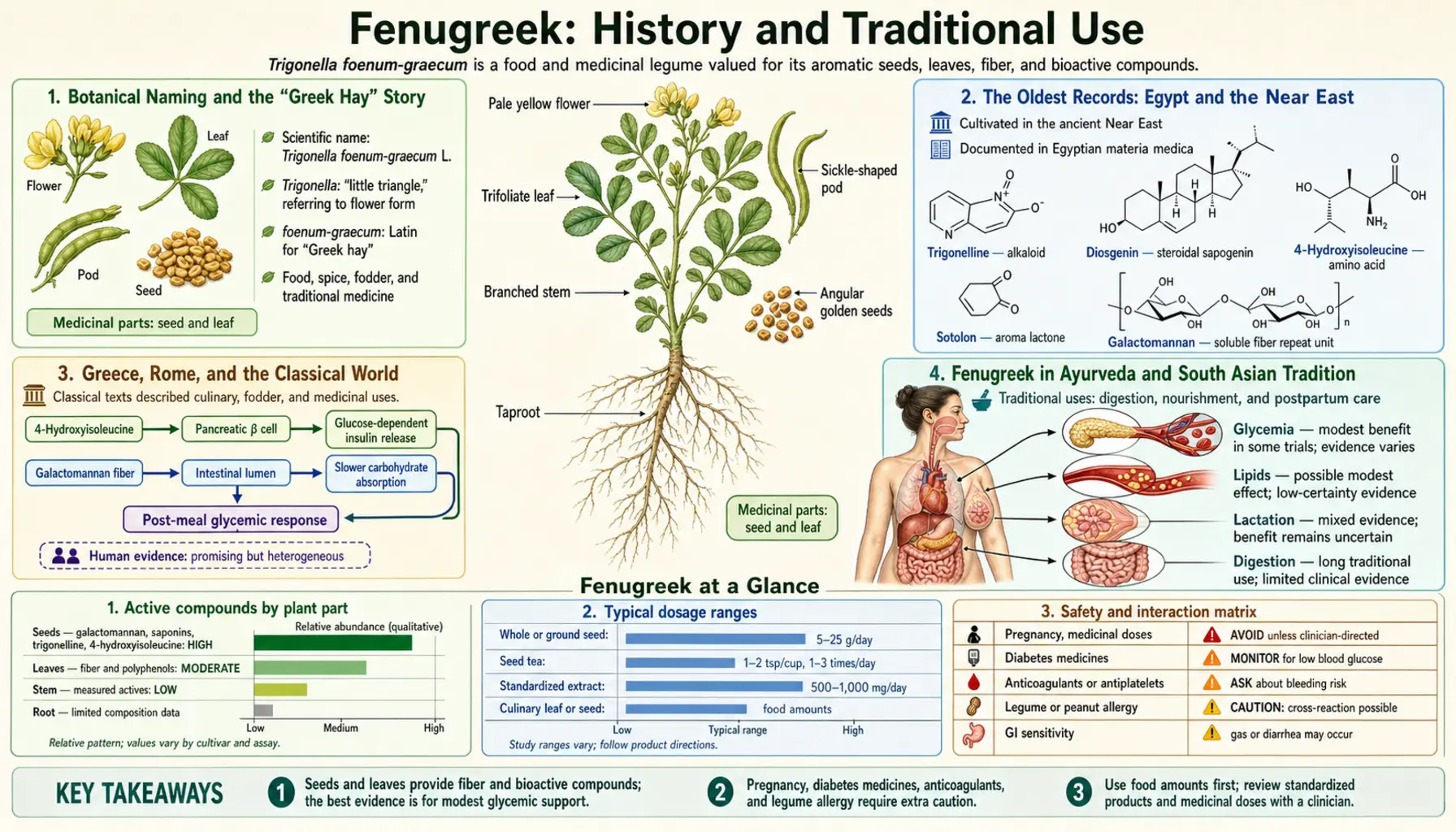
Fenugreek (Trigonella foenum-graecum) is one of the oldest cultivated plants on record — a small, aromatic legume whose maple-scented seeds have been food, medicine, animal fodder, and even a funerary offering for thousands of years. Its trail runs from charred seeds in Bronze Age ruins and the tomb of Tutankhamun, through the kitchens and pharmacies of ancient Greece and Rome, into the living traditions of Ayurveda, Traditional Chinese Medicine, and the herbalism of the Arab world, and finally into a modern laboratory story about the chemistry of steroid hormones. This article traces that documented history honestly: it separates what the archaeological and written record actually shows from what is best understood as living tradition, and it marks tradition clearly as tradition.
Table of Contents
- Botanical Naming and the “Greek Hay” Story
- The Oldest Records: Egypt and the Near East
- Greece, Rome, and the Classical World
- Fenugreek in Ayurveda and South Asian Tradition
- Chinese Medicine and the Arab World
- A Mother’s Herb: Lactation and Childbirth
- Diosgenin and the Twentieth-Century Steroid Story
- From Tradition to Modern Research
- Research Papers and References
- Connections
- Featured Videos
Botanical Naming and the “Greek Hay” Story
Fenugreek is the common English name for Trigonella foenum-graecum L., an annual herb of the bean family (Fabaceae, the legumes) believed to have been brought into cultivation in the Near East — the eastern Mediterranean and western Asia. Like other legumes it carries its seeds in slender pods, and it is those small, hard, amber seeds, with their distinctive scent often compared to maple syrup or burnt sugar, that have made the plant famous as both a spice and a remedy. The whole plant has a strong, hay-like fragrance when dried, and that fragrance is woven directly into its name.
The species name tells a small story on its own. The Latin foenum-graecum — the source of the English word “fenugreek” by way of Middle French fenugrec — means literally “Greek hay.” The usual explanation, repeated across botanical and culinary references, is that the Romans grew the plant as a fodder crop and used the sweet-smelling dried herb to flavour and freshen ordinary hay, an association reinforced by the plant’s eastern-Mediterranean origin. The genus name Trigonella is a Latin diminutive of the Greek trigonon, “triangle” — “little triangle” — and is generally said to refer to the roughly triangular shape of the small pea-type flowers. Together the two halves of the botanical name encode the two oldest facts about fenugreek: it is a triangular-flowered legume, and the classical world already knew it as a fragrant crop for feeding animals.
The plant has carried many regional names that signal how widely it travelled. It is methi across the Indian subcontinent, hulba or helba in the Arabic-speaking world, hu lu ba in Chinese, and Greek-clover or Greek-hay in older English herbals. This abundance of names is itself a kind of historical record: a plant gathers a new name from nearly every culture that adopts it, and fenugreek has been adopted very widely indeed.
The Oldest Records: Egypt and the Near East
Fenugreek has one of the longest documented histories of any cultivated plant, and the evidence is both archaeological and textual. The hard seeds survive remarkably well, and charred fenugreek seeds have been recovered from very old sites in the Near East — most often cited is Tell Halal in Iraq, with seeds carbon-dated to around 4000 BCE — as well as from Bronze Age levels at Lachish in the southern Levant. These finds place fenugreek among the founder crops of early agriculture in the region, grown and eaten thousands of years before it was written about.
In ancient Egypt the plant turns up in two strikingly different settings. Desiccated fenugreek seeds were recovered from the tomb of the pharaoh Tutankhamun (who died around the 1320s BCE), and reviews of the plant’s history record that the Egyptians used fenugreek as a fragrant material and in the embalming of mummies, so that the seeds accompanied the dead into the tomb. At the same time it served the living: fenugreek is traditionally said to appear in the Ebers Papyrus, the great Egyptian medical text usually dated to about 1500 BCE, among recipes for everyday complaints, and Egyptian practice is recorded as having used the herb to ease childbirth and to encourage the flow of a mother’s milk — an indication that, remarkably, the plant still carries today. Some popular accounts add further detail about Egyptian incense or ritual blends; because those specifics are harder to confirm from reliable sources, this page keeps to what the archaeological finds and the well-attested medical and funerary uses support.
What the Near Eastern and Egyptian record establishes beyond reasonable doubt is the sheer antiquity of fenugreek as a useful plant. By the time it appears in the classical Mediterranean it was already an ancient crop with food, medicinal, and ceremonial roles — not a novelty, but an inheritance.
Greece, Rome, and the Classical World
The classical Mediterranean knew fenugreek well, and it is the Greek and Roman record that gives the plant its enduring name. The Roman statesman and farmer Cato the Elder, in his second-century-BCE treatise on agriculture, lists fenugreek together with clover and vetch among the crops grown to feed cattle — the earliest clear written evidence for the fodder use that the name “Greek hay” preserves. The Romans also valued the seed in the kitchen: a surviving first-century-CE recipe records Romans flavouring wine with fenugreek, and the plant was grown as a staple food in the eastern provinces, where the first-century historian Josephus mentions it being cultivated in Galilee.
Fenugreek’s medicinal reputation in the classical world ran alongside its agricultural and culinary uses. The seed’s most characteristic property — the way it swells and turns slippery and soothing in water, because of its high content of soft, gel-forming fibre — made it a natural choice for softening, soothing, and poultice preparations, and classical and later writers describe it being used both internally for the digestion and externally on inflamed skin and swellings. Modern reviews of the plant’s history note that the medicinal value of fenugreek seed is recorded in the Greek and Latin pharmacopoeial tradition, placing it firmly within the same body of Mediterranean plant medicine that shaped European herbalism for the next fifteen centuries.
The classical inheritance, then, is threefold and entirely consistent with what came before and after: fenugreek as animal fodder, as a flavouring and food, and as a gentle, soothing medicine. These were the roles in which the plant passed from antiquity into the medieval and early-modern world, and they are the roles in which it is still used today.
Fenugreek in Ayurveda and South Asian Tradition
Nowhere has fenugreek been more thoroughly woven into daily life and medicine than in the Indian subcontinent, where it is known as methi (the seed) and where the fresh leaves are eaten as a green vegetable and the dried leaves (kasoori methi) used as a herb. In the kitchen, fenugreek is a foundational spice: it is one of the components of many curry and pickling blends and a defining note in countless South Asian dishes. That everyday culinary presence is inseparable from its medicinal one — in traditional South Asian practice, food and medicine are not sharply divided.
In Ayurveda, the classical medical system of the Indian subcontinent, fenugreek is described as a warming, bitter-then-sweet herb traditionally used to support digestion, to settle complaints attributed to excess phlegm and wind, and to act as a general strengthening tonic; it is also traditionally associated with supporting healthy blood sugar and with women’s and reproductive health, and older texts praise it as a restorative. As with all traditional-medicine frameworks, these descriptions reflect a long-standing system of thought and practice rather than modern clinical categories, and they are presented here as documented tradition. What is notable is how closely the Ayurvedic emphases — digestion, blood sugar, lactation — track the three areas where modern research on fenugreek has since concentrated.
The South Asian record is especially valuable to the historian because it is continuous and living: fenugreek has been used in the same broad ways, by enormous numbers of people, without interruption from antiquity to the present. The plant did not have to be rediscovered there, as it arguably was in the modern West; it simply never went away.
Chinese Medicine and the Arab World
Fenugreek travelled east along the trade routes and was absorbed into Traditional Chinese Medicine, where it is known as hu lu ba and where it has been used as a recognised medicinal at least since around the eleventh century; it is included in the modern Chinese pharmacopoeia. In the Chinese system it is classed as a warming herb, traditionally used to “warm the kidneys” and to dispel cold and damp — a framework very different from the Egyptian or Ayurvedic one, yet again converging on fenugreek as a warming, strengthening, digestive remedy. The reference work of modern Western herbal review, the early-2000s monograph by Basch and colleagues, explicitly records this long history of use in both Chinese and Indian medicine.
In the medicine of the medieval and early-modern Arab and Islamic world, fenugreek — hulba — was likewise a staple remedy, valued for the digestive tract, for soothing irritated tissues, for fevers and weakness, and as a strengthening food for the convalescent and the new mother. A well-known piece of folklore, frequently repeated in herbal writing, attributes to fenugreek a saying to the effect that “if people knew what was in fenugreek they would pay its weight in gold” — a memorable line that captures the esteem in which the plant was held, and which is best enjoyed as traditional lore rather than as a precisely sourced quotation. Across the Arab world the herb remained, as everywhere else, simultaneously a food, a spice, and a medicine.
The pattern across all of these systems is the historically interesting part. Egyptian, Greek, Roman, Ayurvedic, Chinese, and Arab traditions developed independently, used entirely different theoretical languages, and nonetheless reached for fenugreek to do much the same work: to soothe and aid digestion, to strengthen the weak, and to support mothers. That convergence is one of the most striking features of the plant’s whole history.
A Mother’s Herb: Lactation and Childbirth
If fenugreek has a single thread running unbroken through its entire recorded history, it is its reputation as a herb for mothers. The use is documented in ancient Egypt — where the plant is recorded as having been used to ease childbirth and to increase the flow of milk — and it reappears, independently, in South Asian, Chinese, Arab, and later European and North American practice. The traditional preparation is simple and consistent across cultures: the soothing, mucilaginous seed is taken as a tea, a gruel, a paste, or a powder by women after childbirth in the hope of building and maintaining a good milk supply. Few traditional uses of any plant are so geographically widespread or so durable.
The term for a substance believed to promote the flow of breast milk is a galactagogue (sometimes spelled galactogogue), from the Greek for “milk” and “to lead.” Fenugreek is, historically and to this day, the single most widely used herbal galactagogue in the world — recommended in folk practice, passed between mothers and grandmothers, and now sold in lactation teas and capsules. The United States National Library of Medicine’s LiverTox resource summarises the inherited tradition plainly, noting fenugreek’s use “in Indian medicine, as a stimulant to lactation.”
It is worth being honest about where tradition meets evidence, because new mothers read pages like this one. The lactation use is genuinely ancient and genuinely cross-cultural, and modern research has taken it seriously: a 2018 network meta-analysis by Khan and colleagues found that, across the controlled trials available, fenugreek did significantly increase the amount of breast milk produced compared with placebo, although the studies were small and of variable quality and some other agents performed better. In other words, the oldest and most universal of fenugreek’s traditional uses is also one of the few with supportive modern clinical data — a rare and satisfying alignment of folklore and science. As always, a parent with concerns about milk supply or an infant’s feeding should work with a clinician or lactation specialist; fenugreek is a traditional support, not a substitute for proper care.
Diosgenin and the Twentieth-Century Steroid Story
One thread of fenugreek’s history belongs not to ancient herbalists but to twentieth-century chemists, and it is worth telling carefully because it is easy to overstate. Fenugreek seed is a documented natural source of diosgenin, a plant compound called a steroidal sapogenin. Diosgenin matters enormously in the history of medicine, because it is the chemical raw material from which the first practical industrial syntheses of steroid hormones — progesterone, and ultimately the cortisone-type anti-inflammatories and the hormones used in oral contraceptives — were built.
The pivotal work was done by the American chemist Russell Earl Marker in the 1940s. Marker developed a chemical process, now known as the “Marker degradation,” that converted plant sapogenins into progesterone, and in doing so helped launch the entire steroid-hormone pharmaceutical industry — an achievement commemorated by the American Chemical Society as a landmark in the history of chemistry. The honest historical detail, and an important one, is that Marker’s breakthrough used diosgenin obtained from wild Mexican yams (Dioscorea), not from fenugreek; the yam was the cheap, abundant source that made the industry possible. Fenugreek’s place in this story is as a fellow diosgenin-bearing plant — one that researchers have since studied as an alternative agricultural source of the same valuable compound — rather than as the plant that Marker actually used.
The reason to include the episode at all is that it changed how science looked at fenugreek. A humble culinary and folk-medicine seed turned out to contain a molecule at the foundation of modern endocrinology, and that discovery is part of why fenugreek’s steroidal sapogenins, its amino acid 4-hydroxyisoleucine, and its soluble fibre have been studied so intensively in the decades since. The kitchen spice and the steroid molecule are, in this one narrow but real sense, branches of the same plant.
From Tradition to Modern Research
The most remarkable feature of fenugreek’s history is how neatly the ancient uses anticipate the modern research agenda. For millennia, independent cultures — Egyptian, Greek, Roman, Ayurvedic, Chinese, and Arab — converged on the same small cluster of uses: aiding digestion, supporting mothers’ milk, strengthening the body, and (in the South Asian and Arab traditions especially) a reputation around blood sugar and metabolism. When twentieth- and twenty-first-century laboratories finally turned to the plant, those are precisely the questions they asked.
Modern phytochemistry has identified the constituents that plausibly underlie the tradition: soluble fibre (galactomannan, which forms the soothing gel and slows the absorption of sugars), the steroidal sapogenin diosgenin, the alkaloid trigonelline, the unusual amino acid 4-hydroxyisoleucine, and a range of flavonoids and saponins. Clinical research has focused most heavily on two of the oldest traditional claims. On blood sugar, a 2014 meta-analysis by Neelakantan and colleagues, pooling clinical trials, found that fenugreek intake significantly lowered fasting glucose and HbA1c, especially at higher doses in people with diabetes — the same metabolic role hinted at in the older traditions. On lactation, as discussed above, the 2018 Khan meta-analysis found a real, if modest, milk-boosting effect. A comprehensive 2025 review in Food Science & Nutrition surveys this whole expanding body of work.
The thread that runs from a charred seed at Tell Halal, through the dried “Greek hay” of a Roman farmyard, the methi in a South Asian kitchen, and a 1940s steroid laboratory, to a modern clinical meta-analysis is unbroken. Tradition raised the questions; research is now testing the answers, and on fenugreek’s two most ancient promises — milk for mothers and steadier blood sugar — the early answers are encouraging. The detailed evidence behind each of fenugreek’s benefits, with dosing and safety, is taken up in the companion Fenugreek Benefits articles.
Research Papers and References
The list below combines key peer-reviewed reviews and clinical analyses of Trigonella foenum-graecum with curated PubMed topic-search links into the ethnobotanical and historical literature. Historical primary sources (the Ebers Papyrus, Cato the Elder’s treatise on agriculture, and Josephus) and the classical Greek and Latin pharmacopoeial tradition are named in the article as historical sources rather than as modern citations. Author names, titles, and journals are given as plain text; only stable identifiers (DOI, PMID, or bookshelf links) are hyperlinked, and each opens in a new tab.
- Basch E, Ulbricht C, Kuo G, Szapary P, Smith M. Therapeutic applications of fenugreek. Alternative Medicine Review. 2003;8(1):20-27. — Search PubMed
- Neelakantan N, Narayanan M, de Souza RJ, van Dam RM. Effect of fenugreek (Trigonella foenum-graecum L.) intake on glycemia: a meta-analysis of clinical trials. Nutrition Journal. 2014;13:7. — doi:10.1186/1475-2891-13-7
- Khan TM, Wu DBC, Dolzhenko AV. Effectiveness of fenugreek as a galactagogue: A network meta-analysis. Phytotherapy Research. 2018;32(3):402-412. — doi:10.1002/ptr.5972
- Akhtar H, Ali YA, Wei CR, et al. Bioactive Potential and Health Benefits of Trigonella foenum-graecum L.: A Comprehensive Review. Food Science & Nutrition. 2025;13(9):e70887. — doi:10.1002/fsn3.70887
- Fenugreek. In: LiverTox: Clinical and Research Information on Drug-Induced Liver Injury (U.S. National Library of Medicine). — NCBI Bookshelf: NBK548826
- Trigonella foenum-graecum ethnobotany, history, and traditional use PubMed: fenugreek ethnobotany and traditional use
- Fenugreek as a galactagogue / for lactation PubMed: fenugreek galactagogue and lactation
External Authoritative Resources
- NCCIH — Herbs at a Glance
- MedlinePlus — Herbs and Supplements
- PubMed — All research on Trigonella foenum-graecum