Walnuts: Soaking and Phytates
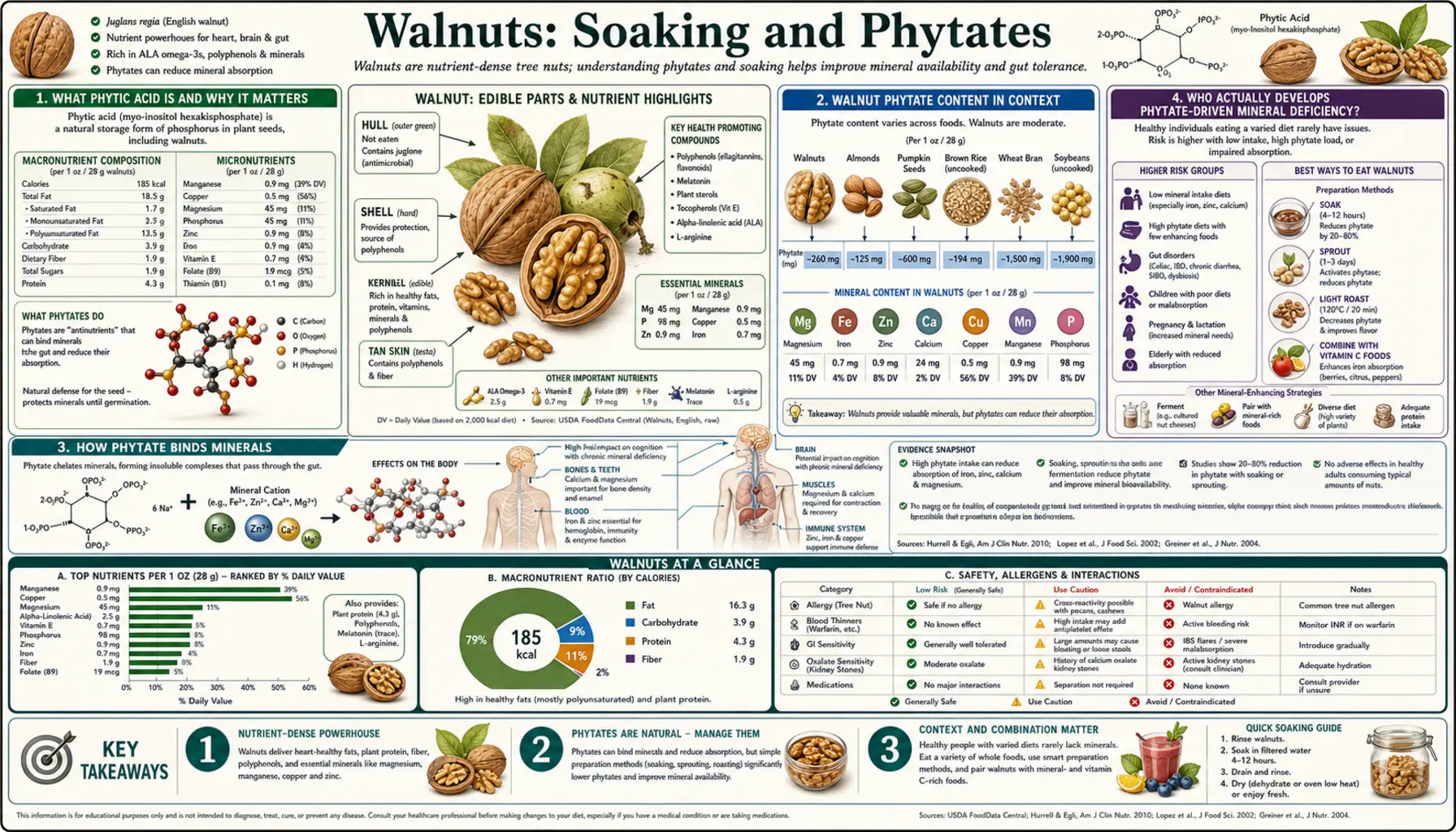
Walnuts contain approximately 660 milligrams of phytic acid per 100 grams — a moderate amount among plant foods, lower than legumes and whole grains but high enough to draw attention in the "anti-nutrient" discussion that has dominated parts of the alternative-nutrition community since the Weston A. Price Foundation popularized Sally Fallon's "Nourishing Traditions" cookbook in 1999. The recommended preparation in that tradition is "activating" the nuts — soaking them in salt water for 12-24 hours, then dehydrating them at low temperature — on the theory that this reduces phytic acid, leaches enzyme inhibitors, and improves digestibility and mineral bioavailability. This deep-dive walks through what the chemistry actually says about phytic acid in walnuts, the science behind soaking, who is most likely to benefit, and a candid assessment of whether the time investment is worth it for adults with normal mineral status.
Table of Contents
- What Phytic Acid Is and Why It Matters
- Walnut Phytate Content in Context
- How Phytate Binds Minerals
- Who Actually Develops Phytate-Driven Mineral Deficiency
- What Soaking Actually Does Mechanistically
- Endogenous Phytase Activity in Walnuts
- Tannins and Other Compounds in the Walnut Pellicle
- The Sally Fallon Activated-Nut Method
- The Other Side: Phytate as a Beneficial Compound
- Practical Recommendations: Worth the Effort?
- Cautions
- Key Research Papers
- Connections
- Featured Videos
What Phytic Acid Is and Why It Matters
Phytic acid, also called inositol hexaphosphate (IP6) or myo-inositol-1,2,3,4,5,6-hexakisphosphate, is the principal storage form of phosphorus in plant seeds. It is a six-carbon ring of inositol with a phosphate group attached to each carbon — six phosphates in total, hence "hexaphosphate." In intact seeds, phytic acid binds tightly to potassium, magnesium, calcium, iron, and zinc, sequestering these minerals in storage form until the seed germinates. Upon germination, the seed activates its own enzyme phytase, which sequentially removes phosphate groups to release the bound minerals for the growing seedling.
From the seed's perspective, phytic acid is a brilliant evolutionary solution to mineral storage: a single molecule efficiently stores six phosphate equivalents and concentrates several minerals at once, ready for release at germination.
From the human-eater's perspective, phytic acid in the diet has two relevant properties:
- It chelates minerals in the small intestinal lumen during digestion, reducing absorption of zinc, iron, calcium, and (to a lesser extent) magnesium and copper from the meal in which phytate is present.
- The human body has no significant intestinal phytase activity, so dietary phytate passes through largely intact unless it has been hydrolyzed by either food-preparation methods (soaking, fermentation, sprouting, cooking) or by phytase-producing gut bacteria (some Lactobacillus, Bacillus, and Saccharomyces species).
The clinical relevance of dietary phytate has been debated for nearly a century. In populations where mineral intake is borderline-adequate and phytate intake is very high (e.g., Iranian rural populations on unleavened flatbread, certain South Asian rural populations), phytate-driven mineral deficiency is a real and documented public health problem. In populations with adequate mixed diets including meat, dairy, eggs, and a variety of plant foods, the clinical impact of phytate is much smaller.
Walnut Phytate Content in Context
The phytic acid content of common foods, per 100 grams (data from Schlemmer et al., Mol Nutr Food Res 2009; Reddy et al., compositional database):
- Walnuts: 660 mg phytate
- Almonds: 1,400 mg phytate
- Brazil nuts: 1,700 mg phytate
- Hazelnuts: 1,000 mg phytate
- Pecans: 1,800 mg phytate
- Pistachios: 290 mg phytate
- Sesame seeds: 5,400 mg phytate — the highest of any common food
- Sunflower seeds: 1,500 mg phytate
- Wheat bran: 3,000-5,800 mg phytate
- Oats (whole): 850 mg phytate
- Brown rice: 900 mg phytate
- Lentils: 700 mg phytate
- Chickpeas: 800 mg phytate
- Pinto beans: 600 mg phytate
- Soybeans: 1,400 mg phytate
Walnuts at 660 mg/100 g are in the moderate range — lower than almonds, brazil nuts, sesame, sunflower seeds, wheat bran, or soybeans, and comparable to lentils and oats. A one-ounce (28 g) walnut serving delivers approximately 185 mg of phytic acid, which is meaningful but not extreme.
The total daily phytate intake on a typical Western diet ranges from about 250 mg/day (low intake of whole grains, legumes, and nuts) to over 1,000 mg/day (vegetarian or whole-grain-heavy diet). Adding one ounce of walnuts daily contributes about 185 mg, well within the normal dietary range.
How Phytate Binds Minerals
The six phosphate groups on the phytic acid molecule create a strongly negative charge under physiologic pH. Divalent metal cations (zinc, calcium, iron) are attracted to this negative charge and form coordination complexes that are insoluble at intestinal pH and resistant to absorption.
The binding affinity is not equal across minerals:
- Zinc: high affinity, most strongly affected by dietary phytate
- Iron: high affinity, particularly non-heme iron from plant sources; heme iron from animal sources is largely protected from phytate inhibition
- Calcium: moderate affinity, but calcium absorption is generally robust enough that dietary phytate has modest impact
- Magnesium: moderate affinity
- Copper: moderate affinity
- Manganese: moderate affinity
The clinically relevant measure is the phytate-to-mineral molar ratio, particularly the phytate-to-zinc molar ratio (Phy:Zn). When Phy:Zn is below 5, zinc absorption is largely unaffected. Between 5 and 15, zinc absorption is moderately reduced. Above 15, zinc absorption is substantially impaired. For iron, the phytate-to-iron molar ratio (Phy:Fe) follows a similar pattern but with the additional complication that vitamin C in the meal can largely overcome the phytate inhibition of non-heme iron.
One ounce of walnuts delivers about 185 mg phytate and 0.9 mg zinc. The phytate-to-zinc molar ratio within walnuts themselves is therefore extremely high — about 20:1 — meaning the zinc within walnuts is poorly absorbed unless something disrupts the phytate. But this is largely irrelevant because walnuts are not eaten as a sole zinc source; they are part of a meal that includes other zinc-contributing foods. The relevant question is whether the phytate from walnuts reduces zinc absorption from other foods in the same meal, and the answer is "modestly, dose-dependently, but not in a way that produces clinical deficiency in adults with otherwise adequate diet."
Who Actually Develops Phytate-Driven Mineral Deficiency
The clinical reality of phytate-driven mineral deficiency depends heavily on dietary context. Populations with documented phytate-driven mineral problems share several characteristics:
- Predominantly plant-based diet with low or absent animal-source mineral contributions
- High intake of high-phytate staples (unleavened flatbread, whole-grain porridge, large quantities of legumes)
- Low intake of phytate-reducing food preparations (sourdough leavening, sprouting, fermentation)
- Borderline mineral intake at baseline with limited dietary diversity
Classic examples include the "Iranian villager zinc deficiency" syndrome documented by Prasad in the 1960s (severe zinc deficiency with hypogonadism and growth failure in young men eating an unleavened-wheat-bread-based diet with minimal animal protein), iron-deficiency anemia in some South Asian rural populations on high-phytate cereal diets, and the documented mineral problems in some Western vegan populations with poorly-planned diets.
Populations who do not develop clinically meaningful phytate-driven deficiency despite consuming substantial dietary phytate include:
- Mediterranean diet populations with legumes, whole grains, and animal protein in combination
- Lacto-ovo vegetarians with adequate dairy and egg intake
- Well-planned vegan diets with deliberate mineral attention (fortified foods, phytate-reducing preparation methods, varied legume and nut intake)
- Typical Western omnivores
For the typical adult eating a Mediterranean or Western mixed diet, adding one ounce of walnuts daily is essentially never going to produce clinically meaningful mineral deficiency. The phytate dose is too small relative to the mineral contribution from the rest of the diet.
The exceptions where phytate concern is more legitimate:
- Strict vegans (no dairy, no eggs, no fish) eating heavy whole-grain and legume diets without phytate-reducing preparation
- Patients with documented zinc or iron deficiency seeking to maximize absorption
- Pregnant or breastfeeding women with elevated mineral demands
- Patients with conditions of malabsorption (celiac, Crohn's, bariatric surgery) where every percent of mineral absorption matters
- Infants and young children eating phytate-rich complementary foods
What Soaking Actually Does Mechanistically
Soaking nuts and seeds in water (with or without acid, salt, or warm temperature) produces several measurable changes:
- Activation of endogenous phytase — the seed's own phytase enzyme is largely inactive in the dry stored seed, but becomes active when the seed is hydrated. Phytase optimal activity is around pH 5-5.5 and 30-45°C. Once active, phytase progressively cleaves phosphate groups from phytic acid (IP6 → IP5 → IP4 → IP3 → IP2 → IP1 → inositol), releasing phosphate and the bound minerals.
- Leaching of water-soluble compounds — some tannins, polyphenols, and saponins are partially water-soluble and leach into the soaking water, which is then discarded.
- Partial gelatinization of starches and proteins — relevant for grains and legumes, less so for nuts which are predominantly fat and protein with minimal starch.
- Initiation of germination — if soaking is prolonged enough (12-24+ hours), the seed activates its full germination program, producing further enzymatic changes including activation of additional digestive enzymes.
- Reduction of trypsin inhibitor activity — some seed protease inhibitors are partially deactivated by extended soaking or by mild heat following soaking.
For walnuts specifically, the practical phytate reduction from a 12-hour cold-water soak is approximately 10-30%, depending on water pH and temperature. Adding salt to the soaking water (the classic Sally Fallon method) modestly increases extraction efficiency. Warm water (35-40°C) accelerates phytase activity. Following the soak with low-temperature dehydration (below 65°C / 150°F) preserves the omega-3 content and any phytase activity that may continue during the drying phase.
For comparison, sprouting (germination beyond simple soaking, typically 24-72 hours with rinsing) can reduce phytate by 50-80%. Fermentation with phytase-producing organisms (sourdough leavening, traditional fermented foods) can reduce phytate by 70-90%. Industrial phytase application (used in animal feed and increasingly in human food processing) can reduce phytate by >95%.
Walnuts are not typically sprouted or fermented in culinary practice. Soaking is the only practical reduction method most home cooks employ.
Endogenous Phytase Activity in Walnuts
Different seeds have very different endogenous phytase activity. Wheat and rye have high phytase activity, which is why sourdough fermentation efficiently reduces wheat-bran phytate. Brown rice has moderate phytase. Oats have low phytase. Legumes have low to moderate phytase. Nuts have generally low phytase activity — lower than grains.
Walnuts in particular have relatively low intrinsic phytase activity compared to wheat or barley. This means soaking walnuts is somewhat less effective at reducing phytate than soaking grains. The 10-30% phytate reduction from 12-hour walnut soaking is real but modest.
The practical implication: if the goal of soaking is purely phytate reduction, the return on time investment for walnuts is lower than for grains or legumes. The justification for soaking walnuts has to come from other claimed benefits (digestibility, tannin reduction, enzyme inhibitor leaching, or simply the texture preference for soaked nuts).
Tannins and Other Compounds in the Walnut Pellicle
The thin brown papery skin (pellicle) on walnuts contains most of the walnut's polyphenol content, including ellagitannins, condensed tannins, and a small amount of juglone. These compounds have complex effects:
- Tannins are astringent and can bind dietary protein in the gut, reducing protein digestibility modestly. They also have legitimate antioxidant and anti-inflammatory effects, and ellagitannins specifically are the source of the gut-microbial-derived urolithins that are responsible for much of the cognitive and cardiovascular benefit of walnut consumption.
- Juglone is a quinone compound found primarily in green walnut hulls and in trace amounts in the seed pellicle. It has antibacterial and antifungal activity but is not present in walnut meat at levels that produce significant biological effects when eaten.
- Enzyme inhibitors — walnuts contain modest amounts of trypsin and chymotrypsin inhibitors that can theoretically reduce protein digestibility. The clinical impact in adults with normal pancreatic function is negligible.
The trade-off with soaking is real: soaking leaches some tannins and reduces the astringent edge, which improves palatability for some eaters but also reduces the very polyphenol content that drives most of the documented walnut health benefits. The PREDIMED and WAHA trials used standard unsoaked walnuts; the cardiovascular and cognitive benefits documented in those trials were achieved with the full polyphenol package intact.
For a polyphenol-focused use of walnuts (cardiovascular protection, cognitive aging, urolithin production), unsoaked walnuts are probably preferable. For a mineral-bioavailability-focused use in a high-phytate-burden diet, soaking has theoretical benefit.
The Sally Fallon Activated-Nut Method
The popular "activated nut" preparation, as described in Sally Fallon's Nourishing Traditions (1999) and widely promulgated by the Weston A. Price Foundation:
- Place 4 cups of raw walnuts in a large bowl
- Cover with warm filtered water (about 35-40°C / 95-105°F)
- Add 1 tablespoon of sea salt (the salt is claimed to enhance enzyme activity and extraction)
- Cover loosely with a cloth and let stand at room temperature for 12-24 hours
- Drain and rinse
- Dehydrate at low temperature (below 65°C / 150°F) for 12-24 hours until crisp, either in a dehydrator or low oven
- Store in a sealed container in the refrigerator
The resulting product is crisper, less astringent, and (subjectively) more digestible than raw walnuts. Some eaters strongly prefer the texture and flavor.
From a strict cost-benefit perspective for an average healthy adult on a mixed diet:
- Modest phytate reduction (10-30%), unlikely to be clinically significant if baseline mineral status is adequate
- Modest tannin and polyphenol loss, possibly reducing the cardiovascular and cognitive benefit per ounce consumed
- Significant time investment (24-48 hours total cycle time, though active labor is brief)
- Improved palatability for those who prefer the texture and flavor
- No documented clinical outcome difference between soaked and unsoaked walnut consumption in any randomized trial
The decision to soak or not is largely a personal preference question rather than a clinically meaningful health question for most adults.
The Other Side: Phytate as a Beneficial Compound
The "anti-nutrient" framing of phytic acid is one-sided. The compound also has documented beneficial effects that are sometimes overlooked in the soaking discussion:
- Antioxidant activity — phytic acid is a potent iron chelator, which means it reduces iron-catalyzed oxidative damage in the gut and in tissues where it is absorbed. The same iron-chelation that reduces iron absorption also reduces iron-driven oxidative stress.
- Cancer prevention — population studies have associated high-phytate-intake diets with lower incidence of colon, breast, and prostate cancer. Inositol hexaphosphate (IP6) is being investigated as a chemopreventive agent, and Abulkalam Shamsuddin's research at the University of Maryland has documented anti-cancer effects of IP6 in cellular and animal models.
- Kidney stone prevention — phytate is one of the most potent inhibitors of calcium-oxalate crystal formation in urine. People with adequate dietary phytate have lower kidney-stone risk than those with very low phytate intake.
- Cardiovascular protection — phytate inhibits vascular calcification, the process by which calcium phosphate deposits in arterial walls in older adults. The opposing dietary calcium-without-phytate pattern (typical of Western diets) may contribute to vascular calcification risk.
- Glycemic control — phytate slows starch digestion modestly, reducing postprandial blood glucose excursion. This is a modest but real benefit for diabetic and pre-diabetic patients.
The net effect of dietary phytate on human health is not straightforwardly negative. For most people on mixed diets, the small reduction in mineral absorption is outweighed by the antioxidant, anti-cancer, kidney-stone-protective, and vascular-protective effects.
Practical Recommendations: Worth the Effort?
The honest assessment for most adults:
- For an average healthy adult on a mixed Mediterranean or Western diet: Don't bother soaking walnuts. The phytate reduction is modest, the time investment is non-trivial, and the soaking probably reduces the very polyphenol content that drives most of the documented walnut health benefits. Eat them raw or lightly toasted.
- For people who simply prefer the texture and flavor of soaked-and-dehydrated walnuts: Go ahead and soak. The hedonic benefit is real, and the clinical downside is minor.
- For strict vegans on a heavy whole-grain-and-legume diet with documented mineral concerns: Phytate reduction across multiple dietary components is reasonable, and soaking nuts is one component of a broader strategy that also includes sprouting grains, fermenting legumes, and supplementing zinc/iron if blood work shows deficiency.
- For patients with documented zinc or iron deficiency: Address the deficiency with targeted supplementation while addressing dietary causes. Reducing phytate through soaking is one minor intervention; more impactful is increasing total mineral intake from a variety of sources.
- For infants and toddlers eating phytate-rich complementary foods: Phytate reduction is more important due to higher mineral demands relative to body weight. Sprouted grains, sourdough breads, and well-soaked legumes are reasonable practices in this population.
- For pregnant and lactating women: Elevated mineral demands make phytate reduction modestly worthwhile. The bigger intervention is ensuring adequate total mineral intake through varied diet plus prenatal vitamin.
The Weston A. Price Foundation and similar traditional-diet advocates make a case for soaking, sprouting, and fermenting as universally beneficial preparation methods. The mainstream nutrition science position is that these methods produce small benefits in specific populations and contexts but are not necessary for most adults on mixed diets.
For a discussion of the broader Weston A. Price approach to traditional food preparation, see our pages on related remedies and traditional dietary practices.
Cautions
- Tree-nut allergy. Soaking does not reduce allergenicity. The Jug r 1, Jug r 2, Jug r 3, and Jug r 4 protein allergens are not destroyed by soaking or low-temperature dehydration. People with walnut allergy cannot make walnuts safe through home preparation.
- Mold risk during soaking. Long soaks at warm temperature can support mold growth on the surface of the nuts. Use clean water, fresh nuts, and discard if any off-odor develops. Refrigerated soaking is safer for extended times.
- Salt content. Sally Fallon-style soaks add 1 tablespoon of salt per 4 cups of nuts. Some of this salt is absorbed; the rest is rinsed away. Salt-sensitive hypertension patients should be aware of the added sodium load.
- Dehydration temperature. Drying above 65°C (150°F) accelerates ALA oxidation and reduces the omega-3 value of the walnuts. Low-temperature dehydration preserves the omega-3 but extends drying time.
- Polyphenol loss. Soaking reduces tannin and polyphenol content modestly, which may reduce the cardiovascular and cognitive benefit per ounce. People targeting these benefits specifically should consider whether the phytate-reduction trade-off is worthwhile.
- Storage after dehydration. Soaked-and-dehydrated walnuts are still high-fat and oxidation-prone. Refrigerate in sealed containers; do not store at room temperature for extended periods.
- No published trial has shown clinical outcome differences between soaked and unsoaked walnut consumption. The body of evidence on walnut cardiovascular and cognitive benefits (PREDIMED, WAHA, Pribis 2012, Banel-Hu meta-analysis) used standard unsoaked walnuts.
Key Research Papers
- Schlemmer U et al. (2009). Phytate in foods and significance for humans: Food sources, intake, processing, bioavailability, protective role and analysis. Molecular Nutrition and Food Research. — PubMed
- Hurrell RF (2003). Influence of vegetable protein sources on trace element and mineral bioavailability. Journal of Nutrition. — PubMed
- Prasad AS (2008). Zinc deficiency: its characterization and treatment. Metal Ions in Life Sciences. — PubMed
- Reddy NR et al. (1989). Phytates in cereals and legumes. CRC Press. Foundational compendium of phytate content data; cited extensively in PubMed indexed reviews. — PubMed
- Fredlund K et al. (2002). Phytate reduction in whole grains of wheat, rye, barley and oats after hydrothermal treatment. Journal of Cereal Science. — PubMed
- Lopez HW et al. (2002). Minerals and phytic acid interactions: is it a real problem for human nutrition? International Journal of Food Science and Technology. — PubMed
- Shamsuddin AM (2002). Anti-cancer function of phytic acid. International Journal of Food Science and Technology. — PubMed
- Vucenik I, Shamsuddin AM (2003). Cancer inhibition by inositol hexaphosphate (IP6) and inositol: from laboratory to clinic. Journal of Nutrition. — PubMed
- Grases F et al. (2000). Phytate (myo-inositol hexakisphosphate) inhibits cardiovascular calcifications in rats. Frontiers in Bioscience. — PubMed
- Curhan GC et al. (2004). Dietary factors and the risk of incident kidney stones in younger women. Archives of Internal Medicine. — PubMed
- Gibson RS et al. (2010). A review of phytate, iron, zinc, and calcium concentrations in plant-based complementary foods used in low-income countries. Food and Nutrition Bulletin. — PubMed
- Sandberg AS, Andlid T (2002). Phytogenic and microbial phytases in human nutrition. International Journal of Food Science and Technology. — PubMed
PubMed Topic Searches
- PubMed: Phytic acid nuts bioavailability
- PubMed: Soaking and phytate reduction
- PubMed: Phytate zinc absorption molar ratio
- PubMed: IP6 inositol hexaphosphate cancer
- PubMed: Germination sprouting phytate
Connections
- All Food
- Walnuts Overview
- Walnut Benefits Hub
- ALA Omega-3 and Brain
- Cognitive Aging
- Heart Health (PREDIMED)
- Zinc
- Iron
- Magnesium
- Calcium
- Lentils
- Almonds
- Oats
- Kidney Stones
- Gastroenterology