Walnuts: History and Origins
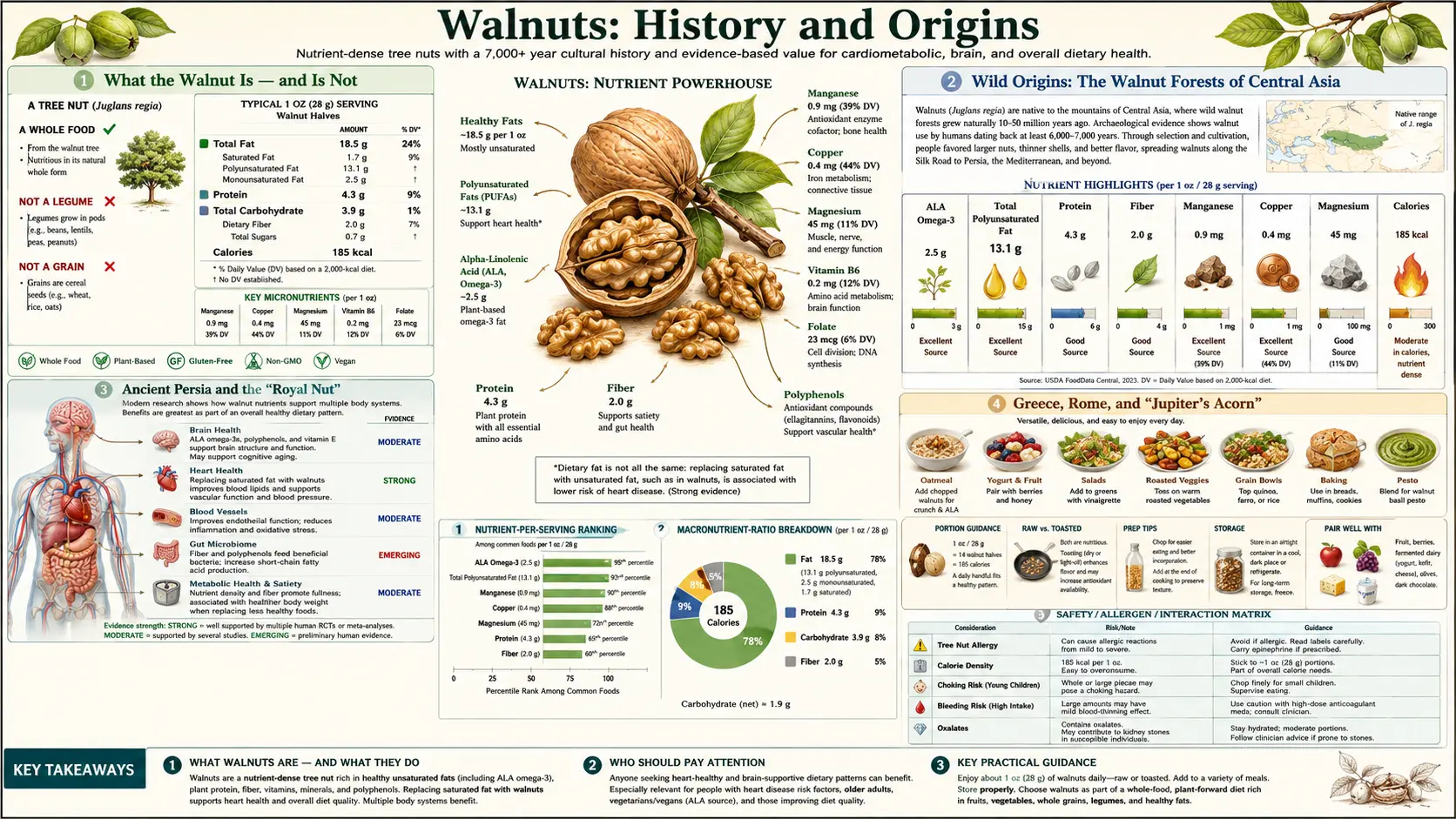
The walnut is one of the oldest tree foods humans have eaten, and its story reads like a map of the ancient world. The tree we mean here is the English or Persian walnut, Juglans regia — not the unrelated black walnut of North America. Its wild ancestors grow in the high country of Central Asia, where vast walnut forests still stand in Kyrgyzstan; it was prized in the royal gardens of ancient Persia, carried west by Greeks and Romans who named it "Jupiter's acorn," scattered at Roman weddings as a charm for fertility, and traded along the Silk Road and across the Roman Empire into Europe. The everyday English name is itself a fossil of trade history — it honours the English merchant ships that carried the nut to the world's ports, not any English orchard. Centuries later the tree crossed the Atlantic to the California missions, and from those small "mission" trees grew the industry that now supplies almost all of America's walnuts. This article follows that documented journey. Where the record is firm we say so; where a detail is etymology, tradition, or lore, we mark it as such.
Table of Contents
- What the Walnut Is — and Is Not
- Wild Origins: The Walnut Forests of Central Asia
- Ancient Persia and the "Royal Nut"
- Greece, Rome, and "Jupiter's Acorn"
- The Silk Road and the Spread Across Europe
- Why It Is Called the "English Walnut"
- Crossing the Atlantic: The California Walnut Industry
- A Different Tree: The North American Black Walnut
- Research Papers and References
- Connections
- Featured Videos
What the Walnut Is — and Is Not
The walnut of commerce and cookery is the seed of Juglans regia, a large deciduous tree in the walnut family, the Juglandaceae. What we crack open and eat is the kernel — two wrinkled, brain-shaped lobes — held inside a hard, sculptured shell. Botanically the whole structure is the stone of a fruit: in the orchard the nut grows wrapped in a thick green husk that splits and is removed at harvest, leaving the familiar woody shell behind. The tree is long-lived and slow-maturing, traits that shaped how people grew and traded it across the centuries.
It is important from the outset to fix which walnut this page is about, because the English word covers more than one tree. Juglans regia goes by several common names that all point to the same species: the Persian walnut (after its ancient heartland), the common walnut (its standard botanical English name), the Carpathian walnut (after cold-hardy strains from the Carpathian mountains of Eastern Europe), and — most familiar of all in North America — the English walnut. These are not different nuts; they are different names for one species with a very long history.
The species name itself carries a clue to that history. In the binomial Juglans regia, the second word, regia, is Latin for "royal" or "regal" — a fitting epithet for a nut that, as the next sections show, was associated with kings and gods long before it was a grocery commodity. The unrelated black walnut of the Americas, a genuinely separate species, is taken up at the end of this article so the two trees are not confused.
Wild Origins: The Walnut Forests of Central Asia
The walnut is a true wild tree that humans tamed, not an invented crop, and its natural home lies across a broad sweep of Eurasia. Botanical sources place the native range of Juglans regia across southwestern and central Asia into southeastern Europe — a band running from the Balkans through Anatolia, the Caucasus, and Iran, eastward across Central Asia toward the Himalayas and into western China. Because the tree has been moved and planted by people for thousands of years, its precise original boundaries are genuinely obscure: scholars are candid that long cultivation has blurred the line between where the walnut grew on its own and where humans carried it.
The most vivid surviving trace of the wild walnut is in Central Asia, above all in Kyrgyzstan, where some of the largest natural walnut-fruit forests on Earth still grow on mountain slopes at roughly 1,000 to 2,000 metres elevation. These ancient stands — in regions such as Arslanbob — are often cited as a living remnant of the tree's wild past, and they remain a centre of the species' genetic diversity. Genetic and historical research, including studies in PLOS One and Frontiers in Plant Science, has shown that even many seemingly "wild" Asian walnut stands were shaped over millennia by human movement of the tree along trade corridors, so the forests we see today are partly natural and partly a very old human legacy.
What the evidence supports, then, is a region and a deep antiquity rather than a single birthplace or a founding date. The walnut emerged from the temperate mountain belt of Asia and the Near East, with the Central Asian forests as its clearest wild anchor, and from there entered cultivation in the hands of the early civilisations that ringed that range. The walnut is frequently described as one of the most ancient tree foods known, a claim consistent with its appearance in the archaeological and textual record of the ancient Near East, though specific "oldest food" dates quoted in popular sources should be treated as tradition rather than precise fact.
Ancient Persia and the "Royal Nut"
Of all the lands in the walnut's range, ancient Persia — roughly modern Iran and its neighbours — holds the most celebrated place in its story, and it is the reason one of the tree's names is the Persian walnut. Iran is recognised by botanists as one of the centres of origin and diversity of Juglans regia, and the tree has been cultivated in this part of west Asia for a very long time. The walnut was not a peasant's afterthought there; tradition and several histories hold that it was esteemed enough to be grown in the gardens of royalty.
That royal association is the source of a widely repeated piece of lore: that walnuts in ancient Persia were reserved for kings and the royal household, which is why the nut came to be thought of as a "royal" food. This nicely echoes the Latin species name regia, "royal," though the two facts come from different traditions — the Persian "royal nut" lore on one hand, and the formal Latin botanical name on the other — and the "reserved for royalty" detail is best read as cultural tradition rather than documented court record. What is solidly established is that Persia was an early and important home of walnut cultivation and a hub from which the tree spread.
From this Persian heartland the cultivated walnut began moving outward in every direction along the era's trade and conquest routes. It travelled east toward China — Chinese sources and genetic studies indicate the walnut reached China from Central Asia roughly two thousand years ago — and, crucially for the Western story, it travelled west into the Mediterranean world, where the Greeks and then the Romans took it up with enthusiasm.
Greece, Rome, and "Jupiter's Acorn"
The walnut entered the classical Mediterranean as an import from the East, and the ancients themselves remembered it that way. A long-standing tradition credits Alexander the Great with helping bring the "Persian nut" westward into Greece and Macedonia in the fourth century BCE, after his campaigns reached into Asia. The Greeks grew and ate walnuts, and from Greece the tree passed to Rome, where it became a thoroughly familiar orchard crop and acquired the name it still bears in science.
That name encodes a small piece of Roman religion. The Latin word Juglans is generally explained as a contraction of Jovis glans — literally "the acorn (or nut) of Jupiter," the chief god of the Roman pantheon. In effect the Romans called the walnut a nut fit for a god, linking the stately tree to Jupiter himself; the eighteenth-century naturalist Carl Linnaeus later formalised Juglans as the genus name when he set up modern botanical nomenclature, adding regia, "royal," to mark the species. The etymology "Jupiter's acorn" is well attested across botanical references, and is presented here as the accepted derivation of the word.
Roman custom wove the walnut into one of life's great rituals: marriage. By tradition the nuts were associated with Juno, Jupiter's consort and the goddess of women and marriage, and a recorded Roman wedding custom was to scatter or throw walnuts at or around the bride and groom as a charm for fertility and good fortune — an old fertility symbolism that some traditions tie to the nut's shape and abundance. These wedding practices are genuine pieces of classical lore and are offered here as cultural history, not as botany or medicine. What they show is how deeply the walnut had entered Roman daily life: a tree from distant Persia had, within a few centuries, become part of how Romans married, ate, and named the world.
The Silk Road and the Spread Across Europe
The walnut was ideally built for long-distance trade. Sealed inside its hard shell, the kernel travels and keeps far better than soft fruit, making it a compact, durable, high-energy food — exactly the sort of cargo that moved along the great overland routes between Asia and the Mediterranean. The walnut accordingly became a classic Silk Road commodity, carried west out of Persia and Central Asia and exchanged across the trading world; researchers describe the tree being spread by humans along these "green corridors," including the Silk Roads and the Persian Royal Road, which let it leap the mountain barriers that would otherwise have hemmed in its natural range.
Within the Roman orbit, the walnut was distributed widely. Roman growers planted it across southern Europe and North Africa, and over the following centuries the tree took firm hold in the warm, suitable parts of the continent — France, Italy, Spain, and the Balkans among them — regions that remained important walnut producers for the long term. Where Roman cultivation faltered, medieval trade renewed it: merchants along the eastern routes are recorded reintroducing walnut varieties into Anatolia and the Near East during the Middle Ages, knitting the European and Asian halves of the walnut's world back together.
The tree's march northward eventually reached cold country. Hardy strains adapted to harsher winters — the so-called Carpathian walnuts, named for the Carpathian mountains of Eastern Europe — allowed Juglans regia to be grown well beyond the gentle Mediterranean, a development that later mattered for North American growers seeking cold-tolerant stock. By the close of the medieval period the walnut was a settled, valued part of European agriculture and cooking, its origins in distant Persia remembered mainly in its names.
Why It Is Called the "English Walnut"
The most familiar name for Juglans regia in North America — the English walnut — is also its most misleading, because England was never an important grower of the tree. The name is a relic of commerce, not of cultivation. As the walnut moved into global trade in the age of sail, English merchant ships and sailors were prominent among those carrying the nut between distant ports, distributing it around the world; the nut that arrived in those holds came to be labelled the "English" walnut after the traders who delivered it, not after any orchard in England.
This origin is stated plainly by both industry history and botanical reference works: the term "English walnut" arose because English mariners were leading distributors of the Juglans regia nut at one time, even though the description is botanically inaccurate and England did not grow walnuts commercially. It is a textbook example of how a food can be named for the middleman who shipped it rather than for the place it came from or the place it was raised.
So the same species answers to several names at once, each remembering a different chapter of its journey: Persian walnut for its ancient heartland, common walnut for the botanist, Carpathian walnut for the cold-hardy European strains, and English walnut for the merchant ships that spread it. None of these names is wrong; together they sketch the whole route from the mountains of Asia to the markets of the world. The detail here is presented as etymology and trade history, the consistent account given by the sources.
Crossing the Atlantic: The California Walnut Industry
Because Juglans regia is an Old World tree, its arrival in the Americas is recorded history rather than guesswork. The Persian walnut was brought to California by Franciscan missionaries — the "Franciscan Fathers" or padres — in the late 1700s, planted at the Spanish missions strung along the California coast. Those first trees produced small, comparatively hard-shelled nuts that came to be called "mission" walnuts, a fitting name for stock the missions had introduced. The trees found California's warm, dry, Mediterranean-style climate congenial — far more like their ancestral range than the cool Atlantic coast of the eastern colonies.
The modern commercial industry, however, dates from the second half of the nineteenth century. Its conventional starting point is 1867, when an orchardist and nurseryman named Joseph Sexton planted English walnuts at Goleta, in Santa Barbara County. From that beginning, walnut growing first concentrated in Southern California and then, over roughly the next seventy years, migrated northward as growers found even better ground in the cooler, fertile interior — especially the great Central Valley of the Sacramento and San Joaquin basins, which became the heart of production.
The result is one of the most lopsided facts in modern agriculture: California now grows essentially all of the United States' commercial walnut crop — on the order of 99 percent — and roughly half of the world's walnut trade. A tree first carried into the state in a missionary's baggage became the foundation of a billion-dollar industry, even as the other great walnut-producing nations — including China and countries across the walnut's ancestral Asian and Mediterranean range — continue to supply the rest of the world. The detailed nutrition, growing, and culinary story is taken up on the main Walnuts page.
A Different Tree: The North American Black Walnut
To finish the walnut's story properly, one common confusion must be cleared up. The black walnut, Juglans nigra, is a genuinely different species from the English/Persian walnut — not a variety of it. It belongs to the same genus, Juglans, and bears edible nuts, but it is native to eastern North America, growing across much of the central and eastern United States and notably through the Mississippi watershed. Unlike Juglans regia, which the Old World gave to the Americas, the black walnut is a tree the Americas already had.
The two trees differ in ways that matter to anyone who eats or grows them. The black walnut has a famously thick, hard shell that is much harder to crack than that of the English walnut, and a stronger, more pungent, earthier flavour that bakers prize but that is quite distinct from the mild taste of the supermarket walnut. The black walnut is also valued for its dark, beautiful timber, long sought for fine furniture and gunstocks — a use largely separate from its role as a food.
So when this page speaks of the walnut's ancient history — Persia, the Silk Road, Jupiter's acorn, the English merchant ships, the California missions — it is the story of Juglans regia, the Old World English/Persian walnut. The North American Juglans nigra is its New World cousin, with its own separate natural history on this continent. Keeping the two trees distinct is the key to reading the walnut's past correctly.
Research Papers and References
The list below combines peer-reviewed and reference sources on the walnut's origin, domestication, botany, and cultural history with curated PubMed and scientific-journal topic-search links. Ancient and classical material (Roman naming and wedding customs, Persian "royal nut" tradition, the Alexander the Great attribution) is named in the article as historical tradition rather than as modern citation. Author names, titles, and journals are given as plain text; only the stable DOI, PMID, or archive link is hyperlinked, and each opens in a new tab.
- Pollegioni P, Woeste KE, Chiocchini F, Olimpieri I, Tortolano V, Clark J, Hemery GE, Mapelli S, Malvolti ME. Ancient humans influenced the current spatial genetic structure of common walnut populations in Asia. PLOS ONE. 2015;10(9):e0135980. — doi:10.1371/journal.pone.0135980 Search PubMed
- Pollegioni P, Woeste K, Chiocchini F, Del Lungo S, Ciolfi M, Olimpieri I, Tortolano V, Clark J, Hemery GE, Mapelli S, Malvolti ME. Rethinking the history of common walnut (Juglans regia L.) in Europe: its origins and human interactions. PLOS ONE. 2017;12(3):e0172541. — doi:10.1371/journal.pone.0172541 Search PubMed
- Bernard A, Barreneche T, Lheureux F, Dirlewanger E. Analysis of genetic diversity and structure in a worldwide walnut (Juglans regia L.) germplasm using SSR markers. PLOS ONE. 2018;13(11):e0208021. — doi:10.1371/journal.pone.0208021 Search PubMed
- Zhao P, Zhou H, Potter D, et al. Domestication and selection footprints in Persian walnuts (Juglans regia). PLOS Genetics. 2022;18(12):e1010513. — doi:10.1371/journal.pgen.1010513 Search PubMed
- Origin, domestication, and dispersal history of the Persian/common walnut PubMed: walnut (Juglans regia) origin and domestication
- Walnut phylogeny, the genus Juglans, and the relationship of J. regia to the black walnut J. nigra PubMed: Juglans phylogeny and species
- Wild walnut-fruit forests of Central Asia (Kyrgyzstan) and walnut genetic diversity PubMed: Central Asian walnut forests and diversity
- Historical spread of wild walnuts in Central Asia along trade corridors — Frontiers in Plant Science: historical spread routes of wild walnuts in Central Asia
- Walnut history, ethnobotany, and Mediterranean nut culture PubMed: walnut history and ethnobotany
External Authoritative Resources
- Wikipedia — Juglans regia (Persian / English / common walnut: range, etymology, history)
- Wikipedia — Walnuts in California (mission introduction and the modern industry)
- PubMed — All research on Juglans regia (walnut)
Connections
- All Food
- Walnuts
- Walnuts Benefits
- Almonds
- Almonds: History and Origins
- Omega-3 Fatty Acids
- Olive Oil
- Magnesium