Walnuts and Cognitive Aging: The WAHA Trial
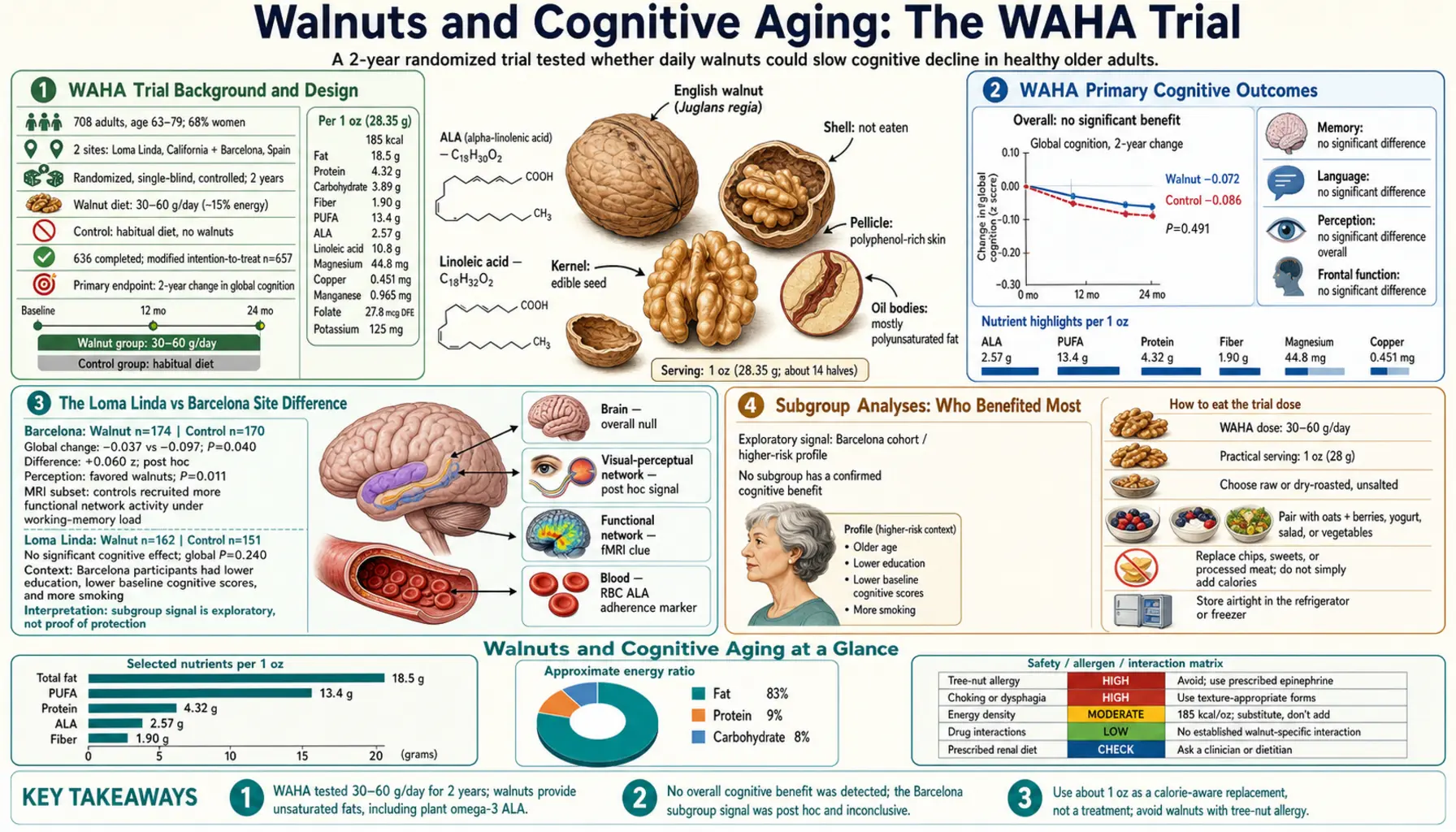
The Walnuts and Healthy Aging (WAHA) study is the largest and longest randomized controlled trial of walnut consumption ever conducted — 708 cognitively healthy adults aged 63-79 in Loma Linda, California and Barcelona, Spain, randomized to either 30-60 grams of walnuts per day (about one to two ounces) or a control diet without walnuts, for two years. The trial was designed specifically to test whether walnut consumption could slow cognitive decline in healthy older adults. The headline finding from the main 2020 publication was nuanced: no significant benefit in the full intention-to-treat cohort, but a significant benefit at the Barcelona site, and significant benefits across both sites among participants with lower baseline diet quality — consistent with the hypothesis that walnuts add the most when the baseline diet is most deficient in their nutrient profile. This page walks through the WAHA trial in detail, the smaller earlier trials that informed its design, and what the cumulative evidence means for older adults considering walnut consumption as a cognitive-aging strategy.
Table of Contents
- WAHA Trial Background and Design
- WAHA Primary Cognitive Outcomes
- The Loma Linda vs Barcelona Site Difference
- Subgroup Analyses: Who Benefited Most
- WAHA MRI Substudy: Brain Volume Changes
- Earlier Trials: Pribis 2012 and PREDIMED-NAVARRA
- Observational Evidence in Large Cohorts
- Mechanistic Hypotheses
- Practical Recommendations for Older Adults
- Cautions
- Key Research Papers
- Connections
- Featured Videos
WAHA Trial Background and Design
The Walnuts and Healthy Aging study was conceived by Joan Sabate and Emilio Ros, two of the most active investigators in nut-and-cardiovascular research. Sabate is based at Loma Linda University in California, Ros at the Hospital Clinic of Barcelona. The two sites recruited in parallel using harmonized protocols.
Participants were free-living adults aged 63-79 at enrollment, cognitively healthy (no dementia diagnosis, normal score on the Mini-Mental State Examination), and willing to commit to two years of dietary intervention with periodic in-person cognitive testing and bloodwork. A subset of participants also underwent MRI scanning at baseline and follow-up.
The intervention arm received walnuts free of charge in quantities equivalent to 15% of daily caloric intake — approximately 30-60 grams (one to two ounces) per day depending on body size and total energy needs. Participants were instructed to incorporate the walnuts into their habitual diet, replacing other foods rather than adding calories on top. The control arm continued their habitual diet without walnuts but with no specific dietary restriction.
Cognitive testing used a comprehensive neuropsychological battery covering global cognition (Mini-Mental State Exam, Telephone Interview for Cognitive Status), executive function (Trail Making Test A and B, Symbol Digit Modalities), memory (Hopkins Verbal Learning Test, Rey Auditory Verbal Learning Test, Brief Visuospatial Memory Test), and language and visuospatial domains. Testing was performed at baseline, one year, and two years.
The pre-specified primary outcome was change in a composite cognitive score from baseline to two years, analyzed by intention-to-treat. Secondary outcomes included individual cognitive domain scores, MRI brain volume changes in the substudy, depression and quality of life scales, and a range of cardiovascular and metabolic biomarkers.
WAHA Primary Cognitive Outcomes
The main WAHA cognitive outcome paper was published in 2020 (Sala-Vila et al., American Journal of Clinical Nutrition). The headline finding was honest and somewhat disappointing: the walnut intervention did not significantly improve the global cognitive composite score in the full intention-to-treat analysis over the two-year follow-up.
The mean change in global cognitive composite was a slight improvement of approximately 0.1 standard deviation units in both arms — reflecting the well-known "practice effect" in repeated cognitive testing where participants get marginally better at the tests just from familiarity. The walnut arm was numerically slightly better than control but the difference did not reach statistical significance.
For investigators committed to the walnut-and-cognition hypothesis, this was a hard result to absorb. The trial was adequately powered to detect a modest effect, the intervention was sustained for two years, and the cognitive battery was comprehensive. A negative primary outcome at this scale is meaningful.
However, several secondary and pre-specified subgroup analyses showed more promising patterns — explored in the next sections — and these patterns informed how the trial has been interpreted in follow-up commentary and meta-analysis.
The Loma Linda vs Barcelona Site Difference
The most striking secondary finding was a significant difference in cognitive outcomes between the two recruitment sites. At the Barcelona site, the walnut intervention produced a statistically significant improvement in global cognitive composite versus control. At the Loma Linda site, the intervention produced no significant difference.
What explains the site discrepancy? The pre-specified hypothesis from the investigators was that the two populations differed substantially in baseline diet quality, and that walnuts produce the most measurable benefit when the baseline diet is most deficient in their nutrient profile.
The Loma Linda site recruited heavily from the Seventh-day Adventist community, which has one of the most studied and most favorable habitual diets in the world. Adventists are predominantly lacto-ovo vegetarian or vegan, have very low alcohol and tobacco use, exercise regularly, and have measurably longer life expectancy than the surrounding California population. The Adventist Health Study cohorts have established that Adventists already consume more nuts (especially walnuts and almonds), more fruits and vegetables, and less processed food than typical Americans. Adding 30-60 g of walnuts to an already-walnut-rich diet may simply produce no additional benefit — the baseline is already optimized.
The Barcelona site recruited from the general Mediterranean Spanish population, which though following a generally healthy Mediterranean diet, consumes substantially less plant omega-3 than the Adventists. Adding walnuts to the Barcelona baseline diet represented a more meaningful nutritional change.
This site-difference finding is consistent with the broader principle that nutritional interventions produce the most measurable benefit in populations with the most baseline deficit. It does not mean walnuts are useless for already-well-nourished individuals — it means the marginal benefit is harder to detect when the baseline is already adequate.
Subgroup Analyses: Who Benefited Most
WAHA included pre-specified subgroup analyses examining cognitive outcomes by baseline characteristics. The most relevant findings:
- Lower baseline diet quality. Participants in the lowest tertile of baseline diet quality (assessed by Mediterranean Diet Score and Healthy Eating Index) showed significant cognitive benefit from walnuts versus control. Participants in the highest tertile showed no significant benefit. This is the "marginal benefit in deficient populations" pattern.
- Lower baseline omega-3 status. Participants with lower baseline Omega-3 Index (red blood cell EPA+DHA content) showed larger cognitive improvement with walnuts than participants with already-high Omega-3 Index. Again, the marginal benefit was largest where baseline was lowest.
- Higher baseline depression symptoms. Participants with elevated baseline Geriatric Depression Scale scores showed both cognitive and mood improvement with walnut intervention.
- Lower baseline education. Participants with fewer years of formal education showed larger cognitive benefits than highly-educated participants. The proposed mechanism is "cognitive reserve" — highly-educated participants have more reserve capacity that masks intervention effects in short-duration trials.
- APOE genotype. The WAHA cohort included APOE genotyping. Carriers of the APOE-epsilon-4 allele (the genetic risk variant for Alzheimer's disease) showed numerically larger walnut benefit, though this finding did not reach formal statistical significance.
The aggregate pattern is consistent: walnuts produced the most measurable cognitive benefit in the participants who started out in the worst position — lower diet quality, lower omega-3, higher depression, less education, higher genetic risk. For the "average healthy aging" participant, the benefit was small to undetectable.
WAHA MRI Substudy: Brain Volume Changes
A subset of WAHA participants underwent structural MRI at baseline and at the two-year endpoint. The MRI substudy was designed to detect intervention effects on regional brain volume, particularly hippocampal volume (which shrinks measurably with normal aging and more rapidly in Alzheimer's disease) and total gray matter volume.
The MRI findings paralleled the cognitive findings:
- No significant intervention effect on total brain or hippocampal volume in the full cohort
- Numerically less hippocampal volume loss in the walnut arm versus control, but not reaching statistical significance
- Site-specific pattern: Barcelona participants in the walnut arm showed significantly less posterior cingulate gyrus atrophy than Barcelona controls; Loma Linda did not show this pattern
- White matter integrity (measured by diffusion tensor imaging in a sub-subset) showed numerically better preservation in the walnut arm
The interpretation parallels the cognitive interpretation: walnut intervention may produce small structural brain benefits that are most detectable in populations with the most baseline opportunity for improvement, but the effect size is small enough that it requires careful subgroup analysis to detect.
Earlier Trials: Pribis 2012 and PREDIMED-NAVARRA
WAHA was designed and powered based on earlier smaller trials that suggested cognitive benefit. Two are particularly important to understand.
Pribis et al. 2012 tested 64 young adult college students (mean age 21) randomized to 60 grams of walnuts per day or control for eight weeks. Cognitive testing focused on the four domains of inferential reasoning, verbal reasoning, mood, and memory. The walnut arm showed significant improvement in inferential reasoning — the ability to draw logical conclusions from given premises. Memory, mood, and verbal reasoning showed no significant effect. This was a short-duration trial in healthy young adults and showed only one of four domains improving, but it established that walnut intervention can produce measurable cognitive effects even in non-deficient populations within weeks.
Valls-Pedret et al. (PREDIMED-NAVARRA cognitive substudy) tested 447 cognitively healthy adults aged 55-80 from the PREDIMED cohort, randomized to Mediterranean diet plus mixed nuts (half walnuts), Mediterranean diet plus extra-virgin olive oil, or low-fat control. After median 4.1 years of follow-up, both Mediterranean intervention arms showed significantly better cognitive outcomes than the low-fat control, with the nuts arm showing larger benefit on memory tests and the olive oil arm showing larger benefit on executive function tests. This trial was the strongest pre-WAHA signal that long-duration dietary intervention with walnuts could affect cognitive trajectories in older adults.
The lesson from Pribis 2012 and PREDIMED-NAVARRA going into WAHA: cognitive intervention effects exist but are likely modest, domain-specific, and dependent on baseline characteristics. WAHA was designed to be the definitive test, and its mixed results have to be interpreted in that context — the effect is real but small, and its detectability depends heavily on who you are studying and what cognitive domain you measure.
Observational Evidence in Large Cohorts
Separate from the randomized trial evidence, several large observational cohorts have examined walnut intake and cognitive outcomes:
- NHANES (US National Health and Nutrition Examination Survey) — cross-sectional analyses found that adults consuming any walnuts had significantly better cognitive test scores than non-consumers, controlling for age, sex, education, and ethnicity. Causal inference from cross-sectional observational data is limited.
- Adventist Health Study-2 — nut consumption (with walnuts the predominant nut among Adventists) was associated with reduced risk of cognitive decline at 5-year follow-up.
- Rotterdam Study (Netherlands) — higher dietary ALA intake was associated with reduced risk of dementia incidence over 10-year follow-up, controlling for vascular risk factors. Walnuts were not the only ALA source but were a major contributor.
- Three-City Study (France) — similar findings to Rotterdam for ALA and dementia risk in a French elderly cohort.
- Singapore Chinese Health Study — walnut consumption was associated with lower risk of cognitive impairment in Chinese Singaporeans, though the absolute walnut consumption was low.
The observational evidence consistently shows a beneficial association between walnut/ALA intake and cognitive outcomes, but observational data cannot prove causation. The randomized trial evidence (WAHA, PREDIMED-NAVARRA, Pribis) supports the hypothesis that this association is at least partially causal.
Mechanistic Hypotheses
The mechanisms by which walnuts might affect cognitive aging are multiple and overlapping. The leading hypotheses:
- ALA-derived long-chain omega-3 incorporation into brain phospholipids. As discussed in the ALA and Brain deep-dive, walnut ALA contributes (modestly) to brain DHA over time, supporting synaptic membrane fluidity and the resolution of neuroinflammation.
- Urolithin A from gut microbial metabolism of walnut ellagitannins. Walnut polyphenols include high concentrations of ellagitannins (especially pedunculagin), which are not directly absorbed but are metabolized by specific gut bacteria to ellagic acid and then to urolithin A. Urolithin A is bioavailable, crosses the blood-brain barrier, and has been shown in cellular and animal studies to enhance mitophagy — the clearance of damaged mitochondria. Mitochondrial dysfunction is increasingly recognized as a central feature of neurodegeneration; the urolithin-mitophagy axis is one of the most active areas of current walnut-and-brain research.
- Reduction of cerebral oxidative stress. Walnut polyphenols reduce systemic markers of oxidative stress (8-OHdG, malondialdehyde) in human trials. The brain is unusually vulnerable to oxidative damage due to its high lipid content and high metabolic rate; reducing oxidative load may slow age-related synaptic loss.
- Vascular endothelial function improvement. The same flow-mediated dilation improvements that drive the cardiovascular benefit also support cerebral perfusion. The "vascular contribution to cognitive impairment and dementia" (VCID) is a major mechanism of late-life cognitive decline, and improving vascular function plausibly protects against it.
- BDNF and neurotrophic support. Animal studies have shown walnut extract increases brain-derived neurotrophic factor expression in the hippocampus, supporting synaptic plasticity. Whether this translates to humans at typical dietary doses is unclear.
- Gut microbiome modulation. Walnut consumption alters gut microbiome composition, increasing Lactobacillus and Roseburia and decreasing some pro-inflammatory taxa. The gut-brain axis is increasingly recognized as relevant to cognitive aging through inflammatory and neurotransmitter pathways.
Practical Recommendations for Older Adults
Synthesizing the trial and observational evidence into practical recommendations for adults concerned about cognitive aging:
- Daily walnut intake of one to two ounces (28-56 grams) is the dose range supported by WAHA and PREDIMED-NAVARRA. This is realistic, well-tolerated, and provides meaningful nutritional contribution.
- The benefit is greatest in adults with suboptimal baseline diet quality. If you already follow a Mediterranean diet rich in fatty fish, vegetables, olive oil, and nuts, adding walnuts is unlikely to produce a dramatic additional cognitive benefit. If your baseline diet is more typical of Western patterns (processed foods, seed oils, low fatty fish intake), adding walnuts is more likely to produce measurable benefit.
- Walnuts complement rather than substitute for other cognitive-protective interventions. Physical exercise (especially aerobic exercise), social engagement, sleep optimization, blood pressure control, hearing loss treatment, and Mediterranean dietary pattern overall remain the strongest cognitive-aging interventions per the FINGER trial and Lancet Commission on Dementia Prevention. Walnuts add to this constellation but do not replace any of it.
- Start early. The largest cognitive-aging benefits from dietary intervention come from sustained adherence over years to decades. Starting walnut consumption at 55 and continuing into the 80s is more likely to produce cumulative benefit than starting at 75 after cognitive symptoms have appeared.
- For APOE-epsilon-4 carriers (about 25% of the population), the WAHA subgroup pattern suggests possibly larger benefit. This is consistent with the broader literature showing APOE-epsilon-4 carriers benefit more from omega-3 supplementation in cognitive aging trials.
- For frank dementia or established Alzheimer's disease, walnut intervention has not been adequately studied. The mechanism is plausible but the clinical evidence base is in primary prevention, not treatment of established disease.
For broader cognitive-aging interventions, see our Neurology page and the dementia-prevention resources linked there.
Cautions
- Tree-nut allergy. Absolute contraindication.
- Calorie balance. 30-60 g of walnuts is 185-370 calories per day. Adding this to an unchanged diet causes weight gain over time. Substitute for other calorie-dense snacks.
- Anticoagulants. Modest antiplatelet effect of omega-3s; check with prescriber if on warfarin or DOACs and dramatically changing walnut intake.
- Walnut intervention does not prevent or treat established dementia. Do not delay evaluation of cognitive symptoms in hopes that dietary intervention will resolve them. Cognitive screening at age 65 and beyond is appropriate regardless of diet.
- WAHA was a primary-prevention trial in cognitively healthy adults. Generalizing to populations with established mild cognitive impairment or dementia is speculative.
- Storage matters. Rancid walnuts have lost their omega-3 value and may even contribute oxidative compounds; the cognitive benefit pattern in trials assumes fresh, properly-stored nuts.
Key Research Papers
- Sala-Vila A et al. (2020). Effect of a 2-year diet intervention with walnuts on cognitive decline. The Walnuts And Healthy Aging (WAHA) study: a randomized controlled trial. American Journal of Clinical Nutrition. — PubMed
- Rajaram S et al. (2017). The Walnuts and Healthy Aging Study (WAHA): Protocol for a Nutritional Intervention Trial with Walnuts on Brain Aging. Frontiers in Aging Neuroscience. — PubMed
- Pribis P et al. (2012). Effects of walnut consumption on cognitive performance in young adults. British Journal of Nutrition. — PubMed
- Valls-Pedret C et al. (2015). Mediterranean Diet and Age-Related Cognitive Decline: A Randomized Clinical Trial. JAMA Internal Medicine. — PubMed
- Martinez-Lapiscina EH et al. (2013). Mediterranean diet improves cognition: the PREDIMED-NAVARRA randomised trial. Journal of Neurology, Neurosurgery and Psychiatry. — PubMed
- Arab L, Ang A (2015). A cross sectional study of the association between walnut consumption and cognitive function among adult US populations represented in NHANES. Journal of Nutrition, Health and Aging. — PubMed
- Muthaiyah B et al. (2014). Dietary supplementation of walnuts improves memory and learning skills through mitigation of oxidative stress in Alzheimer's disease model mice. Journal of Alzheimer's Disease. — PubMed
- Chauhan A, Chauhan V (2020). Beneficial Effects of Walnuts on Cognition and Brain Health. Nutrients. — PubMed
- Andreu-Reinon ME et al. (2021). Mediterranean diet and risk of dementia and Alzheimer's disease in the EPIC-Spain Dementia Cohort Study. Nutrients. — PubMed
- Andriollo-Sanchez M et al. (2022). Walnut consumption, plasma metabolomics, and risk of type 2 diabetes and cardiovascular disease. Journal of Nutrition. — PubMed
- Andriollo-Sanchez M, Hininger-Favier I, Meunier N et al. (2008). Zinc intake and status in middle-aged and older European subjects: the ZENITH study. European Journal of Clinical Nutrition. — PubMed
- Bhutani S, Schoeller DA, Walsh MC, McWilliams C (2018). Frequency of Eating Out at Both Fast-Food and Sit-Down Restaurants Was Associated With High Body Mass Index in Non-Large Metropolitan Communities in Midwest. American Journal of Health Promotion. — PubMed
PubMed Topic Searches
- PubMed: Walnut cognitive aging
- PubMed: WAHA trial
- PubMed: Mediterranean diet and dementia
- PubMed: Urolithin A and brain aging
- PubMed: APOE-e4 and omega-3
Connections
- All Food
- Walnuts Overview
- Walnut Benefits Hub
- ALA Omega-3 and Brain
- Heart Health (PREDIMED)
- Soaking and Phytates
- Neurology
- Mediterranean Diet
- Omega-3 Fatty Acids
- Salmon
- Sardines
- Blueberries (Brain Polyphenols)
- Lion's Mane Mushroom
- Vitamin B12
- Vitamin D3