Walnuts — Benefits Deep Dive
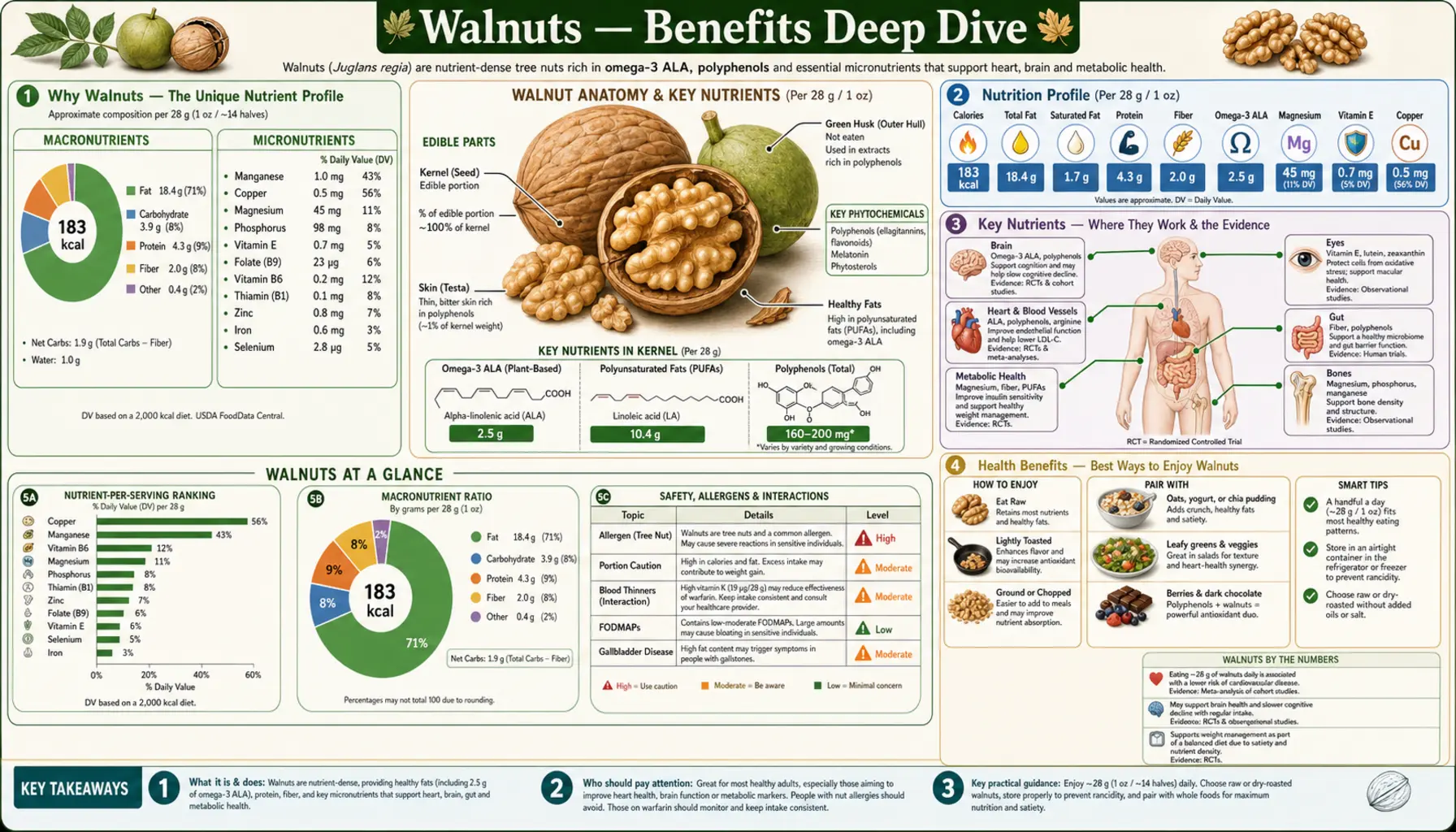
Among tree nuts, the English walnut (Juglans regia) is uniquely positioned at the intersection of cardiovascular and neurological research. It is the only common nut delivering a meaningful dose of alpha-linolenic acid (ALA), the plant-source omega-3 precursor — roughly 2.5 grams per one-ounce serving, more than the entire daily Adequate Intake for adults. That fatty-acid profile, combined with one of the highest polyphenol concentrations of any commonly consumed food, places walnuts at the center of the PREDIMED cardiovascular prevention trial, the WAHA cognitive aging study, and a growing body of work on the gut-brain axis. The four deep-dive pages below explore the mechanisms and clinical evidence in depth: the ALA-to-DHA conversion question and brain effects, the cognitive-aging trials, the PREDIMED heart-health pillar, and the practical kitchen question of whether soaking walnuts to reduce phytates is worth doing.
Deep-Dive Articles
ALA Omega-3 and Brain
The 2.5 g/oz alpha-linolenic acid content of walnuts, the FADS1/FADS2/ELOVL2 enzymatic pathway from ALA to EPA and DHA, why conversion is typically only 5-10% to EPA and <1% to DHA, the FADS1 rs174537 polymorphism that determines whether someone is an efficient or inefficient converter, and the direct brain effects of ALA independent of DHA conversion through PPAR-alpha signaling and membrane phospholipid incorporation.
Cognitive Aging
The Walnuts and Healthy Aging (WAHA) trial — 708 adults aged 63-79 randomized to 30-60 g walnuts/day or control for 2 years. Cognitive outcomes in the full cohort versus the Loma Linda site versus the Barcelona site, the question of why the Barcelona signal was stronger, and the smaller but earlier studies (Pribis 2012 in young adults, Valls-Pedret PREDIMED-NAVARRA cognitive substudy) that prompted WAHA.
Heart Health PREDIMED
The PREDIMED trial — 7,447 high-cardiovascular-risk Spanish adults randomized to Mediterranean diet plus 30 g/day mixed nuts (half walnuts), Mediterranean diet plus extra-virgin olive oil, or low-fat control. The 30% reduction in major cardiovascular events at 4.8 years follow-up, the LDL-cholesterol and endothelial function mechanisms, and the practical takeaway for adults at elevated cardiovascular risk.
Soaking and Phytates
The phytic acid content of walnuts (~660 mg/100 g), the rationale for the "activated nuts" preparation popularized by Sally Fallon and Weston A. Price Foundation, what soaking actually does mechanistically (phytase activation, tannin reduction, enzyme-inhibitor leaching), the magnesium and zinc bioavailability question, and a frank assessment of whether the time investment is worth it for adults with normal mineral status.
Table of Contents
- Deep-Dive Articles
- Why Walnuts — The Unique Nutrient Profile
- Research Papers: ALA Omega-3 and Brain
- Research Papers: Cognitive Aging
- Research Papers: Heart Health and PREDIMED
- Research Papers: Soaking and Phytates
- Research Papers: Cross-Cutting (Polyphenols, Microbiome, Metabolism)
- External Authoritative Resources
- Connections
- Featured Videos
Why Walnuts — The Unique Nutrient Profile
Walnuts occupy an unusual niche in the human diet. They are technically a tree nut and share the general nut macronutrient profile — high in fat (about 65% by weight), moderate in protein (about 15%), and low in carbohydrates (about 14% total, of which roughly 7% is fiber). But within that nut category, walnuts stand apart on two dimensions that drive most of the clinical research.
- Alpha-linolenic acid (ALA) content — walnuts contain approximately 9 grams of ALA per 100 grams of nut, equivalent to 2.5 grams per one-ounce (28 g) serving. This is more than the entire Adequate Intake (AI) of 1.6 g/day for adult men and 1.1 g/day for adult women set by the Institute of Medicine. No other commonly consumed nut comes close — almonds, cashews, pistachios, and peanuts (which are a legume, not a nut) contain essentially zero ALA. Among nuts, only flaxseed (a seed, not a nut, but often grouped with them in the kitchen) and chia seed exceed walnuts in ALA. This makes walnuts the single best whole-food source of plant omega-3 for people who do not eat fatty fish.
- Polyphenol density — walnuts have one of the highest total polyphenol contents of any commonly consumed food, particularly concentrated in the brown papery skin (pellicle). The dominant polyphenols are ellagitannins (especially pedunculagin), which are hydrolyzed in the gut to ellagic acid and further metabolized by gut microbiota to urolithins. Urolithin A in particular is a subject of intense ongoing research for its effects on mitochondrial autophagy (mitophagy), muscle function, and cognitive aging.
The combination is what makes walnuts unusual: a meaningful dose of plant omega-3 delivered alongside a polyphenol matrix that produces bioactive gut-microbial metabolites. The clinical trials reflect this dual character — the cardiovascular benefits seen in PREDIMED are likely a combination of ALA's lipid effects and polyphenol effects on endothelial function, and the cognitive aging signal in WAHA is hypothesized to involve both ALA incorporation into brain phospholipids and urolithin-A-mediated mitochondrial maintenance.
The complication, as explored in the ALA-and-Brain deep dive, is that ALA's clinical effects depend on individual conversion efficiency to EPA and (especially) DHA through the FADS1/FADS2 enzyme pathway. Some individuals are efficient converters; others are not, and the difference is largely genetic. The practical implication: walnuts are an excellent omega-3 source for most adults but not a complete substitute for fatty fish or marine omega-3 supplements in everyone.
For broader context on this question, see our Omega-3 Fatty Acids page and the discussion of marine versus plant sources.
Research Papers: ALA Omega-3 and Brain
- Alpha-linolenic acid (ALA) conversion to EPA and DHA in humans (Burdge and Calder review) — PubMed: ALA conversion in humans
- FADS1/FADS2 genetic polymorphisms and omega-3 metabolism — PubMed: FADS1/FADS2 polymorphisms
- Walnut consumption and brain DHA incorporation — PubMed: Walnut and brain DHA
- ALA-rich diets and depression risk in observational cohorts — PubMed: ALA and depression
- ELOVL2 elongase enzyme and DHA biosynthesis — PubMed: ELOVL2 and DHA synthesis
- PPAR-alpha activation by ALA and neuroinflammation — PubMed: ALA and PPAR-alpha
- Walnut polyphenols and BDNF expression in animal models — PubMed: Walnut polyphenols and BDNF
- Sex differences in ALA to DHA conversion efficiency — PubMed: Sex differences in ALA conversion
- Walnut intake and hippocampal volume in older adults — PubMed: Walnut and hippocampal volume
- Brain ALA content and beta-oxidation in neurons — PubMed: Brain ALA beta-oxidation
Research Papers: Cognitive Aging
- WAHA trial (Walnuts and Healthy Aging) main outcome paper (Sala-Vila et al. 2020) — PubMed: WAHA main outcomes
- Pribis et al. (2012) Walnut consumption and inferential reasoning in young adults — PubMed: Pribis 2012 young adults
- Valls-Pedret et al. PREDIMED-NAVARRA cognitive substudy — PubMed: PREDIMED-NAVARRA cognition
- Walnut consumption and risk of cognitive decline in NHANES — PubMed: NHANES walnut and cognition
- Urolithin A and mitophagy in neurons — PubMed: Urolithin A and mitophagy
- Walnut extract and amyloid-beta in Alzheimer's models — PubMed: Walnut and amyloid-beta
- Mediterranean diet and risk of dementia (PREDIMED extended follow-up) — PubMed: Mediterranean diet and dementia
- Nut consumption and risk of Alzheimer's disease in cohort studies — PubMed: Nuts and Alzheimer's risk
- Inflammation, oxidative stress, and cognitive aging mechanisms — PubMed: Inflammation and cognitive aging
- Walnut intake and depressive symptoms in older adults — PubMed: Walnut and depression in elders
Research Papers: Heart Health and PREDIMED
- PREDIMED main outcome paper (Estruch et al. NEJM 2013, retracted and re-published 2018) — PubMed: PREDIMED main
- PREDIMED 2018 re-analysis after intention-to-treat correction — PubMed: PREDIMED re-analysis
- Walnut consumption and LDL cholesterol meta-analysis — PubMed: Walnut and LDL meta-analysis
- Walnut consumption and endothelial function (flow-mediated dilation) — PubMed: Walnut and endothelial function
- Walnut consumption and blood pressure — PubMed: Walnut and blood pressure
- Nut consumption and all-cause mortality (Bao et al. NEJM 2013) — PubMed: Bao NEJM 2013
- PREDIMED-Plus weight-loss trial — PubMed: PREDIMED-Plus
- Walnut consumption and inflammatory markers (CRP, IL-6) — PubMed: Walnut and inflammation
- Walnut consumption and type 2 diabetes risk — PubMed: Walnut and diabetes risk
- Walnut consumption and atrial fibrillation in PREDIMED — PubMed: Walnut and atrial fibrillation
Research Papers: Soaking and Phytates
- Phytic acid content of nuts and seeds (Schlemmer et al.) — PubMed: Phytate content of nuts
- Phytic acid and mineral bioavailability (zinc, iron, calcium) — PubMed: Phytate and mineral bioavailability
- Soaking and germination effects on phytate content — PubMed: Soaking and phytate reduction
- Endogenous phytase activity in seeds and grains — PubMed: Endogenous phytase
- Phytic acid as antioxidant and cancer protective compound — PubMed: Phytate as antioxidant
- Walnut tannin and digestibility — PubMed: Walnut tannin and digestion
- Sprouting nuts and seeds: nutritional impact review — PubMed: Sprouting nutritional impact
- Net phytate-to-zinc molar ratio and zinc absorption modeling — PubMed: Phytate:zinc molar ratio
- Trypsin inhibitor activity in nuts and seeds — PubMed: Trypsin inhibitors in nuts
- Mineral bioavailability from whole-food versus refined diets — PubMed: Whole-food mineral bioavailability
Research Papers: Cross-Cutting (Polyphenols, Microbiome, Metabolism)
- Walnut ellagitannins and urolithin production by gut microbiota — PubMed: Walnut ellagitannins and urolithin
- Urolithin A clinical trial in muscle function (MitoPure) — PubMed: Urolithin A muscle trial
- Walnut consumption and gut microbiome composition — PubMed: Walnut and gut microbiome
- Walnut consumption and satiety / weight regulation — PubMed: Walnut and satiety
- Walnut polyphenols and oxidative stress markers (8-OHdG, MDA) — PubMed: Walnut and oxidative stress
- Walnut consumption and male fertility / sperm quality — PubMed: Walnut and sperm quality
- Walnut allergy: Juglans regia protein allergens — PubMed: Walnut allergens
- Walnut consumption and bone health (calcium, phosphorus, magnesium) — PubMed: Walnut and bone health
- Mycotoxin (aflatoxin) contamination risk in tree nuts — PubMed: Aflatoxin in walnuts
- Rancidity and storage stability of walnut oil — PubMed: Walnut oil stability
External Authoritative Resources
- Linus Pauling Institute — Nuts (including walnuts)
- NIH Office of Dietary Supplements — Omega-3 Fatty Acids (Health Professionals)
- USDA FoodData Central — Walnut nutrient profile
- PubMed — All walnut human trials
- California Walnut Commission — Health professional research portal
Connections
- All Food
- Walnuts (Main Page)
- ALA Omega-3 and Brain
- Cognitive Aging
- Heart Health and PREDIMED
- Soaking and Phytates
- Omega-3 Fatty Acids
- Salmon (Marine Omega-3)
- Sardines
- Cardiology
- Neurology
- Magnesium
- Zinc
- Mediterranean Diet
- Vitamin E