Natto — Benefits Deep Dive
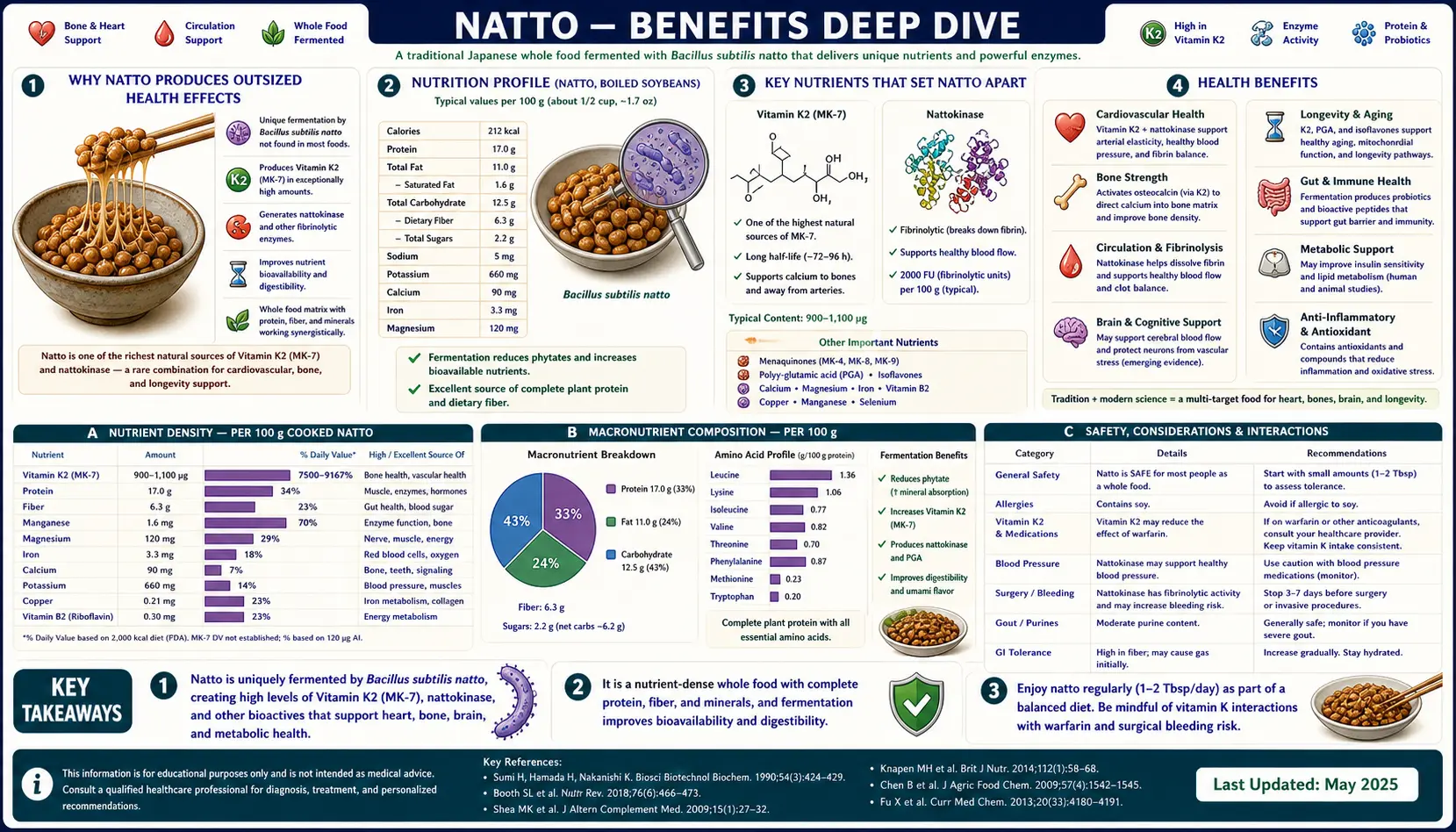
Natto is the single most concentrated dietary source of menaquinone-7 (MK-7), the long-chain form of Vitamin K2 with the longest serum half-life and the most efficient activation of the bone-mineralization protein osteocalcin and the arterial-calcification-blocking protein matrix Gla protein (MGP). The same Bacillus subtilis natto fermentation that produces MK-7 also produces nattokinase, a serine protease with documented fibrinolytic activity in human trials. Four deep-dive pages below explore why a single 50-gram serving of natto delivers more bioavailable K2 than any other food on earth, how nattokinase compares to pharmaceutical clot-busting agents, the Yamaguchi osteoporosis trials in Japanese women, and practical strategies for Westerners learning to tolerate the food's polarizing aroma and texture.
Deep-Dive Articles
Vitamin K2 (MK-7)
Why natto is the densest natural source of MK-7 (~1,000 µg per 100 g), the menaquinone side-chain biochemistry that gives MK-7 its 72-hour serum half-life vs MK-4's 1-2 hours, gamma-carboxylation of osteocalcin and matrix Gla protein, the Rotterdam Study link between K2 intake and cardiovascular mortality, the Geleijnse coronary calcification data, dosing equivalence between natto and supplemental MK-7, and warfarin interactions.
Nattokinase & Fibrinolysis
Sumi's 1987 discovery of the fibrinolytic serine protease produced by Bacillus subtilis natto, the 275-amino-acid enzyme structure, oral bioavailability across the gut wall, FU activity units, comparison to streptokinase and urokinase, the 2009 Hsia hypertension trial, the Kurosawa carotid intima-media thickness data, deep vein thrombosis prophylaxis on long flights, and the strict warfarin / antiplatelet contraindication.
Bone Density
The Kaneki / Yamaguchi observation that hip fracture incidence in Japanese prefectures correlates inversely with natto consumption, the Knapen postmenopausal trial showing 180 µg/day MK-7 reduces vertebral bone loss, the osteocalcin / matrix Gla protein dual mechanism (bone calcium in, vascular calcium out), why Vitamin K2 outperforms isolated calcium supplementation, and the synergy with Vitamin D3 and magnesium for the complete bone-mineralization triumvirate.
Acquired Taste Tips
Practical Western introduction strategies — why ammonia volatiles and the polysaccharide poly-gamma-glutamic acid (PGA) "slime" trigger Western disgust, the karashi mustard + soy sauce + scallion preparation that suppresses both, mixing with raw egg yolk or rice to dilute texture, fridge-cold vs room-temperature presentation, freezer storage to mute aroma, supermarket brands, the MK-7 supplement alternative, and a one-week graded exposure protocol.
Table of Contents
- Deep-Dive Articles
- Why Natto Produces Outsized Health Effects
- Research Papers: Vitamin K2 (MK-7)
- Research Papers: Nattokinase & Fibrinolysis
- Research Papers: Bone Density
- Research Papers: Cardiovascular Outcomes
- Research Papers: Cross-Cutting (Fermentation, Probiotic, Safety)
- External Authoritative Resources
- Connections
- Featured Videos
Why Natto Produces Outsized Health Effects
Most fermented foods deliver modest, diffuse benefits — some probiotic bacteria, some increased bioavailability of base-food nutrients, a slight reduction in antinutrients. Natto is different. The combination of soybean substrate plus the specific Bacillus subtilis var. natto strain produces two bioactive compounds at concentrations not found in any other natural food, each with a distinct and well-documented mechanism of clinical benefit.
- Vitamin K2 as menaquinone-7 (MK-7) — natto delivers approximately 1,000 µg of MK-7 per 100 g, roughly two to three orders of magnitude more than any other dietary source. MK-7 has a serum half-life of approximately 72 hours (compared to 1-2 hours for the MK-4 form found in animal foods), which allows once-daily dietary intake to maintain steady-state activation of osteocalcin (which binds calcium into bone hydroxyapatite) and matrix Gla protein (which prevents calcium deposition in arterial walls). See the Vitamin K2 MK-7 deep dive for the menaquinone side-chain biochemistry and the half-life data.
- Nattokinase as fibrinolytic serine protease — a 275-amino-acid enzyme secreted by Bacillus subtilis during fermentation, with documented oral bioavailability and direct fibrin-cleaving activity in human plasma. Nattokinase has a different mechanism from aspirin (which inhibits platelet aggregation upstream of clotting) and from heparin (which potentiates antithrombin III) — it actively breaks down already-formed fibrin clots. See the Nattokinase deep dive for the Sumi discovery, the FU activity unit, and the human cardiovascular trial data.
- The dual-system synergy — MK-7 prevents calcium from being deposited in arterial walls (via matrix Gla protein activation), while nattokinase breaks down any fibrin clots that do form on a partially calcified plaque. The combination is a uniquely complete dietary intervention for the two intertwined processes that drive arterial disease — calcification and thrombosis. No supplement combination duplicates this naturally.
A complicating factor is that the same fermentation that produces these benefits also produces ammonia, isovaleric acid, and the slime polysaccharide poly-gamma-glutamic acid (PGA) that Westerners typically find off-putting. The Acquired Taste Tips deep dive covers practical strategies for graded exposure, mustard-based aroma suppression, and the supplement alternative for those who genuinely cannot tolerate the food. And the Bone Density deep dive explores why Japanese prefectures with high natto consumption (Mito, Ibaraki, Fukushima) have measurably lower hip fracture rates than low-consumption prefectures — one of the cleanest population-level demonstrations of a single food's effect on a hard skeletal endpoint.
Research Papers: Vitamin K2 (MK-7)
- Schurgers LJ, Vermeer C (2000). Determination of phylloquinone and menaquinones in food. Haemostasis. — PubMed: K1/K2 food content
- Schurgers LJ et al. (2007). Vitamin K-containing dietary supplements: comparison of synthetic vitamin K1 and natto-derived menaquinone-7. Blood. — PubMed: MK-7 supplement bioavailability
- Sato T et al. (2012). Comparison of menaquinone-4 and menaquinone-7 bioavailability in healthy women. Nutrition Journal. — PubMed: MK-4 vs MK-7 bioavailability
- Geleijnse JM et al. (2004). Dietary intake of menaquinone is associated with a reduced risk of coronary heart disease: the Rotterdam Study. J Nutr. — PubMed: Rotterdam Study
- Beulens JW et al. (2009). High dietary menaquinone intake is associated with reduced coronary calcification. Atherosclerosis. — PubMed: Coronary calcification
- Knapen MH et al. (2013). Three-year low-dose menaquinone-7 supplementation helps decrease bone loss in healthy postmenopausal women. Osteoporosis International. — PubMed: 3-year Knapen trial
- Knapen MH et al. (2015). Menaquinone-7 supplementation improves arterial stiffness in healthy postmenopausal women. Thrombosis & Haemostasis. — PubMed: Arterial stiffness trial
- Theuwissen E et al. (2013). Low-dose menaquinone-7 supplementation improved extra-hepatic vitamin K status. British Journal of Nutrition. — PubMed: Extra-hepatic K status
- Halder M et al. (2019). Vitamin K: double bonds beyond coagulation. International Journal of Molecular Sciences. — PubMed: Vitamin K beyond coagulation
- Vermeer C (2012). Vitamin K: the effect on health beyond coagulation — an overview. Food & Nutrition Research. — PubMed: Vermeer overview 2012
Research Papers: Nattokinase & Fibrinolysis
- Sumi H et al. (1987). A novel fibrinolytic enzyme (nattokinase) in the vegetable cheese natto. Experientia. — PubMed: Sumi discovery 1987
- Hsia CH et al. (2009). Nattokinase decreases plasma levels of fibrinogen, factor VII, and factor VIII in human subjects. Nutrition Research. — PubMed: Hsia fibrinogen trial
- Kurosawa Y et al. (2015). A single-dose of oral nattokinase potentiates thrombolysis and anti-coagulation profiles. Scientific Reports. — PubMed: Kurosawa thrombolysis
- Chen H et al. (2018). Nattokinase: a promising alternative in prevention and treatment of cardiovascular diseases. Biomarker Insights. — PubMed: 2018 cardiovascular review
- Jang JY et al. (2013). Nattokinase improves blood flow by inhibiting platelet aggregation and thrombus formation. Laboratory Animal Research. — PubMed: Platelet aggregation
- Suzuki Y et al. (2003). Dietary supplementation of fermented soybean, natto, suppresses intimal thickening. Life Sciences. — PubMed: Intimal thickening
- Fujita M et al. (1995). Purification and characterization of a strong fibrinolytic enzyme (nattokinase) in the vegetable cheese natto. Biochemical & Biophysical Research Communications. — PubMed: Fujita purification
- Weng Y et al. (2017). Nattokinase: an oral antithrombotic agent for the prevention of cardiovascular disease. International Journal of Molecular Sciences. — PubMed: Weng 2017 review
- Pais E et al. (2006). Effects of nattokinase, a pro-fibrinolytic enzyme, on red blood cell aggregation and whole blood viscosity. Clinical Hemorheology & Microcirculation. — PubMed: Blood viscosity
- Kim JY et al. (2008). Effects of nattokinase on blood pressure: a randomized, controlled trial. Hypertension Research. — PubMed: Hypertension trial
Research Papers: Bone Density
- Kaneki M et al. (2001). Japanese fermented soybean food as the major determinant of the large geographic difference in circulating levels of vitamin K2. Nutrition. — PubMed: Kaneki geographic study
- Yamaguchi M (2006). Regulatory mechanism of food factors in bone metabolism and prevention of osteoporosis. Yakugaku Zasshi. — PubMed: Yamaguchi review
- Knapen MH et al. (2013). Three-year low-dose menaquinone-7 supplementation helps decrease bone loss in healthy postmenopausal women. Osteoporosis International. — PubMed: Knapen 3-year trial
- Iwamoto J et al. (2005). High-dose vitamin K supplementation reduces fracture incidence in postmenopausal women. Nutrition Research. — PubMed: Iwamoto fracture trial
- Cockayne S et al. (2006). Vitamin K and the prevention of fractures: systematic review and meta-analysis. Archives of Internal Medicine. — PubMed: Cockayne meta-analysis
- Inaba N et al. (2015). Low-dose daily intake of vitamin K2 (menaquinone-7) improves osteocalcin gamma-carboxylation. Journal of Nutritional Science & Vitaminology. — PubMed: Inaba osteocalcin
- Shea MK et al. (2009). Vitamin K supplementation and progression of coronary artery calcium. American Journal of Clinical Nutrition. — PubMed: Shea coronary calcium
- Plaza SM, Lamson DW (2005). Vitamin K2 in bone metabolism and osteoporosis. Alternative Medicine Review. — PubMed: Plaza review
- Booth SL et al. (2008). Effect of vitamin K supplementation on bone loss in elderly men and women. Journal of Clinical Endocrinology & Metabolism. — PubMed: Booth elderly trial
- Tsugawa N et al. (2006). Vitamin K status of healthy Japanese women: age-related vitamin K requirement for gamma-carboxylation of osteocalcin. American Journal of Clinical Nutrition. — PubMed: Japanese women K status
Research Papers: Cardiovascular Outcomes
- Geleijnse JM et al. (2004). Dietary intake of menaquinone is associated with a reduced risk of coronary heart disease. J Nutr. — PubMed: Rotterdam K2/CHD
- Gast GC et al. (2009). A high menaquinone intake reduces the incidence of coronary heart disease. Nutrition, Metabolism & Cardiovascular Diseases. — PubMed: Gast K2/CHD incidence
- Beulens JW et al. (2009). High dietary menaquinone intake is associated with reduced coronary calcification. Atherosclerosis. — PubMed: Coronary calcification
- Schurgers LJ et al. (2008). Vitamin K-dependent carboxylation of matrix Gla protein. Thrombosis & Haemostasis. — PubMed: MGP carboxylation
- Knapen MH et al. (2015). MK-7 supplementation improves arterial stiffness. Thrombosis & Haemostasis. — PubMed: Arterial stiffness
- Hsia CH et al. (2009). Nattokinase decreases plasma levels of fibrinogen. Nutrition Research. — PubMed: Hsia fibrinogen
- Suzuki Y et al. (2003). Dietary natto suppresses intimal thickening. Life Sciences. — PubMed: Intimal thickening
- Nagata C et al. (2017). Dietary soy and natto intake and cardiovascular disease mortality in Japanese adults. American Journal of Clinical Nutrition. — PubMed: Nagata CVD mortality
- Eriksen AK et al. (2021). Vitamin K intake and atherosclerotic cardiovascular disease. Journal of the American Heart Association. — PubMed: Eriksen JAHA 2021
- Haugsgjerd TR et al. (2020). Association of dietary vitamin K and risk of coronary heart disease in middle-age adults. BMJ Open. — PubMed: Haugsgjerd BMJ Open
Research Papers: Cross-Cutting (Fermentation, Probiotic, Safety)
- Hosoi T, Kiuchi K (2003). Natto — a food made by fermenting cooked soybeans with Bacillus subtilis (natto). Handbook of Fermented Functional Foods. — PubMed: Natto fermentation
- Inatsu Y et al. (2006). Characterization of Bacillus subtilis strains in Touchi, a fermented soybean food in China. Letters in Applied Microbiology. — PubMed: B. subtilis characterization
- Berenjian A et al. (2011). Production of menaquinone-7 by Bacillus subtilis natto. Biotechnology Letters. — PubMed: MK-7 production
- Sumi H et al. (1990). Enhancement of the fibrinolytic activity in plasma by oral administration of nattokinase. Acta Haematologica. — PubMed: Sumi oral 1990
- Cao H et al. (2013). Allergenic potential of soybean: in vivo assessment in natto-fermented soybean. Food & Chemical Toxicology. — PubMed: Allergen assessment
- Tamang JP et al. (2016). Functional properties of microorganisms in fermented foods. Frontiers in Microbiology. — PubMed: Fermented food microbes
- Inaoka Y, Kakimoto K (1999). Quantification of Bacillus subtilis natto and analysis of viability in natto. Bioscience, Biotechnology & Biochemistry. — PubMed: Viability quantification
- Hong KJ et al. (2004). Aspects of the antiplatelet and antithrombotic effects of natto. Korean Journal of Microbiology & Biotechnology. — PubMed: Antiplatelet/antithrombotic
- Wagatsuma A (2007). The way of natto: its tradition and medical perspective. Bulletin of the National Institute of Public Health (Japan). — PubMed: Cultural/medical perspective
- Lampe JW (2003). Isoflavonoid and lignan phytoestrogens as dietary biomarkers. Journal of Nutrition. — PubMed: Isoflavone biomarker
External Authoritative Resources
- Linus Pauling Institute — Vitamin K Micronutrient Information Center — the most authoritative scientific summary of K1/K2 biology, including menaquinone subtype data
- NIH Office of Dietary Supplements — Vitamin K Fact Sheet
- PubMed — All natto / MK-7 / nattokinase research
- PubMed — Nattokinase clinical trials
- PubMed — MK-7 bone & arterial calcification
Connections
- All Food
- Natto (Main Page)
- Vitamin K2 (MK-7) Deep Dive
- Nattokinase & Fibrinolysis
- Bone Density
- Acquired Taste Tips
- Vitamin K2
- Vitamin D3
- Calcium
- Magnesium
- Atherosclerosis
- Deep Vein Thrombosis
- Osteoporosis
- Yogurt (Fermented Foods)
- Probiotics