Natto Acquired Taste Tips
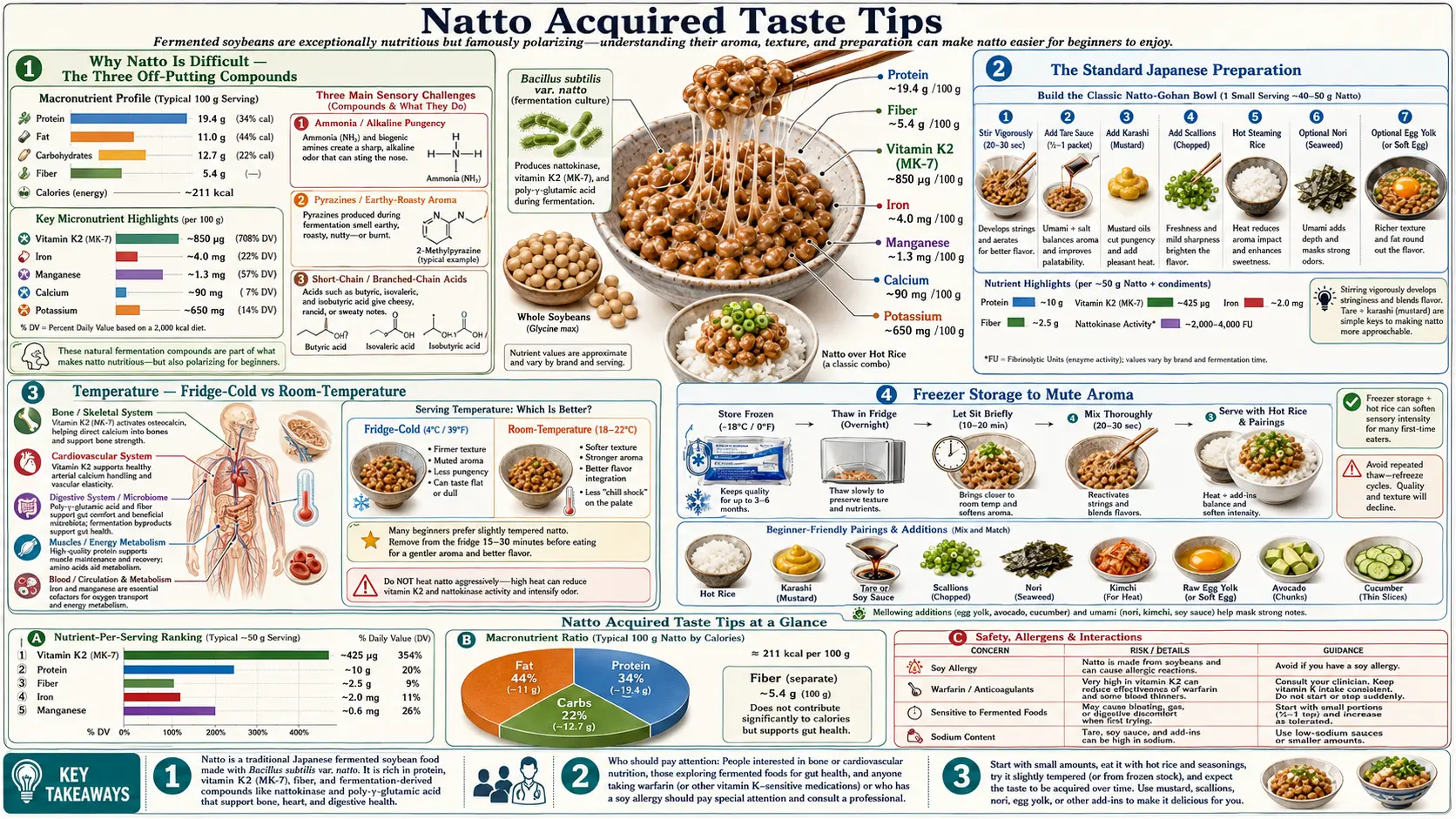
Natto's polarizing reputation is well-earned. The same Bacillus subtilis fermentation that produces MK-7 and nattokinase also generates ammonia, isovaleric acid, and tetramethylpyrazine — volatiles that the human nose evolved to recognize as warning signs of rotten protein. On top of the aroma, the bacterium secretes poly-gamma-glutamic acid (PGA), a stringy polysaccharide that produces the famous "spider web" texture when natto is stirred. Westerners encountering natto for the first time typically have a strongly negative reaction; many never come back. This page is a practical bridge for the curious reader who wants the documented MK-7 and nattokinase benefits without surrendering to a food they truly cannot stomach. We cover the chemistry of the polarizing compounds, the classic Japanese karashi + soy sauce + scallion preparation that suppresses both aroma and texture, fridge-cold versus room-temperature presentation, freezer storage to mute volatiles, the rice + raw egg yolk dilution method, a graded one-week exposure protocol modeled on flavor-learning research, and the MK-7 supplement alternative for those who genuinely cannot adapt. Acquired taste is not a moral imperative — the supplement route delivers the K2 benefit without the food itself.
Table of Contents
- Why Natto Is Difficult — The Three Off-Putting Compounds
- The Standard Japanese Preparation
- Temperature — Fridge-Cold vs Room-Temperature
- Freezer Storage to Mute Aroma
- Dilution Strategies — Rice, Egg, Avocado
- Brand Selection in US Asian Markets
- A One-Week Graded Exposure Protocol
- The MK-7 Supplement Alternative
- Recipes — Natto Toast, Natto Pasta, Hidden Natto
- References — Flavor Learning & Bacterial Volatiles
- Connections
- Featured Videos
Why Natto Is Difficult — The Three Off-Putting Compounds
Three independent biochemical features of natto produce the strong sensory response that Westerners typically experience as disgust:
- Ammonia (NH₃) — produced by bacterial deamination of soybean amino acids during fermentation. Human olfactory neurons are exquisitely sensitive to ammonia (detection threshold ~5 ppm) because it is a key biomarker of decomposing protein. The hardwired association of ammonia with rotten meat is evolutionarily ancient. Natto's ammonia content rises with fermentation time and storage; older natto smells more strongly of ammonia than fresh natto.
- Isovaleric acid and short-chain fatty acids — the same compounds responsible for the sharp aroma of aged cheese (Roquefort, Limburger, Stilton). Westerners who enjoy strong cheese typically find natto's isovaleric component less objectionable than they expected; westerners who avoid strong cheese will find natto challenging on this dimension. The compounds bind to olfactory receptors OR5K1 and OR2W3.
- Poly-gamma-glutamic acid (PGA) "slime" — a polysaccharide-protein gel secreted by Bacillus subtilis during fermentation. PGA produces the characteristic stringy, mucilaginous texture that natto develops when stirred. The texture is the single most challenging sensory feature for Westerners — the visual and tactile experience of a food that produces long, sticky threads as you lift it from the dish triggers strong aversion in cultures without textural counterparts. Even Japanese children typically need 20-30 exposures to develop tolerance.
Understanding which dimension is most off-putting helps target the remediation. If ammonia is the issue, freshness and mustard suppression are the levers. If the slime is the issue, dilution into rice / egg / other matrices is the lever. If the cheese-like notes are the issue, the food may simply not be for you and the supplement alternative is the rational choice.
The Standard Japanese Preparation
The traditional Japanese natto packet (sold in supermarkets in three-pack sets) comes with two small condiment packets: a packet of karashi (Japanese yellow mustard, much sharper than American yellow mustard) and a packet of tare (sweet soy-based sauce, often with mirin and dashi). The preparation ritual is precise and has evolved over centuries:
- Open the natto container at room temperature (not fridge-cold, not warm)
- Add the karashi mustard packet to the natto
- Stir vigorously with chopsticks in one direction for approximately 40-50 strokes — this stirring is essential. It develops the PGA into a glossy, well-incorporated structure rather than leaving it as discrete strings, and aerates the natto so that ammonia and other volatiles dissipate
- Add the tare sauce packet, stir another 10-20 strokes
- Optional: add finely chopped scallion (negi) and a few drops of additional soy sauce
- Serve over a small bowl of warm short-grain rice (genmai or hakumai)
The stirring step is not optional and is the single most common Western mistake. Unstirred natto is intensely difficult; well-stirred natto has muted aroma (volatiles dispersed by the 40-50 strokes), a smoother creamy texture (the PGA reorganized rather than left as strings), and well-integrated mustard and soy that mask the residual aroma.
The karashi mustard specifically does double duty: it provides a sharp horseradish-family pungency that olfactory neurons interpret as the dominant aroma, suppressing perception of the underlying natto volatiles; and the isothiocyanates in the mustard chemically react with some of the ammonia and short-chain acid volatiles, reducing their headspace concentration. Without the mustard, the natto is considerably more difficult.
Temperature — Fridge-Cold vs Room-Temperature
Volatile aroma compounds release more readily at warmer temperatures. Natto served fridge-cold (4°C) has noticeably less perceived aroma than natto served at room temperature (20-22°C). For Westerners adapting to the food, eating it fridge-cold is a meaningful temporary accommodation — the perceived aroma can be reduced by 40-60% while the flavor (which is registered at the tongue rather than the olfactory bulb) remains largely intact.
The Japanese traditional preparation is at room temperature, partly because the warm rice base brings the natto to room temperature anyway. But for a Westerner in the adaptation phase, eating natto on a cold dish (rather than warm rice) preserves the lower-aroma fridge state through the meal.
As tolerance develops, room-temperature presentation becomes acceptable and eventually preferred — the warmer aromatic complexity is what natto enthusiasts come to appreciate. But "cold first, warm later" is a reasonable on-ramp.
Avoid microwaving natto. Heat above approximately 50°C denatures the nattokinase enzyme and degrades the MK-7 content modestly, defeating much of the nutritional purpose. Brief warming over warm (but not hot) rice is fine; active cooking is not.
Freezer Storage to Mute Aroma
A useful technique reported by many Westerners learning to eat natto: store natto in the freezer rather than the refrigerator. Frozen natto retains its texture and most of its bioactive content (MK-7 is stable through freeze-thaw cycles), and the freezer storage suppresses the slow ongoing fermentation that continues even at fridge temperatures (4°C is not enough to fully halt Bacillus subtilis metabolism). The result is a milder, less aromatic product when thawed.
To use frozen natto: transfer a single packet from freezer to refrigerator the night before, allowing it to thaw slowly. Use within 24 hours of thawing. Do not refreeze. The texture will be slightly looser than fresh-fermented natto, but the flavor and aroma are noticeably milder.
This technique is also useful for buying natto in bulk at an Asian grocery (where it is much cheaper per packet than at a mainstream supermarket) and storing for 2-3 months without aroma deterioration.
Dilution Strategies — Rice, Egg, Avocado
Dilution into other foods is the most practical strategy for adapting to natto. The traditional Japanese approach — natto over warm short-grain rice — works precisely because the rice physically and aromatically dilutes the natto. The carbohydrate matrix of rice traps volatiles and slows their release, and the bland rice flavor provides a baseline that the natto can punctuate without dominating.
Specific dilution combinations that work well:
- Natto + warm short-grain rice + soy sauce + scallion (the canonical Japanese breakfast) — 50 g natto over 150-200 g rice produces a 1:3 to 1:4 dilution that is approachable for most Westerners after a few exposures
- Natto + raw egg yolk + rice (tamago kake gohan style) — the egg yolk produces a creamy emulsion that smooths the natto texture; many adapters find this their favorite preparation
- Natto + sliced avocado + sesame oil + soy sauce — the avocado's fat content carries the natto's flavor compounds without the slime sensation, producing a smoother mouthfeel
- Natto on buttered toast (Japanese sandwich-style) — the butter and bread crumb structure dilute texture; some Western adapters find this an easier entry than rice
- Natto in miso soup — stirred into hot miso soup just before serving, the natto's aroma is masked by the dashi and miso flavors while the warmth helps the texture integrate
- Natto with kimchi — the Korean fusion approach. Kimchi's strong sour and spicy flavors easily dominate natto's ammonia notes, and the two fermented foods complement each other nutritionally
The dilution principle is that natto needs to be a flavoring rather than a main ingredient during the adaptation phase. 30-50 g of natto integrated into a 200-300 g composite dish is far easier than 50 g of natto eaten plain from a packet.
Brand Selection in US Asian Markets
Natto quality varies meaningfully across brands. Some are aggressively fermented (high ammonia, strong cheese notes); some are milder and more approachable. For a Western adapter, starting with a mild brand is significantly easier than starting with an aggressive one.
- Megumi Natto — a Japanese-American brand widely available in US Asian groceries. Moderate aroma, well-balanced texture. A reasonable starting point.
- Mishima Natto — mild profile, smaller bean size, less aggressive ammonia. Often easier for first-time eaters.
- Nyu Hozumi / Hozumi — smaller-bean varieties; the smaller beans are sometimes perceived as less off-putting than large-bean preparations.
- Okame Natto — widely available in Japan and exported; reliable quality and moderate intensity.
- Kurogome / Black Natto — made from black soybeans; somewhat earthier flavor that some adapters find more palatable than yellow-soybean natto.
If your local Asian market carries multiple brands, ask the staff which are considered mild (淡白, tanpaku, lit. "plain/mild"). Avoid brands labeled "extra-fermented" (極熟, kokujuku) or "strong" (濃厚, noukou) until you are well adapted.
Reading the package: a fresher natto (within 1-2 weeks of production) is milder than an older one. Check the production date if printed; in Japan natto has a relatively short shelf life because the ongoing fermentation degrades the eating quality even though the food remains safe.
A One-Week Graded Exposure Protocol
Flavor learning research (notably work by Birch and colleagues at Penn State on childhood food acceptance, and more recent adult-flavor-learning studies) suggests that 10-20 exposures to a new food are typically required for acceptance, with each exposure reducing the negative response by a measurable increment. The protocol below is adapted for adult natto adoption:
- Day 1: Tiny taste — 5 g (about one teaspoon) of well-stirred natto on a tablespoon of warm rice, with karashi mustard and soy sauce. Note your reaction. Do not force more than the tablespoon.
- Day 2: Same 5 g portion. Even if you disliked it on Day 1, the second exposure typically registers as less surprising and less aversive than the first.
- Day 3: Increase to 10 g (about two teaspoons). Try the raw-egg-yolk addition (tamago kake gohan style).
- Day 4: 15 g. Try a different brand if possible.
- Day 5: 25 g. Try the natto-on-buttered-toast preparation as an alternative to rice.
- Day 6: Full half-packet (~25 g) with rice and your preferred condiments. Notice that the aroma is registering as less intense than on Day 1.
- Day 7: Full packet (~50 g) as a complete breakfast. By this point most adapters report that the texture and aroma have moved from "actively unpleasant" to "neutral" or even "intriguing."
- Days 8-21: Continue at one packet, 3-5 times per week. Tolerance becomes acceptance becomes preference for many adapters in this window.
Honest assessment after 21 days: some adapters genuinely come to enjoy natto and incorporate it as a regular breakfast. Some tolerate it but do not enjoy it — for these individuals, eating it for the documented benefits is reasonable, but it remains a chore rather than a pleasure. Some never adapt and find that even after 21 exposures the food remains unpleasant. For this third group, the MK-7 supplement alternative below is the rational choice.
The MK-7 Supplement Alternative
For individuals who genuinely cannot tolerate natto after a sincere adaptation attempt, the MK-7 supplement route delivers the K2 benefit without the food. Bioequivalence has been established directly in head-to-head trials (Schurgers 2007 Blood): supplemental MK-7 produces the same gamma-carboxylation of osteocalcin and matrix Gla protein as MK-7 from natto, at equivalent doses.
The supplement does not duplicate the nattokinase content of food natto. For the fibrinolytic effect, a separate nattokinase supplement (2,000 FU per capsule, taken daily) is the equivalent — see the Nattokinase deep dive. The MK-7 and nattokinase supplements can be taken in the same regimen.
Recommended supplement regimen for individuals not eating natto:
- MK-7: 100-200 µg/day, taken with a fat-containing meal for absorption. Brands matter; look for the trademarked MenaQ7 (NattoPharma source, the most-studied preparation in published trials) or MK-7 from Bacillus subtilis natto fermentation. Avoid synthetic isomeric mixtures — the cis-isomer of MK-7 produced by some manufacturing routes has poor bioavailability.
- Nattokinase (optional, if cardiovascular indication): 2,000 FU per day with breakfast, 2,000 FU FU twice daily for higher-end therapeutic dose. Enteric-coated preparations preferred.
- Vitamin D3: 2,000-5,000 IU/day; the K2 is partly dependent on adequate D3 to mobilize calcium for osteocalcin to capture.
- Magnesium: 400-800 mg/day elemental as glycinate, citrate, or malate, for the reasons discussed on the Bone Density deep dive.
The supplement route is rational, evidence-supported, and not inferior to the food route for the K2 specifically. There is no shame in choosing it.
Recipes — Natto Toast, Natto Pasta, Hidden Natto
Three preparations that have helped Western adapters who struggled with natto over rice:
Natto Toast (Western breakfast style)
- 1 slice toasted whole grain bread, buttered
- 1 packet natto (50 g), well-stirred with karashi mustard
- 1 teaspoon soy sauce
- Optional: 1 thinly sliced scallion, sprinkle of furikake (Japanese rice seasoning), drizzle of sesame oil
- Spread natto on buttered toast, top with scallion. Eat immediately while toast is crisp.
The bread + butter combination is forgiving of natto's texture — the bread provides a substrate, the butter provides fat that carries flavor, and the contrast between crisp toast and creamy natto is more pleasant than rice for some palates.
Natto Pasta (Italian-Japanese fusion)
- 100 g cooked spaghetti or linguine, hot
- 1 packet natto, stirred
- 1 tablespoon olive oil
- 2 cloves garlic, minced and lightly cooked in the oil
- 1 teaspoon soy sauce, 1 teaspoon mirin (or honey)
- 1 sheet nori, torn into strips
- 1 egg yolk on top (optional)
- Toss hot pasta with the garlic oil, soy sauce, and mirin. Add natto and toss to coat. Top with nori strips and egg yolk. Eat immediately.
This preparation is widely popular among younger Japanese consumers and works because the pasta's heat and starch tame the natto texture while the garlic and oil provide flavor distractions.
Hidden Natto (for skeptical family members)
- Stir natto thoroughly into hot miso soup just before serving — the dashi and miso flavors dominate
- Fold natto into scrambled eggs at the end of cooking — the egg matrix conceals texture and aroma
- Layer natto inside a sushi roll (futomaki style) with cucumber, avocado, and a sweet sauce — the rice and other ingredients dilute the experience
- Mix natto with hummus and tahini in a 1:3 ratio for a dip — the chickpea and tahini flavors mask the natto entirely
These approaches are particularly useful for households where one member wants to incorporate natto for the K2 benefit but others are not yet adapted.
References — Flavor Learning & Bacterial Volatiles
- Birch LL (1999). Development of food preferences. Annual Review of Nutrition. — PubMed
- Sullivan SA, Birch LL (1990). Pass the sugar, pass the salt: experience dictates preference. Developmental Psychology. — PubMed
- Wadhera D, Capaldi-Phillips ED (2014). A review of visual cues associated with food on food acceptance and consumption. Eating Behaviors. — PubMed
- Owusu-Apenten R (2005). Introduction to Food Chemistry. (Textbook chapter on fermented soy bacterial volatiles).
- Hosoi T, Kiuchi K (2003). Natto — a food made by fermenting cooked soybeans with Bacillus subtilis. Handbook of Fermented Functional Foods. — PubMed
- Inaoka Y, Kakimoto K (1999). Quantification of Bacillus subtilis natto and viability analysis. Bioscience, Biotechnology & Biochemistry. — PubMed
- Ashida M et al. (2009). Volatile compounds in natto fermentation. Bioscience, Biotechnology & Biochemistry. — PubMed
- Park EY et al. (2007). Aroma extract dilution analysis of natto. Journal of Agricultural & Food Chemistry. — PubMed
- Schurgers LJ et al. (2007). Vitamin K supplements: synthetic K1 vs natto-derived MK-7. Blood. — PubMed
- Tamang JP et al. (2016). Functional properties of microorganisms in fermented foods. Frontiers in Microbiology. — PubMed
- Berenjian A et al. (2011). Production of menaquinone-7 by Bacillus subtilis natto. Biotechnology Letters. — PubMed
- Wagatsuma A (2007). The way of natto: tradition and medical perspective. — PubMed
PubMed Topic Searches
- PubMed: Natto aroma volatiles
- PubMed: Poly-gamma-glutamic acid (PGA)
- PubMed: Adult flavor learning
- PubMed: B. subtilis fermentation optimization
- PubMed: Fermented soybean / functional food
Connections
- All Food
- Natto (Main Page)
- Natto Benefits Hub
- Vitamin K2 (MK-7)
- Nattokinase & Fibrinolysis
- Bone Density
- Vitamin K2
- Vitamin D3
- Magnesium
- Yogurt (Fermented Foods)
- Eggs
- Rice
- Avocados
- Probiotics
- Organ Meats