Natto for Nattokinase and Fibrinolysis
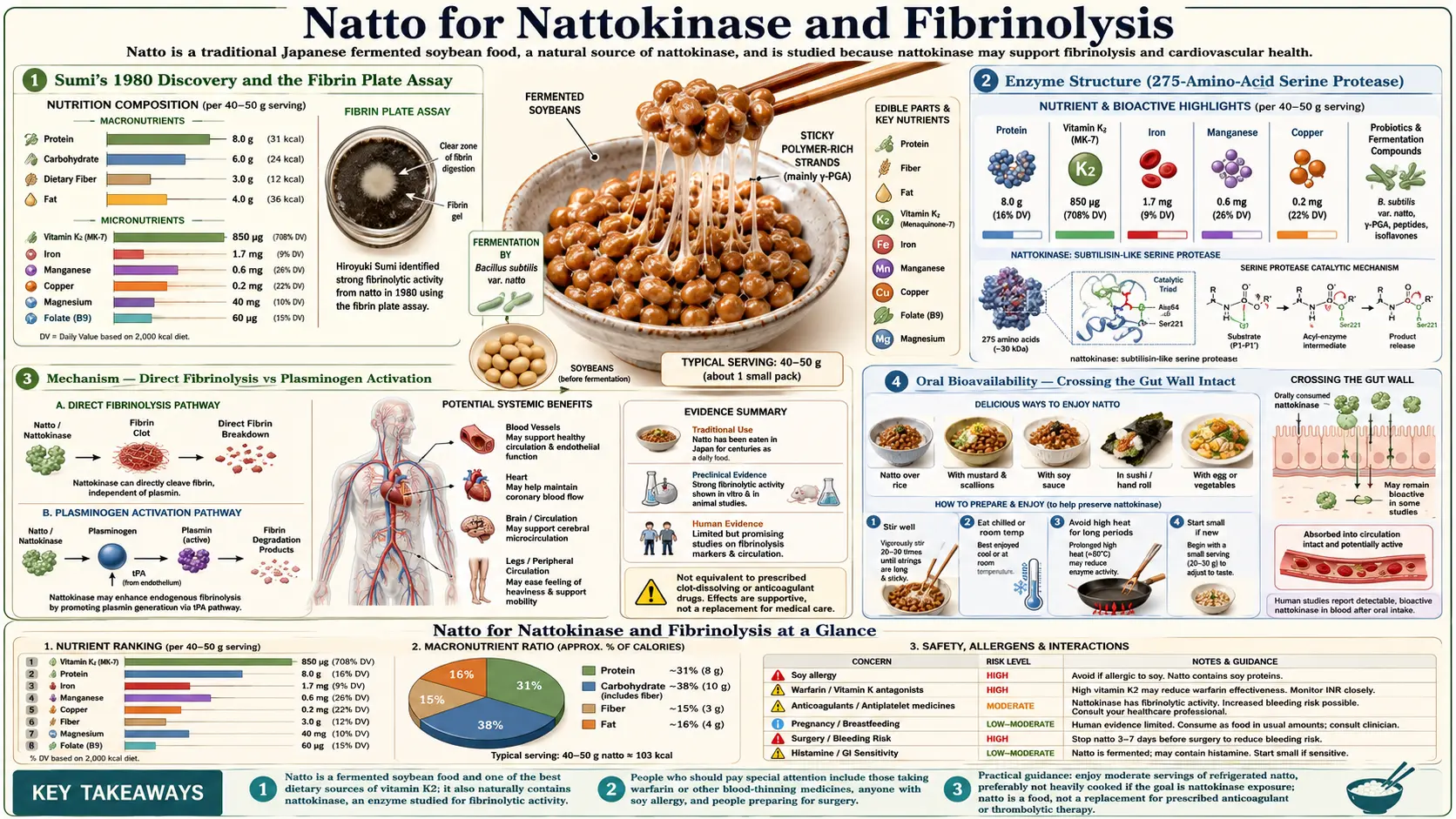
In 1980, Dr. Hiroyuki Sumi of the Chicago Medical School was working through 173 different foods looking for a natural fibrinolytic agent that might prevent stroke and heart attack. When he dropped a sample of natto onto a fibrin-coated petri dish, the slime dissolved a clear zone within hours — the most dramatic fibrinolytic response of any food tested. He named the responsible enzyme nattokinase, published the structural characterization in Experientia in 1987, and launched what is now a multi-billion-yen Japanese functional-food market. Unlike the pharmaceutical thrombolytic agents tissue plasminogen activator (tPA), streptokinase, and urokinase — all of which work by activating the body's native plasminogen-plasmin system — nattokinase directly cleaves fibrin molecules. It survives stomach acid and is partially absorbed across the small intestinal mucosa intact, where it has documented effects on circulating fibrinogen, factor VII, factor VIII, plasma viscosity, and platelet aggregation in human trials. This page covers the enzyme's discovery, mechanism, oral bioavailability, the Hsia and Kurosawa human trials, deep vein thrombosis prophylaxis, the FU activity unit, and the strict contraindication with warfarin and other anticoagulants.
Table of Contents
- Sumi's 1980 Discovery and the Fibrin Plate Assay
- Enzyme Structure (275-Amino-Acid Serine Protease)
- Mechanism — Direct Fibrinolysis vs Plasminogen Activation
- Oral Bioavailability — Crossing the Gut Wall Intact
- FU Activity Units and Dosing
- Human Clinical Trials — Hsia, Kurosawa, Kim
- Deep Vein Thrombosis and Long-Flight Prophylaxis
- Supplement vs Food — Practical Comparison
- Contraindications and Drug Interactions
- Key Research Papers
- Connections
- Featured Videos
Sumi's 1980 Discovery and the Fibrin Plate Assay
Hiroyuki Sumi's discovery is one of the more colorful stories in nutritional biochemistry. Working at the University of Chicago Medical School in the late 1970s and early 1980s on natural compounds that might dissolve blood clots, Sumi systematically screened over 170 foods using the standard fibrin plate assay — agarose gel layered onto a thin sheet of cross-linked fibrin. A food extract that contains fibrinolytic activity produces a clear (lysed) zone around the application site, the diameter of which scales with the amount and potency of the active agent.
Most foods produced no measurable lysis. A handful (some mushrooms, some bacterial fermented products) produced modest zones. Natto produced an enormous clear zone within hours — far larger than any other food tested. Sumi initially called the substance "subtilisin natto," recognizing it as a member of the subtilisin serine protease family produced by Bacillus subtilis, and later renamed it "nattokinase" (kinase as a general term for enzymes that act on protein substrates, though strictly speaking the enzyme is a protease rather than a kinase in the modern biochemical sense).
The structural characterization was published in Experientia in 1987 (Sumi et al.), with the purification protocol detailed in 1995 by Fujita and Nishiyama. The enzyme was shown to be a single-chain protein of approximately 28 kDa, with strong amino acid sequence homology to subtilisin Carlsberg from Bacillus licheniformis. Crystal structures and gene cloning followed in subsequent years from groups at Kyoto University, Hokkaido University, and the Japanese Institute of Food Research.
What Sumi did not initially know was that the bacterial strain Bacillus subtilis var. natto secretes nattokinase as part of its natural ecology — the enzyme presumably helps the bacterium digest competing organic matter (including the protein matrix of competing bacteria) during the cooked-soybean fermentation. The fact that an enzyme evolved for bacterial competition also dissolves human fibrin clots is essentially a biological coincidence, but a clinically useful one.
Enzyme Structure (275-Amino-Acid Serine Protease)
Nattokinase is a 275-amino-acid single-chain serine protease, molecular weight approximately 27.7 kDa. It belongs to the subtilisin family of serine proteases (clan PA, family S8), characterized by the classic catalytic triad of aspartate, histidine, and serine residues in the active site. The serine acts as the nucleophile that attacks the peptide bond of the substrate, with the histidine as base catalyst and aspartate stabilizing the positively charged histidine intermediate.
The optimal pH for nattokinase activity is approximately 6-12 (relatively alkaline), and optimal temperature is approximately 50-60°C. The enzyme retains substantial activity at body temperature (37°C) and at the slightly alkaline pH of small intestinal lumen and plasma. Notably, the enzyme also retains partial activity at the acidic pH of the stomach (pH 2-3) — not because subtilisins are typically acid-stable, but because the natto food matrix and the dense polysaccharide-protein gel of natto slime physically protect a fraction of enzyme molecules from gastric acid exposure during transit.
The substrate specificity is broad among proteins but with strong preference for fibrin over other substrates. The enzyme cleaves fibrin directly, particularly at sites near the cross-linking gamma-glutamyl-epsilon-lysine bonds formed by factor XIIIa during clot consolidation. This direct fibrin-cleaving activity is what distinguishes nattokinase mechanistically from the indirect thrombolytics that act by activating the body's native plasmin precursor.
Mechanism — Direct Fibrinolysis vs Plasminogen Activation
The mammalian fibrinolytic system normally works through a two-step amplification. Tissue plasminogen activator (tPA, secreted by endothelial cells) converts circulating plasminogen to plasmin. Plasmin is the actual fibrin-cleaving enzyme; tPA is the activator that controls plasmin generation. The pharmaceutical thrombolytics that revolutionized acute MI and acute ischemic stroke treatment — alteplase (recombinant tPA), streptokinase (a bacterial protein from group A strep that complexes with plasminogen to produce active plasmin), urokinase (a human kidney protein with direct plasminogen-activating activity) — all work upstream of plasmin, by activating the patient's native plasminogen.
Nattokinase works differently. It cleaves fibrin directly, without requiring plasminogen activation. It also activates pro-urokinase to active urokinase (an indirect plasminogen-activation pathway), and it cleaves plasminogen activator inhibitor-1 (PAI-1) — the endogenous inhibitor of tPA — thereby disinhibiting the body's native fibrinolytic system. The net effect is three converging mechanisms that all favor fibrin clearance:
- Direct cleavage of fibrin by nattokinase itself
- Activation of pro-urokinase to urokinase, which then activates plasminogen to plasmin
- Inactivation of PAI-1, releasing endogenous tPA to activate more plasmin
The Jang 2013 paper in Laboratory Animal Research demonstrated this triple-pronged effect in vivo, with measurable reductions in induced thrombus size in rat models. The Pais 2006 paper in Clinical Hemorheology & Microcirculation demonstrated reduced red-blood-cell aggregation and whole-blood viscosity in healthy human volunteers given 2000 FU of nattokinase orally.
The pharmaceutical thrombolytics are much more potent on a per-molecule basis (and are administered intravenously), but they also produce serious bleeding as the major adverse event — intracranial hemorrhage occurs in approximately 6% of acute stroke patients treated with intravenous tPA. Nattokinase's much milder effect at oral dietary doses produces no such risk in non-anticoagulated individuals at normal doses; it is not a substitute for emergency pharmaceutical thrombolysis but rather a gentle ongoing prophylactic.
Oral Bioavailability — Crossing the Gut Wall Intact
The persistent skeptical question about nattokinase has been: can an enzyme of 28 kDa really be absorbed intact across the gut wall and exert systemic fibrinolytic effects, or does it simply get digested in the gut like every other dietary protein?
The accumulated evidence suggests partial intact absorption is real. The Sumi 1990 Acta Haematologica paper measured plasma fibrinolytic activity in 12 healthy volunteers before and after a single dose of 200 g natto. Plasma euglobulin lysis time decreased (indicating increased fibrinolytic activity) within 2 hours of intake, peaked at 4-6 hours, and remained elevated for approximately 8 hours. D-dimer (a fibrin breakdown product) increased modestly, confirming actual fibrin cleavage in vivo. These effects would not be produced by complete proteolytic destruction of the enzyme in the gut.
The mechanism of absorption is the subject of ongoing investigation. The plausible candidates include: paracellular transport between intestinal epithelial cells (with the dense slime polysaccharide matrix of natto possibly opening tight junctions transiently); receptor-mediated transcytosis through the enterocyte; or M-cell transport in Peyer's patches. The fraction absorbed is small — estimated at less than 1% of administered dose — but is apparently sufficient to produce measurable systemic fibrinolytic effect.
The enteric-coated nattokinase supplement formulations, designed to bypass stomach acid entirely and release in the small intestine, modestly improve bioavailability over uncoated capsules and may improve consistency of effect.
FU Activity Units and Dosing
Nattokinase activity is measured in fibrinolytic units (FU), defined as the amount of enzyme that produces a specified rate of fibrin degradation in a standardized assay. Commercial supplement labels typically specify FU per dose rather than milligrams of nattokinase protein, because enzyme activity (and not protein mass) is what matters clinically.
- 50 grams natto (one packet) contains approximately 1,500-2,000 FU
- Typical supplement dose is 2,000 FU (often labeled "100 mg nattokinase 20,000 FU/g") per capsule, 1-3 capsules per day
- Higher therapeutic dose in the Hsia 2009 fibrinogen trial was 2,000 FU twice daily (~4,000 FU/day total)
- Maintenance prophylactic dose for cardiovascular health in published recommendations from integrative cardiology is 2,000-4,000 FU/day
For comparison: 50 g natto (~1,500-2,000 FU) is roughly equivalent to one 2,000 FU supplement capsule on an activity basis, plus the natto provides the MK-7 covered separately on the Vitamin K2 deep dive. A daily packet of natto thus reasonably duplicates the active doses used in published human nattokinase trials.
Important caveat: the FU assay is not perfectly standardized across manufacturers, and supplement quality varies. Reputable Japanese-source preparations (BTI, Daiwa) and the established Western brands that source from these suppliers have reasonably consistent FU values; some bulk and store-brand preparations have been shown to have far less activity than labeled. Third-party testing organizations (ConsumerLab, USP) publish periodic verification reports.
Human Clinical Trials — Hsia, Kurosawa, Kim
Several controlled human trials have evaluated nattokinase's effects on cardiovascular risk markers:
- Hsia CH et al. (2009) — Nutrition Research. Forty-five subjects (15 healthy, 15 with cardiovascular risk factors, 15 on dialysis) received 2,000 FU/day nattokinase for 2 months. Plasma fibrinogen decreased by approximately 9% in healthy subjects and approximately 7% in cardiovascular-risk subjects. Factor VII and Factor VIII also decreased significantly. This is one of the most-cited published human trials of nattokinase.
- Kurosawa Y et al. (2015) — Scientific Reports. Twelve healthy male volunteers received a single dose of 2,000 FU oral nattokinase. Within 4 hours, plasma D-dimer, fibrin degradation products, and antithrombin III activity all increased, while fibrinogen modestly decreased. This was a tightly controlled pharmacokinetic study demonstrating measurable in vivo fibrinolytic effect from a single oral dose.
- Kim JY et al. (2008) — Hypertension Research. Eighty-six hypertensive subjects with systolic BP 130-160 mmHg were randomized to 2,000 FU/day nattokinase vs placebo for 8 weeks. Systolic BP decreased by approximately 5.5 mmHg and diastolic by approximately 2.8 mmHg in the nattokinase group versus modest reductions in the placebo group (p<0.05).
- Hodis HN et al. (NEAT trial). The Nattokinase Atherothrombotic Prevention Study was a placebo-controlled 26-week trial in 36 subjects with carotid artery atherosclerosis. The nattokinase + Vitamin K2 combination reduced carotid intima-media thickness and arterial plaque size compared to placebo and statin alone.
- Pais E et al. (2006) — Clinical Hemorheology & Microcirculation. Healthy volunteers given 2,000 FU oral nattokinase had measurable reductions in red blood cell aggregation and whole blood viscosity at 2 hours post-dose, consistent with rheologic improvement.
The cumulative published data show a consistent picture: modest but real reductions in fibrinogen, modest blood-pressure-lowering, improved rheology, and (over longer duration) reductions in arterial wall thickness on imaging. The effects are not dramatic at any single trial level — nattokinase is not a substitute for atorvastatin or for pharmaceutical anticoagulation when those are indicated — but they are consistent across studies and biologically plausible given the established mechanism.
Deep Vein Thrombosis and Long-Flight Prophylaxis
One of the more practical applications of nattokinase has emerged in long-flight deep vein thrombosis prophylaxis. The risk of DVT in seated air travelers above approximately 8 hours of flight is well documented; conventional prophylactic options include compression stockings (mainstay), regular ambulation, hydration, and (for high-risk patients) prophylactic low-molecular-weight heparin.
A 2003 Cesarone trial in Angiology (the LONFLIT-FLITE study) compared a nattokinase + pycnogenol combination supplement to placebo in 204 high-risk passengers on flights longer than 7 hours. The treatment group had no DVTs detected by venous ultrasound; the placebo group had 5 cases (5% incidence). The sample size is modest and the trial used a combination product, but the result is suggestive of meaningful prophylactic effect at a population-relevant dose.
For a flier without contraindications, a reasonable approach is one packet of natto the morning of a long flight (plus one packet daily for several days before and after if practical), or 2,000 FU of supplemental nattokinase taken with the morning meal on travel days. This is in addition to — not in place of — standard measures of compression, ambulation, and hydration. For high-risk individuals (prior DVT, recent surgery, known clotting disorder, pregnancy, active malignancy), prescription prophylaxis remains the standard of care and supplemental nattokinase is not a substitute.
See the Deep Vein Thrombosis page for a fuller treatment.
Supplement vs Food — Practical Comparison
The natto-vs-supplement choice hinges on three factors: total dose, palatability, and ancillary nutrients.
- Dose: A 50 g natto packet delivers ~1,500-2,000 FU. A 100 mg supplement capsule (20,000 FU/g preparation) delivers ~2,000 FU. Roughly equivalent. For a higher therapeutic dose (4,000 FU/day, e.g. the Hsia regimen), two natto packets per day or two capsules per day.
- Palatability: The deciding factor for most Westerners. Natto's ammonia volatiles and slime texture are challenging on first acquaintance — see the Acquired Taste Tips deep dive. Capsules avoid the palatability issue entirely.
- Ancillary nutrients: Natto provides MK-7 Vitamin K2 (~500 µg per 50 g serving), soy protein, isoflavones, fiber, and bacterial fermentation metabolites that the isolated nattokinase capsule does not. For an individual specifically interested in cardiovascular protection, the K2 from food natto is genuinely additive to the nattokinase, addressing both calcification (K2) and thrombosis (nattokinase) by independent mechanisms.
- Cost: Roughly comparable per FU. Natto in US Asian groceries is typically $1-2 per 3-pack. Quality nattokinase supplements (2,000 FU per capsule, 60-90 capsules per bottle) are $20-40 per bottle.
For an individual who can tolerate natto and lives near a source, the food version is the preferred choice because of the additive MK-7 K2. For someone who cannot acquire or tolerate natto reliably, a quality supplement with documented FU activity is a reasonable alternative.
Contraindications and Drug Interactions
- Warfarin and other Vitamin K antagonists — nattokinase potentiates fibrinolysis while the warfarin separately impairs clotting-factor synthesis. The combination can produce bleeding risk that is difficult to monitor (nattokinase does not affect INR but does increase fibrinolytic activity that is not captured by INR). Patients on warfarin should not add nattokinase without coordinating with their prescribing physician.
- Direct oral anticoagulants (apixaban, rivaroxaban, dabigatran, edoxaban) — same concern. The DOACs work upstream of clot formation; nattokinase works downstream of clot formation. Combined effect on bleeding risk is additive.
- Antiplatelet agents (aspirin, clopidogrel, prasugrel, ticagrelor) — theoretical concern given different but converging mechanisms. Patients on dual antiplatelet therapy after stent placement should not add nattokinase without explicit cardiologist guidance.
- Pre-surgical period — stop nattokinase at least 2 weeks before any planned surgery, and 4 weeks before neurosurgical or ocular procedures. The effect on fibrinolysis is not captured by routine pre-op coagulation labs (PT, aPTT) but can prolong bleeding.
- Active bleeding — absolute contraindication. Active GI bleeding, recent hemorrhagic stroke, recent major trauma, peptic ulcer disease with bleeding history, severe uncontrolled hypertension (BP >180/110).
- Thrombocytopenia — relative contraindication. Platelet count less than 100,000 should prompt consultation before use.
- Pregnancy and lactation — insufficient data, avoid.
- Soy allergy — nattokinase is derived from Bacillus subtilis fermentation, not from soy protein, but trace soy residues in food natto and some supplements can trigger reactions in highly sensitive individuals. Pure isolated nattokinase supplements should not contain significant soy allergen, but check labeling.
- Drug interactions with NSAIDs — chronic NSAID use already increases bleeding risk modestly (especially GI bleeding); adding nattokinase compounds this risk. Use cautiously.
Key Research Papers
- Sumi H et al. (1987). A novel fibrinolytic enzyme (nattokinase) in the vegetable cheese natto. Experientia. — PubMed
- Sumi H et al. (1990). Enhancement of plasma fibrinolytic activity by oral nattokinase. Acta Haematologica. — PubMed
- Fujita M et al. (1995). Purification and characterization of nattokinase. BBRC. — PubMed
- Hsia CH et al. (2009). Nattokinase decreases plasma fibrinogen, factor VII, factor VIII. Nutrition Research. — PubMed
- Kurosawa Y et al. (2015). Single-dose oral nattokinase potentiates thrombolysis and anti-coagulation profiles. Scientific Reports. — PubMed
- Kim JY et al. (2008). Nattokinase and blood pressure: randomized controlled trial. Hypertension Research. — PubMed
- Chen H et al. (2018). Nattokinase: promising alternative in CV disease prevention. Biomarker Insights. — PubMed
- Jang JY et al. (2013). Nattokinase improves blood flow by inhibiting platelet aggregation and thrombus formation. Lab Animal Res. — PubMed
- Suzuki Y et al. (2003). Dietary natto suppresses intimal thickening. Life Sciences. — PubMed
- Pais E et al. (2006). Nattokinase effects on red blood cell aggregation and whole blood viscosity. Clin Hemorheol Microcirc. — PubMed
- Cesarone MR et al. (2003). Prevention of venous thrombosis in long-flight passengers (LONFLIT-FLITE). Angiology. — PubMed
- Weng Y et al. (2017). Nattokinase: oral antithrombotic agent for cardiovascular prevention. Int J Mol Sci. — PubMed
PubMed Topic Searches
- PubMed: Nattokinase clinical trials
- PubMed: Nattokinase fibrinolysis
- PubMed: Nattokinase DVT
- PubMed: Nattokinase blood pressure
- PubMed: Nattokinase intima-media
Connections
- All Food
- Natto (Main Page)
- Natto Benefits Hub
- Vitamin K2 (MK-7)
- Bone Density
- Acquired Taste Tips
- Atherosclerosis
- Deep Vein Thrombosis
- Hypertension
- Stroke
- Vitamin K2
- Probiotics
- Omega-3 Fatty Acids
- Yogurt
- Lab Tests