Milk — Benefits Deep Dive
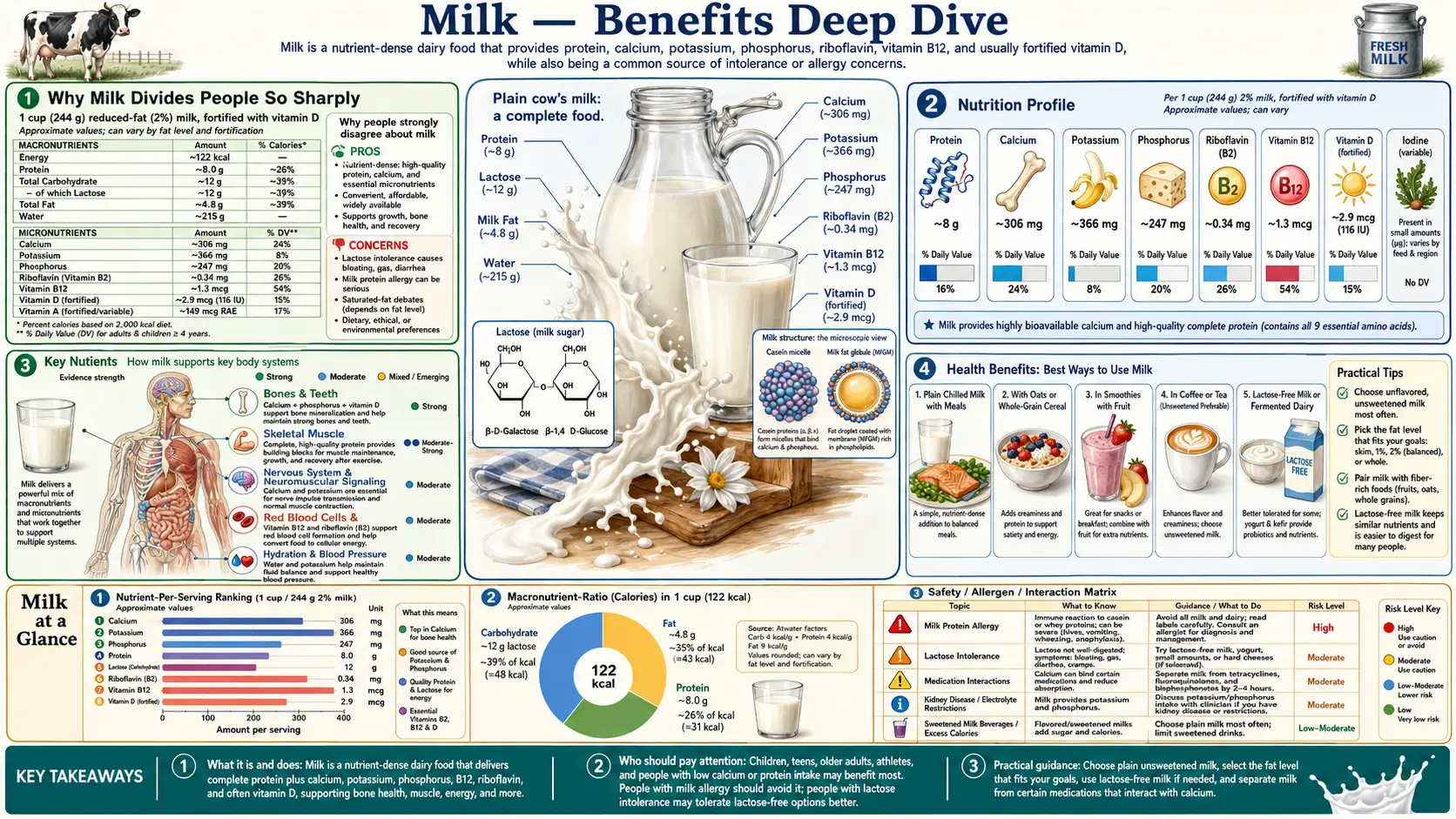
Cow's milk is one of the most consumed and most debated foods in the modern diet. Genuinely it delivers high-quality complete protein, the most concentrated dietary source of calcium, vitamin B12, riboflavin, iodine, and (when fortified) vitamin D. Yet four specific axes of variation — casein variant (A1 vs A2), processing (raw vs pasteurized), feeding regimen (grass-fed vs grain-fed), and the consumer's own lactase genotype — determine whether any given bottle of milk acts as a near-complete food or a source of digestive distress. The four deep-dive pages below examine each axis with the underlying biochemistry and the actual randomized-controlled-trial evidence.
Deep-Dive Articles
A1 vs A2 Casein
The single amino-acid difference at position 67 of the beta-casein chain (histidine in A1 vs proline in A2) determines whether digestion releases the opioid-like peptide beta-casomorphin-7 (BCM-7). Why most Holstein-derived herds produce A1, why Jersey, Guernsey, goat, sheep, buffalo, and human milk produce only A2, and what the published RCTs actually show about GI symptoms, transit time, and inflammatory markers.
Raw vs Pasteurized
What HTST (72°C/15 sec), UHT (135°C/2 sec), and vat pasteurization actually do to milk proteins, vitamins, and pathogens. Why pathogen kill is essentially complete with proper pasteurization, what the residual heat damage to whey, vitamin C, B12, and folate looks like quantitatively, and the FDA / CDC outbreak data on raw milk listeriosis, brucellosis, and pediatric HUS.
Grass-Fed & CLA
The omega-3, conjugated linoleic acid (CLA), beta-carotene, and vitamin K2 advantages of milk from cows on pasture vs total mixed ration. The omega-6:omega-3 ratio narrows from ~5.7:1 in conventional milk to ~2:1 in grass-fed, CLA concentrations roughly double, and the carotenoid content (visible as a yellower butterfat) doubles to triples. What the human-trial evidence does and does not support.
Lactose Intolerance
The MCM6 / LCT regulatory region, the −13910*T allele that drives lactase persistence in 95% of Northern Europeans but only 5% of East Asians, the difference between lactose intolerance (LI) and milk-protein allergy, the threshold dose (12 g) below which most LI individuals are asymptomatic, the role of yogurt and kefir microbial beta-galactosidase, and the lactase enzyme supplement options.
Table of Contents
- Deep-Dive Articles
- Why Milk Divides People So Sharply
- Research Papers: A1 vs A2 Casein
- Research Papers: Raw vs Pasteurized
- Research Papers: Grass-Fed and CLA
- Research Papers: Lactose Intolerance
- Research Papers: Cross-Cutting (Bone, Cardiovascular, Cancer)
- External Authoritative Resources
- Connections
- Featured Videos
Why Milk Divides People So Sharply
Milk is unusual among foods in that its biological effect on any given individual depends on three different layers of genetic and biochemical variability — one in the cow, one in the processor, and one in the consumer.
- The cow's casein genotype. A single base substitution in the beta-casein gene (CSN2) determines whether the milk contains the ancestral A2 variant or the more recently arisen A1 variant. Digestion of A1 beta-casein releases the seven-amino-acid opioid-like peptide beta-casomorphin-7 (BCM-7), which appears to slow gut transit and trigger inflammation in a subset of consumers. Originally all cattle produced A2; the A1 mutation arose roughly 5,000-10,000 years ago and is now dominant in most Holstein-Friesian herds. The first deep-dive page walks through the biochemistry and the human-trial evidence on GI symptoms.
- The processor's thermal regimen. HTST pasteurization at 72°C for 15 seconds kills essentially all pathogenic organisms while causing only modest damage to vitamin C, B12, folate, and the whey proteins. UHT at 135°C for 2 seconds extends shelf life dramatically but causes substantially more whey denaturation and a measurable loss of B vitamins. Raw milk preserves all native enzymes and vitamins but carries a documented risk of Listeria, Campylobacter, Salmonella, Shiga-toxin-producing E. coli, and Brucella infection. The second deep-dive page quantifies the trade-offs.
- The consumer's lactase genotype. The MCM6 regulatory region upstream of the LCT (lactase) gene contains the −13910*T variant that keeps lactase expression high into adulthood. The variant is present in ~95% of Northern Europeans, ~50% of Southern Europeans, ~25% of West Africans, and ~5% of East Asians and Native Americans. Adults without the variant lose intestinal lactase expression after weaning and develop osmotic diarrhea, bloating, and flatulence when they consume more than about 12 grams of lactose at one sitting (roughly one cup of milk). The fourth deep-dive page covers the genetics, the threshold dose, and the workarounds.
A fourth axis — the cow's feed and pasture access — modulates the fatty-acid profile (omega-3:omega-6 ratio, CLA content) and the fat-soluble vitamin content (beta-carotene, vitamin K2) of the milk fat. This axis is independent of the casein and lactose questions and matters most for individuals consuming whole milk and butter rather than skim.
The implication is that "is milk good for you?" is not a single answer. For a Northern European adult with the lactase-persistence variant, drinking grass-fed A2 whole milk, the answer is essentially yes — high-quality complete protein, the most concentrated calcium source in the diet, a good vitamin B12 vehicle, and the omega-3 and CLA bonus from pasture. For a Han Chinese adult without the lactase variant, drinking conventional A1 skim milk, the answer is essentially no — predictable GI distress and minimal nutritional advantage over fermented dairy or non-dairy calcium sources. The four deep-dive pages below give you the tools to figure out where on that spectrum you sit.
Research Papers: A1 vs A2 Casein
- Kamiński S et al., Polymorphism of bovine beta-casein and its potential effect on human health (2007 review) PubMed: Kamiński 2007
- Jianqin S et al., Effects of milk containing only A2 beta casein versus milk containing both A1 and A2 beta casein on gastrointestinal physiology, symptoms of discomfort, and cognitive behavior (Nutr J 2016) — PubMed PMID 27039383
- Ho S et al., Comparative effects of A1 versus A2 beta-casein on gastrointestinal measures: a blinded randomized cross-over pilot study (Eur J Clin Nutr 2014) — Search PubMed
- Brooke-Taylor S et al., Systematic review of the gastrointestinal effects of A1 compared with A2 beta-casein (Adv Nutr 2017) — Search PubMed
- Sheng X et al., Effects of conventional milk versus milk containing only A2 beta-casein on digestion in Chinese children (J Pediatr Gastroenterol Nutr 2019) — Search PubMed
- Pal S et al., Milk intolerance, beta-casein and lactose (Nutrients 2015) — PubMed PMID 26404362
- Beta-casomorphin-7 (BCM-7) opioid activity and gut release PubMed: BCM-7 search
- Kullenberg de Gaudry D et al., Milk A1 beta-casein and health-related outcomes (Cochrane / systematic review) PubMed: A1/A2 systematic review
- Truswell AS, The A2 milk case: a critical review (Eur J Clin Nutr 2005) — PubMed PMID 15867940
- Cieslinska A et al., Beta-casomorphins and human health (Peptides 2012) PubMed: Cieslinska BCM review
Research Papers: Raw vs Pasteurized
- Lucey JA, Raw milk consumption: risks and benefits (Nutr Today 2015) — PubMed PMID 27340300
- Mungai EA, Behravesh CB, Gould LH, Increased outbreaks associated with non-pasteurized milk, United States 2007-2012 (Emerg Infect Dis 2015) — Search PubMed
- Macdonald LE et al., A systematic review and meta-analysis of the effects of pasteurization on milk vitamins (J Food Prot 2011) — Search PubMed
- Headrick ML et al., The epidemiology of raw milk-associated foodborne disease outbreaks reported in the United States, 1973-1992 (Am J Public Health 1998) — Search PubMed
- Loss G et al., Consumption of unprocessed cow's milk protects infants from common respiratory infections (PASTURE study) — Search PubMed
- Pasteurization effects on milk whey proteins (denaturation kinetics) PubMed: Whey denaturation
- Listeria monocytogenes and raw milk outbreaks PubMed: Listeria raw milk
- Brucellosis from raw dairy consumption PubMed: Brucellosis raw milk
- Shiga-toxin-producing E. coli and pediatric HUS from raw dairy PubMed: STEC raw milk HUS
- Vitamin B12, folate, and B6 retention in pasteurized vs UHT milk PubMed: B vitamins UHT
Research Papers: Grass-Fed and CLA
- Benbrook CM et al., Enhancing the fatty acid profile of milk through forage-based rations, with nutrition modeling of dietary outcomes (Food Sci Nutr 2018) — Search PubMed
- Dewhurst RJ et al., Increasing the concentrations of beneficial polyunsaturated fatty acids in milk produced by dairy cows in high-forage systems (Anim Feed Sci Technol 2006) PubMed: Dewhurst forage omega-3
- Couvreur S et al., The linear relationship between the proportion of fresh grass in the cow diet, milk fatty acid composition, and butter properties (J Dairy Sci 2006) — PubMed PMID 16606738
- Ip C et al., Conjugated linoleic acid: a powerful anticarcinogen from animal fat sources (Cancer 1994) — Search PubMed
- Belury MA, Dietary conjugated linoleic acid in health: physiological effects and mechanisms of action (Annu Rev Nutr 2002) — Search PubMed
- Smit LA et al., Conjugated linoleic acid in adipose tissue and risk of myocardial infarction (Am J Clin Nutr 2010) — Search PubMed
- Vitamin K2 (MK-4) content of pasture-fed dairy PubMed: K2 in pasture dairy
- Beta-carotene transfer from pasture to milk fat (yellow butterfat) PubMed: Carotenoid transfer
- Rumenic acid (cis-9, trans-11 CLA) endogenous synthesis from vaccenic acid PubMed: Vaccenic to rumenic
- Omega-6:Omega-3 ratio in conventional vs grass-fed dairy PubMed: O6/O3 dairy ratio
Research Papers: Lactose Intolerance
- Enattah NS et al., Identification of a variant associated with adult-type hypolactasia (Nat Genet 2002) — PubMed PMID 11788828
- Tishkoff SA et al., Convergent adaptation of human lactase persistence in Africa and Europe (Nat Genet 2007) — PubMed PMID 17159977
- Suchy FJ et al., NIH consensus development conference statement: lactose intolerance and health (Ann Intern Med 2010) — PubMed PMID 20404261
- Savaiano DA et al., Lactose digestion from yogurt: mechanism and relevance (Am J Clin Nutr 2014) — Search PubMed
- Misselwitz B et al., Update on lactose malabsorption and intolerance: pathogenesis, diagnosis and clinical management (Gut 2019) — Search PubMed
- Storhaug CL et al., Country, regional, and global estimates for lactose malabsorption in adults: a systematic review and meta-analysis (Lancet Gastroenterol Hepatol 2017) — PubMed PMID 28690131
- Hertzler SR, Savaiano DA, Colonic adaptation to daily lactose feeding in lactose maldigesters reduces lactose intolerance (Am J Clin Nutr 1996) — Search PubMed
- Lactase enzyme supplementation efficacy trials PubMed: Lactase supplements
- Hydrogen breath test for lactose malabsorption diagnosis PubMed: H2 breath test
- Kefir vs milk in lactose maldigesters — PubMed PMID 12728216
Research Papers: Cross-Cutting (Bone, Cardiovascular, Cancer)
- Weaver CM, Heaney RP, Calcium in human health (book chapters / NIH reviews) PubMed: Weaver/Heaney calcium
- Soedamah-Muthu SS et al., Milk and dairy consumption and incidence of cardiovascular diseases and all-cause mortality: dose-response meta-analysis of prospective cohort studies (Am J Clin Nutr 2011) — PubMed PMID 21068345
- Drouin-Chartier JP et al., Systematic review of the association between dairy product consumption and risk of cardiovascular-related clinical outcomes (Adv Nutr 2016) — Search PubMed
- Aune D et al., Dairy products and the risk of type 2 diabetes: a systematic review and dose-response meta-analysis of cohort studies (Am J Clin Nutr 2013) — Search PubMed
- Aune D et al., Dairy products, calcium, and prostate cancer risk: a systematic review and meta-analysis of cohort studies (Am J Clin Nutr 2015) — PubMed PMID 25527754
- Bischoff-Ferrari HA et al., Milk intake and risk of hip fracture in men and women: meta-analysis of prospective cohort studies (J Bone Miner Res 2011) — PubMed PMID 20949604
- Aune D et al., Dairy products and colorectal cancer risk (Ann Oncol 2012) — PubMed PMID 22241899
- Rautiainen S et al., Dairy consumption in association with weight change and risk of becoming overweight or obese in middle-aged and older women: a prospective cohort study (Am J Clin Nutr 2016) — Search PubMed
- Insulin-like growth factor 1 (IGF-1) response to milk consumption PubMed: Milk and IGF-1
- Dairy fat (whole vs low-fat) and cardiometabolic outcomes review PubMed: Whole vs low-fat dairy
External Authoritative Resources
- NIH Office of Dietary Supplements — Calcium Fact Sheet (Health Professionals)
- CDC — Raw Milk Q&A (outbreak data, regulatory background)
- FDA — The Dangers of Raw Milk
- NIH NIA — Lactose Intolerance Information
- MedlinePlus — Lactose Intolerance
- PubMed — All research on milk and dairy health
Connections
- All Food
- Milk (Main Page)
- A1 vs A2 Casein
- Raw vs Pasteurized
- Grass-Fed and CLA
- Lactose Intolerance
- Yogurt
- Eggs
- Calcium
- Vitamin D3
- Vitamin K2
- Vitamin B12
- Creatine
- Leucine
- Gastroenterology