Raw vs Pasteurized Milk — Pathogen Risk, Nutrient Retention, and the Evidence
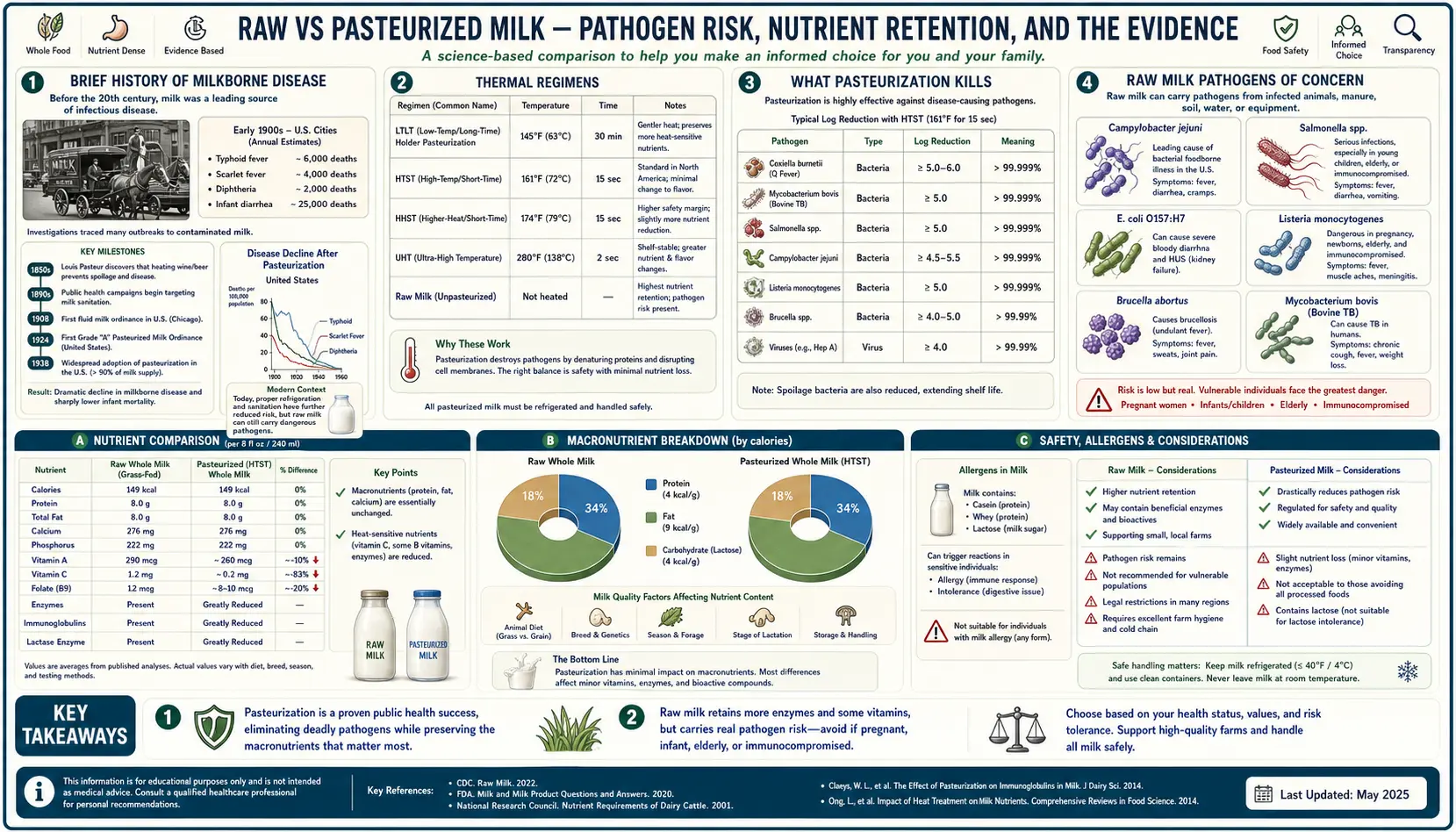
Pasteurization is the single most consequential public-health intervention in the modern dairy industry. Before its widespread adoption in the 1920s, milkborne tuberculosis, brucellosis, typhoid, and scarlet fever killed tens of thousands of children annually in the United States and Europe. The standard HTST regimen (72°C for 15 seconds) reduces pathogenic organisms by at least 5 log10 (a 100,000-fold reduction) while causing only modest losses in heat-sensitive vitamins. The raw-milk-revival movement frames the trade-off as a personal-choice issue, but the CDC outbreak data of the last twenty years is unambiguous: raw dairy products account for the overwhelming majority of dairy-associated foodborne illness in the United States, despite making up under 1% of dairy consumption.
Table of Contents
- A Brief History of Milkborne Disease
- The Thermal Regimens
- What Pasteurization Kills
- Raw Milk Pathogens of Concern
- CDC and FDA Outbreak Data
- Nutrient Effects of Heat Treatment
- Enzyme and Immunoglobulin Claims
- PASTURE / GABRIEL Studies on Asthma
- Practical Guidance
- Research Papers
- External Resources
- Connections
- Featured Videos
1. A Brief History of Milkborne Disease
In the late nineteenth and early twentieth centuries, raw milk was a major vector for fatal childhood disease in the industrializing world. Bovine tuberculosis transmitted through raw milk accounted for an estimated 25-30% of all pediatric tuberculosis cases in the United States in 1900, and roughly 65,000 deaths attributable to milkborne tuberculosis were documented in the US between 1907 and 1932. Milkborne typhoid, scarlet fever, diphtheria, and septic sore throat outbreaks were chronic public-health crises in dense urban populations where the supply chain extended from increasingly large dairies to apartment dwellers without refrigeration.
The first commercial pasteurization plant in the United States was opened in 1891. Chicago required pasteurization of milk in 1908; New York City mandated it in 1914. By the 1950s, mandatory pasteurization had been adopted by most US states. Bovine tuberculosis in humans declined by over 99% between 1900 and 1960 as a direct consequence. The historical record is one of the cleanest examples of a single public-health intervention producing a near-complete elimination of an endemic disease.
2. The Thermal Regimens
Three thermal regimens are in commercial use:
- Vat pasteurization (LTLT, low-temperature long-time): 63°C (145°F) for 30 minutes. The original commercial method, still used by small dairies and for cheese-making where high-temperature protein denaturation would impair clotting. Shelf life of refrigerated milk is approximately 14-21 days.
- HTST (high-temperature short-time, "flash" pasteurization): 72°C (161°F) for 15 seconds. The standard method for fluid milk in the United States. Shelf life of refrigerated milk is approximately 14-21 days, depending on initial bacterial load and packaging.
- UHT (ultra-high-temperature): 135-138°C (275-280°F) for 2-5 seconds. Followed by aseptic packaging. Produces a shelf-stable product that does not require refrigeration until opened, with an unopened shelf life of 6-9 months. Standard for fluid milk in continental Europe; less common in the US.
Each step up in temperature increases pathogen kill (reaching essentially complete sterilization with UHT) but also increases denaturation of whey proteins and degradation of heat-sensitive vitamins.
3. What Pasteurization Kills
The HTST regimen is calibrated to achieve a 5-log10 reduction (a 100,000-fold reduction) of Coxiella burnetii, the etiologic agent of Q fever and the most heat-resistant non-spore-forming pathogen that may occur in raw milk. By achieving a 5-log10 reduction of C. burnetii, HTST also achieves complete (greater than 6-log10) reduction of all the more heat-sensitive vegetative bacterial pathogens: Mycobacterium bovis, Brucella abortus, Listeria monocytogenes, Salmonella spp., Campylobacter jejuni, Yersinia enterocolitica, Shiga-toxin-producing Escherichia coli (including O157:H7), and Staphylococcus aureus.
Pasteurization does not kill bacterial spores (so spore-forming organisms such as Bacillus cereus can survive, but these are rarely a clinical concern at the levels surviving in pasteurized milk), and pasteurization does not destroy preformed heat-stable toxins (so milk that was heavily contaminated with Staphylococcus aureus producing enterotoxin before pasteurization can still cause foodborne illness).
4. Raw Milk Pathogens of Concern
The pathogens most commonly implicated in raw-milk outbreaks in the United States, in approximate order of outbreak frequency over the last twenty years, are:
- Campylobacter jejuni: the most common raw-milk pathogen by reported outbreaks. Causes acute bloody diarrhea, fever, and abdominal pain. Most cases resolve in 5-7 days. A subset trigger Guillain-Barre syndrome (acute ascending paralysis) approximately 1-3 weeks after the GI illness in roughly 1 in 1,000 cases.
- Shiga-toxin-producing Escherichia coli (STEC, including O157:H7): causes bloody diarrhea with a 5-10% risk of progression to hemolytic uremic syndrome (HUS), particularly in children under 5. HUS is characterized by acute kidney failure, hemolytic anemia, and thrombocytopenia and has a 3-5% mortality rate even with full dialysis support.
- Salmonella enterica: causes acute gastroenteritis with fever; invasive disease occurs in roughly 5% of cases, with bacteremia and metastatic infection.
- Listeria monocytogenes: particularly dangerous to pregnant women (fetal loss in roughly 20-30% of maternal cases), neonates, immunocompromised adults, and the elderly. Mortality of invasive listeriosis is 20-30% in vulnerable populations even with appropriate antibiotic therapy.
- Brucella abortus / melitensis: causes brucellosis, a chronic febrile illness with hepatosplenomegaly, arthritis, and occasionally endocarditis. Rare in the US since the bovine eradication program, but still common in countries with unpasteurized dairy traditions.
- Mycobacterium bovis: the bovine tuberculosis pathogen, now rare in the US due to herd testing and culling, but still endemic in some regions globally.
5. CDC and FDA Outbreak Data
The Mungai, Behravesh, and Gould 2015 paper in Emerging Infectious Diseases (PMID 25531893) analyzed CDC outbreak data from 2007-2012 and found that raw dairy products were associated with 81 outbreaks and 979 illnesses, compared with 26 outbreaks and 154 illnesses from pasteurized dairy. Raw dairy outbreaks resulted in 73 hospitalizations vs 1 from pasteurized dairy. Given that raw dairy accounts for less than 1% of total dairy consumption in the United States, the per-serving illness rate for raw milk is approximately 150 times higher than for pasteurized milk.
The Headrick et al. 1998 paper (PMID 9618613) reviewed outbreaks 1973-1992 and found similar patterns: raw milk and raw-milk products accounted for the great majority of dairy-associated outbreaks, despite low consumption. Children under 5 years made up a disproportionate share of HUS cases.
States that have legalized retail sale of raw milk (currently about 15 US states, with another 15 allowing on-farm sales) have consistently shown higher per-capita rates of raw-milk-associated outbreaks than states where raw-milk sale is prohibited. The trend has been monotonic and consistent across study periods.
6. Nutrient Effects of Heat Treatment
The Macdonald et al. 2011 meta-analysis in Journal of Food Protection (PMID 22054192) is the definitive systematic review of pasteurization effects on milk vitamins. Quantitative findings:
- Vitamin B1 (thiamine): loss ~10% with HTST, ~20% with UHT
- Vitamin B6 (pyridoxine): loss ~10% with HTST, ~50% with UHT
- Vitamin B9 (folate): loss ~10% with HTST, ~30-50% with UHT
- Vitamin B12 (cobalamin): loss ~10% with HTST, ~50% with UHT
- Vitamin C: loss ~25% with HTST, ~75% with UHT (milk is not a meaningful vitamin C source regardless)
- Vitamin A, D, E, K: essentially no loss with HTST or UHT (fat-soluble vitamins are heat-stable)
- Riboflavin (B2): essentially no loss with HTST; modest loss with UHT
- Niacin (B3): no significant loss
- Calcium, phosphorus, potassium, magnesium, zinc: no loss (minerals are not affected by heat)
- Protein quantity: no loss; the amino acid composition of caseins is essentially unaffected by HTST
- Whey protein conformation: partial denaturation of beta-lactoglobulin and alpha-lactalbumin (~10% loss of native conformation with HTST, ~60-90% with UHT). Nutritional value of the amino acids is preserved.
For the major nutritional roles of milk — calcium delivery, complete protein, vitamin B12 source, vitamin D2/D3 fortification carrier — HTST pasteurization causes essentially no meaningful loss. UHT causes meaningful losses in B12, B6, folate, and vitamin C, which is one reason UHT milk is uncommon in markets where milk is regarded as the primary B-vitamin source.
7. Enzyme and Immunoglobulin Claims
Advocates of raw milk often cite preservation of native enzymes (alkaline phosphatase, lactoperoxidase, xanthine oxidase, lipase, plasmin) and immunoglobulins (primarily IgG) as health benefits unique to raw milk. The claim that these molecules confer health benefits to the adult human consumer is poorly supported.
Most native milk enzymes have no demonstrated function in the human consumer. Alkaline phosphatase is used as a diagnostic marker of pasteurization effectiveness (its inactivation is the test for proper HTST treatment) but has no demonstrated nutritional role in humans. Lactoperoxidase has some antimicrobial activity in the gut but is rapidly inactivated by stomach acid. Lipase facilitates fat digestion within the milk droplet but is redundant given the human pancreatic and lingual lipases.
The claim that raw milk lactase facilitates lactose digestion in lactose-intolerant adults is essentially false — raw cow's milk does not contain significant beta-galactosidase (the lactase enzyme). What raw milk does contain (xanthine oxidase, plasmin) is not a useful supplement for human digestion.
Bovine immunoglobulin G survives pasteurization with approximately 50-80% of activity retained (it is partially denatured but not destroyed by HTST). The biological role of bovine IgG in the adult human consumer is minimal — the human gut does not absorb intact IgG after the first few weeks of life, and bovine IgG specific to bovine pathogens does not cross-react with human pathogens in a clinically meaningful way.
8. PASTURE / GABRIEL Studies on Asthma
One area where there is genuine scientific interest in raw milk is the consistent epidemiologic observation that European farm children who drink raw milk during infancy and early childhood have lower rates of asthma and allergic sensitization than urban or suburban children. The PASTURE birth cohort (Loss et al. 2014, PMID 25441648) and the GABRIEL study (Riedler 2001) reported odds ratios of approximately 0.5-0.7 for asthma and atopic sensitization among children with documented unprocessed-milk consumption in the first year of life.
The mechanism is unclear and may relate to whey-protein conformation (which is partially altered by pasteurization), to differences in the milk fat globule membrane, to microbial exposure, or to confounding by the broader farm-environment effect (the "hygiene hypothesis"). The studies cannot distinguish a unique effect of raw milk from the broader effect of the rural/farm environment.
The studies' authors have been explicit that they do not recommend feeding raw milk to children given the documented pathogen risk. Industry research is exploring whether the same protective effect can be achieved with minimally heat-treated milk (lower-temperature pasteurization, microfiltration plus mild heat) that preserves more of the native whey-protein conformation while still achieving pathogen kill.
9. Practical Guidance
For most adult consumers, pasteurized milk (whether HTST or UHT) is the rational default. The nutritional difference vs raw milk is modest, and the pathogen risk reduction is substantial.
For pregnant women, infants, young children, the elderly, and immunocompromised individuals (HIV, post-organ-transplant, chemotherapy, autoimmune disease on biologic therapy), raw milk is contraindicated. The risk of listeriosis alone — with its 20-30% case mortality and 20-30% fetal-loss rate — outweighs any conceivable benefit.
For consumers who specifically prefer raw milk on flavor, philosophical, or supply-chain grounds, the harm-reduction approach is: source from a single small herd you can visit and inspect, prefer states with a regulated raw-milk inspection regime, refrigerate immediately and consume within 5-7 days, and discontinue at the first sign of unusual flavor or off-smell. Standard food-safety practices (cold chain, clean handling, no consumption past freshness) reduce but do not eliminate the residual pathogen risk.
If the goal of buying raw milk is to preserve heat-sensitive vitamins, HTST-pasteurized milk loses only about 10% of B-complex vitamins; the trade-off favors HTST. If the goal is to preserve native whey-protein conformation for the PASTURE-study reasons, microfiltered or low-temperature pasteurized milk (where available) is a defensible middle ground that preserves more of the native protein structure while still achieving pathogen kill.
10. Research Papers
- Lucey JA, Raw milk consumption: risks and benefits (Nutr Today 2015;50:189-193) — PubMed PMID 27340300
- Mungai EA, Behravesh CB, Gould LH, Increased outbreaks associated with non-pasteurized milk, United States 2007-2012 (Emerg Infect Dis 2015;21:119-122) — Search PubMed
- Macdonald LE et al., A systematic review and meta-analysis of the effects of pasteurization on milk vitamins, and evidence for raw milk consumption and other health-related outcomes (J Food Prot 2011;74:1814-1832) — Search PubMed
- Headrick ML et al., The epidemiology of raw milk-associated foodborne disease outbreaks reported in the United States, 1973-1992 (Am J Public Health 1998;88:1219-1221) — Search PubMed
- Loss G et al., Consumption of unprocessed cow's milk protects infants from common respiratory infections (J Allergy Clin Immunol 2015;135:56-62, PASTURE cohort) — Search PubMed
- Riedler J et al., Exposure to farming in early life and development of asthma and allergy: a cross-sectional survey (Lancet 2001;358:1129-1133, ALEX/GABRIEL) — PubMed PMID 11597666
- Langer AJ et al., Nonpasteurized dairy products, disease outbreaks, and state laws — United States, 1993-2006 (Emerg Infect Dis 2012;18:385-391) — PubMed PMID 22377202
- Olsen SJ et al., Multidrug-resistant Salmonella Typhimurium infection from milk contaminated after pasteurization (Emerg Infect Dis 2004) — Search PubMed
- Oliver SP, Jayarao BM, Almeida RA, Foodborne pathogens in milk and the dairy farm environment: food safety and public health implications (Foodborne Pathog Dis 2005;2:115-129) — PubMed PMID 15992306
- Sieber R et al., Cooking of milk and changes in heat-sensitive nutrients (review of vitamin retention) PubMed: Vitamin retention review
- Whey protein denaturation kinetics in HTST and UHT milk processing PubMed: Whey denaturation kinetics
- Listeria monocytogenes outbreaks linked to raw milk and raw-milk cheese PubMed: Listeria raw dairy
11. External Resources
- CDC — Raw Milk Q&A and Outbreak Data
- FDA — The Dangers of Raw Milk
- foodsafety.gov — Raw Milk Risks
- WHO — Listeriosis Fact Sheet
- PubMed — All raw milk vs pasteurization research
12. Connections
- Milk Benefits Hub
- A1 vs A2 Casein
- Grass-Fed and CLA
- Lactose Intolerance
- Milk (Main Page)
- Yogurt
- Eggs
- Gastroenterology
- Bacteria
- Vitamin B12
- Vitamin D3
- Calcium