A1 vs A2 Beta-Casein — Genetics, BCM-7, and the Clinical Evidence
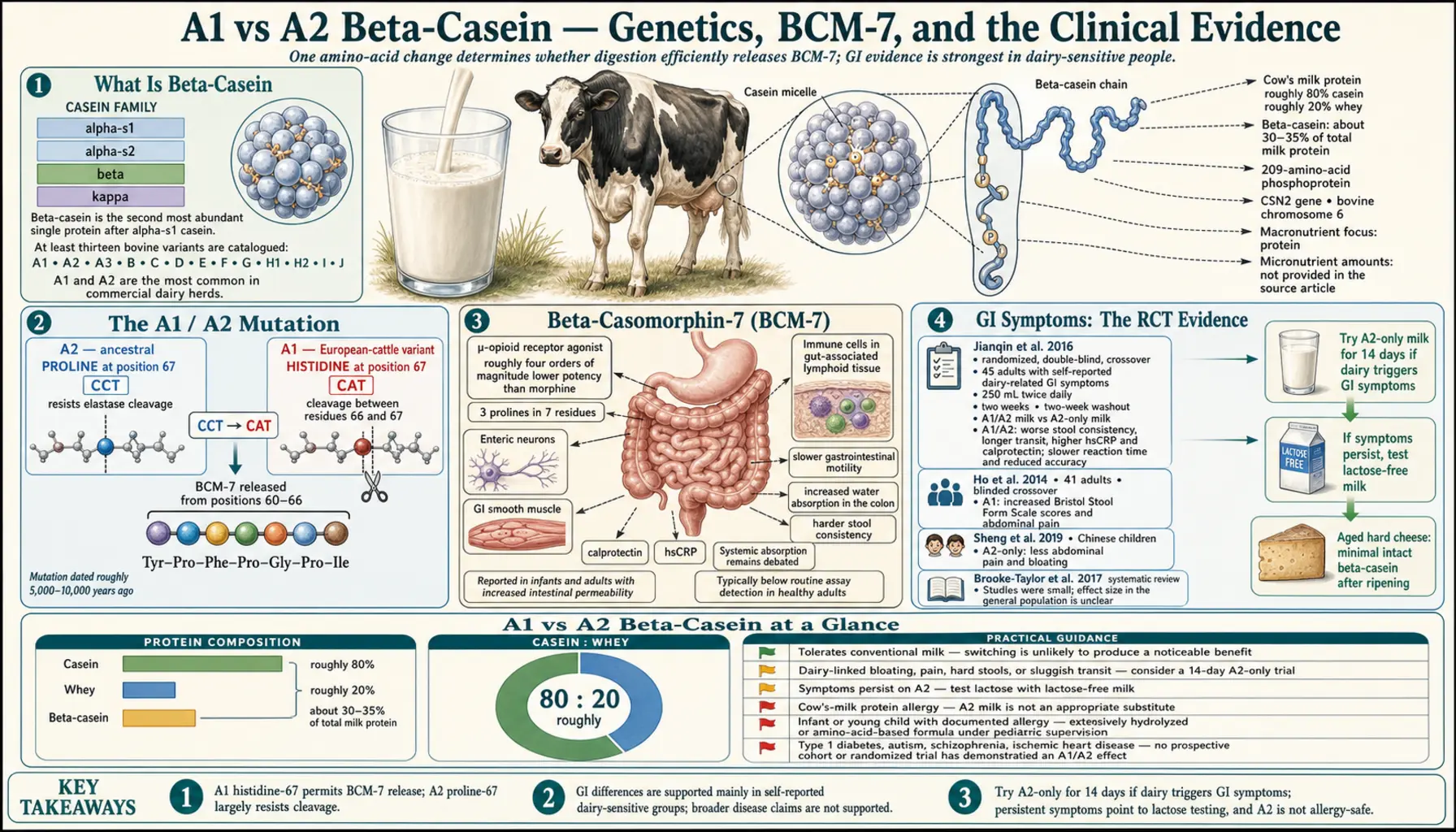
A single amino-acid substitution at position 67 of the bovine beta-casein chain — histidine in A1, proline in A2 — determines whether digestion releases the seven-amino-acid opioid-like peptide beta-casomorphin-7 (BCM-7). A2 beta-casein is the ancestral form found in human milk, goat, sheep, buffalo, camel, and breeds such as Jersey and Guernsey. The A1 variant arose in European cattle approximately 5,000-10,000 years ago and is now dominant in most modern Holstein-Friesian herds. The question of whether A1 milk causes clinically meaningful symptoms in some consumers is now supported by several blinded RCTs, while the broader claims about diabetes and heart disease are not.
Table of Contents
- What Is Beta-Casein
- The A1 / A2 Mutation
- Beta-Casomorphin-7 (BCM-7)
- GI Symptoms: The RCT Evidence
- Broader Claims vs Evidence
- Which Breeds Produce A1 vs A2
- Testing and Sourcing A2 Milk
- Practical Guidance
- Research Papers
- External Resources
- Connections
- Featured Videos
1. What Is Beta-Casein
Cow's milk protein is roughly 80% casein and 20% whey. Casein itself is a family of four proteins — alpha-s1, alpha-s2, beta, and kappa casein — that together form micellar aggregates in milk. Beta-casein alone accounts for about 30-35% of total milk protein, making it the second most abundant single protein in cow's milk after alpha-s1 casein. Beta-casein is a 209-amino-acid phosphoprotein encoded by the CSN2 gene on bovine chromosome 6.
Like most milk proteins, beta-casein exists in multiple genetic variants. To date, at least thirteen variants of bovine beta-casein have been catalogued (A1, A2, A3, B, C, D, E, F, G, H1, H2, I, and J). Of these, A1 and A2 are by far the most common in commercial dairy herds. The A3 variant occurs at low frequency in some Holstein populations, the B variant is moderately common, and the remaining variants are rare.
2. The A1 / A2 Mutation
The structural difference between A1 and A2 beta-casein is a single amino-acid substitution. At position 67 of the mature beta-casein chain (counting from the N-terminus after the signal peptide is cleaved), A2 carries the ancestral proline residue, while A1 carries histidine. The substitution traces to a single base change (CCT → CAT) in codon 67 of CSN2.
This appears trivial. It is not. Proline at position 67 stabilizes the beta-casein backbone against cleavage by the digestive endoprotease elastase. Histidine does not. As a direct result, when A1 beta-casein is exposed to gastrointestinal proteases, an elastase cleavage occurs between residues 66 and 67, releasing the peptide chain from positions 60 through 66 — tyrosine-proline-phenylalanine-proline-glycine-proline-isoleucine, abbreviated BCM-7 for beta-casomorphin-7. With proline at position 67 (A2), this cleavage does not happen efficiently and BCM-7 is not released in meaningful quantities from A2 beta-casein.
Molecular dating places the A1 mutation at roughly 5,000-10,000 years ago in European cattle — well after the initial domestication of cattle from the wild aurochs about 10,500 years ago. Genomic surveys of zebu cattle (Bos indicus), wild aurochs DNA where available, and indigenous African and Asian breeds all carry exclusively the ancestral A2 variant. Human breast milk, goat milk, sheep milk, water buffalo milk, camel milk, and yak milk also contain only A2-equivalent beta-casein, because the histidine-67 substitution is unique to a clade of European-derived Bos taurus.
3. Beta-Casomorphin-7 (BCM-7)
BCM-7 (tyr-pro-phe-pro-gly-pro-ile) is a mu-opioid receptor agonist. Its potency as a mu agonist is roughly four orders of magnitude lower than morphine, but BCM-7 is highly resistant to proteolytic degradation because of its high proline content (three prolines in seven residues), so even a slow but sustained mu-receptor signal can produce measurable physiological effects.
In the gut, mu-opioid receptors are abundantly expressed on enteric neurons, on the smooth muscle of the gastrointestinal tract, and on immune cells in the gut-associated lymphoid tissue. Activation of these receptors slows gastrointestinal motility (the same mechanism by which loperamide and morphine cause constipation), increases water absorption in the colon, and modulates local inflammation. Several published RCTs (cited below) have shown that consumption of A1 milk is associated with slower colonic transit time, harder stool consistency, and increased markers of intestinal inflammation (calprotectin, hsCRP) compared with A2 milk in the same individuals.
Whether BCM-7 crosses the intestinal epithelium into systemic circulation in measurable quantities in adults with intact gut barriers is the subject of ongoing debate. Detection of BCM-7 in plasma and urine has been reported in infants (whose gut barrier is more permeable) and in adults with increased intestinal permeability, but levels in healthy adults are typically below the limit of detection of routine assays.
4. GI Symptoms: The RCT Evidence
The most rigorous study to date is the Jianqin et al. 2016 trial published in Nutrition Journal (PMID 27039383). The trial was a randomized, double-blind, crossover study of 45 Chinese adults who reported dairy-related GI symptoms. Each participant consumed 250 mL twice daily of either A1/A2 conventional milk or A2-only milk for two weeks, with a two-week washout. The A1/A2 milk caused significantly worse Bristol stool consistency scores, longer whole-gut transit time, and higher inflammatory markers (hsCRP and calprotectin) than the A2-only milk. Cognitive testing also showed slower reaction times and reduced accuracy after A1 consumption.
The Ho et al. 2014 pilot study (PMID 24824009) was a smaller blinded crossover of 41 adults that found similar — though more modest — results: increased Bristol Stool Form Scale scores and abdominal pain after A1 consumption relative to A2.
The Sheng et al. 2019 trial in Chinese children (PMID 30188368) extended the finding to a pediatric population and found again that A2-only milk produced significantly less abdominal pain and bloating than conventional A1/A2 milk.
The Brooke-Taylor et al. 2017 systematic review (PMID 28793990) examined the available evidence and concluded that A1 beta-casein consumption is associated with statistically significant differences in GI function and symptoms compared with A2, while noting that the studies to date have been small and that the effect size in the general population (i.e., not just self-reported dairy-symptom subjects) is unclear.
One important caveat: these studies all enroll self-reported dairy-sensitive subjects. The effect of A1 vs A2 milk in the general adult population, where roughly two-thirds of adults tolerate conventional milk without symptoms, has not been adequately studied.
5. Broader Claims vs Evidence
The marketing of A2 milk has expanded well beyond the GI evidence. Common claims include reduced risk of type 1 diabetes, autism, schizophrenia, and ischemic heart disease. These claims trace primarily to ecological correlations published in the late 1990s by Bob Elliott and colleagues, who observed that population-level rates of type 1 diabetes and ischemic heart disease correlated with population-level consumption of A1 beta-casein.
The European Food Safety Authority reviewed all the available evidence in 2009 and concluded that a cause-and-effect relationship could not be established between A1 beta-casein and any non-communicable disease. The Truswell 2005 review (PMID 15867940) reached a similar conclusion. As of this writing, no prospective cohort or randomized trial has demonstrated an effect of A1 vs A2 consumption on diabetes, autism, schizophrenia, or cardiovascular outcomes.
What the evidence does and does not support, then, is straightforward. Supported: A1 beta-casein consumption produces small but measurable GI effects (slower transit, harder stools, modest increases in inflammatory markers) in self-reported dairy-sensitive individuals. Not supported: Any role for A1 in type 1 diabetes, autism, schizophrenia, or ischemic heart disease.
6. Which Breeds Produce A1 vs A2
The A1 allele is most common in Holstein-Friesian cattle, the dominant dairy breed in industrial commercial production worldwide. Most US, UK, Canadian, Australian, and New Zealand milk supplies are mixtures of A1 and A2 beta-casein, typically 50:50 to 70:30 in favor of A1.
A2-dominant or A2-exclusive sources include: Jersey cattle (heavily A2-skewed, typically 70-100% A2), Guernsey cattle (typically 90%+ A2), Brown Swiss, indigenous African and Asian Bos indicus breeds (zebu), water buffalo (Bos bubalis), goats, sheep, and camels. Human breast milk is exclusively A2-equivalent.
Commercial A2-branded milk (e.g., the "a2 Milk" brand from New Zealand) is produced from herds that have been genetically tested and selectively bred for the A2/A2 genotype. The cows can be any breed; what matters is that both copies of the CSN2 gene in each individual cow carry the A2 allele. Genotype-selected A2/A2 Holsteins produce milk indistinguishable in composition from conventional Holstein milk except for the beta-casein variant.
7. Testing and Sourcing A2 Milk
Commercial labels marked "A2" (most notably the a2 Milk Company brand, now widely distributed in the US, UK, Australia, New Zealand, and China) come from herds where every cow has been DNA-tested for A2/A2 genotype. Other producers (Snowville Creamery, Alexandre Family Farm, and various small grass-fed dairies in the US; Coombe Castle in the UK) also offer A2-certified products.
For consumers who do not have access to commercial A2-labeled product, alternatives that are naturally A2-dominant include: Jersey or Guernsey breed milk from small dairies, goat milk, sheep milk, water buffalo mozzarella, and camel milk. Hard cheeses made from A1 milk contain only minimal intact beta-casein (it is largely hydrolyzed during ripening), so the BCM-7 question is moot for aged cheeses regardless of source.
Direct-to-consumer DNA genotyping kits for cattle CSN2 are available to small dairies for around $30 per cow, making A2 conversion of a small herd a one-time investment of several thousand dollars.
8. Practical Guidance
For an adult who tolerates conventional milk without symptoms, switching to A2 milk is unlikely to produce a noticeable benefit. The blinded trials do not show effects in subjects without baseline dairy symptoms.
For an adult who experiences bloating, abdominal pain, hard stools, or sluggish bowel transit specifically after dairy consumption, a 14-day A2-only trial is worth doing — cheaper, faster, and lower risk than the alternative dietary eliminations. If symptoms resolve on A2 milk, the issue is BCM-7 sensitivity rather than lactose intolerance or milk-protein allergy. If symptoms persist on A2 milk, the next variable to test is lactose — switch to lactose-free milk (which is conventional A1/A2 milk treated with lactase) and see if that resolves the symptoms.
For infants and young children with documented cow's milk protein allergy, A2 milk is not an appropriate substitute — the allergy is typically to alpha-s1 casein or whey proteins, not to beta-casein, and A2 milk contains all of the same alpha-s1 casein and whey proteins as A1 milk. Extensively hydrolyzed formula or amino-acid-based formula is the appropriate substitute under pediatric supervision.
9. Research Papers
- Jianqin S et al., Effects of milk containing only A2 beta-casein versus milk containing both A1 and A2 beta-casein on gastrointestinal physiology, symptoms of discomfort, and cognitive behavior of people with self-reported intolerance to traditional cows' milk (Nutr J 2016;15:35) — PubMed PMID 27039383
- Ho S et al., Comparative effects of A1 versus A2 beta-casein on gastrointestinal measures: a blinded randomized cross-over pilot study (Eur J Clin Nutr 2014;68:994-1000) — Search PubMed
- Sheng X et al., Effects of conventional milk versus milk containing only A2 beta-casein on digestion in Chinese children: a randomized study (J Pediatr Gastroenterol Nutr 2019;69:375-382) — Search PubMed
- Brooke-Taylor S et al., Systematic review of the gastrointestinal effects of A1 compared with A2 beta-casein (Adv Nutr 2017;8:739-748) — Search PubMed
- Kamiński S et al., Polymorphism of bovine beta-casein and its potential effect on human health (J Appl Genet 2007;48:189-198) — PubMed PMID 17666771
- Truswell AS, The A2 milk case: a critical review (Eur J Clin Nutr 2005;59:623-631) — PubMed PMID 15867940
- Pal S et al., Milk intolerance, beta-casein and lactose (Nutrients 2015;7:7285-7297) — PubMed PMID 26404362
- Cieslinska A et al., Beta-casomorphin-7 in raw and hydrolyzed milk derived from cows of alternative beta-casein genotypes (J Dairy Sci 2012) PubMed: Cieslinska BCM-7
- Elliott RB et al., Type I (insulin-dependent) diabetes mellitus and cow milk: casein variant consumption (Diabetologia 1999) — PubMed PMID 10333050
- Sodhi M et al., Milk proteins and human health: A1/A2 milk hypothesis (Indian J Endocrinol Metab 2012) PubMed: Sodhi A1/A2 review
- European Food Safety Authority (EFSA), Review of the potential health impact of beta-casomorphins and related peptides (EFSA Scientific Report 2009) PubMed: EFSA review
- De Noni I, Cattaneo S, Occurrence of beta-casomorphins 5 and 7 in commercial dairy products and in their digests after in vitro simulated gastro-intestinal digestion (Food Chem 2010) PubMed: De Noni dairy BCM
10. External Resources
- The a2 Milk Company — commercial source of A2/A2 milk in US, UK, China, Australia, New Zealand
- EFSA Scientific Report — Beta-Casomorphins Review (2009)
- PubMed — All A1/A2 beta-casein research
- Linus Pauling Institute Micronutrient Information Center
11. Connections
- Milk Benefits Hub
- Raw vs Pasteurized
- Grass-Fed and CLA
- Lactose Intolerance
- Milk (Main Page)
- Yogurt
- Eggs
- Gastroenterology
- Irritable Bowel Syndrome
- Calcium
- Vitamin B12
- All Foods