Grass-Fed Milk and CLA — Omega-3, Conjugated Linoleic Acid, and the Pasture Difference
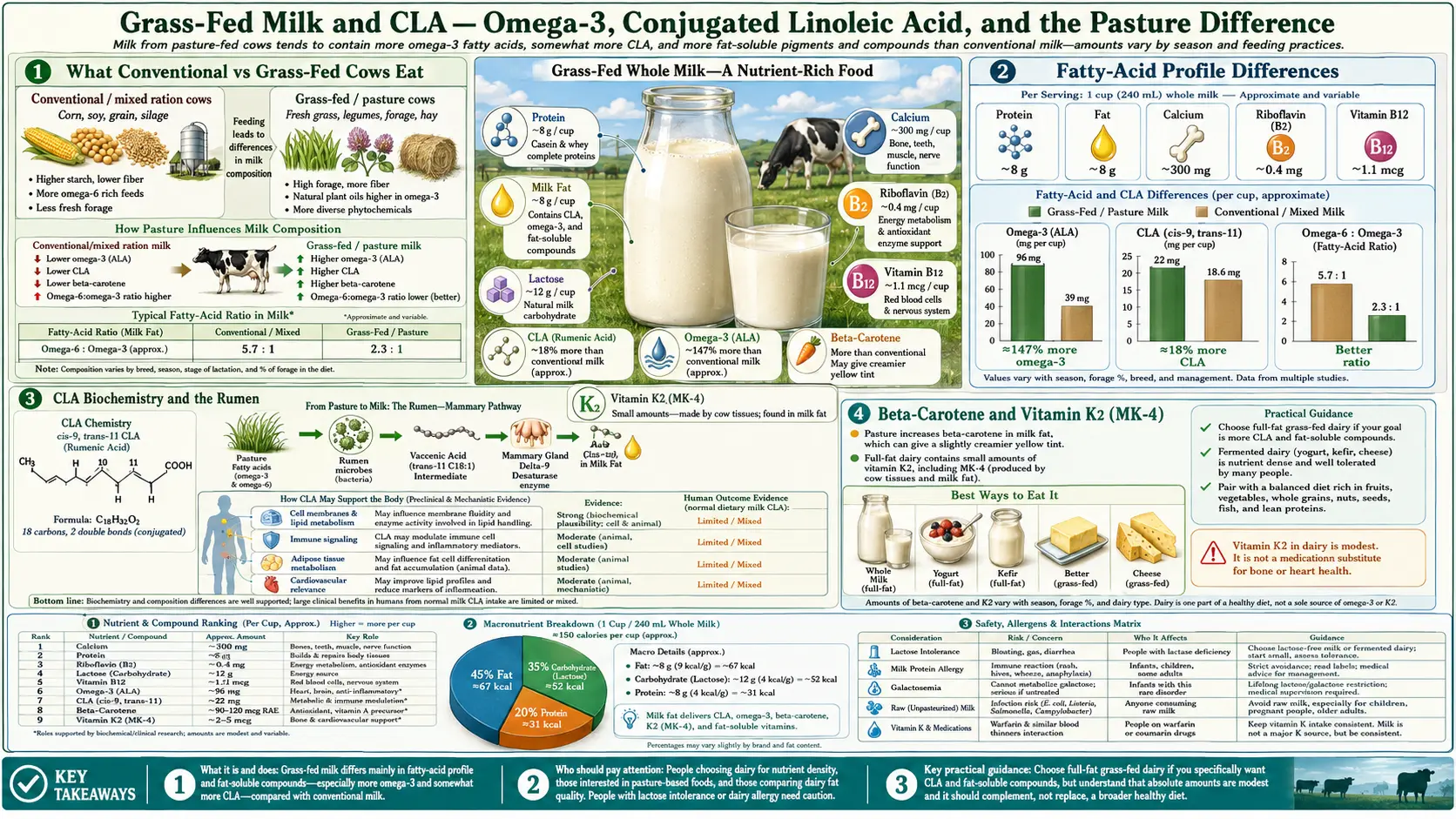
Milk fat composition is a near-direct reflection of what the cow ate. Cows on fresh pasture produce milk with roughly twice the alpha-linolenic acid (the plant-source omega-3 found in grass leaves), twice the conjugated linoleic acid (CLA), two to three times the beta-carotene (visible as a yellower butterfat), and substantially more vitamin K2 (MK-4) than cows on a total mixed ration of corn silage, grain, and soybean meal. The omega-6:omega-3 ratio shifts from approximately 5.7:1 in conventional milk to approximately 2:1 in grass-fed milk — a meaningful difference for consumers who get a substantial fraction of their fat intake from dairy. The effect on cardiovascular and metabolic outcomes in randomized trials of grass-fed dairy in humans is modest but measurable.
Table of Contents
- What Conventional vs Grass-Fed Cows Eat
- Fatty-Acid Profile Differences
- CLA Biochemistry and the Rumen
- Beta-Carotene and Vitamin K2 (MK-4)
- Human Trial Evidence
- CLA Supplements vs Dairy CLA
- Labeling and Certification
- Cost, Availability, and Practical Sourcing
- Research Papers
- External Resources
- Connections
- Featured Videos
1. What Conventional vs Grass-Fed Cows Eat
The dominant model in US dairy production since the 1970s is the confined-animal feeding operation (CAFO) and the "total mixed ration" (TMR). A typical TMR for a high-producing Holstein consists of approximately 50-60% corn silage and high-moisture corn (energy density), 15-25% alfalfa hay or silage (protein and fiber), 10-15% soybean meal or distillers' grains (protein), and the remaining 5-15% in vitamin/mineral premixes, oilseeds, and other supplements. The cow may or may not have any access to pasture; many large operations do not provide outdoor access at all.
Grass-fed dairy operations vary by certification regime. The American Grassfed Association certification requires lifetime pasture access during the growing season and prohibits all grain feeding. The PCO Certified 100% Grassfed and Real Organic Project 100% Grassfed labels have similar requirements. The Organic Valley Grassmilk product (a leading US commercial brand) is certified to a 100% forage standard. The European equivalent, common in Ireland and New Zealand, is a low-cost "grass-based" production system in which cows spend most of the year on pasture and receive only modest supplemental concentrates.
Between these extremes is a wide range of intermediate practices — cows on pasture for half the year and on TMR for half the year, cows with limited daily turnout, cows on a forage-heavy but not exclusive diet. The fatty-acid profile of the milk reflects the diet on a roughly week-by-week basis, so a single bottle of "pasture-raised" milk may or may not have the full grass-fed fatty-acid signature depending on the season and the herd's management.
2. Fatty-Acid Profile Differences
The Benbrook et al. 2018 study in Food Science & Nutrition (PMID 29983998) analyzed 1,163 samples of conventional, organic, and 100% grass-fed retail milk in the United States over a 3-year period. The headline findings, expressed as percentage of total milk fatty acids:
- Alpha-linolenic acid (ALA, the plant-source omega-3 in grass leaves): 0.50% in conventional milk, 0.65% in organic milk, 1.43% in 100% grass-fed milk — an approximately 3-fold increase in grass-fed
- Total omega-3: 0.95% in conventional, 1.07% in organic, 1.84% in grass-fed — an approximately 2-fold increase
- Linoleic acid (LA, the omega-6 in grain): 2.4% in conventional, 2.0% in organic, 1.4% in grass-fed
- Omega-6:Omega-3 ratio: approximately 5.7:1 in conventional, 2.3:1 in organic, 0.95:1 in grass-fed
- Conjugated linoleic acid (CLA, rumenic acid c9,t11): approximately 0.4% of total fatty acids in conventional, ~0.55% in organic, ~1.0% in grass-fed — an approximately 2.5-fold increase in grass-fed
- Vaccenic acid (trans-11 18:1, CLA precursor): elevated similarly in grass-fed milk
The Couvreur et al. 2006 paper (PMID 16606738) found a linear dose-response between the fraction of fresh grass in the cow's diet and the rumenic acid (CLA) content of the milk fat, supporting the interpretation that the CLA elevation is a direct consequence of grass intake rather than a generic "pasture effect."
3. CLA Biochemistry and the Rumen
Conjugated linoleic acid (CLA) is the collective term for a family of geometric and positional isomers of linoleic acid (18:2). The single most abundant isomer in ruminant milk fat is rumenic acid, cis-9, trans-11 conjugated linoleic acid, which accounts for approximately 75-90% of total CLA in milk and butter. The dominant minor isomer is trans-10, cis-12 CLA.
CLA in ruminant milk has two origins. First, dietary linoleic acid (from green leaves and feed) is partially biohydrogenated by rumen microbes — principally Butyrivibrio fibrisolvens — in a multi-step pathway that first isomerizes linoleic acid to cis-9, trans-11 CLA and then reduces it stepwise through vaccenic acid (trans-11 18:1) to stearic acid (18:0). Some of the cis-9, trans-11 CLA escapes complete biohydrogenation and is absorbed into the cow's bloodstream, ultimately appearing in the milk fat.
Second — and more importantly — vaccenic acid that is fully absorbed into the cow's tissues can be converted back to rumenic acid (cis-9, trans-11 CLA) by the enzyme stearoyl-CoA desaturase (SCD1) in the mammary gland. This is the dominant pathway: most rumenic acid in milk is endogenously synthesized from vaccenic acid by the cow rather than absorbed directly from the rumen. This explains why grass-fed cows produce more milk-fat CLA — grass provides more substrate (linoleic and alpha-linolenic acid) for rumen biohydrogenation, generating more vaccenic acid for the mammary SCD1 enzyme to convert to rumenic acid.
The same SCD1 pathway operates in human tissues. When a human consumes vaccenic acid (whether from grass-fed dairy or from partially hydrogenated vegetable oils, though the latter is now banned in the US food supply), some fraction is converted endogenously to rumenic acid in human adipose tissue. This is one reason rumenic acid content of human adipose tissue has been used as a long-term biomarker of dairy consumption in epidemiologic studies.
4. Beta-Carotene and Vitamin K2 (MK-4)
Beta-carotene is the orange pigment in green leaves (it is masked by chlorophyll). Cows on fresh pasture ingest substantial quantities of beta-carotene, a fraction of which is partitioned into the milk fat (where it imparts the characteristic yellow color of grass-fed butter). Pasture-raised dairy fat typically contains 2-3 times the beta-carotene of conventional dairy fat, in the range of 6-10 mg per kg of fat vs 2-4 mg per kg.
The relevance for human nutrition is modest in absolute terms — a tablespoon of butter delivers only about 100 mcg of beta-carotene from a grass-fed source, providing roughly 1-2% of the recommended daily intake. The same individual could obtain 10x more beta-carotene from a small carrot. The carotenoids do, however, contribute to the antioxidant content of the milk fat and may play a role in the lower lipid peroxidation rates observed in grass-fed dairy on storage.
Vitamin K2 (menaquinone-4, MK-4) is produced in the cow's tissues from dietary vitamin K1 (phylloquinone, the form abundant in green leaves) by the enzyme UBIAD1. Grass-fed milk fat consistently contains more MK-4 than grain-fed milk fat, in the range of 5-10 mcg per 100 g fat vs 1-3 mcg per 100 g. Vitamin K2 directs calcium into bone (via activation of osteocalcin) and away from arterial walls (via activation of matrix Gla protein), and the dairy fat of pasture-raised animals was historically a major dietary source of K2 in pre-industrial diets. Modern grain-fed dairy provides substantially less K2.
5. Human Trial Evidence
Most of the evidence on the human health effects of dairy CLA, omega-3, and vitamin K2 comes from observational studies and a small number of randomized trials. The principal findings:
Cardiovascular outcomes: The Smit et al. 2010 study in American Journal of Clinical Nutrition (PMID 20484447) used CLA in adipose tissue as a biomarker of dairy intake in a Costa Rican case-control study of acute myocardial infarction. Higher adipose CLA (highest quintile vs lowest) was associated with an approximately 50% lower odds of myocardial infarction, with a clear dose-response. The result is consistent with several similar studies but should be interpreted in the context of significant residual confounding by lifestyle and overall diet quality.
Body composition: CLA (specifically the trans-10, cis-12 isomer, which is a minor component of dairy CLA but the dominant isomer in industrial CLA supplements) reduces body fat mass modestly in animal models. In human trials of supplemental CLA, the effect on body composition has been small (about 0.5 kg fat loss over 12 weeks) and not always reproducible. Dairy-CLA at typical intake levels (less than 1 g/day) is unlikely to produce measurable body-composition effects.
Cancer: The Ip et al. 1994 paper (PMID 8004587) was the foundational paper demonstrating an anti-cancer effect of CLA in rodent mammary cancer models. Translation to human cancer outcomes has been inconclusive. The Belury 2002 review (PMID 12055341) summarizes the mechanistic evidence.
Inflammation and insulin sensitivity: Several small trials suggest modest improvements in inflammatory markers and insulin sensitivity with grass-fed dairy fat consumption vs conventional dairy fat, but the effect sizes are small and the trials have been short.
6. CLA Supplements vs Dairy CLA
Commercial CLA supplements (typically derived from safflower oil with industrial isomerization) contain a roughly 50:50 mixture of cis-9, trans-11 and trans-10, cis-12 isomers. This isomer profile is very different from the predominantly cis-9, trans-11 profile of dairy CLA. The trans-10, cis-12 isomer is the active body-fat-reducing isomer in animal studies, but it has also been implicated in insulin resistance and pro-inflammatory effects in some human trials at supplement doses (3-6 g/day).
Dairy CLA is consumed at much lower doses (typically 0.1-0.4 g/day even in heavy dairy consumers), is dominantly the cis-9, trans-11 isomer, and is consumed in the natural matrix of milk fat alongside vaccenic acid, beta-carotene, vitamin K2, and a complex range of other fatty acids. The risk-benefit profile of dairy CLA at dietary intake levels is favorable; the risk-benefit profile of high-dose industrial CLA supplements is unclear.
7. Labeling and Certification
The term "grass-fed" in US food labeling has been largely unregulated since 2016, when the USDA withdrew its previous standard. Producers can use the term in marketing without third-party verification. Consumers should look for the following third-party certifications for verified grass-fed dairy:
- American Grassfed Association (AGA) Certified: requires lifetime pasture access during the growing season and prohibits all grain feeding
- PCO Certified 100% Grassfed: Pennsylvania Certified Organic auditing for 100% forage diet
- Real Organic Project 100% Grassfed: add-on certification to USDA Organic requiring 100% forage
- Organic Valley Grassmilk: a brand-specific 100% grass-fed product line within the Organic Valley cooperative
USDA Organic certification alone does not require 100% grass-fed (it requires only that organic dairy cows receive at least 30% of their dry-matter intake from pasture during the grazing season), so organic milk and grass-fed milk are not synonymous. The fatty-acid analysis in the Benbrook 2018 paper showed that organic milk lies between conventional and 100% grass-fed in CLA and omega-3 content.
8. Cost, Availability, and Practical Sourcing
Commercial 100% grass-fed milk in the United States typically retails for $5-9 per half-gallon, compared with $2-4 for conventional milk. The premium reflects lower yield per cow (a grass-fed Holstein produces roughly half the milk of a grain-finished Holstein), the cost of pasture management, and the smaller scale of the producers.
For consumers who use dairy fat as a meaningful fraction of total fat intake (whole milk drinkers, butter and cream consumers, cheese eaters), the upgrade to grass-fed has a defensible nutritional rationale — the fatty-acid profile difference is real and meaningful. For consumers of skim or 1% milk, where the fat is largely removed, the rationale is much weaker — the grass-fed advantage is essentially in the fat, and the protein and lactose are unchanged.
For consumers in regions with limited 100% grass-fed availability, the practical alternative is European import butter from grass-based dairy systems (Irish Kerrygold, French Beurre d'Isigny, certain New Zealand Anchor products), which captures most of the grass-fed fatty-acid profile in concentrated form. Cheese aged from grass-fed milk (Irish Dubliner, Comte, certain alpine cheeses) is similarly enriched in CLA and omega-3.
The synergy with A2 beta-casein is worth noting: Jersey and Guernsey breeds tend to be both more often A2/A2 and more commonly raised in grass-based systems (because their lower milk yield aligns better with the economics of pasture management). A Jersey-breed, 100% grass-fed, A2-certified raw or HTST-pasteurized whole milk is the maximum-quality dairy option available in most US markets, at a corresponding maximum price.
9. Research Papers
- Benbrook CM et al., Enhancing the fatty acid profile of milk through forage-based rations, with nutrition modeling of dietary outcomes (Food Sci Nutr 2018;6:681-700) — Search PubMed
- Couvreur S et al., The linear relationship between the proportion of fresh grass in the cow diet, milk fatty acid composition, and butter properties (J Dairy Sci 2006;89:1956-1969) — PubMed PMID 16606738
- Dewhurst RJ et al., Increasing the concentrations of beneficial polyunsaturated fatty acids in milk produced by dairy cows in high-forage systems (Anim Feed Sci Technol 2006;131:168-206) PubMed: Dewhurst forage review
- Ip C, Singh M, Thompson HJ, Scimeca JA, Conjugated linoleic acid suppresses mammary carcinogenesis and proliferative activity of the mammary gland in the rat (Cancer Res 1994;54:1212-1215) — Search PubMed
- Belury MA, Dietary conjugated linoleic acid in health: physiological effects and mechanisms of action (Annu Rev Nutr 2002;22:505-531) — Search PubMed
- Smit LA et al., Conjugated linoleic acid in adipose tissue and risk of myocardial infarction (Am J Clin Nutr 2010;92:34-40) — Search PubMed
- Lock AL, Bauman DE, Modifying milk fat composition of dairy cows to enhance fatty acids beneficial to human health (Lipids 2004;39:1197-1206) — PubMed PMID 15736916
- Whigham LD, Watras AC, Schoeller DA, Efficacy of conjugated linoleic acid for reducing fat mass: a meta-analysis in humans (Am J Clin Nutr 2007;85:1203-1211) — PubMed PMID 17490954
- Riserus U et al., Treatment with dietary trans-10 cis-12 conjugated linoleic acid causes isomer-specific insulin resistance in obese men (Diabetes Care 2002) — Search PubMed
- Schwendel BH et al., Invited review: organic and conventionally produced milk — an evaluation of factors influencing milk composition (J Dairy Sci 2015;98:721-746) — PubMed PMID 25497795
- Daley CA et al., A review of fatty acid profiles and antioxidant content in grass-fed and grain-fed beef (Nutr J 2010;9:10) — PubMed PMID 20219103
- Vitamin K2 (MK-4) content of pasture-fed vs grain-fed dairy fat PubMed: K2 in pasture dairy
10. External Resources
- American Grassfed Association (certification body and producer directory)
- Organic Valley Grassmilk (commercial 100% grass-fed product line)
- NIH ODS — Vitamin K Fact Sheet (Health Professionals)
- Linus Pauling Institute — Essential Fatty Acids
- PubMed — All grass-fed dairy and CLA research
11. Connections
- Milk Benefits Hub
- A1 vs A2 Casein
- Raw vs Pasteurized
- Lactose Intolerance
- Milk (Main Page)
- Yogurt
- Beef (Grass-Fed)
- Vitamin K (K2)
- Vitamin A
- Vitamin D3
- Calcium
- Salmon (Omega-3)
- All Foods