Kale — Benefits Deep Dive
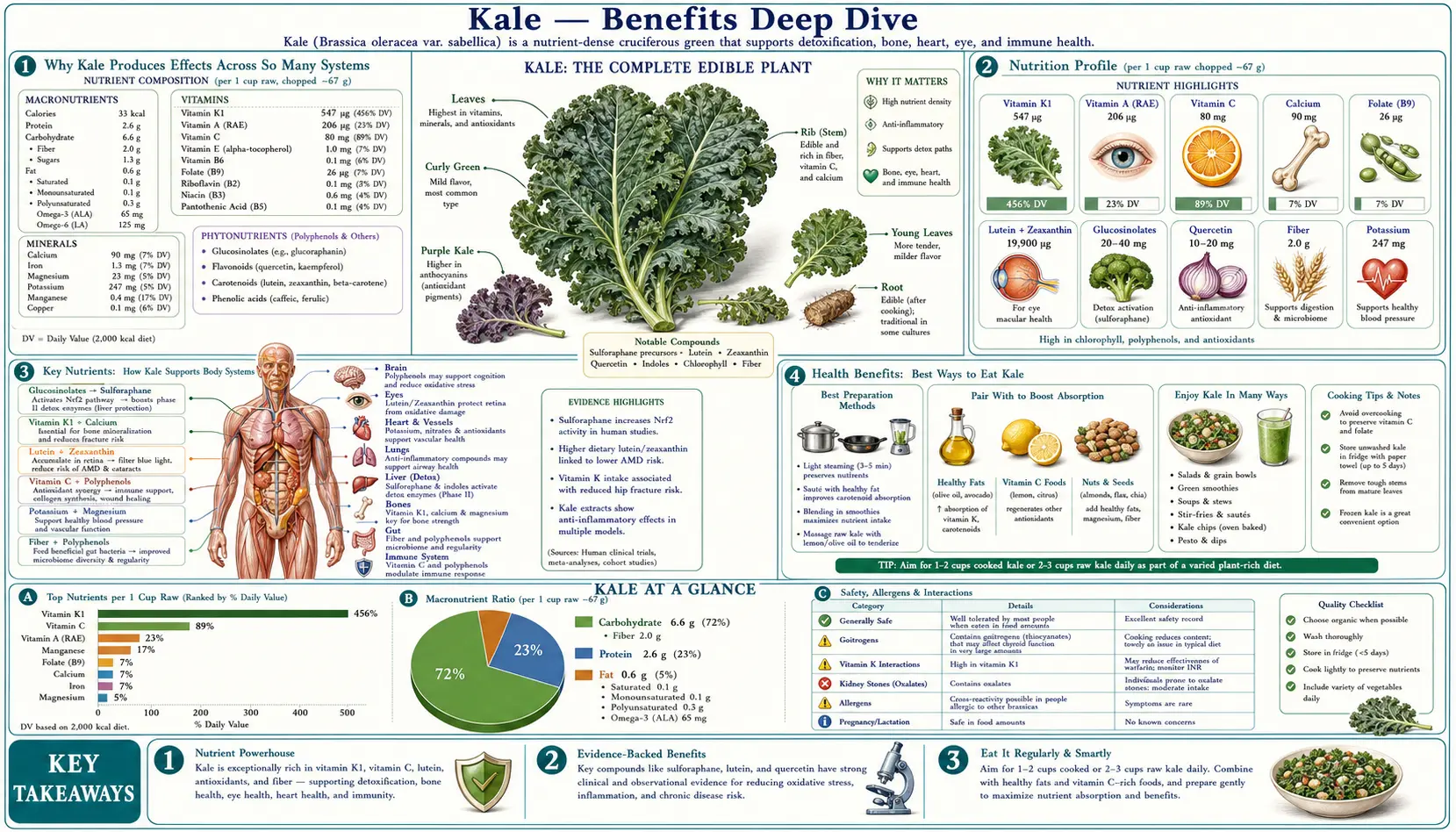
Kale (Brassica oleracea var. sabellica or var. acephala) is the most nutrient-dense leafy green commonly consumed in the Western diet, with a single 67-gram cup of raw chopped leaves delivering 684% of the Reference Daily Intake for Vitamin K, 206% for Vitamin A (as provitamin carotenoids), and 134% for Vitamin C. Four benefit pages below explore the conditions where kale produces the most measurable clinical effect — bone metabolism and warfarin-dose interaction (Vitamin K1 / phylloquinone), age-related macular degeneration and cataract (lutein and zeaxanthin), cancer chemoprevention (glucosinolate-derived sulforaphane and indole-3-carbinol), and the kidney-stone / thyroid-uptake tradeoff that determines who should eat kale raw vs cooked and how often.
Deep-Dive Articles
Vitamin K and Bone
Phylloquinone (K1) in kale chloroplasts as the gold-standard dietary K source, the gamma-carboxylation of osteocalcin and matrix Gla protein, the Nurses' Health Study hip-fracture data, conversion of K1 to MK-4 in tissues, the warfarin interaction (consistent intake is the goal, not avoidance), and the Loenen 2004 ratio comparing kale K1 bioavailability to other green sources.
Lutein and Eye Health
Why kale is the highest-density dietary source of lutein and zeaxanthin (~26 mg per 100 g cooked), the macular pigment optical density (MPOD) story, the AREDS2 substitution of lutein/zeaxanthin for beta-carotene after the smoker safety signal, blue-light filtering and cataract prevention, the LUNA trial methodology, and the fat-cooking absorption optimization (4-5x bioavailability with oil).
Glucosinolates and Cancer
The myrosinase enzyme released by chewing or chopping converts glucoraphanin to sulforaphane and glucobrassicin to indole-3-carbinol / DIM, NRF2 pathway induction of Phase II detoxification enzymes, the Johns Hopkins broccoli-sprout work translated to mature kale, estrogen metabolism modulation (2-hydroxyestrone vs 16-alpha-hydroxyestrone ratio), and breast / prostate / colon epidemiology.
Oxalates and Cooking
The kale oxalate content (~20 mg per 100 g raw, much lower than spinach's 750 mg) and why kale is generally safe for calcium-oxalate stone formers in moderation, the goitrogen story (glucosinolate-derived thiocyanates competing for thyroid iodine uptake), how blanching, steaming, and sauteing change the oxalate / glucosinolate / vitamin profile, and the practical raw-vs-cooked decision tree.
Table of Contents
- Deep-Dive Articles
- Why Kale Produces Effects Across So Many Systems
- Research Papers: Vitamin K and Bone
- Research Papers: Lutein and Eye Health
- Research Papers: Glucosinolates and Cancer
- Research Papers: Oxalates, Goitrogens, and Cooking
- Research Papers: Cross-Cutting (Cardiovascular, Inflammation, Microbiome)
- External Authoritative Resources
- Connections
- Featured Videos
Why Kale Produces Effects Across So Many Systems
Most leafy greens deliver a familiar baseline of fiber, folate, magnesium, and potassium — kale delivers all of those plus four additional bioactive categories at densities that exceed almost every other commonly consumed vegetable. Each category maps to a distinct organ-system effect:
- Phylloquinone (Vitamin K1) at exceptional density — one cup of raw chopped kale delivers approximately 547 micrograms of phylloquinone, more than 5x the adult Adequate Intake. K1 drives gamma-carboxylation of osteocalcin (bone matrix protein), matrix Gla protein (vascular calcification inhibitor), and the coagulation factors II, VII, IX, X. This single nutrient density is the foundation of the bone-health story and the reason kale appears on every warfarin-patient handout.
- Lutein and zeaxanthin xanthophyll carotenoids — kale provides 26 mg of combined lutein and zeaxanthin per 100 g cooked, far above spinach (~12 mg), collards (~7 mg), or romaine (~2 mg). These xanthophylls accumulate specifically in the macula of the retina where they function as a yellow blue-light filter and antioxidant, producing the macular-pigment, age-related macular degeneration, and cataract effects.
- Glucosinolates (glucoraphanin, glucobrassicin, sinigrin) — the brassica-family sulfur compounds that, on contact with the myrosinase enzyme released by chewing or chopping, convert to isothiocyanates (sulforaphane), indoles (indole-3-carbinol, diindolylmethane), and nitriles. These metabolites drive the NRF2-mediated Phase II detoxification induction, estrogen metabolism modulation, and epidemiologic cancer-risk reduction attributed to the cruciferous family.
- Provitamin A carotenoids (beta-carotene, alpha-carotene) — a cup of cooked kale delivers roughly 17,700 IU of provitamin A activity, supporting vision, mucosal barrier integrity, and immune function (see our Vitamin A Benefits Hub for the full retinoid-system story). Conversion is governed by the BCMO1 enzyme with a typical 12:1 plant-source ratio.
The therapeutic complication is that the same compounds that confer benefit can produce problems in specific clinical contexts: the same high K1 content that supports bone density antagonizes warfarin dose-finding in atrial fibrillation patients; the same glucosinolates that drive cancer chemoprevention can transiently reduce thyroid iodine uptake in iodine-deficient individuals; the modest oxalate content (~20 mg per 100 g raw, much lower than spinach) is still relevant for calcium-oxalate stone formers consuming large daily smoothie volumes. The fourth deep-dive page covers the cooking decisions and clinical exceptions that determine optimal kale use for any given individual.
Research Papers: Vitamin K and Bone
- Booth SL, phylloquinone intake and hip fracture risk (Nurses' Health Study) — PubMed: Booth Nurses' Health
- Vitamin K1 in kale and other leafy greens: USDA database analysis — PubMed: K1 content greens
- Osteocalcin gamma-carboxylation and bone matrix — PubMed: Osteocalcin carboxylation
- Matrix Gla protein and vascular calcification (Schurgers) — PubMed: Schurgers MGP
- Conversion of dietary K1 to MK-4 in extrahepatic tissues — PubMed: K1 to MK-4 conversion
- Warfarin and dietary vitamin K consistency — PubMed: Warfarin and K
- Booth SL, dietary K intake and bone mineral density — PubMed: Booth BMD
- Loenen 2004, K1 bioavailability from cooked vegetables vs supplement — PubMed: K1 bioavailability
- Kale and the Vitamin K-Vitamin D interaction at the calcium-balance level — PubMed: K x D interaction
- Subclinical Vitamin K deficiency assessment: under-carboxylated osteocalcin (ucOC) — PubMed: ucOC marker
Research Papers: Lutein and Eye Health
- AREDS2 (Lutein/Zeaxanthin substituted for beta-carotene in age-related macular degeneration) — PubMed: AREDS2
- LUNA (Lutein Nutrition effects measured by Autofluorescence) trial — PubMed: LUNA trial
- Macular pigment optical density (MPOD) and dietary lutein intake — PubMed: MPOD and diet
- Lutein and zeaxanthin content in kale vs other leafy greens (Perry analysis) — PubMed: Lutein content
- Cataract prevention and dietary carotenoid intake (Nurses' Health) — PubMed: Cataract carotenoids
- Blue-light filtering and macular protection — PubMed: Blue-light filter
- Cooking and dietary fat increase lutein bioavailability — PubMed: Lutein absorption
- Lutein and cognitive function in older adults — PubMed: Lutein and cognition
- Carotenoid status biomarkers: serum lutein and skin reflectance — PubMed: Carotenoid biomarkers
- Beatty 2013, MPOD and AMD risk reduction longitudinal data — PubMed: Beatty MPOD
Research Papers: Glucosinolates and Cancer
- Sulforaphane and NRF2 / Phase II detoxification (Talalay, Johns Hopkins) — PubMed: Talalay sulforaphane
- Glucosinolate content of kale and other brassicas (McNaughton 2003) — PubMed: Glucosinolate content
- Myrosinase activity and isothiocyanate formation upon chewing — PubMed: Myrosinase chewing
- Indole-3-carbinol and diindolylmethane in estrogen metabolism — PubMed: I3C/DIM estrogen
- Cruciferous vegetables and breast cancer risk meta-analysis — PubMed: Cruciferous breast cancer
- Cruciferous vegetables and prostate cancer — PubMed: Prostate cancer
- Cruciferous vegetables and colorectal cancer — PubMed: Colorectal cancer
- Lung cancer and cruciferous vegetable intake — PubMed: Lung cancer
- GSTM1/GSTT1 polymorphisms and cruciferous vegetable benefit — PubMed: GST polymorphisms
- Sulforaphane and bladder cancer Phase II trial — PubMed: Bladder cancer trial
Research Papers: Oxalates, Goitrogens, and Cooking
- Oxalate content of leafy greens (Noonan, Savage 1999) — PubMed: Noonan oxalates
- Calcium oxalate kidney stones and dietary oxalate — PubMed: Oxalate stones
- Goitrogenic effects of cruciferous vegetables (Felker 2016 review) — PubMed: Felker goitrogens
- Boiling reduces glucosinolate content of brassicas — PubMed: Cooking glucosinolates
- Steaming preserves glucosinolates vs boiling — PubMed: Steaming brassica
- Vitamin C and Vitamin K thermal stability in kale — PubMed: C and K cooking
- Oxalate bioavailability and calcium binding — PubMed: Oxalate binding
- Massaged raw kale, dressing, and palatability research — PubMed: Raw kale sensory
- Conn-Goeke 2017 carotenoid retention in cooked kale — PubMed: Carotenoid retention
- Thyroid uptake and brassica intake in iodine-replete populations — PubMed: Brassica thyroid iodine
Research Papers: Cross-Cutting (Cardiovascular, Inflammation, Microbiome)
- Leafy green vegetable intake and incident cardiovascular disease — PubMed: Greens and CVD
- Dietary nitrate from leafy greens and blood pressure — PubMed: Dietary nitrate BP
- Kale and serum lipid profile randomized trial — PubMed: Kale lipids
- Cruciferous vegetables and systemic inflammation markers (CRP) — PubMed: Cruciferous and CRP
- Cruciferous vegetables and gut microbiome composition — PubMed: Brassica microbiome
- Kale fiber and short-chain fatty acid production — PubMed: Kale SCFA
- Bezem 2022, leafy green intake and type 2 diabetes risk — PubMed: Greens and T2D
- Carotenoid status and all-cause mortality (NHANES) — PubMed: Carotenoids mortality
- Magnesium content of kale and other greens — PubMed: Magnesium greens
- USDA National Nutrient Database kale entries — PubMed: USDA kale
External Authoritative Resources
- USDA FoodData Central — Kale — canonical nutrient composition data
- Linus Pauling Institute — Cruciferous Vegetables
- Linus Pauling Institute — Vitamin K (kale's headline nutrient)
- NIH ODS — Vitamin K Fact Sheet
- PubMed — All research on kale
Connections
- All Food
- Kale (Main Page)
- Vitamin K and Bone
- Lutein and Eye Health
- Glucosinolates and Cancer
- Oxalates and Cooking
- Vitamin K
- Vitamin A
- Vitamin A Benefits Hub
- Vitamin C
- Sulforaphane
- Macular Degeneration
- Oncology (Cancer)
- Spinach
- Broccoli