Kale Glucosinolates, Sulforaphane, and Cancer Chemoprevention
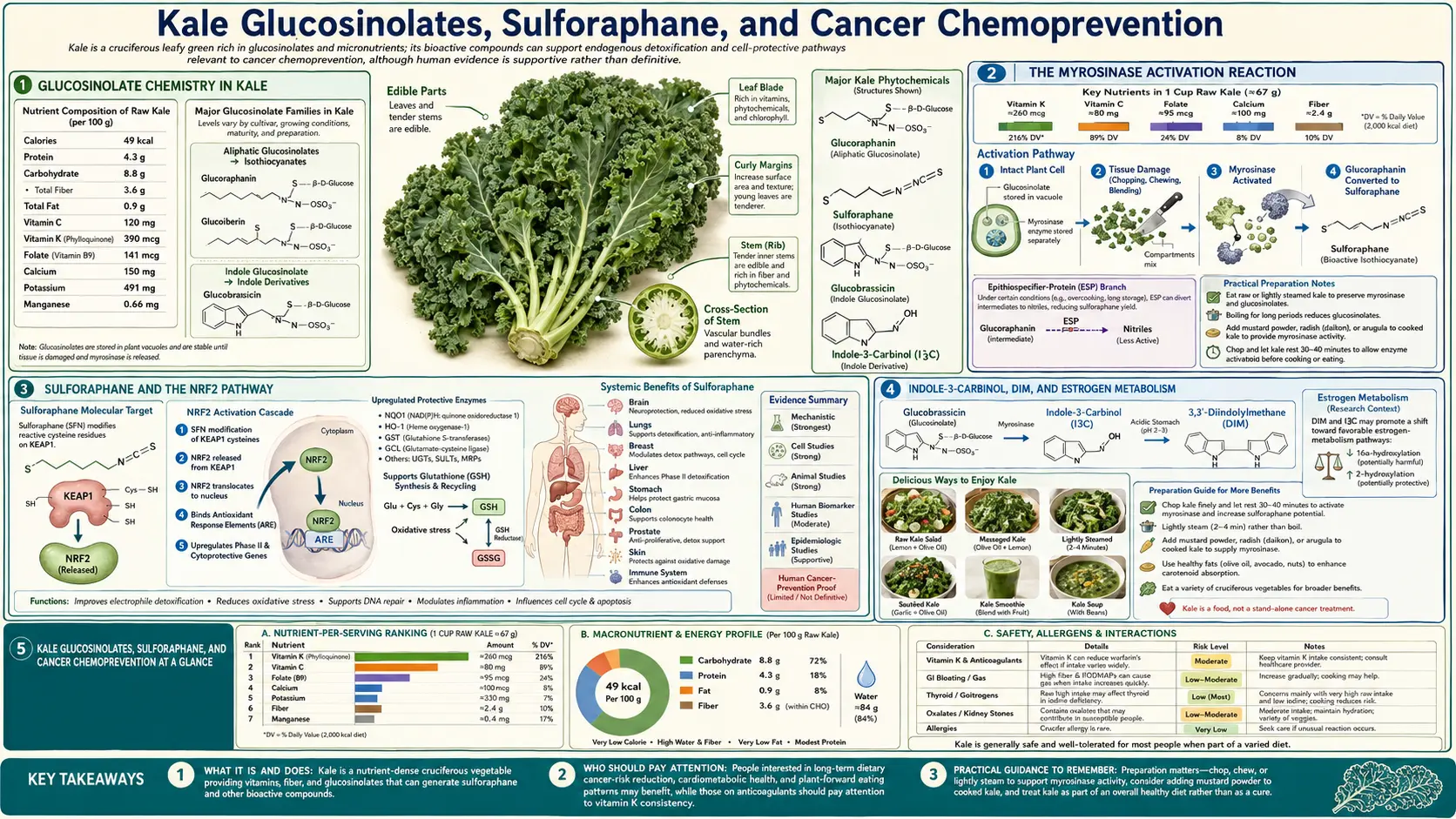
Kale, like every member of the Brassica genus, contains sulfur-rich glucosinolate compounds stored in cell vacuoles separate from the enzyme myrosinase. When the plant tissue is damaged by chewing, chopping, or insect feeding, the two compartments fuse and myrosinase hydrolyzes glucosinolates into a cascade of bioactive metabolites — isothiocyanates (the most-studied being sulforaphane from glucoraphanin), indoles (indole-3-carbinol from glucobrassicin, which further condenses to diindolylmethane), and minor nitriles. These metabolites induce the master cellular antioxidant transcription factor NRF2 (nuclear factor erythroid 2-related factor 2), which transcribes the Phase II detoxification enzymes (glutathione S-transferases, NAD(P)H quinone dehydrogenase 1, heme oxygenase-1) that conjugate and excrete carcinogens before they can damage DNA. The same metabolites modulate estrogen metabolism toward the protective 2-hydroxyestrone pathway and away from the proliferative 16-alpha-hydroxyestrone pathway. The epidemiologic translation has been consistent across breast, prostate, colorectal, lung, and bladder cancer cohorts — high cruciferous-vegetable intake is associated with 15-30% reductions in incidence, with the largest effects in individuals with GSTM1-null or GSTT1-null detoxification-gene polymorphisms. This deep-dive walks through the chemistry, the mechanism, the epidemiology, the pivotal Johns Hopkins broccoli-sprout work, and the practical question of how to prepare kale to maximize the bioactive yield.
Table of Contents
- Glucosinolate Chemistry in Kale
- The Myrosinase Activation Reaction
- Sulforaphane and the NRF2 Pathway
- Indole-3-Carbinol, DIM, and Estrogen Metabolism
- Breast Cancer Epidemiology
- Prostate and Colorectal Cancer
- Lung and Bladder Cancer
- GSTM1 / GSTT1 Polymorphisms and Personal Variability
- Broccoli Sprouts vs Mature Kale: Concentration vs Practicality
- Preparation for Maximum Bioactive Yield
- Cautions and Drug Interactions
- Key Research Papers
- Connections
- Featured Videos
Glucosinolate Chemistry in Kale
Glucosinolates are a family of secondary metabolites with a common chemical scaffold — a beta-thioglucose moiety, a sulfonated oxime group, and a variable side chain derived from a precursor amino acid. The plant uses them as a chemical defense system against herbivores and microbial pathogens. Approximately 130 distinct glucosinolates have been identified across the order Brassicales, with most plant species expressing a characteristic subset.
Kale (Brassica oleracea var. sabellica) typically contains a profile dominated by:
- Glucoraphanin (4-methylsulfinylbutyl glucosinolate) — the precursor to sulforaphane, the most-studied bioactive isothiocyanate. Concentration in kale is moderate (10-30 mg per 100 g fresh weight), lower than in broccoli (50-100 mg per 100 g) and dramatically lower than in 3-day-old broccoli sprouts (1,500-2,000 mg per 100 g), but still substantial in a one-cup serving
- Glucobrassicin (3-indolylmethyl glucosinolate) — the precursor to indole-3-carbinol (I3C) and downstream diindolylmethane (DIM), the principal modulators of estrogen metabolism. Concentration in kale is comparable to other brassicas at 20-50 mg per 100 g
- Sinigrin (allyl glucosinolate) — the precursor to allyl isothiocyanate, the compound responsible for the pungent flavor of mustard greens and some kale varieties. Concentration is variety-dependent and ranges from trace to substantial
- Progoitrin (2-hydroxy-3-butenyl glucosinolate) — the precursor to goitrin, which has some thyroid-iodine-uptake-inhibitory activity. Concentration in kale is low compared to rapeseed or rutabaga but non-zero. See the cooking page for the thyroid discussion
Total glucosinolate content of fresh kale typically falls in the range of 50-150 mg per 100 g fresh weight, with significant variation by cultivar, growing conditions, season, and post-harvest handling. Lacinato (dinosaur) kale tends toward the higher end; baby kale and curly kale toward the middle.
The Myrosinase Activation Reaction
The chemistry that makes brassicas pharmacologically interesting is the spatial separation of glucosinolates from the enzyme that activates them. In intact plant tissue, glucosinolates are stored in S-cells (specialized cells in the leaf vasculature), while the activating enzyme myrosinase (thioglucoside glucohydrolase, EC 3.2.1.147) is stored in adjacent myrosin cells. The two are physically separated until the plant tissue is damaged — by chewing, chopping, insect feeding, freezing, or crushing — at which point the cell walls rupture and myrosinase contacts its glucosinolate substrate.
The hydrolysis reaction is rapid (seconds to minutes) and produces a glucose moiety plus an unstable thiohydroximate-O-sulfonate intermediate. The intermediate undergoes spontaneous rearrangement to produce one of several products depending on the glucosinolate side chain, the pH, the presence of epithiospecifier protein (ESP), and the iron content of the cell:
- Isothiocyanate (the desired product for cancer chemoprevention) — formed by Lossen rearrangement at neutral pH in the absence of ESP. Sulforaphane from glucoraphanin, allyl isothiocyanate from sinigrin, benzyl isothiocyanate from glucotropaeolin
- Indole metabolites (indole-3-carbinol) — the product of indole-glucosinolate hydrolysis. Unstable in acidic stomach pH, where I3C oligomerizes to diindolylmethane (DIM) and related condensation products
- Nitrile (the alternative, less-bioactive product) — formed in the presence of ESP or under acidic / low-iron conditions. Nitriles lack the cancer-chemopreventive activity of isothiocyanates
The practical implication is that to get maximum isothiocyanate yield, the glucosinolates must come in contact with active myrosinase under neutral-pH conditions. Two factors deactivate myrosinase: cooking heat (myrosinase is denatured at temperatures above ~70°C / 158°F, depending on duration) and stomach acid (the gastric pH of 1.5-2 destroys ingested myrosinase before it can act). The cooking question is therefore not "should I cook kale?" but "how should I cook it to preserve myrosinase activity?" — covered in the preparation section below and on the cooking page.
The good news: even when food-source myrosinase is fully destroyed by cooking, intact glucosinolates can be hydrolyzed by myrosinase-producing gut bacteria (notably Bifidobacterium and certain Lactobacillus species) in the colon. The conversion efficiency is much lower than with plant myrosinase (10-20% vs 60-80%), and inter-individual variability is high, but this colonic salvage pathway means cooked brassicas still deliver some isothiocyanate.
Sulforaphane and the NRF2 Pathway
Sulforaphane (4-methylsulfinylbutyl isothiocyanate) is the most extensively studied dietary chemopreventive agent. Its principal mechanism is induction of NRF2 (nuclear factor erythroid 2-related factor 2), the master transcription factor for the cellular antioxidant and Phase II detoxification response.
NRF2 is normally held in the cytoplasm bound to its inhibitor KEAP1 (Kelch-like ECH-associated protein 1), which targets NRF2 for ubiquitination and proteasomal degradation. KEAP1 contains reactive cysteine residues that act as oxidative-stress sensors. When sulforaphane (or other electrophilic compounds, or reactive oxygen species directly) modifies these cysteines, the KEAP1-NRF2 complex dissociates. Liberated NRF2 translocates to the nucleus, binds antioxidant response elements (AREs) in the promoter regions of cytoprotective genes, and induces transcription of:
- Phase II detoxification enzymes — glutathione S-transferases (GSTM1, GSTP1), UDP-glucuronosyltransferases, sulfotransferases, NAD(P)H quinone dehydrogenase 1 (NQO1), heme oxygenase-1 (HO-1). These enzymes conjugate carcinogens with glutathione, glucuronate, or sulfate, increasing water solubility and accelerating biliary or renal excretion before the carcinogen can react with DNA
- Glutathione biosynthesis enzymes — gamma-glutamylcysteine ligase (GCL, the rate-limiting enzyme of glutathione synthesis), glutathione synthetase, glutathione reductase
- Antioxidant defense enzymes — superoxide dismutase, catalase, glutathione peroxidase, thioredoxin
The net effect is a coordinated upregulation of carcinogen detoxification and oxidative-stress defense, sustained for 2-3 days after a single dose of sulforaphane. Regular consumption of kale or other brassicas maintains a tonic activation of this protective response.
The Johns Hopkins group (Paul Talalay and colleagues) pioneered the broccoli-sprout work that established the NRF2 mechanism. Three-day-old broccoli sprouts contain 20-100x the glucoraphanin concentration of mature broccoli, and the seminal Talalay 1992 paper in PNAS demonstrated that sprout extracts induce Phase II enzymes in mammalian cells. Subsequent clinical trials in China and elsewhere have shown measurable urinary excretion of aflatoxin-glutathione conjugates and benzene-mercapturic acid metabolites after broccoli-sprout beverage consumption in environmentally exposed populations.
Indole-3-Carbinol, DIM, and Estrogen Metabolism
The second major chemopreventive pathway involves indole-3-carbinol (I3C), the hydrolysis product of glucobrassicin. I3C itself is unstable in stomach acid and rapidly condenses to diindolylmethane (DIM) and several minor oligomers. DIM is the dominant bioactive species reaching the systemic circulation and tissues.
DIM modulates the metabolism of estrogens through cytochrome P450 enzyme induction, shifting the balance between the two major estrogen 2-position and 16-alpha-position hydroxylation pathways:
- 2-hydroxyestrone (2-OHE1) — the product of CYP1A1-mediated 2-hydroxylation. 2-OHE1 has weak estrogenic activity, is rapidly conjugated and excreted, and is considered the "protective" estrogen metabolite. DIM induces CYP1A1 and increases 2-OHE1 production
- 16-alpha-hydroxyestrone (16-alpha-OHE1) — the product of CYP3A4-mediated 16-alpha-hydroxylation. 16-alpha-OHE1 has potent estrogenic activity, binds estrogen receptors with high affinity, and is considered the "proliferative" estrogen metabolite. Elevated 16-alpha-OHE1 has been associated with increased breast and uterine cancer risk in some cohorts
The ratio of 2-OHE1 to 16-alpha-OHE1 (the "2/16 ratio") is a research-grade biomarker of estrogen metabolism. DIM supplementation in clinical trials has been shown to increase the 2/16 ratio, theoretically reducing the proliferative estrogen load on hormone-responsive tissues. The clinical translation to breast cancer prevention outcomes is plausible but not yet definitively established — the 2/16 ratio is a surrogate marker, not a cancer endpoint.
The practical implication: regular cruciferous-vegetable intake (kale, broccoli, cabbage, brussels sprouts) supports a more favorable estrogen-metabolite profile in pre-menopausal and post-menopausal women, which is one of several proposed mechanisms behind the consistent epidemiologic association between cruciferous intake and reduced breast cancer risk. For more on hormone-balancing strategies, see our Endocrinology category.
Breast Cancer Epidemiology
The cruciferous-vegetable-and-breast-cancer association has been studied in dozens of prospective cohorts. The 2013 meta-analysis by Liu and Lv pooled 13 cohort studies and found a 15% reduction in breast cancer risk comparing highest vs lowest cruciferous-vegetable intake quintiles. Asian populations (Shanghai Women's Health Study, Singapore Chinese Health Study) consistently show stronger inverse associations than Western populations, possibly due to higher baseline intake levels (Asian cohorts averaging 100+ g/day vs Western cohorts averaging 20-30 g/day) and earlier exposure (cruciferous greens consumed regularly from childhood).
The Shanghai Women's Health Study (Fung 2013) showed a 22% reduction in breast cancer mortality among women in the highest cruciferous-intake quintile during the first three years after diagnosis, suggesting the effect operates on tumor progression and not only initiation. The Long Island Breast Cancer Study Project found inverse associations with both estrogen-receptor-positive and triple-negative breast cancer subtypes, with the effect on triple-negative disease being numerically larger.
The mechanism is mechanistically plausible across multiple pathways — sulforaphane induction of Phase II carcinogen detoxification, DIM modulation of estrogen metabolism, sulforaphane and DIM inhibition of histone deacetylases (epigenetic modulation), and sulforaphane induction of apoptosis in transformed cells. The convergent mechanistic evidence supports the epidemiologic association.
Important caveat: the cohort studies use questionnaire-based intake assessment with substantial measurement error, and the effect sizes are modest (15-25% relative risk reduction). Cruciferous vegetables are not a substitute for screening, primary prevention, or treatment of breast cancer. They are a meaningful but small contributor to lifetime risk modification.
Prostate and Colorectal Cancer
Prostate cancer. The Health Professionals Follow-up Study found a 30% reduction in invasive prostate cancer risk in men consuming >28 servings/week of vegetables, with cruciferous vegetables driving most of the effect. The European EPIC cohort and the Multiethnic Cohort have shown comparable inverse associations. Sulforaphane has been shown to inhibit androgen-receptor signaling in prostate cancer cell lines and to induce apoptosis in androgen-independent tumor models — the latter mechanism being clinically interesting given the current treatment-resistance problem in advanced prostate cancer.
A randomized clinical trial (Cipolla 2015) of broccoli-sprout extract in men with prostate cancer recurrence showed measurable reductions in PSA doubling time on supplementation, supporting the mechanistic plausibility of dietary cruciferous benefit. Larger confirmatory trials are in progress.
Colorectal cancer. The cruciferous-and-colorectal-cancer association is somewhat weaker than for breast or prostate but consistent across cohorts. The 2013 meta-analysis by Wu et al. pooled 24 case-control and cohort studies and found an 18% reduction in colorectal cancer risk comparing highest to lowest cruciferous-intake quintiles. The effect is stronger for left-sided (distal) colon and rectal cancer than for right-sided (proximal) colon cancer.
Sulforaphane has direct effects on colorectal cancer cell lines (apoptosis induction, cell cycle arrest, Wnt-pathway inhibition) and indirect effects through the gut microbiome — cruciferous-rich diets alter gut bacterial composition toward populations with higher short-chain fatty acid (butyrate) production, which has independent colon-protective effects.
Lung and Bladder Cancer
Lung cancer. The cruciferous-and-lung-cancer association is strongest in current smokers, where dietary isothiocyanates accelerate detoxification of tobacco-smoke carcinogens (4-(methylnitrosamino)-1-(3-pyridyl)-1-butanone or NNK, benzo[a]pyrene, polycyclic aromatic hydrocarbons). The China Health and Nutrition Study and the Singapore Chinese Health Study have shown 20-40% reductions in lung cancer risk among smokers in the highest cruciferous-intake quintiles. The effect among never-smokers is smaller but still present.
Bladder cancer. The cruciferous-and-bladder-cancer association has been documented in the Health Professionals Follow-up Study, the Vitamins and Lifestyle (VITAL) study, and a Phase II clinical trial of broccoli-sprout extract in non-muscle-invasive bladder cancer. Mechanistically, isothiocyanates concentrate in the urine after dietary intake (urinary mercapturic acid metabolites are elevated for 24-48 hours after cruciferous consumption), providing direct exposure to bladder epithelial cells. The Bladder Cancer Advocacy Network has summarized the trial evidence.
GSTM1 / GSTT1 Polymorphisms and Personal Variability
Two common glutathione S-transferase polymorphisms strongly modify individual response to dietary isothiocyanates:
- GSTM1-null genotype (homozygous deletion of the gene) — present in approximately 50% of Caucasians and 30% of African Americans. GSTM1-null individuals have absent baseline GSTM1 activity and respond more dramatically to sulforaphane-mediated Phase II induction, with larger urinary isothiocyanate-mercapturic acid excretion and larger reductions in cancer risk per unit cruciferous intake
- GSTT1-null genotype — comparable frequency, comparable mechanism, sometimes additive with GSTM1-null
The practical implication is that individuals with one or both null genotypes derive proportionally larger benefit from cruciferous-vegetable intake than individuals with intact GSTM1 / GSTT1. Genetic testing is not routinely required to inform dietary advice — the recommendation to eat cruciferous vegetables is the same regardless of genotype — but it explains some of the inter-individual variability in epidemiologic effect sizes.
Broccoli Sprouts vs Mature Kale: Concentration vs Practicality
Three-day-old broccoli sprouts contain 20-100x the glucoraphanin concentration of mature broccoli on a per-gram basis. A single tablespoon of fresh broccoli sprouts (~10 g) can contain as much glucoraphanin as a full head of mature broccoli. This concentration advantage is why the Johns Hopkins research program focused on sprouts as the experimental delivery vehicle for sulforaphane.
However, sprouts present practical challenges that mature greens do not:
- Food-safety risk from Salmonella and E. coli contamination of sprouted seeds (multiple outbreaks documented; the FDA has issued advisories recommending pregnant women, immunocompromised individuals, young children, and the elderly avoid raw sprouts)
- Short shelf life (3-5 days refrigerated)
- Cost per serving relative to commodity greens
- Palatability issues for some consumers
Mature kale is the pragmatic compromise: lower glucoraphanin concentration per gram, but much higher per-serving volume (one cup of kale >> one tablespoon of sprouts), excellent food safety, year-round availability, low cost, and broader culinary versatility. For the typical person trying to derive cancer-chemopreventive benefit from cruciferous vegetables, daily kale (or rotating kale, broccoli, brussels sprouts, cabbage) is the practical strategy. Sprouts can be added as a concentrated boost if desired and tolerated, with appropriate food-safety caution.
Preparation for Maximum Bioactive Yield
- Chop or chew before cooking — the mechanical damage initiates myrosinase activity immediately. Letting chopped kale sit for 5-10 minutes before cooking allows substantial isothiocyanate formation before heat destroys the enzyme
- Light steaming preserves myrosinase better than boiling — 3-5 minutes of steaming retains 60-80% of myrosinase activity vs full inactivation by boiling
- Sauteing in a hot pan rapidly inactivates myrosinase but the brief contact time with active enzyme during chopping still yields substantial isothiocyanate
- Add a small portion of raw cruciferous to the meal — even 1-2 tablespoons of raw chopped kale, raw broccoli sprouts, or mustard seed sprinkled on top of cooked greens provides active myrosinase to hydrolyze any glucosinolates remaining in the cooked portion
- Mustard seed powder is an exceptional myrosinase source — small amounts (1/4 teaspoon ground mustard seed) added to cooked brassicas can dramatically increase isothiocyanate yield. This is the same principle behind the traditional Indian and Eastern European practice of mustard-seeding cooked cabbage and greens
- Microwaving has variable effects — brief microwaving (under 60 seconds) appears to preserve more myrosinase than longer cooking; extended microwaving inactivates the enzyme
- Freezing and thawing rupture cell walls and initiate hydrolysis, but the active period is short and most home-frozen brassicas have already undergone substantial glucosinolate loss by the time of cooking
The simplest practical advice: chop kale, let it sit 5-10 minutes on the cutting board, then steam or saute briefly, dress with a teaspoon of olive oil and a pinch of mustard seed if you like the flavor. This is not perfect maximization of bioactive yield, but it is realistic, palatable, and substantially better than overboiled kale eaten without preparation considerations.
Cautions and Drug Interactions
- Acetaminophen (paracetamol, Tylenol) metabolism — high cruciferous intake induces UDP-glucuronosyltransferase and CYP1A2, which accelerate acetaminophen clearance. Therapeutic effect of acetaminophen may be slightly reduced; toxicity threshold is not affected at clinically relevant intakes
- Warfarin interaction — covered on the Vitamin K page. Glucosinolates themselves do not interact with warfarin, but the high K1 content of the kale matrix does
- Iodine deficiency — in iodine-deficient individuals, very high cruciferous intake can transiently suppress thyroid hormone synthesis. Iodine-replete populations (most Americans, given iodized salt) are not at risk. See the cooking page
- Chemotherapy timing — some cytotoxic chemotherapy agents rely on intracellular oxidative stress for tumor cell killing. The NRF2-induced antioxidant defense from heavy cruciferous intake could theoretically protect tumor cells along with normal cells. The clinical relevance is debated; oncologists may advise temporary reduction of high-dose cruciferous intake during active chemotherapy cycles, with normal intake resuming on off-cycle days
- I3C / DIM supplementation — concentrated I3C or DIM supplements (200-400 mg/day) used for hormone modulation in some integrative-medicine protocols can have stronger estrogen-metabolism effects than dietary intake and may interact with hormone-replacement therapy or oral contraceptives. Discuss with the prescribing clinician
- Allergy — brassica allergy exists but is rare; cross-reactivity with mugwort pollen (mugwort-mustard syndrome) is the most-documented variant
Key Research Papers
- Talalay P, Fahey JW (2001). Phytochemicals from cruciferous plants protect against cancer by modulating carcinogen metabolism. Journal of Nutrition. PMID: 11694625 — Search PubMed
- Zhang Y, Talalay P, Cho CG, Posner GH (1992). A major inducer of anticarcinogenic protective enzymes from broccoli: isolation and elucidation of structure. PNAS. PMID: 1542818 — Search PubMed
- Fahey JW, Zhang Y, Talalay P (1997). Broccoli sprouts: an exceptionally rich source of inducers of enzymes that protect against chemical carcinogens. PNAS. PMID: 9294217 — PubMed 9294217
- Kensler TW, Ng D, Carmella SG, Chen M, Jacobson LP, Munoz A, Egner PA, Chen JG, Qian GS, Chen TY, Fahey JW, Talalay P, Groopman JD, Yuan JM, Hecht SS (2012). Modulation of the metabolism of airborne pollutants by glucoraphanin-rich and sulforaphane-rich broccoli sprout beverages in Qidong, China. Carcinogenesis. PMID: 22045030 — Search PubMed
- Liu X, Lv K (2013). Cruciferous vegetables intake is inversely associated with risk of breast cancer: a meta-analysis. The Breast. PMID: 23332658 — Search PubMed
- Wu QJ, Yang Y, Vogtmann E, Wang J, Han LH, Li HL, Xiang YB (2013). Cruciferous vegetables intake and the risk of colorectal cancer: a meta-analysis of observational studies. Annals of Oncology. PMID: 23211940 — Search PubMed
- Cipolla BG, Mandron E, Lefort JM, Coadou Y, Della Negra E, Corbel L, Le Scodan R, Azzouzi AR, Mottet N (2015). Effect of Sulforaphane in Men with Biochemical Recurrence after Radical Prostatectomy. Cancer Prevention Research. PMID: 26276751 — Search PubMed
- Higdon JV, Delage B, Williams DE, Dashwood RH (2007). Cruciferous vegetables and human cancer risk: epidemiologic evidence and mechanistic basis. Pharmacological Research. PMID: 17317210 — PubMed 17317210
- Lampe JW, King IB, Li S, Grate MT, Barale KV, Chen C, Feng Z, Potter JD (2000). Brassica vegetables increase and apiaceous vegetables decrease cytochrome P450 1A2 activity in humans. Carcinogenesis. PMID: 10874018 — Search PubMed
- Bradlow HL, Telang NT, Sepkovic DW, Osborne MP (1996). 2-hydroxyestrone: the 'good' estrogen. Journal of Endocrinology. PMID: 8943553 — Search PubMed
- Lampe JW (2009). Interindividual differences in response to plant-based diets: implications for cancer risk. American Journal of Clinical Nutrition. PMID: 19403634 — Search PubMed
- Atwell LL, Beaver LM, Shannon J, Williams DE, Dashwood RH, Ho E (2015). Epigenetic regulation by sulforaphane: opportunities for breast and prostate cancer chemoprevention. Current Pharmacology Reports. PMID: 26618103 — Search PubMed
PubMed Topic Searches
- PubMed: Sulforaphane NRF2 chemoprevention
- PubMed: Cruciferous and breast cancer
- PubMed: I3C/DIM estrogen metabolism
- PubMed: GSTM1/GSTT1 polymorphisms
- PubMed: Broccoli sprouts
Connections
- All Food
- Kale (Main Page)
- Kale Benefits Hub
- Kale, Vitamin K and Bone
- Kale, Lutein, and Eye Health
- Kale Oxalates and Cooking
- Sulforaphane
- Broccoli
- Brussels Sprouts
- Cabbage
- Oncology (Cancer)
- Breast Cancer
- Prostate Cancer
- Colorectal Cancer
- Detoxification
- Vitamin C