Raw Honey vs Pasteurized Honey — What Is Actually Different
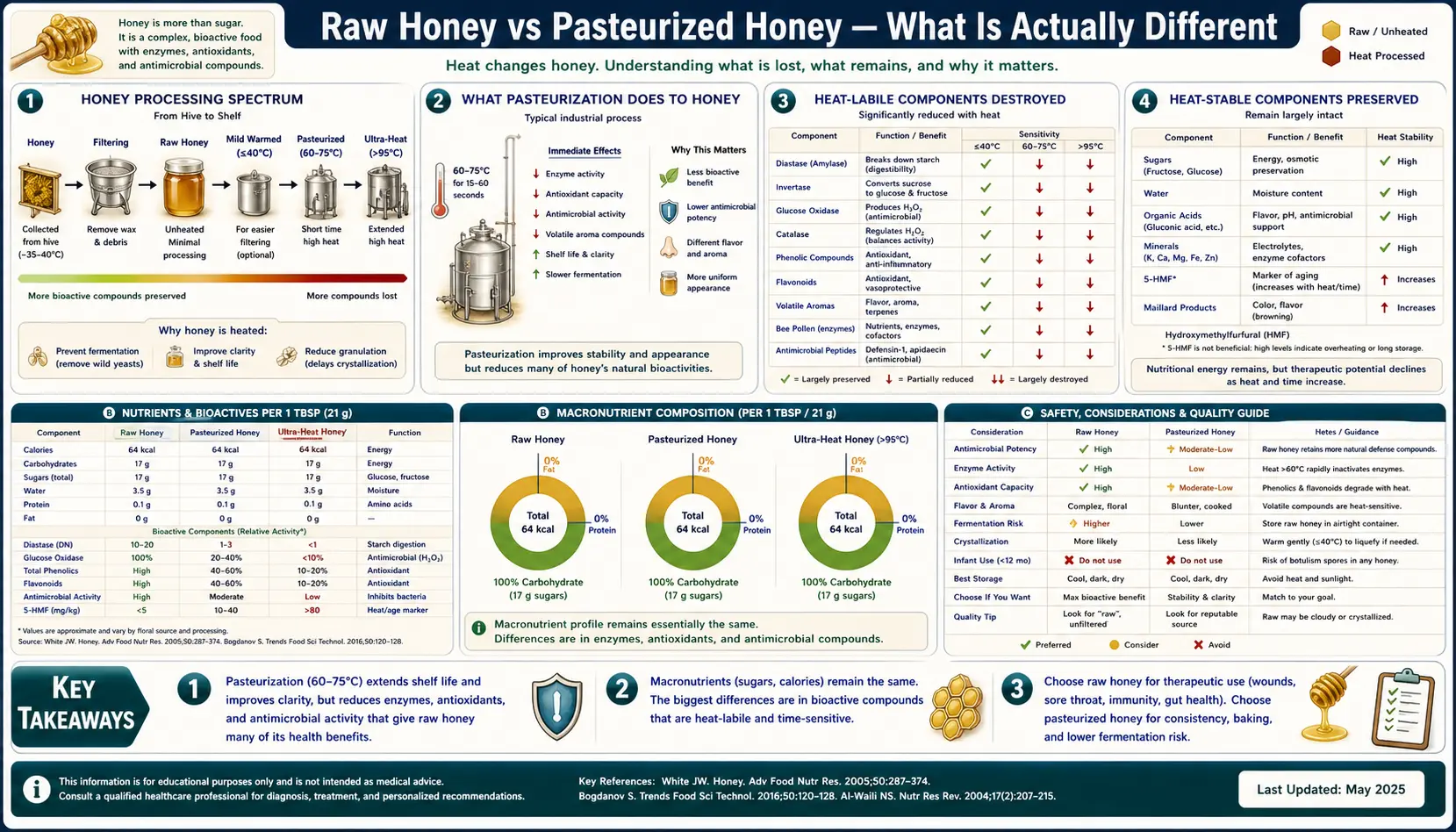
Most honey sold in mainstream US supermarkets has been heated to 60-70°C (140-160°F) and pushed through filters fine enough to remove visible pollen. The food-science purpose is shelf appearance: heat-treated honey resists crystallization for months longer in clear bottles on warm grocery shelves, and ultra-filtration produces the glassy clarity consumers associate with quality. The cost is the destruction of glucose oxidase (the enzyme that generates the hydrogen peroxide responsible for most non-Manuka honey's antibacterial activity), the loss of heat-labile phenolic antioxidants, and the elimination of beneficial Lactobacillus species naturally present in raw honey. None of this changes the sugar profile, the basic acidity, or (in Manuka) the methylglyoxal content, which is heat-stable. This page walks through the spectrum of honey processing, what is preserved or lost at each level, the regulatory ambiguity of the word "raw" in the United States, and the universal infant-botulism contraindication that does not differ between raw and pasteurized.
Table of Contents
- The Honey Processing Spectrum
- What Pasteurization Does to Honey
- Heat-Labile Components Destroyed
- Heat-Stable Components Preserved
- HMF as a Heat-Damage Marker
- The Word "Raw" Is Not Regulated
- Crystallization and Why It Matters
- Infant Botulism — Universal Contraindication
- Adulteration and Authenticity
- Cautions
- Key Research Papers
- Connections
- Featured Videos
The Honey Processing Spectrum
"Raw" and "pasteurized" are the two endpoints of a continuum. Real-world commercial honey falls somewhere along it, and the labels can be unhelpfully vague. From least processed to most processed:
- Comb honey — the honey is still in the original beeswax comb cells cut from the frame. Zero processing. The wax cappings are typically chewed and discarded by the consumer. Most expensive, shortest shelf life on a warm shelf (the honey will sometimes crystallize in the comb, which is harmless), most natural.
- Chunk honey — pieces of comb suspended in liquid extracted honey. A compromise between comb and extracted.
- Extracted raw, unfiltered — centrifugally extracted from the comb, allowed to settle to remove larger debris (wax cappings, bee parts), bottled as-is. Contains intact pollen, propolis particles, and bee-derived enzymes. May or may not be lightly warmed (under 40°C / 104°F) to ease handling. Will crystallize over months to years depending on the floral source. This is the honey most beekeepers themselves consume.
- Extracted raw, strained — the same as above, but pushed through a coarse cloth or screen filter (often 200-400 microns) to remove visible debris while preserving pollen and most of the natural particulate. Still considered "raw" by most beekeeping definitions.
- Filtered, not heat-pasteurized — warmed enough (typically 35-43°C / 95-110°F) to reduce viscosity for fine filtration. Pollen is partially removed. Glucose oxidase is mostly preserved. Some commercial products labeled "raw" fall into this category.
- Pasteurized — rapidly heated to 60-70°C (140-160°F) for about 30 minutes, then cooled. Destroys most enzymes including glucose oxidase. Slows crystallization by killing the yeast and microcrystalline glucose nuclei that seed it.
- Ultra-filtered — pushed through filters fine enough (typically < 0.2 micron) to remove all pollen. Often follows pasteurization. Produces the glassy, perfectly clear honey of generic supermarket brands. The pollen removal makes geographical origin verification impossible, which is one reason ultra-filtration is associated with imported and adulterated product.
What Pasteurization Does to Honey
Honey pasteurization is fundamentally different from milk pasteurization. Milk pasteurization is a food-safety intervention — it kills Listeria, Salmonella, Campylobacter, E. coli, and other pathogens that grow readily in milk. Honey does not need pasteurization for safety in the same sense — the low water activity (aw < 0.6) of honey already prevents pathogenic bacterial growth. Honey can sit on a shelf at room temperature for years without spoiling.
What honey pasteurization actually achieves is commercial cosmetic improvement:
- Slows crystallization — raw honey contains microcrystalline glucose nuclei and yeast cells that nucleate crystallization over weeks to months. Heat destroys both. Pasteurized honey can stay liquid for a year or more.
- Reduces fermentation risk — if honey has been over-diluted with water (above about 19% water content), osmotolerant yeast (Zygosaccharomyces rouxii and others) can ferment it. Pasteurization kills the yeast. Properly cured honey is below 18% water and does not need pasteurization for this reason.
- Eases bottling and filtering — warm honey is less viscous and pumps and filters more easily.
- Imparts cosmetic clarity when paired with fine filtration.
The cost is the destruction of all heat-labile components, which is most of what distinguishes raw honey from sugar syrup nutritionally.
Heat-Labile Components Destroyed
The following components are partly or fully destroyed by pasteurization (60-70°C, 30 min) and are progressively damaged at even modest warming (above 40°C / 104°F):
- Glucose oxidase (GOx) — the bee-derived enzyme that produces the slow-release hydrogen peroxide responsible for most of the antibacterial activity of non-Manuka honey. Destruction of GOx is the single largest functional loss in pasteurization. For wound applications, pasteurized honey is dramatically less effective.
- Diastase (alpha-amylase) — a bee-derived starch-digesting enzyme. Diastase activity is the standard regulatory marker for honey heat damage in the Codex Alimentarius international honey standard. Codex requires a minimum diastase activity in commercial honey.
- Invertase — converts sucrose to glucose and fructose; partly heat-labile.
- Heat-labile phenolic antioxidants — total polyphenol content drops 30-50% with full pasteurization. Specific compounds like chrysin and pinocembrin (the dominant flavonoids in many raw honeys) are partly degraded.
- Beneficial yeast and lactic acid bacteria — raw honey contains a small population of Lactobacillus and Bifidobacterium species derived from the bee gut, which research published in the 2010s has begun to characterize as potentially beneficial gut microbes. These are heat-sensitive.
- Antimicrobial bee peptides — defensin-1 and other small antimicrobial peptides produced by the bee and incorporated into honey are partly heat-labile.
- Some volatile aroma compounds — the floral aroma of fresh raw honey is partly lost on pasteurization, replaced by a flatter "cooked" flavor.
Heat-Stable Components Preserved
The following components are essentially unaffected by pasteurization:
- The sugar profile — fructose, glucose, and minor sugars. Pasteurized honey is the same fructose-glucose mix as raw honey, with the same glycemic load.
- Basic acidity (pH 3.2-4.5) — gluconic acid and other organic acids are heat-stable; honey pH is essentially unchanged.
- Water activity (aw < 0.6) — the osmotic dehydration of bacteria works equally well with pasteurized honey on a wound surface, even though the peroxide mechanism is destroyed.
- Methylglyoxal (MGO) — the dominant antibacterial in Manuka honey is heat-stable. Pasteurized Manuka retains most of its MGO activity. This is part of why Manuka dominates clinical wound-care use: its main mechanism survives heat and gamma irradiation, allowing manufacture of sterile medical-grade dressings.
- Heat-stable phenolics — gallic acid and some other small phenolic acids are reasonably stable to honey-pasteurization temperatures.
- Minerals — potassium, calcium, iron, magnesium, and trace elements are heat-stable (and present in very small amounts in any case).
HMF as a Heat-Damage Marker
Hydroxymethylfurfural (HMF) is a furan derivative produced when glucose and fructose in honey are heated or stored at elevated temperatures. Fresh raw honey contains less than 10 mg/kg of HMF; pasteurized commercial honey commonly contains 30-50 mg/kg; aged, badly stored, or heat-abused honey can contain over 100 mg/kg. The Codex Alimentarius international honey standard sets a maximum of 40 mg/kg for honey in normal commerce and 80 mg/kg for honey from tropical climates (acknowledging higher baseline temperatures).
HMF itself is not acutely toxic at food-encountered concentrations. It is a normal Maillard-reaction byproduct present in many heated foods (coffee, baked goods, dried fruit). The point is that HMF is a marker — high HMF in honey indicates either heat damage during processing, prolonged storage, or storage at high temperature. A consumer who wants minimally processed honey can use HMF data (when available on premium products) to compare brands. Honey from a local beekeeper, harvested within a year and never heated above ambient temperature, will typically test below 10 mg/kg HMF.
The Word "Raw" Is Not Regulated
In the United States, the FDA does not regulate or define the word "raw" on a honey label. Any producer can call their honey "raw" regardless of processing. The National Honey Board (an industry trade group) offers a voluntary definition (essentially: "honey as it exists in the beehive or as obtained by extraction, settling, or straining, without adding heat above what honey naturally encounters in the hive"), but this is not legally enforceable.
In practice, the "raw" label on a US supermarket honey can mean any of:
- Truly raw, never warmed above ambient temperature — the gold standard
- Lightly warmed (under 40°C / 104°F) for ease of bottling but not pasteurized — effectively raw, enzymes preserved
- Warmed to 43-49°C (110-120°F) for fine filtration but not pasteurized in the formal sense — partial enzyme loss
- Pasteurized but re-labeled "raw" by an unethical producer — effectively dead honey marketed as live
How to actually verify rawness:
- Visible pollen — held against a light, raw honey is slightly cloudy; ultra-filtered honey is glassy clear
- Eventual crystallization — truly raw honey will crystallize within months on a kitchen shelf; perpetually liquid clear honey has been heat-treated
- Floral aroma — raw honey has a distinct floral aroma reflecting the nectar source; pasteurized honey smells more uniformly sweet and flat
- Local source — a local beekeeper's product, where you can verify the bottling process, is the most reliable
Crystallization and Why It Matters
Honey crystallization is a normal, harmless physical process. Honey is a supersaturated sugar solution, and over time the dissolved glucose precipitates as glucose monohydrate crystals, transforming the liquid into a granular spread (sometimes called "creamed" or "set" honey). The fructose remains dissolved in the residual liquid. The kinetics of crystallization depend on the glucose-to-fructose ratio, with high-glucose honeys (clover, dandelion) crystallizing in weeks and high-fructose honeys (acacia, tupelo) staying liquid for years.
Pasteurization slows crystallization by killing yeast and dissolving microcrystalline glucose nuclei, so a pasteurized commercial honey may stay liquid for over a year. This is the primary commercial reason for pasteurization. Raw honey will crystallize, sometimes within months. There is nothing wrong with crystallized honey — it is the same product, just physically rearranged. To return crystallized honey to liquid form for cooking or pouring, warm the jar gently in a water bath at no more than 40°C (104°F) for an hour or two. Avoid microwaves, which create local hot spots that pasteurize the heated regions while leaving cold regions untouched.
Infant Botulism — Universal Contraindication
The single most important safety rule for honey applies equally to raw and pasteurized: no honey for infants under 12 months of age. This recommendation comes from the US Centers for Disease Control and Prevention, the American Academy of Pediatrics, the World Health Organization, and the equivalent agencies in every developed country.
The reason is infant botulism. Clostridium botulinum spores are environmentally widespread (soil, dust, plant surfaces, occasionally in honey itself). The spores are heat-resistant and survive honey pasteurization at standard temperatures — this is not a heat-treatment issue. In an adult or older child, the small number of spores that might be ingested with honey are killed by stomach acid and outcompeted by the established gut microbiome, never germinating in the gut. In an infant under 12 months, both defenses are immature — the spores can germinate into vegetative C. botulinum cells in the infant colon and produce botulinum toxin in vivo, causing infant botulism: progressive flaccid paralysis starting with constipation and weak feeding, progressing to "floppy baby" syndrome, sometimes requiring weeks of mechanical ventilation, and occasionally fatal.
Honey is the single most common identified food source of infant botulism. The risk applies to:
- Raw honey, pasteurized honey, ultra-filtered honey — all equally contraindicated
- Manuka honey of any MGO grade
- Honey on a pacifier, on a finger, in cereal, in tea, in any cooked dish
- Comb honey, chunk honey
- All commercial baby foods are honey-free by US regulation, but home-made foods are not
The only honey product that is verified spore-free is hospital medical-grade Manuka wound dressings, which have been gamma-irradiated. These are not for oral use.
After 12 months of age, the infant gut microbiome and gastric acid production have matured enough that C. botulinum spores no longer germinate, and honey becomes safe.
Adulteration and Authenticity
Honey is one of the most commonly adulterated foods globally, ranking with olive oil and saffron. The two dominant adulteration patterns are:
- Sugar-syrup adulteration — cheap corn syrup, rice syrup, or sugar-beet syrup is blended with real honey or sold straight as "honey." Detection methods include carbon isotope ratio analysis (SCIRA), nuclear magnetic resonance spectroscopy (NMR), and chromatographic profiling of trace sugars. The FDA does not routinely test imported honey for adulteration.
- Origin laundering — Chinese honey under US antidumping duties is sometimes re-exported through Vietnam, India, Thailand, or other countries with "blended" labels that obscure the actual origin. Ultra-filtered honey with no pollen content makes this practically undetectable on the consumer end.
Defenses against adulteration:
- Buy from a local beekeeper at a farmer's market when possible
- Buy honey with visible pollen content (raw or coarsely filtered)
- Buy honey with a single specified floral source (e.g. "100% Buckwheat from Pennsylvania") rather than generic "honey" or "blended honey"
- Prefer products certified by True Source Honey (an industry traceability program) or by USDA Organic (which has additional sourcing requirements)
- For Manuka, prefer UMF-certified or MPI-export-certified product — see the Manuka rating page
Cautions
- Infants under 12 months — absolute contraindication, raw or pasteurized, see above section
- Diabetes — honey is approximately 80% sugar (mostly fructose and glucose) and produces a meaningful glucose response. It is not a "free" sweetener; count it as carbohydrate.
- Allergy — honey allergy is rare but can include anaphylaxis. Individuals with severe bee-venom allergy or with allergies to specific pollens may react. Raw honey, with intact pollen, may be more allergenic than ultra-filtered honey for pollen-allergic individuals.
- Mad honey poisoning — raw honey from Rhododendron-rich regions of Turkey, Nepal, and certain other areas can contain grayanotoxin (a sodium-channel modulator), producing bradycardia, hypotension, dizziness, and occasionally seizures. This is rare in commercial honey but a real risk for tourist purchases in affected regions.
- Pyrrolizidine alkaloid contamination — honey from regions with abundant Senecio, Echium, or Borago can contain low levels of hepatotoxic pyrrolizidine alkaloids. European Food Safety Authority guidance addresses this; commercial European honey is monitored.
- Pesticide residues — commercial honey can contain residues of neonicotinoid insecticides applied to crops the bees foraged on. Organic certification reduces but does not eliminate this risk. The neonicotinoid concentrations in honey are low compared to dietary exposure routes for humans, but the cumulative effect on bee colonies is a major concern.
- Dental caries — honey is a fermentable sugar in the oral cavity. Brush after consumption; do not let an infant or toddler fall asleep with a honey-coated pacifier (this also revisits the infant-botulism concern).
Key Research Papers
- Bogdanov S et al. (2008). Honey for nutrition and health: a review. Journal of the American College of Nutrition. — Search PubMed
- White JW (1979). Composition of honey. In Crane E (ed): Honey: A Comprehensive Survey. USDA reference. PubMed: White composition
- Tosi E et al. (2008). Effect of heat treatment on honey: heat-induced changes in enzyme activity and HMF concentration. Food Chemistry. PubMed: Tosi heat treatment
- Turkmen N et al. (2006). Effects of prolonged heating on antioxidant activity and colour of honey. Food Chemistry. PubMed: Turkmen heating antioxidant
- Olas B (2020). Honey and Its Phenolic Compounds as an Effective Natural Medicine for Cardiovascular Diseases in Humans? Nutrients. — Search PubMed
- Olofsson TC, Vasquez A (2008). Detection and identification of a novel lactic acid bacterial flora within the honey stomach of the honeybee. Current Microbiology. — Search PubMed
- Arnon SS et al. (1979). Honey and other environmental risk factors for infant botulism. Journal of Pediatrics. PubMed: Arnon infant botulism
- CDC (2024). Infant botulism prevention guidance. PubMed: CDC infant botulism
- Codex Alimentarius (2001, revised 2019). Standard for Honey CXS 12-1981. PubMed: Codex honey standard
- Soares S et al. (2017). A comprehensive review on the main honey authentication issues: production and origin. Comprehensive Reviews in Food Science and Food Safety. — Search PubMed
- Da Silva PM et al. (2016). Honey: chemical composition, stability and authenticity. Food Chemistry. — Search PubMed
- Brudzynski K, Miotto D (2011). Honey melanoidins: analysis of the compositions of the high molecular weight melanoidins exhibiting radical scavenging activity. Food Chemistry. PubMed: Brudzynski melanoidins
PubMed Topic Searches
- PubMed: Raw vs pasteurized enzymes
- PubMed: HMF heat marker
- PubMed: Infant botulism and honey
- PubMed: Honey adulteration detection
- PubMed: Glucose oxidase and peroxide
Connections
- All Food
- Honey Main Page
- Honey Benefits Hub
- Manuka and MGO Rating
- Wound Healing Topical
- Cough Suppressant Evidence
- Clostridium botulinum
- Diabetes
- Pesticides (Neonicotinoids)
- Remedies
- Sweet Potatoes
- Yogurt (Live Cultures)
- Ginger
- Immune Boosting