Green Tea Brewing Time and Temperature
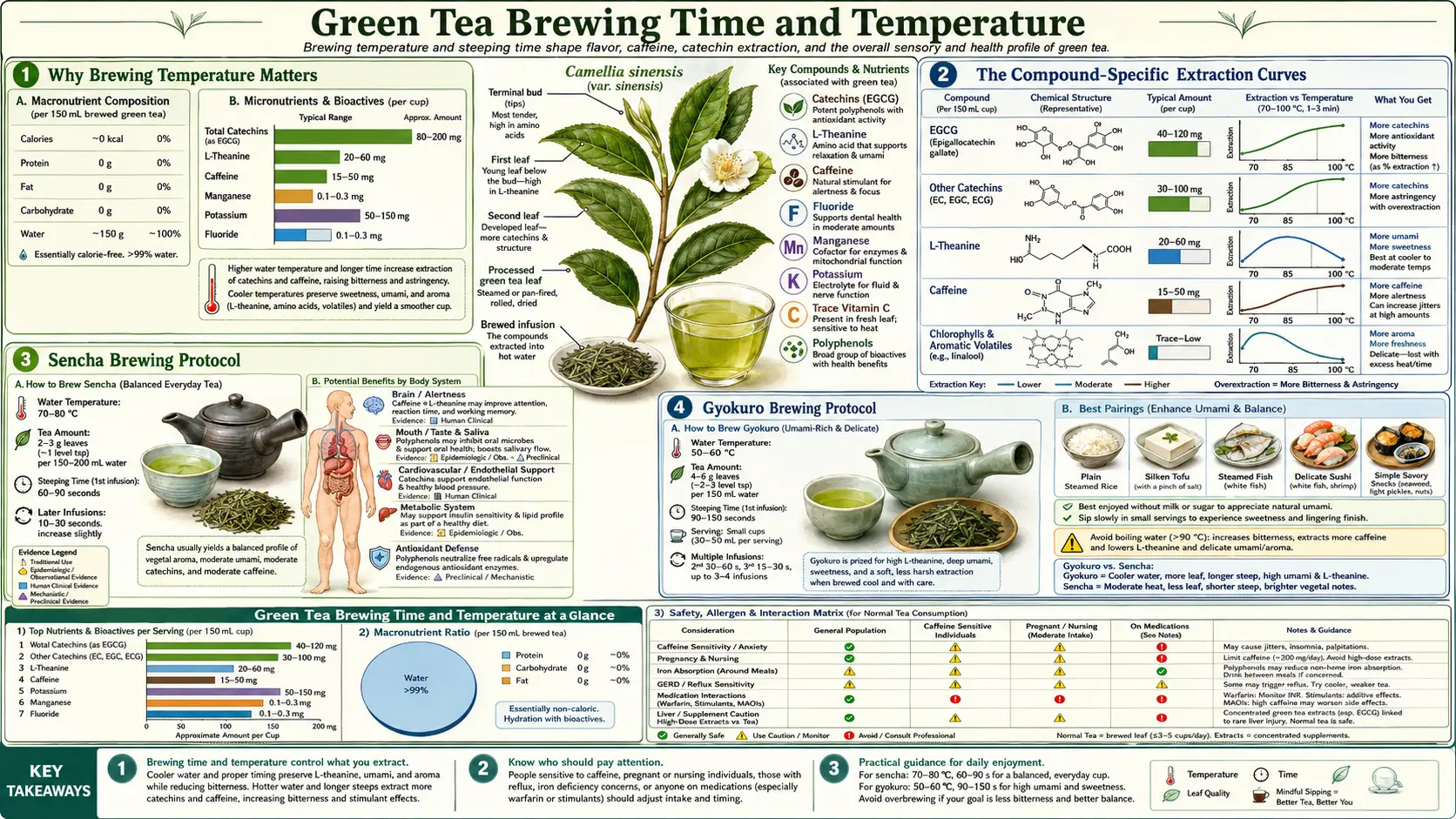
Most green tea consumed in the West is brewed wrong — boiling water poured over a tea bag and steeped for 4 minutes, producing a bitter astringent infusion that bears little resemblance to the umami-sweet beverage of the Japanese tradition. The difference is almost entirely a matter of brewing temperature and time. Catechin and caffeine extraction is strongly temperature-dependent, while L-theanine extraction is only weakly temperature-dependent. Brewing at 95-100°C pulls the maximum of every compound including the bitter and astringent ones; brewing at 75-80°C pulls the L-theanine and a moderated amount of catechin and caffeine, with the bitter compounds substantially suppressed. This page walks through the chemistry of extraction, the brewing protocols for each major green tea style, the multiple-infusion technique that doubles the yield of high-grade leaves, and the water-quality and lemon-addition considerations that further modulate the final cup.
Table of Contents
- Why Brewing Temperature Matters
- The Compound-Specific Extraction Curves
- Sencha Brewing Protocol
- Gyokuro Brewing Protocol
- Matcha Whisking Protocol
- Multiple Infusions — The Western Mistake
- Water Quality — Hardness, pH, Chlorine
- Lemon, Ascorbic Acid, Milk
- Cold-Brew Green Tea
- Equipment and Ratio Guidelines
- Key Research Papers
- Connections
- Featured Videos
Why Brewing Temperature Matters
Green tea contains hundreds of water-soluble compounds, but four classes dominate the final flavor and pharmacology of the infusion: catechins (bitter, astringent), caffeine (bitter), L-theanine (umami, sweet), and minor amino acids and sugars (sweet, savory). Each class has its own extraction kinetics — the temperature and time profile by which it diffuses out of the leaf into the surrounding water.
The fundamental relationship from extraction chemistry: solubility and diffusion rate are roughly exponential functions of temperature for most polyphenols. Doubling the temperature gradient between leaf interior and water typically triples or quadruples the extraction rate. Catechins are temperature-sensitive on the high end of this curve — an 80°C brew extracts perhaps 60-70% as much catechin as a 95°C brew of equal time, but a 70°C brew extracts only 30-40% as much.
Caffeine extraction is also strongly temperature-dependent, with kinetics closely tracking catechin extraction (which is why higher-temperature brews are both more bitter and more stimulating).
L-theanine and other free amino acids are much less temperature-sensitive. They are relatively small, polar, and freely water-soluble — cooler water extracts them nearly as efficiently as boiling water. This is the chemical asymmetry that makes selective brewing possible: by using cooler water, you can extract most of the L-theanine and only a modest fraction of the bitter catechins and caffeine. The result is the sweet, umami-rich infusion that defines high-grade Japanese green tea.
Practical implication: the right brewing temperature for green tea depends on what you want from the cup. If you want maximum caffeine and antioxidant catechin delivery, brew hotter. If you want the calm-focus L-theanine signature with moderated caffeine and bitter character, brew cooler. The Japanese tradition has converged on 70-80°C as the sweet spot for premium leaf, with cheaper everyday-grade sencha brewed at 80-85°C and only the lowest grade hojicha and bancha brewed near boiling.
The Compound-Specific Extraction Curves
Approximate extraction kinetics for the dominant compound classes during a 2-minute infusion, expressed as percent of maximum extraction (data abstracted from multiple food chemistry studies):
- L-theanine — 70°C: 75%. 80°C: 85%. 90°C: 92%. 95°C: 95%. Relatively flat extraction curve across the practical brewing temperature range.
- Caffeine — 70°C: 45%. 80°C: 65%. 90°C: 85%. 95°C: 95%. Steep extraction curve — cooler water delivers substantially less caffeine.
- EGCG (and other catechins) — 70°C: 35%. 80°C: 55%. 90°C: 80%. 95°C: 95%. Steepest extraction curve of the major compounds — cooler water dramatically reduces catechin delivery.
- Astringent tannins (high-molecular-weight polyphenols) — even steeper than EGCG; very little extraction below 80°C, dominant above 90°C.
- Free amino acids (other than L-theanine) and simple sugars — flat extraction curve like L-theanine; nearly complete extraction even at 70°C.
The reason 75-80°C is the empirically optimal brewing range for premium Japanese green tea is now visible: you capture nearly all the L-theanine and sweet amino acids (the flavor that defines high-grade tea) and a moderate amount of caffeine and EGCG (enough to provide the cognitive and metabolic effects), while substantially leaving behind the bitter tannins and the most aggressive astringent catechin fraction.
Steep time has a similar logic. Most of the L-theanine and free amino acid extraction is essentially complete within 60-90 seconds. Catechins continue to extract for several minutes. Beyond 3-4 minutes, the catechin-to-theanine ratio shifts decisively toward bitter. The combination of cool water and short steep time selectively favors the sweet umami character.
Sencha Brewing Protocol
Sencha is the standard everyday Japanese green tea, accounting for approximately 80% of Japanese tea production. It is sun-grown (not shaded), needle-shaped, deep green to yellow-green, with a balanced flavor profile of vegetal, marine, and modest umami character.
Canonical sencha brewing protocol:
- Leaf-to-water ratio — 4-5 grams of leaf per 200 mL of water (approximately 1 heaped teaspoon per 6-ounce cup)
- Water temperature — 75-80°C. Practical method: bring water to a boil, pour into the cooled empty serving vessel and let stand for 30-60 seconds, then transfer to the teapot containing the leaves.
- Steep time — 60-90 seconds for the first infusion. Do not exceed 2 minutes.
- Pour — pour the entire contents of the teapot into the serving cups, leaving no liquid in contact with the leaves. Pouring back-and-forth between multiple cups equalizes strength.
- Second infusion — use slightly hotter water (80-85°C) and shorter steep time (30-45 seconds). The second infusion of good sencha is often the most balanced.
- Third infusion — use hotter water again (85-90°C) and 60-90 seconds. Often a third infusion still produces a pleasant cup, with leaf-grade-dependent diminishing returns thereafter.
Common mistakes to avoid: using water that has been re-boiled (loses dissolved oxygen, makes the tea taste flat), using water from a kettle that has been kept boiling for several minutes (same problem plus over-extraction risk), and using too much leaf in too little water at too high a temperature (the brute-force American approach, which masks the leaf's actual character with bitter astringency).
Gyokuro Brewing Protocol
Gyokuro is the highest grade of Japanese loose-leaf tea. The plants are shaded with black cloth or reed mats for approximately 3 weeks before harvest, which suppresses catechin synthesis and elevates L-theanine content. The leaves are deep dark green, glossy, needle-shaped, and intensely umami-rich.
Because the L-theanine content is high and the catechin content is modest, gyokuro is brewed at very low temperatures and high leaf-to-water ratios to maximize the umami signature:
- Leaf-to-water ratio — 5-6 grams of leaf per 60-90 mL of water (much more concentrated than sencha)
- Water temperature — 50-60°C. Practical method: cool boiled water through two or three transfer vessels before pouring on the leaves. The water should feel barely warm.
- Steep time — 2 minutes for the first infusion at this low temperature
- Serving size — small, perhaps 30-45 mL of liquor per serving, drunk in 2-3 small sips like an espresso. The point of gyokuro is concentrated flavor, not volume.
- Second infusion — 60-70°C water, 30-60 seconds. Often the second infusion is equally good or better.
- Third infusion — 70-80°C water, 60-90 seconds. Good gyokuro will give 3-4 infusions.
- Final "eat the leaves" tradition — some tea ceremonies finish gyokuro service by dressing the spent leaves with a few drops of ponzu sauce and eating them as a side dish, capturing the remaining catechins, chlorophyll, and L-theanine that did not extract into the water.
Gyokuro is the most expensive form of loose-leaf green tea (premium grades retail for $50-150 per 50 grams). The brewing protocol is unforgiving — brewed at sencha temperatures, gyokuro becomes an aggressive bitter astringent infusion that wastes both the leaf and the money. The low-temperature, short-steep, concentrated-pour approach is the only way to honor the leaf.
Matcha Whisking Protocol
Matcha is shaded tea leaves stone-ground to a fine powder, with the entire leaf consumed in suspension rather than as an infusion of soluble extract. The whisking ritual produces a frothy suspension that delivers all of the leaf's components — not just the water-soluble fraction.
Two traditional preparations:
- Usucha ("thin tea") — the everyday matcha. 2 grams (1 heaped chashaku scoop, or 1 teaspoon) of matcha powder + 60-70 mL of 75-80°C water. Whisk briskly in a "W" or "M" pattern with a bamboo chasen until a thick layer of fine foam forms on the surface. Drink immediately while the foam is still active.
- Koicha ("thick tea") — the formal-ceremony matcha. 4 grams of matcha powder + 30-40 mL of 75-80°C water. The result is a thick, paint-like consistency that is kneaded with the chasen rather than whisked. Reserved for ceremony, formal tea events, and high-grade matcha that can support the concentration without bitterness.
Matcha grade matters substantially. Ceremonial-grade matcha (intended for usucha and koicha) is made from the youngest, most carefully shaded leaves and has a sweet, smooth, intensely umami flavor. Culinary-grade matcha (intended for baking, smoothies, and lattes) is made from older leaves with less shading and has a more vegetal, slightly bitter flavor that holds up to mixing with milk and sugar but is unpleasant prepared straight.
Per-serving compound delivery is substantially higher with matcha than with brewed sencha or gyokuro because the whole leaf is consumed:
- L-theanine: 30-60 mg per 2-gram serving (vs. 15-30 mg in a cup of brewed sencha)
- Caffeine: 30-70 mg per 2-gram serving (vs. 30-50 mg in a cup of brewed sencha)
- EGCG: 130-180 mg per 2-gram serving (vs. 50-100 mg in a cup of brewed sencha)
- Chlorophyll: substantially higher (the source of matcha's deep green color)
- Fiber: small amount, from leaf cell wall material
Matcha is the most efficient delivery vehicle for green tea compounds per serving, with the trade-off being higher caffeine per cup and the labor of proper preparation. For more on matcha, see our Matcha page.
Multiple Infusions — The Western Mistake
Western tea-drinking practice tends to treat the tea leaves as a one-shot ingredient: one tea bag, one infusion, discarded. The East Asian tradition treats high-grade loose-leaf tea as a multi-infusion ingredient where the second and third infusions are often as good or better than the first.
The chemistry: a typical first infusion at 75-80°C extracts roughly 30-40% of the soluble solids from the leaf. The leaf still contains the majority of its catechins, L-theanine, caffeine, and flavor compounds. A second infusion at a slightly higher temperature and shorter time can extract another 25-35%, and a third another 15-25%. By the third or fourth infusion, the leaf is largely exhausted.
The infusion-by-infusion flavor profile changes meaningfully. The first infusion of a high-grade sencha or gyokuro is typically the most umami-forward and least bitter, as the easily-extracted L-theanine and free amino acids dominate. The second infusion brings out more vegetal and marine notes as catechins extract more fully. The third often has the most balanced character, integrating sweet umami with savory catechin. Cheaper grades show their limitations earlier — commodity sencha may produce only one or two reasonable infusions, while premium gyokuro can yield four to five distinct cups from the same leaves.
Practical brewing economy: a $30 packet of high-grade sencha that yields three 90-second infusions per leaf charge costs perhaps the same per cup as a $10 packet of commodity tea brewed once. The quality of the cup is incomparably higher.
Water Quality — Hardness, pH, Chlorine
Tea is mostly water (typically 99.5%+ of the cup by mass), so the chemistry of the water itself has substantial influence on the final infusion. Three water characteristics matter most:
- Hardness (calcium and magnesium content) — hard water (high in calcium carbonate) reduces polyphenol extraction because the divalent cations form complexes with catechins, precipitating them out of solution. Hard water also tends to bring out chalky and bitter notes in the finished cup. Most traditional Japanese tea regions have moderately soft water that is well-matched to green tea. In hard-water areas, a Brita or similar carbon-and-ion-exchange filter substantially improves the result.
- pH — slightly acidic to neutral water (pH 6.5-7.5) is optimal. Alkaline water (pH >8) tends to accelerate catechin oxidation, browning the cup and bringing out bitter notes. Strongly acidic water is rarely a problem in practice.
- Chlorine and chloramine — municipal tap water typically contains residual chlorine or chloramine for sanitation. Both interact unfavorably with polyphenols, generating off-flavors. Letting tap water sit overnight evaporates chlorine but not chloramine; a carbon filter removes both. Bottled spring water or filtered water is the simplest solution.
- Dissolved oxygen — freshly-drawn water has higher dissolved oxygen than re-boiled or long-kept water, and produces brighter, more lively tea. The traditional advice "do not re-boil the kettle" has empirical support.
Spring water labeled "still" with a moderate mineral content (typically 50-150 mg/L total dissolved solids) is generally an excellent match for green tea. Strongly mineralized "premium" water can be too aggressive; nearly distilled water (under 20 mg/L TDS) can produce a flat, lifeless cup.
Lemon, Ascorbic Acid, Milk
Two common additions to green tea have meaningful effects on the chemistry of the cup, and one is generally undesirable.
Lemon (and ascorbic acid generally): adding a squeeze of lemon juice or a small dose of ascorbic acid to brewed green tea has been shown to substantially increase catechin stability and bioavailability. The mechanism: ascorbic acid is a competitive reducing agent that prevents catechin oxidation in the brewed infusion, and may also reduce intestinal degradation of catechins after consumption. A 2007 Purdue University study by Peters and Ferruzzi found that adding lemon juice increased the recoverable EGCG in brewed tea by 6-13 fold over a 4-hour storage period. This is a small, almost free intervention that meaningfully increases the EGCG delivered per cup.
Milk: adding milk (or cream, or non-dairy creamer) to tea is more controversial. Casein protein in milk binds polyphenols, forming insoluble complexes that may reduce bioavailability. The British and Indian black-tea tradition of milk-and-tea is well-established and the tea is still beneficial, but the polyphenol-protein binding does reduce the antioxidant fraction available for absorption. For green tea specifically, milk is rarely added in the traditional contexts and probably reduces some of the metabolic and antioxidant benefit. A small splash for matcha lattes is fine; flooding a cup of green tea with milk substantially reduces its catechin signature.
Honey, sugar, and stevia add sweetness without much chemical interference with the tea polyphenols, though they obviously add caloric load.
Cold-Brew Green Tea
Cold-brewing green tea — steeping the leaves in room-temperature or refrigerated water for several hours instead of in hot water for minutes — produces a substantially different beverage and is worth understanding.
Cold-brew chemistry: at cool temperatures, extraction kinetics shift dramatically. Caffeine and bitter catechin extraction slows to a near-stop, while L-theanine and free amino acid extraction proceeds (slowly) because their molecular size and polarity make them less temperature-dependent. The result over a 6-12 hour cold steep:
- L-theanine extraction: roughly 70-80% of hot-brew level
- EGCG and catechin extraction: roughly 30-50% of hot-brew level
- Caffeine extraction: roughly 30-40% of hot-brew level
- Bitter tannin extraction: essentially nil
- Astringent character: nearly absent
The resulting cold-brew is sweeter, smoother, less bitter, and less caffeinated than a hot brew of the same leaves. It is the preferred summer preparation in Japan (called "mizudashi") and is particularly suited to high-grade leaves where the umami sweetness is the point.
Cold-brew protocol: 6-8 grams of sencha or gyokuro per liter of cold filtered water, refrigerated for 6-12 hours, then strained. Drink within 24 hours of straining for best flavor; the polyphenols slowly oxidize even under refrigeration.
Cold-brew is an excellent option for caffeine-sensitive individuals who still want the L-theanine and modest catechin benefit. The lower caffeine load (perhaps 20-40 mg per cup vs. 30-50 mg from hot brew) also makes cold-brew well-suited to evening consumption.
Equipment and Ratio Guidelines
Basic equipment that meaningfully improves green tea preparation:
- Variable-temperature electric kettle — a kettle with selectable temperatures (typically 60, 70, 80, 90, 95, 100°C) eliminates the guesswork of cooling boiled water. The single most impactful equipment upgrade for green tea drinking.
- Small teapot (kyusu) — a 200-300 mL teapot with a fine internal mesh strainer is the traditional Japanese vessel for sencha and gyokuro. The small size keeps the brewed liquor in contact with the leaves only briefly during the pour.
- Yuzamashi (water cooling vessel) — a wide-mouthed open vessel for cooling boiled water before pouring on premium leaves. A small ceramic bowl serves the same function.
- Chasen (bamboo whisk) and chawan (matcha bowl) — for matcha preparation. A high-quality chasen costs $15-30 and lasts perhaps 6 months of regular use before the tines wear out.
- Chashaku (bamboo scoop) — for measuring matcha powder. One scoop is approximately 1 gram.
- Scale (0.1 gram precision) — for measuring leaf or matcha by weight. More accurate than volumetric measurement, particularly important for the expensive grades.
Recommended ratios (for those without a scale):
- Sencha — 1 heaped teaspoon (~3-4 g) per 6-ounce (180 mL) cup
- Gyokuro — 2 level teaspoons (~5-6 g) per small 3-ounce (90 mL) cup
- Usucha matcha — 1 heaped chashaku scoop (~2 g) per 2-ounce (60 mL) preparation
- Cold brew — 6-8 g leaf per liter of cold water
None of this equipment is strictly necessary. Excellent green tea can be prepared with a basic kettle, a small saucepan to cool the water briefly, and a simple infuser basket. The point of better equipment is to make the right preparation easier and more consistent, not to be the gateway to enjoying the tea.
Key Research Papers
- Peters CM, Ferruzzi MG (2007). Lemon juice and other citric acid sources stabilize green tea catechins. Molecular Nutrition & Food Research. — PubMed
- Vuong QV et al. (2011). Effect of extraction conditions on total polyphenols, antioxidant activity and caffeine content of green tea catechins. Journal of Food Science and Technology. — PubMed
- Komes D et al. (2010). Green tea preparation and its influence on the content of bioactive compounds. Food Research International. — PubMed
- Lin YS et al. (2003). Factors affecting the levels of tea polyphenols and caffeine in tea leaves. Journal of Agricultural and Food Chemistry. — PubMed
- Kim ES et al. (2018). Cold-brew tea: a review of physicochemical and sensory properties. Journal of Food Science. — PubMed
- Damiani E et al. (2014). Antioxidant activity of different white teas: comparison of hot and cold tea infusions. Journal of Food Composition and Analysis. — PubMed
- Lakenbrink C et al. (2000). Flavonoids and other polyphenols in consumer brews of tea and other caffeinated beverages. Journal of Agricultural and Food Chemistry. — PubMed
- Sang S, Lambert JD, Yang CS (2011). Bioavailability and stability issues in understanding the cancer preventive effects of tea polyphenols. Journal of the Science of Food and Agriculture. — PubMed
- Mossion A et al. (2008). Effect of water composition on aluminium, calcium and organic carbon extraction in tea infusions. Food Chemistry. — PubMed
- Yashin AY et al. (2015). Bioavailability of tea components. Journal of Food Research. — PubMed
- Wang H, Helliwell K (2000). Epimerisation of catechins in green tea infusions. Food Chemistry. — PubMed
- Ho CT, Lin JK, Shahidi F (eds., 2009). Tea and Tea Products: Chemistry and Health-Promoting Properties. — PubMed
PubMed Topic Searches
- PubMed: Brewing temperature and catechin extraction
- PubMed: Steep time and EGCG yield
- PubMed: Cold-brew green tea
- PubMed: Matcha catechin delivery
- PubMed: Water hardness and tea extraction
Connections
- All Food
- Green Tea Overview
- Green Tea Benefits Hub
- EGCG & Antioxidants
- Metabolism & Fat Oxidation
- L-Theanine & Calm Focus
- L-Theanine
- Coffee
- Vitamin C (Catechin Stabilizer)
- Iron (Brewing Time Affects Interaction)
- Hydration
- Cardiology
- Type 2 Diabetes
- Hepatology