Green Tea for Metabolism and Fat Oxidation
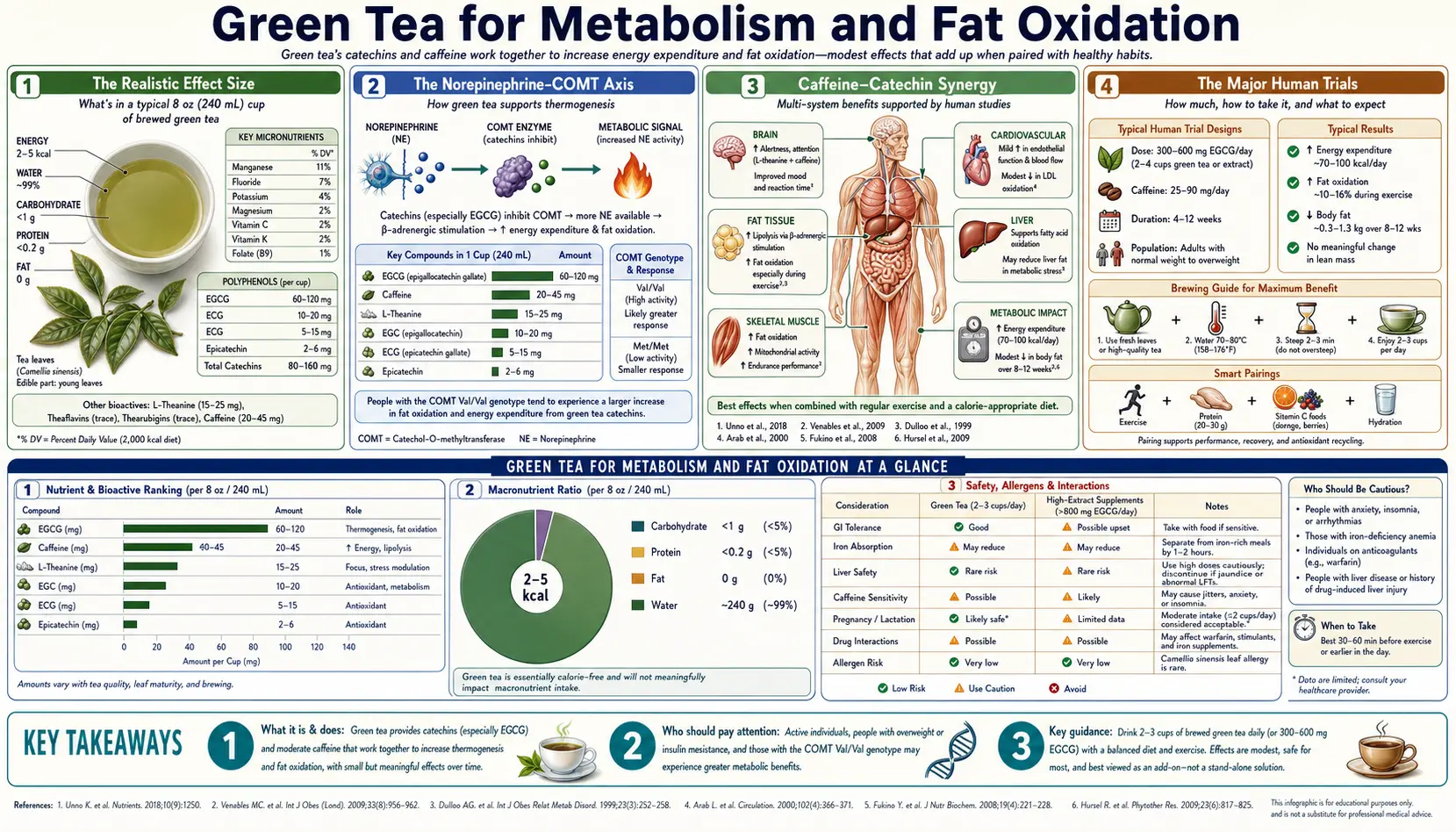
Green tea's metabolic effect is real, reproducible, and modest. Roughly twenty randomized trials have measured 24-hour energy expenditure, fat oxidation rate, or weight loss in adults consuming green tea or its concentrated catechin extract. The convergent finding is a 4-5% increase in daily energy expenditure (about 80-100 extra kcal/day at typical adult basal rates), a meaningful increase in fat-as-percent-of-fuel during sub-maximal exercise, and a 1-2 kg weight loss advantage over 12 weeks in placebo-controlled trials — smaller in habitual caffeine consumers, larger in caffeine-naive participants and East Asian populations. This page walks through the COMT-inhibition mechanism, the caffeine synergy, the realistic clinical effect size, and why isolated EGCG capsules consistently underperform the whole brewed beverage on satiety and adherence endpoints.
Table of Contents
- The Realistic Effect Size
- The Norepinephrine-COMT Axis
- Caffeine-Catechin Synergy
- The Major Human Trials
- Fat Oxidation During Exercise
- Visceral Fat and Body Composition
- Insulin Sensitivity and Glucose Handling
- The Caffeine-Naive Effect Multiplier
- Practical Protocol for Metabolic Use
- Limitations and Honest Framing
- Key Research Papers
- Connections
- Featured Videos
The Realistic Effect Size
Green tea is often marketed as a "fat burner" with implied dramatic effects. The actual clinical effect size is modest but real. The most rigorous meta-analysis of green tea catechins for weight management (Hursel, Viechtbauer, and Westerterp-Plantenga, International Journal of Obesity, 2009) pooled 11 randomized controlled trials and found:
- Mean weight loss difference: -1.3 kg over 12 weeks for green tea catechins versus placebo
- Body mass index reduction: -0.6 kg/m²
- Effect was significantly larger in non-Asian populations and in non-habitual caffeine consumers
- Effect was magnified when catechins were combined with caffeine (vs. catechins alone)
This is the realistic frame. Green tea is not a substitute for caloric restriction or exercise. It produces a modest additional advantage that, sustained over months and years, compounds into a meaningful but unspectacular metabolic edge. The mechanism is well-understood, the effect is reproducible across study designs, and the safety profile of the brewed beverage at the relevant doses (3-5 cups per day or matched extract) is essentially perfect.
The proper marketing claim, if one had to construct one, would be: "Add green tea to a sensible diet and exercise routine and you may lose an extra pound or two over three months." That is not what most green tea marketing claims, but it is what the data actually support.
The Norepinephrine-COMT Axis
The molecular mechanism behind green tea's thermogenic and lipolytic effect centers on a single enzyme: catechol-O-methyltransferase, abbreviated COMT. To understand why COMT matters for fat metabolism, follow the normal sequence:
- The sympathetic nervous system releases norepinephrine at adipose tissue beta-adrenergic receptors
- Beta-3 receptor activation on white adipocytes triggers hormone-sensitive lipase (HSL) via cAMP / protein kinase A
- HSL hydrolyzes stored triglycerides to free fatty acids and glycerol, which are released into circulation to be oxidized by other tissues
- The norepinephrine signal is terminated when COMT methylates norepinephrine to inactive normetanephrine
EGCG is a competitive inhibitor of COMT, with a Ki in the low micromolar range achievable by physiologic catechin intake. When EGCG is present, norepinephrine is metabolized more slowly and the lipolytic signal persists longer. The net effect is prolonged hormone-sensitive lipase activation, prolonged fatty acid release from adipose tissue, and slightly elevated whole-body fat oxidation.
The COMT-inhibition mechanism explains several features of the green tea metabolic effect that would otherwise be puzzling:
- The effect is larger in individuals with the high-activity COMT Val/Val genotype (more headroom to inhibit) than in Met/Met genotype individuals (already lower baseline COMT activity)
- The effect is preserved (and sometimes magnified) in decaffeinated green tea, ruling out caffeine as the dominant driver
- The effect is more pronounced when combined with sympathetic stimulation (exercise, cold exposure, caffeine) which raises endogenous norepinephrine to give COMT inhibition more substrate to act on
- The effect is essentially nil at rest in caffeine-habituated couch-bound adults — with low baseline norepinephrine, prolonging the signal yields little additional lipolysis
This mechanism also tracks with the kinetics: COMT inhibition by EGCG begins within an hour of ingestion (matching plasma EGCG kinetics), peaks at 2-3 hours, and persists for 4-6 hours. The acute 24-hour thermogenesis trials capturing approximately 4-5% energy expenditure increase reflect this pharmacokinetic profile.
Caffeine-Catechin Synergy
Caffeine on its own has a modest thermogenic effect (roughly 3-5% energy expenditure increase per 100 mg in caffeine-naive individuals, dropping toward zero with chronic high-dose habituation). The thermogenic mechanism is partly through adenosine receptor antagonism in the central nervous system (increasing sympathetic outflow) and partly through phosphodiesterase inhibition in adipose tissue (extending the cAMP signal initiated by norepinephrine).
EGCG and caffeine act through complementary mechanisms on the same lipolytic cascade:
- Caffeine — raises sympathetic outflow centrally, generating more norepinephrine release at adipose tissue, and extends the cAMP signal by inhibiting phosphodiesterase
- EGCG — prolongs the norepinephrine signal by inhibiting COMT-mediated catecholamine breakdown
The combined effect is supra-additive: caffeine alone (50 mg) produces a small thermogenic response. EGCG alone (90 mg) produces a small thermogenic response. The combination at the doses present in a single cup of green tea produces a thermogenic response larger than the sum of the two effects measured in isolation. This is the Dulloo 1999 finding that established green tea's thermogenic credibility in the modern nutritional science literature.
The practical implication: green tea's metabolic effect is in large part a caffeine-catechin co-formulation effect. Decaffeinated green tea retains the COMT-inhibition mechanism but loses the synergy multiplier. For maximum metabolic effect, caffeinated green tea consumed by someone with low caffeine tolerance, paired with exercise or post-meal periods of elevated sympathetic activity, delivers the largest measurable energy expenditure response.
The Major Human Trials
The literature has accumulated dozens of randomized trials measuring green tea effects on energy expenditure, fat oxidation, body weight, body fat, and waist circumference. The most informative are:
- Dulloo et al., American Journal of Clinical Nutrition, 1999 — the foundational acute trial. 10 healthy young men randomized to placebo, caffeine alone (50 mg), or green tea extract (90 mg EGCG + 50 mg caffeine) in a crossover. Measured 24-hour energy expenditure in a respiratory chamber. Caffeine alone: 24-hour EE was not significantly different from placebo. Green tea extract: 24-hour EE increased by approximately 4% (about 80 kcal/day). The increase was driven by elevated fat oxidation rather than carbohydrate oxidation.
- Westerterp-Plantenga et al., Obesity Research, 2005 — weight regain trial after very-low-calorie-diet weight loss. Green tea catechin + caffeine supplementation reduced weight regain over 13 weeks compared to placebo, with the effect more pronounced in habitual low-caffeine consumers.
- Nagao et al., American Journal of Clinical Nutrition, 2005 — 12-week trial in Japanese men. 583 mg/day catechin (high-catechin green tea beverage) vs. 96 mg/day (control beverage). Catechin arm showed significantly greater reductions in body weight, BMI, waist circumference, body fat mass, and subcutaneous fat area. The high-dose catechin beverage was simply a stronger-brewed green tea, not a concentrated extract.
- Maki et al., Journal of Nutrition, 2009 — American adult overweight/obese participants in a 12-week randomized trial. Catechin + caffeine arm (625 mg catechins + 39 mg caffeine, from green tea beverage) lost more abdominal fat than control beverage, especially when combined with exercise.
- Hsu et al., Clinical Nutrition, 2008 — 12-week placebo-controlled trial of green tea extract in obese women. Modest but significant reduction in LDL cholesterol and body fat percent versus placebo, with good tolerability.
- Jurgens et al., Cochrane Database, 2012 — the Cochrane systematic review pooled 18 RCTs in 1,945 overweight/obese adults. Concluded that green tea preparations produce a small but statistically significant weight loss (mean: -0.95 kg) that is "not likely to be clinically important." The review correctly flagged that effect size varies by population (larger in Asian populations and in non-caffeine-habituated participants).
The convergent picture from the trial corpus is consistent with the mechanism: a real but modest thermogenic and fat-oxidation effect, larger in caffeine-naive individuals, larger when combined with exercise, and dose-dependent up to roughly 600 mg catechins per day.
Fat Oxidation During Exercise
One of the more reliable acute effects of green tea is an increase in the proportion of energy derived from fat during sub-maximal exercise. The Venables et al. trial (American Journal of Clinical Nutrition, 2008) gave 12 healthy young men either green tea extract (366 mg catechins, 150 mg EGCG, 30 mg caffeine) or placebo 1 hour before 30 minutes of cycling at 60% VO2 max. The green tea arm:
- Fat oxidation rate was approximately 17% higher during exercise
- Respiratory exchange ratio (RER) was lower, indicating shift toward fat as fuel
- Insulin sensitivity by oral glucose tolerance test was improved 24 hours later
The endurance-athlete implication is that pre-exercise green tea may favor fat oxidation and glycogen sparing during sub-maximal aerobic exercise. The magnitude of effect is real but modest — not transformative, but consistent with the COMT-inhibition mechanism prolonging the exercise-induced norepinephrine signal that drives adipose lipolysis.
For weight-loss-oriented exercisers, the practical guidance is: a cup of green tea 30-60 minutes before zone-2 aerobic exercise (the fat-oxidation-dominant intensity zone) is a low-risk additive intervention that may modestly increase the fat component of fuel burned during the session. It will not substitute for the exercise itself, but it complements rather than competes.
Visceral Fat and Body Composition
Several green tea trials have reported preferential reductions in visceral (abdominal/intra-abdominal) fat compared to subcutaneous fat, with corresponding improvements in metabolic markers tied to visceral adiposity (insulin resistance, triglycerides, HDL).
The Nagao 2005 trial in Japanese men measured body composition by abdominal CT. The high-catechin beverage arm showed significantly greater reductions in:
- Visceral fat area (intra-abdominal fat between the abdominal organs)
- Subcutaneous fat area (less pronounced than visceral)
- Waist circumference
- Total body fat mass
The preferential visceral-fat reduction is mechanistically plausible. Visceral adipocytes are more sensitive to beta-adrenergic stimulation than subcutaneous adipocytes, so a COMT-inhibition-driven enhancement of catecholamine-induced lipolysis should preferentially mobilize visceral fat. The clinical relevance is substantial because visceral fat is the strongly metabolically deleterious depot — the fat that drives insulin resistance, atherogenic dyslipidemia, and inflammatory cytokine production. A relatively small body-weight change can produce a disproportionately large metabolic improvement if the lost mass is preferentially visceral.
For more on visceral adiposity and metabolic syndrome, see our Metabolic Syndrome page.
Insulin Sensitivity and Glucose Handling
Multiple trials have measured fasting glucose, fasting insulin, HbA1c, or oral glucose tolerance test response after green tea intervention. The effect is modest but reproducible: meta-analyses generally find small reductions in fasting glucose (around 1-2 mg/dL) and modest improvements in HOMA-IR (insulin resistance index), with larger effects in trial populations who started with elevated baseline glucose or frank impaired fasting glucose.
The mechanism likely involves several parallel paths:
- Alpha-glucosidase inhibition — EGCG and other catechins are modest competitive inhibitors of intestinal alpha-glucosidase, slightly slowing carbohydrate digestion and blunting post-prandial glucose peak. The magnitude is much smaller than the prescription alpha-glucosidase inhibitors (acarbose) but is additive.
- Glucose transporter modulation — catechins modulate intestinal SGLT1 and GLUT2 in animal models, slowing intestinal glucose absorption
- Insulin sensitivity — the reduced visceral fat and reduced inflammatory tone from chronic green tea consumption translates to modestly improved peripheral insulin sensitivity, with all the metabolic syndrome benefits that follow
- Hepatic gluconeogenesis — EGCG modulates hepatic glucose-6-phosphatase and PEPCK expression in animal models, reducing fasting hepatic glucose output
For diabetic and pre-diabetic patients, green tea is a reasonable adjunct to standard pharmacologic and lifestyle treatment, but not a substitute. The effect size is comparable to other lifestyle micro-interventions (one daily handful of nuts, one daily serving of legumes, modest fiber increase) — meaningful when stacked, modest in isolation.
The Caffeine-Naive Effect Multiplier
One of the most consistent findings across the trial literature is that habitual caffeine consumers experience a substantially smaller thermogenic and weight-loss effect from green tea than caffeine-naive participants. The Hursel meta-analysis estimated approximately three-fold larger weight loss effect in low-caffeine consumers compared to high-caffeine consumers.
The mechanism is straightforward. Chronic caffeine intake produces tolerance through upregulation of adenosine receptors and downregulation of beta-adrenergic sensitivity. By the time someone is drinking 400 mg of caffeine per day from coffee, the acute sympathomimetic response to an additional 50 mg from green tea is essentially nil. The caffeine component of the green tea synergy is wasted on someone already saturated.
The COMT-inhibition mechanism is preserved — that is biochemistry, not pharmacology — so habitual coffee drinkers still get the EGCG-mediated portion of the metabolic effect. But the multiplier from the caffeine-catechin synergy is mostly lost.
The practical implication: if you are using green tea specifically for its metabolic effect, a brief (1-2 week) caffeine taper before starting can roughly double the effect size. For most people this is not worth the discomfort of caffeine withdrawal, and they are using green tea for many reasons beyond metabolism. But the trial data make this dose-response clear, and it explains a lot of the heterogeneity in individual response.
Practical Protocol for Metabolic Use
For an adult specifically interested in the metabolic benefit of green tea, the following protocol is consistent with the trial evidence:
- Dose — 3-5 cups per day, ideally of brewed Japanese sencha or gyokuro, brewed at 75-80°C for 1-2 minutes (see the brewing page for technique). This delivers approximately 400-600 mg catechins and 100-200 mg caffeine across the day.
- Timing — one cup with breakfast, one mid-morning, one with lunch, optionally one mid-afternoon. Avoid late-afternoon and evening consumption if caffeine-sensitive.
- Pre-exercise — if doing zone-2 aerobic exercise (running, cycling at conversational pace), a cup 30-60 minutes before the session may modestly increase fat oxidation during exercise.
- Concurrent strategy — pair with moderate caloric restriction (300-500 kcal deficit) and resistance + aerobic training. Green tea is an additive, not a substitute.
- Iron consideration — if female of reproductive age, vegetarian, or otherwise at iron-deficiency risk, drink tea between meals rather than with meals to avoid catechin-iron chelation reducing iron absorption.
- Form — brewed beverage strongly preferred over concentrated capsules. Matcha is an excellent option that delivers higher catechin per serving with the matrix protection of the whole leaf. EGCG-isolate supplements are not recommended for general use due to the hepatotoxicity case series.
- Realistic expectation — 1-2 kg over 12 weeks added to your other interventions, with the effect potentially larger if you are caffeine-naive and East Asian.
Limitations and Honest Framing
The green tea metabolic story has been over-marketed for two decades. Several limitations of the underlying science deserve plain statement:
- Modest effect size — the actual effect is small. People expecting transformative weight loss from green tea will be disappointed. The Cochrane reviewer's phrasing — "not likely to be clinically important" — is technically defensible at the individual-trial level, even if the population-level cardiovascular and longevity benefits documented in the Ohsaki cohort are substantial.
- Trial duration short — most weight-loss trials run 12-24 weeks. Whether the effect persists, attenuates, or compounds over years has not been adequately studied.
- Publication bias — positive trials are more likely to be published than null trials, and the literature may be modestly inflated as a result.
- Concentrated extract vs. beverage — many of the trials used concentrated catechin extracts, not brewed tea. Whether the brewed-beverage delivery produces equivalent metabolic effect at equivalent catechin dose is generally assumed but not rigorously proven.
- Caffeine confounding — the caffeine in green tea contributes to the metabolic effect, and most trials cannot separate the catechin-specific effect from the caffeine effect. Decaffeinated green tea preserves some but not all of the metabolic benefit.
- Individual variability — COMT polymorphisms, caffeine habituation, baseline metabolic rate, and genetic background all modulate response. Some individuals will get larger benefit than the average; some will get essentially none.
None of these limitations invalidate the use of green tea as a pleasant beverage with documented modest metabolic benefit. They invalidate the use of green tea as a primary weight-loss strategy.
Key Research Papers
- Dulloo AG et al. (1999). Efficacy of a green tea extract rich in catechin polyphenols and caffeine in increasing 24-h energy expenditure and fat oxidation in humans. American Journal of Clinical Nutrition. — PubMed
- Hursel R, Viechtbauer W, Westerterp-Plantenga MS (2009). The effects of green tea on weight loss and weight maintenance: a meta-analysis. International Journal of Obesity. — PubMed
- Westerterp-Plantenga MS et al. (2005). Body weight loss and weight maintenance in relation to habitual caffeine intake and green tea supplementation. Obesity Research. — PubMed
- Nagao T et al. (2005). Ingestion of a tea rich in catechins leads to a reduction in body fat and malondialdehyde-modified LDL in men. American Journal of Clinical Nutrition. — PubMed
- Maki KC et al. (2009). Green tea catechin consumption enhances exercise-induced abdominal fat loss in overweight and obese adults. Journal of Nutrition. — PubMed
- Venables MC et al. (2008). Green tea extract ingestion, fat oxidation, and glucose tolerance in healthy humans. American Journal of Clinical Nutrition. — PubMed
- Hsu CH et al. (2008). Effect of green tea extract on obese women: a randomized, double-blind, placebo-controlled clinical trial. Clinical Nutrition. — PubMed
- Jurgens TM et al. (2012). Green tea for weight loss and weight maintenance in overweight or obese adults. Cochrane Database of Systematic Reviews. — PubMed
- Lu H et al. (2003). Glucuronides of tea catechins: enzymology of biosynthesis and biological activities. Drug Metabolism and Disposition. — PubMed
- Auvichayapat P et al. (2008). Effectiveness of green tea on weight reduction in obese Thais: a randomized controlled trial. Physiology & Behavior. — PubMed
- Belza A et al. (2009). Body fat loss achieved by stimulation of thermogenesis by a combination of bioactive food ingredients. International Journal of Obesity. — PubMed
- Phung OJ et al. (2010). Effect of green tea catechins with or without caffeine on anthropometric measures: a systematic review and meta-analysis. American Journal of Clinical Nutrition. — PubMed
PubMed Topic Searches
- PubMed: Green tea thermogenesis
- PubMed: EGCG COMT inhibition
- PubMed: Green tea fat oxidation
- PubMed: Green tea visceral fat
- PubMed: Green tea insulin sensitivity
Connections
- All Food
- Green Tea Overview
- Green Tea Benefits Hub
- EGCG & Antioxidants
- L-Theanine & Calm Focus
- Brewing Time & Temperature
- Type 2 Diabetes
- Metabolic Syndrome
- Obesity
- Cardiology
- Intermittent Fasting
- Ketogenic Diet
- Coffee
- All Vitamins