Green Tea L-Theanine and Calm Focus
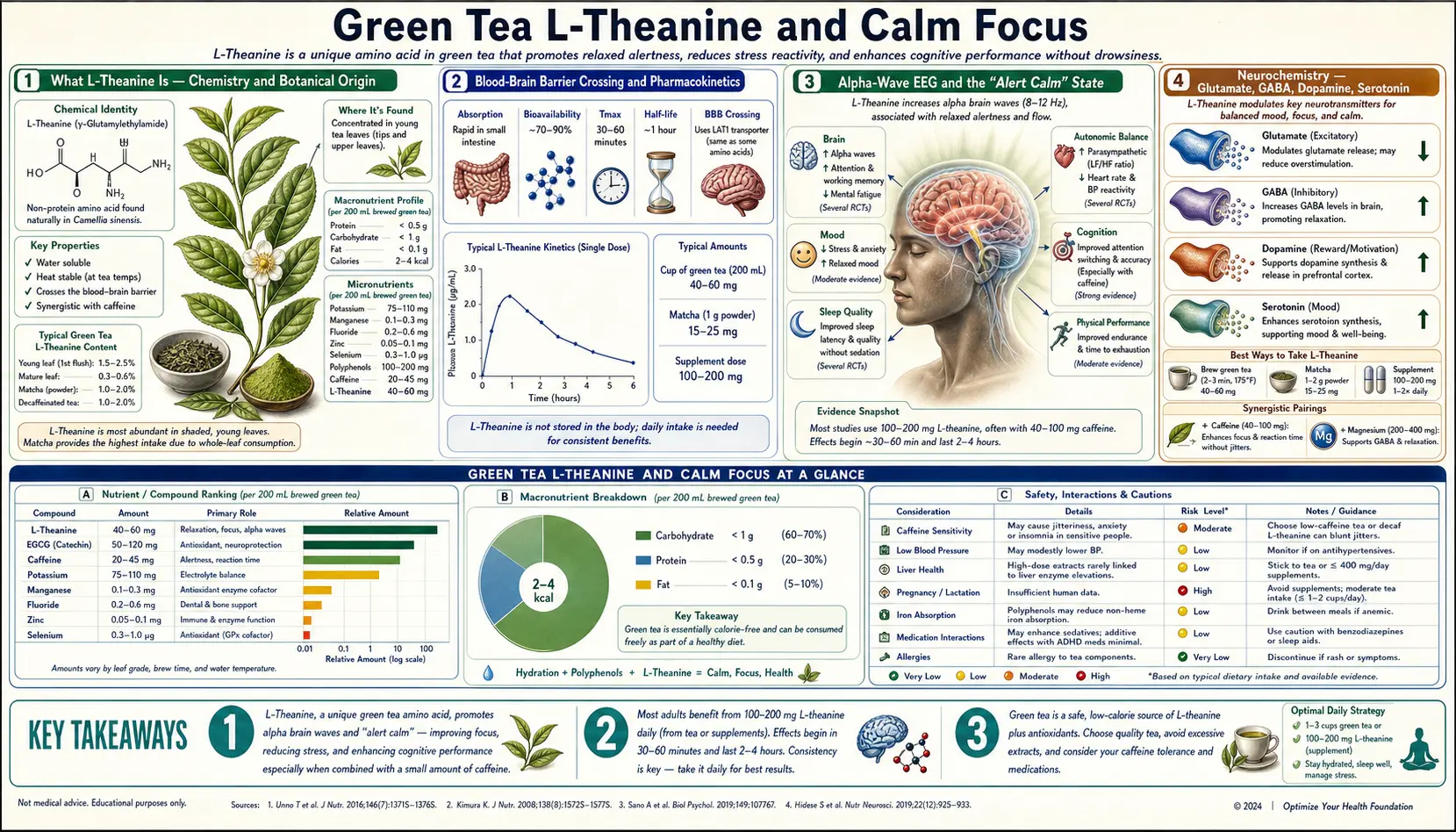
L-theanine (gamma-glutamylethylamide) is a non-protein amino acid that occurs almost exclusively in Camellia sinensis and a small number of edible mushrooms (Xerocomus badius notably). It is the single compound most responsible for the experiential difference between a cup of green tea and an equivalent caffeine dose from coffee or cola. L-theanine crosses the blood-brain barrier within 30-40 minutes, increases alpha-wave EEG activity, modestly elevates GABA and dopamine, partially antagonizes the excitatory glutamate AMPA and NMDA receptors, and produces the subjective state that Japanese tea culture calls "alert calm" — relaxed body, focused mind, no drowsiness. The synergy with caffeine is the central pharmacology: caffeine alone increases task vigilance with jitter and reduced calm; L-theanine alone increases relaxation with mild attentional drift; the combination at the 2:1 L-theanine:caffeine ratio characteristic of high-grade matcha and gyokuro produces both attention and calm without either side effect. This page covers the chemistry, the neural mechanisms, the human cognitive trials, and the practical dose-and-form guidance.
Table of Contents
- What L-Theanine Is — Chemistry and Botanical Origin
- Blood-Brain Barrier Crossing and Pharmacokinetics
- Alpha-Wave EEG and the "Alert Calm" State
- Neurochemistry — Glutamate, GABA, Dopamine, Serotonin
- The Caffeine-Theanine Synergy (2:1 Ratio)
- Cognitive Performance Trials
- Anxiety, Stress Reactivity, and Cortisol
- Sleep Architecture and Onset Latency
- Cultivar and Shading — Why Matcha and Gyokuro Are L-Theanine-Rich
- Practical Dose and Form
- Key Research Papers
- Connections
- Featured Videos
What L-Theanine Is — Chemistry and Botanical Origin
L-theanine is structurally similar to glutamic acid and the neurotransmitter glutamate — the resemblance is the central explanation for its central nervous system activity. Specifically, L-theanine is the ethylamide of L-glutamic acid: gamma-glutamylethylamide. It carries the alpha-amino group, the alpha-carboxylic acid, and the gamma-carbon chain of glutamate, with the gamma-carboxylic acid converted to an ethylamide (CONHCH2CH3) instead of a free acid.
L-theanine is biosynthesized in the roots of Camellia sinensis from ethylamine and L-glutamate by the enzyme L-theanine synthetase. From the roots, L-theanine is transported up the plant to the young leaves and stems, where it accumulates — eventually comprising 1-2% of the dry weight of green tea leaves. In sunlight, L-theanine is gradually converted to catechins in the leaf, which is why shading the plants for the final weeks before harvest (the technique used to produce gyokuro and matcha) results in elevated L-theanine and reduced bitter catechins relative to standard sencha.
L-theanine's ethylamide group is the molecular feature that distinguishes it from glutamate and gives it its distinct receptor pharmacology. Glutamate is the dominant excitatory neurotransmitter in the mammalian CNS; L-theanine is its structural analog but with much weaker affinity for ionotropic glutamate receptors and a different pattern of agonist-versus-antagonist behavior depending on which receptor subtype is involved.
Blood-Brain Barrier Crossing and Pharmacokinetics
L-theanine's amino acid character allows it to cross the blood-brain barrier via the large neutral amino acid transporter (LAT1, SLC7A5), the same transporter that ferries phenylalanine, tyrosine, tryptophan, leucine, and methionine across the BBB. This transporter is normally saturated by the abundant dietary aromatic and branched-chain amino acids, but L-theanine effectively competes for transport because of its structural similarity to glutamate.
Pharmacokinetics in humans after oral L-theanine:
- Time to peak plasma — approximately 30-60 minutes after oral ingestion
- Time to peak brain concentration — approximately 60-90 minutes (slight lag behind plasma due to BBB transport kinetics)
- Plasma half-life — approximately 60-80 minutes
- Brain residence — longer than plasma half-life, suggesting active uptake into neurons
- Elimination — primarily renal as unchanged L-theanine and as ethylamine + glutamate after hydrolysis
The kinetic profile means that the subjective effect of L-theanine from a cup of tea begins to be noticeable about 30-40 minutes after drinking, peaks at 60-90 minutes, and tapers over the following 2-3 hours. This matches the experience that the "alert calm" state from green tea takes some time to develop — it is not the immediate hit of a caffeine bolus but a slower, gentler onset.
Alpha-Wave EEG and the "Alert Calm" State
The most reproducible objective neural effect of L-theanine in humans is an increase in occipital alpha-wave EEG activity. Alpha waves (8-13 Hz) are the dominant EEG rhythm during relaxed wakeful states with closed eyes — meditation, daydreaming, alert relaxation. Increased alpha activity is generally interpreted as a marker of internally-directed attention, mental calm, and a reduction in the sensory-vigilance posture associated with sympathetic arousal.
The Nobre et al. trial (Asia Pacific Journal of Clinical Nutrition, 2008) is the canonical demonstration: 35 young healthy participants received either 50 mg L-theanine (the dose in approximately two cups of green tea) or placebo, and underwent EEG recording over the next 105 minutes with eyes both closed and open. The L-theanine arm showed:
- Significantly elevated alpha-wave power at 45 minutes post-dose, persisting through the recording period
- Effect present with both eyes open and eyes closed, with the eyes-open finding being more striking (alpha is normally suppressed by visual input)
- No reduction in vigilance — the increased alpha was a state of relaxed attentiveness rather than drowsiness
The eyes-open alpha increase is the key finding because it suggests L-theanine produces a state of active relaxation — the kind of mental posture that supports sustained focused work without the hyperarousal cost of high caffeine intake. This maps onto the subjective experience reported by tea drinkers and onto the Japanese aesthetic tradition that places green tea at the center of contemplative practices like the tea ceremony and Zen meditation.
Neurochemistry — Glutamate, GABA, Dopamine, Serotonin
L-theanine's neurochemical signature includes modest effects on multiple neurotransmitter systems, with the glutamate system being the entry point:
- Glutamate receptors — L-theanine is a weak partial antagonist at AMPA and NMDA receptors and a weak agonist at metabotropic glutamate receptors (mGluR). The net effect is dampening of glutamatergic excitatory transmission, which translates to reduced central neuronal hyperactivity in stress-related circuits.
- GABA — L-theanine modestly increases brain GABA concentrations in rodents, consistent with the relaxation effect. The mechanism is uncertain but may involve increased glutamate decarboxylase (GAD) activity, which is the enzyme that synthesizes GABA from glutamate.
- Dopamine — L-theanine increases dopamine release in the striatum in rodents, which may contribute to the mood-elevating component of the subjective effect and possibly to the attention-supporting component.
- Serotonin — L-theanine modulates brain serotonin in rodent models, though the human translation is less clear.
- Glycine — L-theanine appears to potentiate glycinergic inhibitory transmission in the brainstem, contributing to calming and sleep-supportive effects at higher doses.
The neurochemical pattern is reminiscent of a mild benzodiazepine without the GABA-A receptor binding, dependency risk, cognitive impairment, or motor side effects. L-theanine's signature is "relaxation without sedation" — a property that is hard to achieve with any other widely available compound. Most calming agents (alcohol, benzodiazepines, antihistamines, opioids) impose some attentional or motor cost. L-theanine appears to preserve and even slightly enhance attention.
For more on glutamate / GABA balance in anxiety and stress, see our Anxiety page and L-Theanine amino acid page.
The Caffeine-Theanine Synergy (2:1 Ratio)
The pharmacology of L-theanine becomes clinically interesting when combined with caffeine. Caffeine alone produces:
- Increased alertness, faster reaction times, improved vigilance on sustained-attention tasks
- Increased sympathetic outflow, mild tachycardia, mild blood pressure elevation
- Subjective jitter, anxiety, mild GERD, possible insomnia at higher doses
- Eventually tolerance with chronic high-dose use
L-theanine alone produces:
- Increased subjective calm and relaxation
- Increased alpha-wave EEG activity
- Modest improvement on attention tasks, smaller effect than caffeine
- No sympathetic stimulation; possibly modest blood pressure reduction
The combination at the 2:1 L-theanine:caffeine ratio characteristic of green tea preserves the attention-enhancing benefit of caffeine while suppressing the jitter, anxiety, and sympathetic-arousal side effects. The Owen et al. trial (Nutritional Neuroscience, 2008) and follow-up studies by the Unilever R&D group documented this synergy on sustained-attention tasks (Rapid Visual Information Processing, Stroop interference, intersensory attention switching), showing that the combination produces:
- Faster and more accurate task performance than caffeine alone
- Reduced subjective rating of jitter and "wired" feeling
- Modestly elevated mood
- Reduced post-task cognitive fatigue
The 2:1 ratio (200 mg L-theanine + 100 mg caffeine) appears to be the empirical sweet spot for cognitive endpoints, which is closely matched by the natural ratio in 1-2 cups of high-grade matcha or gyokuro. This is also the ratio used in most commercial L-theanine-plus-caffeine supplements aimed at office workers and students.
The synergy is part of why coffee and green tea, at equivalent caffeine doses, produce subjectively different states. Coffee delivers caffeine alone (with chlorogenic acid and small amounts of other minor compounds). Green tea delivers caffeine with the modulating L-theanine. Habitual coffee drinkers often report that switching to green tea produces a calmer, more sustained alertness with less afternoon energy crash — this is plausibly the L-theanine synergy modifying their caffeine response.
Cognitive Performance Trials
The L-theanine cognitive literature has accumulated approximately 30 randomized human trials, mostly using doses of 100-400 mg L-theanine with or without caffeine. The convergent findings:
- Sustained attention tasks — L-theanine + caffeine combinations consistently outperform placebo and frequently outperform caffeine alone on Rapid Visual Information Processing (RVIP) and similar vigilance tasks. Effect sizes are modest (d = 0.2-0.4) but consistent.
- Working memory — effects on N-back and similar working memory tasks are smaller and less consistent than attention effects, but generally positive.
- Mood — L-theanine consistently reduces self-reported tension and increases self-reported calm without sedation in healthy participants.
- Stress response — physiological stress markers (cortisol, immunoglobulin A, heart rate variability) show modest improvements during stressful tasks with L-theanine pretreatment.
- Schizophrenia adjunct — small pilot trials suggest L-theanine 250-400 mg as adjunct to standard antipsychotic therapy modestly reduces positive symptoms and anxiety in schizophrenia, with good tolerability.
- ADHD — a few pediatric pilot trials of L-theanine 200-400 mg in ADHD have shown modest sleep-quality improvements but more limited effects on core attention deficits.
- Geriatric cognition — small trials in older adults with mild cognitive impairment have shown modest improvements in attention and executive function with L-theanine plus green tea catechins.
The pattern is that L-theanine is a real, modest cognitive enhancer in the attention-and-calm domain. It is not a powerful nootropic on the order of prescription psychostimulants, but it is a reliable, well-tolerated, low-risk additive that pairs especially well with caffeine for sustained focused work.
Anxiety, Stress Reactivity, and Cortisol
L-theanine's stress-attenuating effect is reproducible in human laboratory stress paradigms. Several trials have used standardized stressors (mental arithmetic, public speaking simulations, cold pressor) and measured physiological and subjective responses with and without L-theanine pretreatment.
Representative findings:
- Salivary cortisol — reduced stress-induced cortisol elevation with 200 mg L-theanine pretreatment
- Salivary alpha-amylase — reduced sympathetic stress marker elevation
- Heart rate — modest attenuation of stress-induced heart rate elevation
- Blood pressure — small reduction in stress-induced blood pressure elevation
- Subjective stress rating — reduced State-Trait Anxiety Inventory score during stressful tasks
The clinical implication is that habitual green tea drinkers may benefit from a small, sustained reduction in stress-reactivity tone. This is consistent with the longevity-cohort observation that habitual tea consumers have modestly lower cardiovascular mortality (Kuriyama Ohsaki 2006). The stress-attenuation effect plausibly contributes to the cardiovascular benefit alongside the catechin antioxidant and endothelial effects.
For acute anxiety management, L-theanine 200-400 mg taken 30-45 minutes before a known stressful event (public speaking, exam, difficult conversation) is a reasonable, low-risk intervention. It will not abort a panic attack or substitute for definitive anxiety treatment, but it modestly blunts the physiological and subjective stress response.
Sleep Architecture and Onset Latency
Despite caffeine being a stimulant, the L-theanine in green tea modestly improves sleep quality in some studies — an apparent paradox resolved by separating the two compounds' effects on sleep architecture.
The Lyon et al. trial (Alternative Medicine Review, 2011) in adolescent boys with ADHD found that 200 mg L-theanine twice daily (morning and after school, well before bedtime) was associated with improved sleep efficiency and reduced nocturnal activity on actigraphy compared to placebo. The Rao et al. trial in healthy adults found similar modest improvements in sleep quality and reduced sleep-onset latency with 200 mg L-theanine before bedtime.
The mechanism is presumably that L-theanine's relaxation and stress-attenuation effects, plus the modest GABA and glycine modulation, support the parasympathetic shift needed for sleep onset. The effect is small in magnitude — nothing like prescription hypnotics — but is consistent and well-tolerated.
For practical sleep use, L-theanine is reasonable as a low-risk adjunct for occasional sleep difficulty or as an alternative to over-the-counter antihistamine sleep aids (which have substantial morning hangover and anticholinergic burden). Doses of 200-400 mg taken 30-60 minutes before bedtime are well-tolerated, but the brewed-tea source delivers smaller doses (20-40 mg per cup) and the accompanying caffeine probably outweighs the L-theanine benefit for evening consumption.
Cultivar and Shading — Why Matcha and Gyokuro Are L-Theanine-Rich
L-theanine content in tea leaves varies substantially by cultivar, growing region, leaf age, and most importantly cultivation technique. The single largest determinant of L-theanine concentration in finished tea is whether the plants were grown in full sun or under shade in the final weeks before harvest.
Mechanism: in sunlit leaves, L-theanine is gradually converted to polyphenolic catechins as part of the leaf's normal photoprotective response. In shaded leaves (typically covered with black cloth or reed mats for 3-4 weeks before harvest), this conversion is suppressed and L-theanine accumulates. Shading also increases chlorophyll content (giving the leaves their deep green color) and reduces bitter catechin content.
The classical Japanese shaded tea categories:
- Gyokuro — "jade dew," shaded for approximately 3 weeks before harvest. Among the highest L-theanine content of any tea, with characteristic umami sweetness and minimal bitterness. L-Theanine content typically 30-50 mg per 2-gram serving.
- Matcha — shaded leaves stone-ground to a fine powder, with the entire leaf consumed in suspension. L-Theanine content typically 30-60 mg per 2-gram serving, with the highest concentration in ceremonial-grade matcha grown for the tea ceremony.
- Kabusecha — shaded for approximately 1 week, intermediate between gyokuro and sencha in L-theanine content
- Sencha — the standard Japanese green tea, grown in full sun. L-Theanine content typically 10-25 mg per cup, lower than shaded teas but still meaningful.
Chinese green teas (longjing, gunpowder, biluochun) are typically grown in full sun and have L-theanine content comparable to Japanese sencha. They tend toward different flavor profiles — nutty, vegetal, sometimes smoky — rather than the deep umami of Japanese shaded teas.
For maximizing the L-theanine benefit per cup, the shaded Japanese teas (matcha and gyokuro) deliver substantially more L-theanine per serving than sencha or Chinese greens. Matcha has the additional advantage that the whole leaf is consumed in suspension, capturing L-theanine and catechins that would otherwise remain in spent tea leaves.
For more on matcha specifically, see our Matcha page.
Practical Dose and Form
The relevant L-theanine doses across different goals:
- Background daily intake from tea — 3-5 cups per day of high-grade Japanese sencha or 1-2 servings of matcha delivers 60-200 mg total daily L-theanine. This is enough for the cognitive and stress-attenuation benefits without supplementation.
- Acute focus support (with caffeine) — a single cup of matcha (40-60 mg L-theanine + 30-60 mg caffeine, naturally at the 1:1 ratio characteristic of matcha), consumed 30-45 minutes before a focused work block
- Acute focus support (capsule, paired with coffee) — 100-200 mg L-theanine capsule with a single cup of coffee provides the 2:1 L-theanine:caffeine ratio that the cognitive trials suggest is optimal
- Stress and anxiety adjunct — 200-400 mg L-theanine, can be taken acutely before a stressor or twice daily as standing therapy
- Sleep adjunct — 200-400 mg L-theanine, 30-60 minutes before bedtime, ideally separated from caffeine intake by at least 6 hours
- Schizophrenia / anxiety disorder adjunct (medical supervision) — 250-400 mg twice daily under prescriber oversight, as adjunct to standard treatment
The supplement form is well-tolerated. Suntheanine (Taiyo International) is the pharmacopeial-grade synthetic L-theanine used in most clinical trials and most commercial products; it is structurally identical to the natural plant L-theanine. There is no documented benefit to higher-purity preparations of natural plant-derived L-theanine over the synthetic.
Safety profile: essentially unblemished. L-theanine has been administered at doses up to 2,000 mg single-dose and 600 mg daily for extended periods without significant adverse events in human trials. The Generally Recognized as Safe (GRAS) status in the United States permits its use in food and beverage products without restriction.
The principal caution is that L-theanine may enhance the effects of antihypertensive drugs (slight additive blood pressure reduction) and of sedating drugs (slight additive calming). Neither interaction is clinically dangerous in the documented range, but combining L-theanine with sedatives, benzodiazepines, or alcohol may produce more sedation than expected.
Key Research Papers
- Nobre AC, Rao A, Owen GN (2008). L-theanine, a natural constituent in tea, and its effect on mental state. Asia Pacific Journal of Clinical Nutrition. — PubMed
- Owen GN et al. (2008). The combined effects of L-theanine and caffeine on cognitive performance and mood. Nutritional Neuroscience. — PubMed
- Haskell CF et al. (2008). The effects of L-theanine, caffeine and their combination on cognition and mood. Biological Psychology. — PubMed
- Kelly SP et al. (2008). L-theanine and caffeine in combination affect human cognition as evidenced by oscillatory alpha-band activity and attention task performance. Journal of Nutrition. — PubMed
- Kimura K et al. (2007). L-Theanine reduces psychological and physiological stress responses. Biological Psychology. — PubMed
- Yokogoshi H et al. (1995). Effect of theanine, r-glutamylethylamide, on brain monoamines and striatal dopamine release in conscious rats. Neurochemical Research. — PubMed
- Lyon MR et al. (2011). The effects of L-theanine (Suntheanine®) on objective sleep quality in boys with attention deficit hyperactivity disorder (ADHD). Alternative Medicine Review. — PubMed
- Rao TP et al. (2015). In search of a safe natural sleep aid. Journal of the American College of Nutrition. — PubMed
- Ritsner MS et al. (2011). L-theanine relieves positive, activation, and anxiety symptoms in patients with schizophrenia and schizoaffective disorder: an 8-week, randomized, double-blind, placebo-controlled, 2-center study. Journal of Clinical Psychiatry. — PubMed
- Hidese S et al. (2019). Effects of L-theanine administration on stress-related symptoms and cognitive functions in healthy adults: a randomized controlled trial. Nutrients. — PubMed
- Juneja LR et al. (1999). L-theanine, a unique amino acid of green tea and its relaxation effect in humans. Trends in Food Science & Technology. — PubMed
- Williams JL et al. (2020). The effects of green tea amino acid L-theanine consumption on stress and anxiety: a systematic review. Plant Foods for Human Nutrition. — PubMed
PubMed Topic Searches
- PubMed: L-theanine and alpha-wave EEG
- PubMed: L-Theanine-caffeine cognition
- PubMed: L-theanine stress and cortisol
- PubMed: L-theanine and sleep
- PubMed: L-theanine schizophrenia adjunct
Connections
- All Food
- Green Tea Overview
- Green Tea Benefits Hub
- EGCG & Antioxidants
- Metabolism & Fat Oxidation
- Brewing Time & Temperature
- L-Theanine (Amino Acid)
- All Amino Acids
- Anxiety
- Insomnia
- Neurology
- Meditation
- Adaptogens
- Coffee