Green Tea: History and Origins
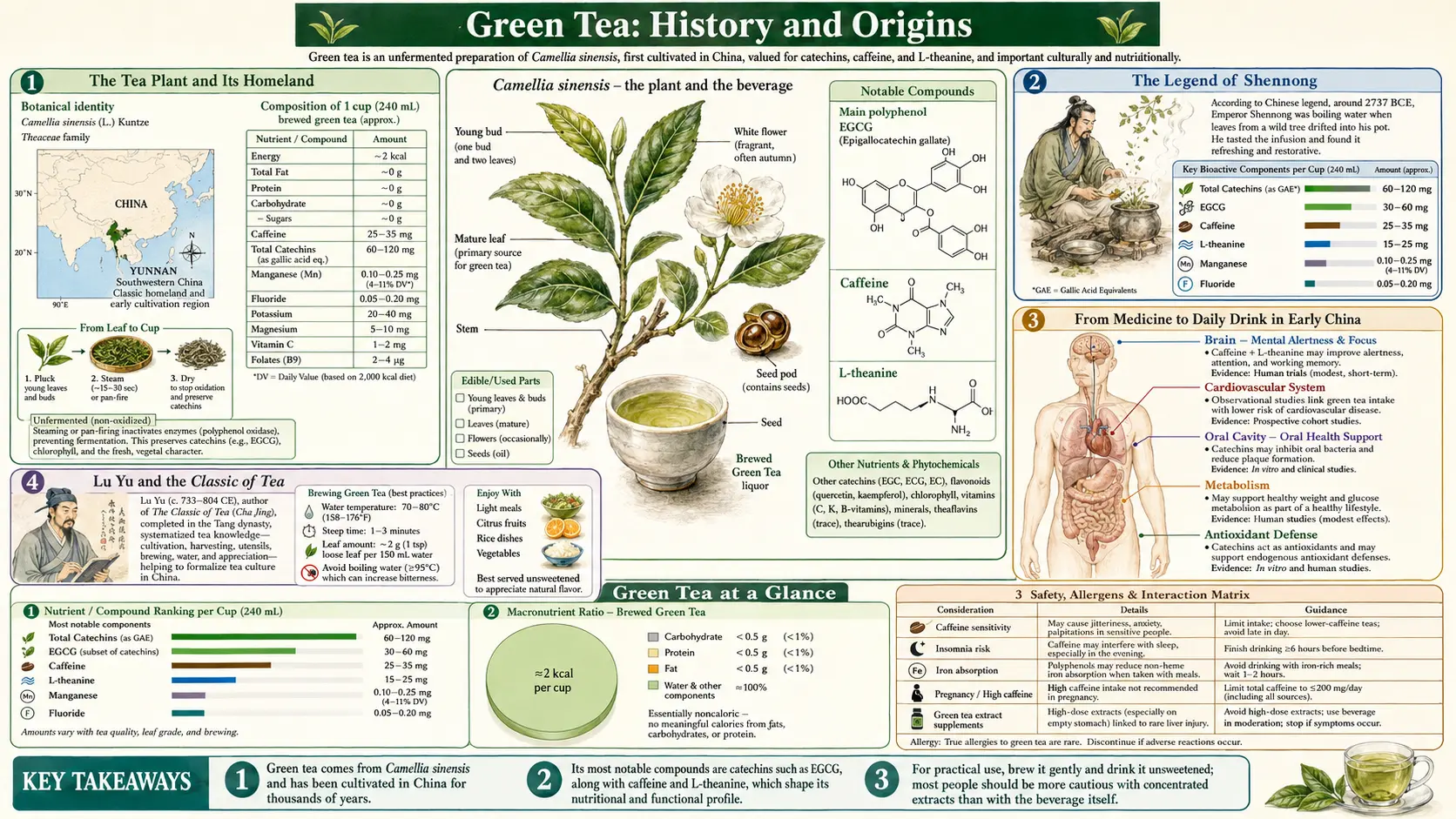
Green tea is not an invention but an inheritance. It comes from the leaves of a single evergreen shrub, Camellia sinensis, native to the warm, misty hills where southwestern China meets the eastern edge of the Himalayas — and people there have gathered and used those leaves for thousands of years. There is no lone inventor of tea; like every traditional food, it emerged slowly, through the accumulated habits of many communities. This article traces what the historical and scientific record actually supports: where the tea plant came from and where it was domesticated, the famous Chinese legend that places its discovery in deep antiquity (and why that story is a legend, not a date), how tea moved from a bitter medicine to the everyday drink of a whole civilisation, the Tang-dynasty book that first wrote it all down, its journey to Japan in the hands of Buddhist monks, and the great age of sea trade that carried it — under two different names — to the rest of the world. Where the record is firm we say so; where a claim is folklore or still debated, we name it as such.
Table of Contents
- The Tea Plant and Its Homeland
- The Legend of Shennong
- From Medicine to Daily Drink in Early China
- Lu Yu and the Classic of Tea
- The Journey to Japan: Monks, Matcha, and the Way of Tea
- Two Words for One Leaf: How Tea Spread Across the World
- From Tradition to the Modern Cup
- Research Papers and References
- Connections
- Featured Videos
The Tea Plant and Its Homeland
All true tea — green, white, oolong, and black alike — comes from one plant: Camellia sinensis, an evergreen shrub or small tree in the camellia family. What separates green tea from black tea is not the plant but the handling. Soon after the leaves are picked they are heated — pan-fired in the Chinese style or steamed in the Japanese style — which halts oxidation and keeps the leaf green and its compounds largely intact. Black tea, by contrast, is allowed to oxidise fully. The plant is the same; only the craft differs.
The homeland of that plant is well established. Botanically and genetically, Camellia sinensis is native to the broad upland region where southwestern China meets northern Myanmar, northeastern India, and the eastern Himalayan foothills. A detailed genetic study by M. K. Meegahakumbura and colleagues, published in Frontiers in Plant Science in 2018, found evidence for three independent domestication events rather than one: a small-leaf "China type" tea domesticated in southern China, a broad-leaf "Chinese Assam type" centred in Yunnan in southwestern China, and an "Indian Assam type" domesticated separately in Assam, in northeastern India. In other words, more than one community appears to have taken the wild plant into cultivation, in more than one place — a useful corrective to any tidy single-origin story.
Tea is one of the older tree crops humans have tended. Researchers generally describe its domestication as reaching back on the order of three thousand years or more, with the wild plant used long before that. Old, large tea trees still grow in the forests of Yunnan and neighbouring regions, and the area remains, to this day, a heartland of the plant. The precise centuries are debated and the deep past is hazy, but the direction of travel is not in question: the green-tea tradition that later spread across the world began in this warm, wet corner of East Asia, with a hardy shrub that grew there naturally.
The Legend of Shennong
No history of tea is complete without its most famous origin story — and it should be read as exactly that: a legend, not a dated event. Chinese tradition credits the discovery of tea to Shennong (also written Shen Nung), the "Divine Farmer," a mythical emperor and herbalist of deep antiquity. The popular telling, often pinned to the symbolic year 2737 BCE, holds that as Shennong sat in the shade while water was boiling, a few leaves from a nearby tree drifted into his pot; he tasted the fragrant brew and found it refreshing and restorative. It is a lovely story, and it has been retold for centuries, but it belongs to mythology rather than to the historical record. Shennong is a legendary culture-hero, the date is symbolic, and no contemporary evidence exists for the episode.
What the legend reflects, accurately, is the role tea played in early Chinese thought as a medicine before it was a pleasure. Shennong is also the figure to whom tradition attributes the Shennong Bencao Jing ("The Divine Farmer's Classic of Materia Medica"), an early Chinese pharmacopoeia. Scholars regard this herbal as a text compiled by many hands over a long period — with much of its material taking written form around the Han period (roughly 206 BCE to 220 CE) — rather than the literal work of a single ancient emperor. In the tradition that grew up around it, tea was classed among the "superior" herbs: gentle plants thought safe to take regularly to support health. The honest summary is this: the Shennong story tells us how the Chinese understood tea — as a healthful, slightly medicinal gift of nature — not when or how it was actually first used.
From Medicine to Daily Drink in Early China
For a long stretch of its early history, tea in China was valued chiefly as a medicinal and restorative drink rather than the casual everyday beverage it later became. In traditional Chinese medicine the leaf was used as a mild stimulant, as an astringent, and as an aid to digestion and alertness — the kind of plant a physician might recommend to clear the head and settle the stomach. This medicinal framing is consistent across the early sources and helps explain why tea was first treasured at all.
Hard archaeological evidence for tea-drinking deepens over the centuries. Excavations associated with the Han dynasty have yielded what researchers identify as tea residues, indicating that tea was being consumed by the elite well over two thousand years ago. Over the following centuries the habit spread and changed character: from a bitter medicinal infusion, often cooked with other ingredients, toward a refined drink prepared and appreciated for its own sake. By the Tang dynasty (618–907 CE) tea had become genuinely popular and culturally central — grown across many regions, traded widely, taxed by the state, and bound up with Buddhist monastic life, where monks valued it for keeping the mind awake and clear during long hours of meditation.
It is worth being plain about what this tradition does and does not establish. The early uses described above are historical facts about how tea was used and understood; they are not modern medical claims, and a traditional indication is not the same as proven effectiveness. What the record reliably shows is a long, continuous transformation — a wild medicinal leaf becoming, over many centuries, the defining drink of an entire civilisation.
Lu Yu and the Classic of Tea
If tea has a single founding document, it is the Cha Jing, or The Classic of Tea, written by the scholar Lu Yu during the Tang dynasty. The work is generally dated to around 760–762 CE and is recognised as the earliest known treatise devoted entirely to tea. Lu Yu, an orphan raised in a Buddhist monastery in what is now Hubei province, gathered into one book the whole world of tea as it was practised in his day: where the best leaf grew, how to cultivate and process it, the tools and utensils for preparing it, how to brew and drink it well, and the history and lore surrounding it. The book is traditionally arranged in three scrolls and ten chapters.
The Cha Jing matters not only as an instruction manual but as the moment tea passed from custom into literature. By writing it down — methodically, almost reverently — Lu Yu helped lift tea-drinking into an art and a discipline, and he is remembered in Chinese tradition as the "Sage of Tea." (A note on sources: Lu Yu's original manuscript does not survive; the oldest editions that come down to us are much later copies, with the earliest available datable to the Ming dynasty. That is normal for texts of this age and does not put the work's authorship or substance in serious doubt.)
The deeper significance is cultural. Through the Cha Jing and the refined tea culture of the Tang and the following Song dynasty — when the fashion shifted toward grinding tea to a fine powder and whisking it with hot water — tea became woven into Chinese poetry, painting, monastic practice, and hospitality. That powdered, whisked style of preparing green tea is the direct ancestor of Japanese matcha, which carries the story into the next section.
The Journey to Japan: Monks, Matcha, and the Way of Tea
Tea reached Japan along the same channel that carried so much else from China: Buddhism. The earliest introductions are traditionally credited to monks who studied in China and brought seeds and the custom home in the early ninth century. Accounts name the monks Saichō and Kūkai in connection with bringing tea seeds around 805, and record that in 815 CE a monk named Eichū served tea to the Emperor Saga. After this early flowering, however, interest in tea faded in Japan for a time, and it did not yet take deep root.
The lasting transformation came nearly four centuries later, through the Zen monk Eisai (Myōan Eisai, 1141–1215). Returning from study in Song-dynasty China in the late twelfth century, Eisai brought back both Zen Buddhism and the Chinese practice of preparing powdered tea — the technique that would become matcha. In 1211 he wrote the Kissa Yōjōki ("Notes on Drinking Tea for Health"), traditionally regarded as the first Japanese book about tea; tellingly, it frames tea above all as a medicine for health and longevity, drawing on Chinese medical ideas. Seeds linked to Eisai were planted by his disciple in the Kyoto area, and the region of Uji, near Kyoto, grew into Japan's foremost tea-producing district — a status it still holds.
From these monastic roots, Japan developed one of the most distinctive tea cultures in the world: the Japanese tea ceremony (chanoyu, the "Way of Tea"), a deliberate, meditative ritual of preparing and serving matcha that came to embody ideals of harmony, respect, purity, and tranquillity. It is largely thanks to this tradition that green tea — and matcha in particular — became as much a part of Japanese identity as of Chinese, and why Japan remains, alongside China, one of the two great homelands of green-tea culture.
Two Words for One Leaf: How Tea Spread Across the World
One of the most charming pieces of evidence for how tea travelled is hidden in the word for it. Across the world's languages, the name for tea comes in essentially two forms — some version of "cha" or some version of "te" — and which one a language uses is, in effect, a map of old trade routes. Both descend from the same written Chinese character (茶) but from different spoken pronunciations. The "cha" family spread overland, along the Silk Road and across Central Asia, giving Persian, Hindi, Russian, Arabic, and Japanese their words for tea (the familiar "chai" among them). The "te" family spread by sea: it derives from the pronunciation used in the Min Nan dialect of the southern coastal province of Fujian, where European traders bought their tea at ports such as Amoy (modern Xiamen).
The Europeans who dominated that maritime trade were the Dutch, and they carried the coastal word with the cargo — Dutch thee, which became English tea, French thé, German Tee, and so on across western Europe. The first European encounters with tea came a little earlier, in the sixteenth century, through the Portuguese operating out of Macau; the Dutch East India Company then established the regular import of tea to Europe in the early seventeenth century (commonly dated to around 1606–1610). The exception that proves the rule is Portugal itself and the lands it influenced, which — trading via Cantonese-speaking Macau and Guangzhou — kept a "cha" form.
In Europe tea began as an expensive luxury for the wealthy and gradually became a daily habit. Its fashion in England is often associated with Catherine of Braganza, the Portuguese princess who married King Charles II in 1662 and brought her tea-drinking taste to the English court. From these beginnings tea grew into one of the great global commodities, with all the weight that carried — reshaping economies, diets, and at times the course of history. For the purposes of this article the key point is simpler: a leaf domesticated in the hills of East Asia had, within a few centuries, become a drink shared on every inhabited continent, its very name still recording the route by which it arrived.
From Tradition to the Modern Cup
For almost all of its long history, green tea was used and loved long before anyone could say what was in it. That changed with modern chemistry, which identified the leaf's distinctive constituents: a family of plant compounds called catechins (the most studied of which is epigallocatechin gallate, or EGCG), together with caffeine and the calming amino acid L-theanine that gives green tea its characteristic mellow, focused quality. The minimal heating that defines green-tea processing is precisely what preserves a high proportion of these catechins, which is why green tea differs chemically, and not just in colour, from black tea.
Over recent decades green tea has become one of the most heavily researched beverages in the world, with a large body of studies examining the traditional reputation it carried for millennia — as a healthful, gently restorative drink. Two honest cautions belong at the end of any history like this. First, a long tradition of use is a reason to investigate something, not proof that it works: tradition raises the questions, and research tests the answers. Second, the dose matters — a few cups of brewed green tea are a very different thing from concentrated catechin extracts, some of which have been associated with rare reports of liver injury, which is why the brewed drink and high-dose supplements should not be treated as interchangeable.
The detailed evidence, the active compounds, the brewing science, and the cautions are covered on the main Green Tea page and in the companion Green Tea Benefits articles; this history is concerned only with how the drink came to be. The thread is remarkably unbroken — from a wild leaf in the hills of East Asia, to a medicine, to the Tang-dynasty book that named it an art, to a monk's bowl of whisked matcha, to a Dutch merchant ship, to the cup most of the world now drinks without a second thought. Following that thread carefully, and honestly, is the point of knowing the history at all.
Research Papers and References
The list below combines peer-reviewed reviews and a genetic study of Camellia sinensis with curated PubMed topic-search links into the historical, ethnobotanical, and phytochemical literature. Historical primary texts — Lu Yu's Cha Jing (The Classic of Tea), Eisai's Kissa Yōjōki, and the Shennong Bencao Jing — are named in the article as historical sources rather than as modern citations. Author names, titles, and journals are given as plain text; only the stable DOI, PMID, or archive link is hyperlinked, and each opens in a new tab.
- Meegahakumbura MK, Wambulwa MC, Li MM, Thapa KK, Sun YS, Möller M, Xu JC, Yang JB, Liu J, Liu BY, Li DZ, Gao LM. Domestication origin and breeding history of the tea plant (Camellia sinensis) in China and India based on nuclear microsatellites and cpDNA sequence data. Frontiers in Plant Science. 2018;8:2270. — doi:10.3389/fpls.2017.02270
- Zhao T, Li C, Wang S, Song X. Green tea (Camellia sinensis): a review of its phytochemistry, pharmacology, and toxicology. Molecules. 2022;27(12):3909. — PMID: 35745040
- Chacko SM, Thambi PT, Kuttan R, Nishigaki I. Beneficial effects of green tea: a literature review. Chinese Medicine. 2010;5:13. — doi:10.1186/1749-8546-5-13
- Camellia sinensis origin, domestication, and history — PubMed: tea plant origin and domestication
- Green tea ethnobotany and traditional medicinal use — PubMed: green tea traditional use and history
External Authoritative Resources
- NCCIH — Green Tea
- Wikipedia — History of Tea (overview with primary-source references)
- PubMed — All research on Camellia sinensis