Babesia: Tick-Borne Parasite That Destroys Red Blood Cells
Deep-Dive Articles
Symptoms Hub
Overview of all Babesia symptom presentations — from mild flu-like illness to severe hemolysis.
Read the deep dive →Hemolytic Anemia & Flu Symptoms
The hallmark hemolytic anemia, fever, chills, myalgia, and the tetrad/Maltese-cross ring form on smear.
Read the deep dive →Severe Babesiosis & Immunocompromised
ARDS, renal failure, DIC, and splenic rupture in asplenic, HIV, and elderly patients.
Read the deep dive →Diagnosis: Blood Smear & PCR
Giemsa smear, PCR gold standard, IFA serology, and distinguishing Babesia from Plasmodium.
Read the deep dive →Treatments Hub
Overview of all treatment protocols — mild-moderate vs. severe Babesiosis regimens.
Read the deep dive →Atovaquone & Azithromycin
The standard FDA-approved regimen for mild-to-moderate Babesiosis, with dosing and monitoring.
Read the deep dive →Exchange Transfusion & Severe Disease
When and how exchange transfusion is used — indications, procedure, and ICU management.
Read the deep dive →Tick Prevention & Environmental Control
DEET, permethrin, tick checks, blood donation screening, and asplenic patient counseling.
Read the deep dive →Babesiosis is caused by intraerythrocytic Babesia parasites transmitted by the same Ixodes ticks that carry Lyme disease — and can be co-transmitted in a single bite. It causes a malaria-like illness of fever, hemolytic anemia, and fatigue; in asplenic or immunocompromised patients it can be life-threatening with severe hemolysis, organ failure, and death. Cases are rising in the northeastern United States as tick populations expand.
Table of Contents
1. What Babesia Is
Babesia is a genus of intraerythrocytic protozoan parasites belonging to the phylum Apicomplexa — the same group that includes Plasmodium (malaria), Toxoplasma, and Cryptosporidium. Over 100 Babesia species infect various vertebrates; only a handful cause human disease. In North America, the dominant human pathogen is Babesia microti, transmitted by the black-legged (deer) tick Ixodes scapularis in the northeastern and upper midwestern United States. In Europe, Babesia divergens causes a more severe disease transmitted by Ixodes ricinus.
Babesia microti was first recognized as a human pathogen in the 1960s, and cases have been increasing steadily since then. The CDC now reports several thousand confirmed cases annually in the United States, with the heaviest burden on Nantucket, Martha's Vineyard, and Long Island in summer months, when tick activity peaks and outdoor exposure is greatest. Like Borrelia burgdorferi (the agent of Lyme disease), B. microti cycles between white-footed mice (the reservoir) and Ixodes scapularis ticks, with deer as the reproductive host that sustains large tick populations.
2. Shared Tick Vector with Lyme Disease
Babesia microti and Borrelia burgdorferi (Lyme disease) share the same vector: the nymphal stage of Ixodes scapularis. Because nymphs are tiny (the size of a poppy seed) and their bites are often painless and unnoticed, co-infection with both pathogens in a single tick bite is possible and clinically documented. Co-infection with Anaplasma phagocytophilum (anaplasmosis) — also transmitted by Ixodes ticks — adds a third simultaneous infection in some patients.
Co-infection matters clinically because each pathogen requires different treatment. Lyme disease responds to doxycycline or amoxicillin; anaplasmosis responds to doxycycline; babesiosis requires atovaquone plus azithromycin or clindamycin plus quinine. A patient presenting after an Ixodes tick bite with fever, flu-like illness, and hemolytic anemia should be evaluated for all three simultaneously. Treatment of Lyme disease alone will not cure babesiosis in a co-infected patient.
The risk period for babesiosis parallels the nymphal tick activity season: late spring through early fall, with peak risk in June and July in the northeastern United States. Unlike adult ticks (which are visible and more likely to be noticed and removed), nymphs are small enough to be missed, and the tick must remain attached for several hours to transmit Babesia.
3. How It Destroys Red Blood Cells
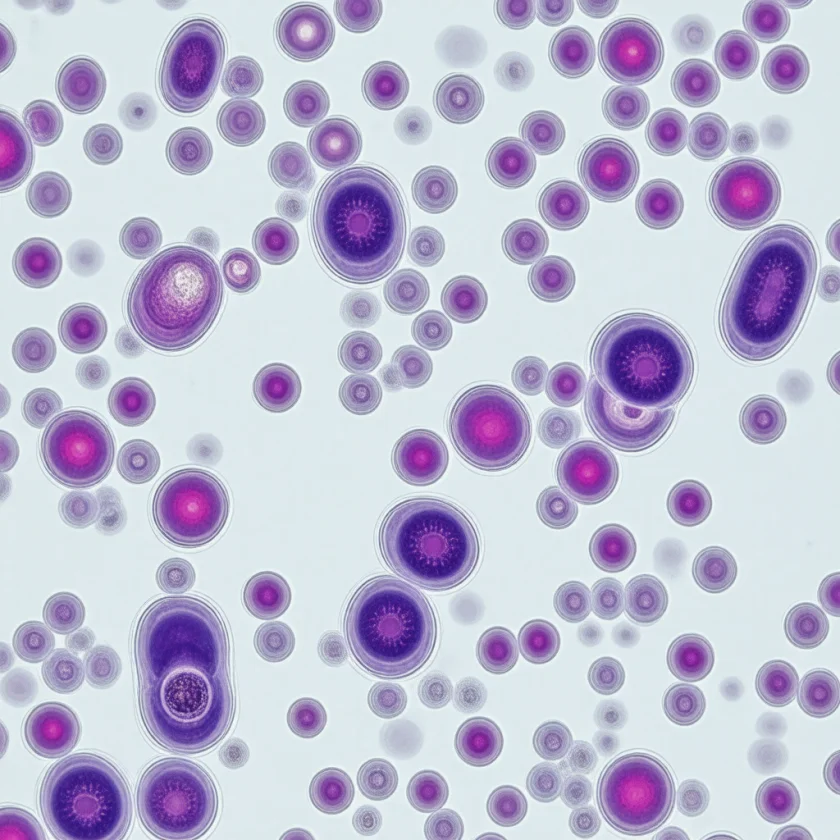
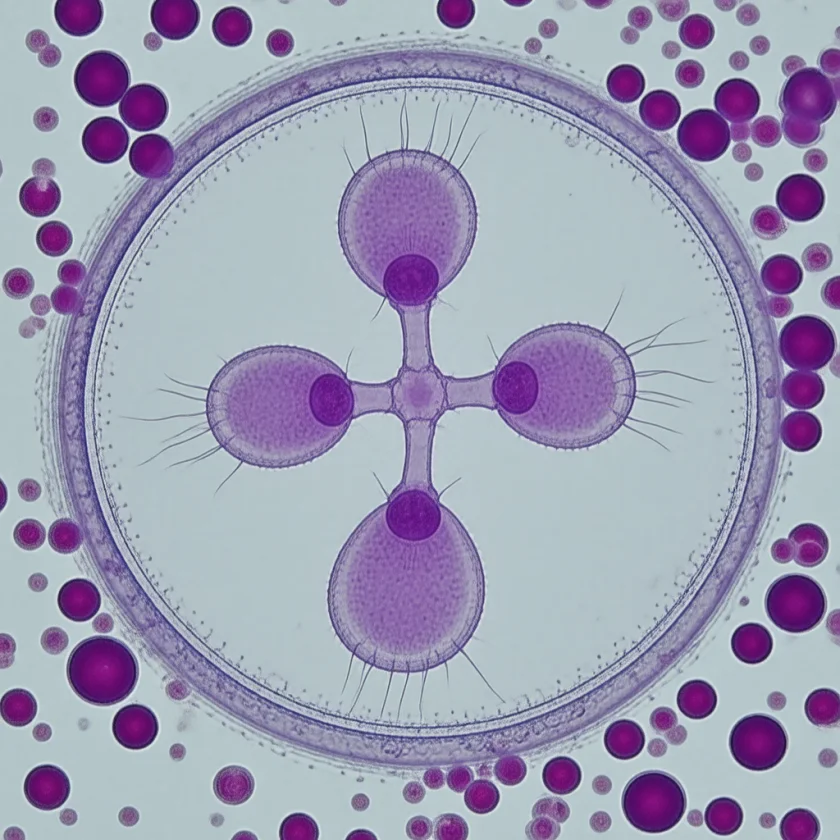
Babesia is an obligate intraerythrocytic parasite — it lives and multiplies exclusively inside red blood cells (RBCs). After a tick bite delivers merozoites into the bloodstream, they attach to RBC surface receptors and invade the cell. Inside, the parasite divides by binary fission, eventually producing four merozoites arranged in a characteristic Maltese cross (tetrad) formation, visible on blood smear and pathognomonic of babesiosis (distinguishing it from malaria).
When the infected RBC ruptures, merozoites are released to invade new cells, continuing the cycle. This intraerythrocytic multiplication causes hemolysis — destruction of red blood cells — and the cascade of problems that follows: anemia, jaundice (from bilirubin released by lysed cells), hemoglobinuria (dark "tea-colored" urine from hemoglobin released into the bloodstream), and in severe cases, renal failure from hemoglobin-driven tubular damage. The degree of hemolysis correlates with the parasitemia level (percentage of RBCs infected), which in severe cases — particularly in asplenic patients — can exceed 80%.
4. Who Is at High Risk
The majority of B. microti infections in immunocompetent adults cause mild, self-limited illness, and some infections are entirely asymptomatic. Severe and potentially fatal babesiosis is concentrated in high-risk groups:
- Asplenic patients: The spleen is the primary organ responsible for filtering parasitized and deformed RBCs from the circulation and mounting the immune response against intraerythrocytic parasites. Patients who have had their spleen surgically removed (splenectomy) or who have functional asplenia (as in sickle cell disease) cannot clear parasitized RBCs efficiently. Parasitemia levels can reach extreme values (>80% of RBCs) and death can occur within days.
- Immunocompromised patients: HIV/AIDS (especially with low CD4 counts), malignancies, and immunosuppressive therapy impair the cellular immune response that controls parasitemia.
- Elderly patients: Age-associated immune decline increases both the likelihood of symptomatic infection and the risk of serious complications.
- Blood transfusion recipients: Babesia can survive in stored blood products; transfusion-transmitted babesiosis is the most commonly reported transfusion-transmitted parasitic infection in the United States. Asymptomatic donors in endemic areas may unknowingly donate infected blood.
5. Symptoms
The incubation period after a tick bite is typically 1–4 weeks, or up to 9 weeks for transfusion-transmitted cases. Symptoms typically begin gradually with:
- Fever — often high and intermittent, resembling the cyclic fevers of malaria
- Fatigue, malaise, and weakness — often the most prominent complaints
- Chills and sweats
- Headache and myalgias (muscle aches)
- Anorexia and nausea
Physical examination may reveal fever, pallor from anemia, and jaundice. Splenomegaly (enlarged spleen) occurs as the spleen works to clear parasitized cells. In severe cases, hemoglobinuria turns the urine dark brown or red. Severe disease also includes respiratory distress (acute respiratory distress syndrome), renal insufficiency, and thrombocytopenia.
Notably, unlike Lyme disease, babesiosis does not cause a rash. The absence of a rash in a febrile patient from an endemic area with hemolytic anemia should raise suspicion for babesiosis specifically.
6. Diagnosis
The diagnosis of babesiosis rests on two complementary approaches:
- Peripheral blood smear (Giemsa or Wright stain): The gold standard for acute diagnosis during symptomatic parasitemia. Multiple smears may be needed, as parasitemia can fluctuate. Characteristic findings include ring forms inside RBCs and the pathognomonic Maltese cross (tetrad) form — four merozoites joined at their apices inside a single RBC. The absence of a central pigment clump (hemozoin, present in malaria) helps distinguish babesiosis from Plasmodium falciparum.
- PCR (polymerase chain reaction): More sensitive than blood smear, particularly at low parasitemia levels and in early infection. PCR on whole blood is now the preferred confirmatory and follow-up test. It remains positive even after parasitemia drops below the threshold of microscopic detection.
- Serology (IFA for IgM and IgG antibodies): Useful for confirming past exposure or for diagnosing cases where parasitemia has already cleared. Not useful for acute diagnosis in the first week of illness when antibodies have not yet developed.
- CBC: Hemolytic anemia (low hemoglobin, elevated indirect bilirubin, elevated LDH, elevated reticulocyte count) supports the diagnosis. Thrombocytopenia and mildly elevated transaminases are common.
7. Treatment
Treatment is recommended for all symptomatic babesiosis. The standard regimen for mild-to-moderate disease is:
- Atovaquone plus azithromycin for 7–10 days — the preferred regimen for most patients. Better tolerated than the alternative, and the combination acts synergistically against the parasite.
For severe babesiosis (high parasitemia, severe hemolysis, respiratory or renal compromise), the preferred regimen is:
- Clindamycin plus quinine for 7–10 days. More effective than atovaquone/azithromycin in severe disease. Quinine can cause significant side effects (tinnitus, hearing loss, cinchonism) that limit tolerability.
- Exchange transfusion is used as an adjunct in severe disease — particularly when parasitemia exceeds 10%, when hemolysis is severe, or when the patient is asplenic and deteriorating rapidly. Exchange transfusion rapidly reduces parasitemia and removes damaged RBCs.
In immunocompromised patients, longer treatment courses (up to 6 weeks total) may be needed to prevent relapse. Persistent parasitemia despite therapy has been reported in patients with B-cell deficiencies and those on rituximab, who lack the antibody responses needed to fully clear the infection.
Key Research Papers
Landmark studies and reviews on Babesia biology, epidemiology, and treatment.
- Homer MJ, Aguilar-Delfin I, Telford SR 3rd, Krause PJ, Persing DH. Babesiosis. Clinical Microbiology Reviews. 2000;13(3):451–469. — doi:10.1128/CMR.13.3.451
- Vannier EG, Diuk-Wasser MA, Ben Mamoun C, Krause PJ. Babesiosis. Infectious Disease Clinics of North America. — PubMed PMID: 25999229 · Search PubMed
- Krause PJ, Gewurz BE, Hill D, et al. Persistent and Relapsing Babesiosis in Immunocompromised Patients. Clinical Infectious Diseases. — PubMed PMID: 18181735 · Search PubMed
- Wormser GP, Dattwyler RJ, Shapiro ED, et al. The Clinical Assessment, Treatment, and Prevention of Lyme Disease, Human Granulocytic Anaplasmosis, and Babesiosis. Clinical Infectious Diseases. — Search PubMed · Search PubMed
- Bloch EM, Kumar S, Krause PJ. Persistence of Babesia microti Infection in Humans. Pathogens. — Search PubMed · Search PubMed
- Krause PJ, Auwaerter PG, Bannuru RR, et al. Clinical Practice Guidelines by the Infectious Diseases Society of America: 2020 Guidelines on Diagnosis and Management of Babesiosis. Clinical Infectious Diseases. — Search PubMed · Search PubMed
PubMed Topic Searches
Connections
- All Parasites
- Babesia Symptoms Hub
- Hemolytic Anemia & Flu Symptoms
- Severe Babesiosis & Immunocompromised
- Diagnosis: Blood Smear & PCR
- Babesia Treatments Hub
- Atovaquone & Azithromycin
- Exchange Transfusion & Severe Disease
- Tick Prevention & Environmental Control
- Malaria
- Toxoplasma
- Trypanosoma
- Hematology
- Infectious Disease
- Lyme Disease
- All Conditions
- Babesiosis — the clinical disease this parasite causes, in the infectious-disease section.