Babesia Treatment: Antiparasitic Regimens for Every Severity Level
Symptoms Hub
Overview of all Babesia symptom presentations — from mild flu-like illness to severe hemolysis.
Read the deep dive →Hemolytic Anemia & Flu Symptoms
The hallmark hemolytic anemia, fever, chills, myalgia, and the tetrad/Maltese-cross ring form on smear.
Read the deep dive →Severe Babesiosis & Immunocompromised
ARDS, renal failure, DIC, and splenic rupture in asplenic, HIV, and elderly patients.
Read the deep dive →Diagnosis: Blood Smear & PCR
Giemsa smear, PCR gold standard, IFA serology, and distinguishing Babesia from Plasmodium.
Read the deep dive →Treatments Hub
Overview of all treatment protocols — mild-moderate vs. severe Babesiosis regimens.
Read the deep dive →Atovaquone & Azithromycin
The standard FDA-approved regimen for mild-to-moderate Babesiosis, with dosing and monitoring.
Read the deep dive →Exchange Transfusion & Severe Disease
When and how exchange transfusion is used — indications, procedure, and ICU management.
Read the deep dive →Tick Prevention & Environmental Control
DEET, permethrin, tick checks, blood donation screening, and asplenic patient counseling.
Read the deep dive →Deep-Dive Treatment Articles
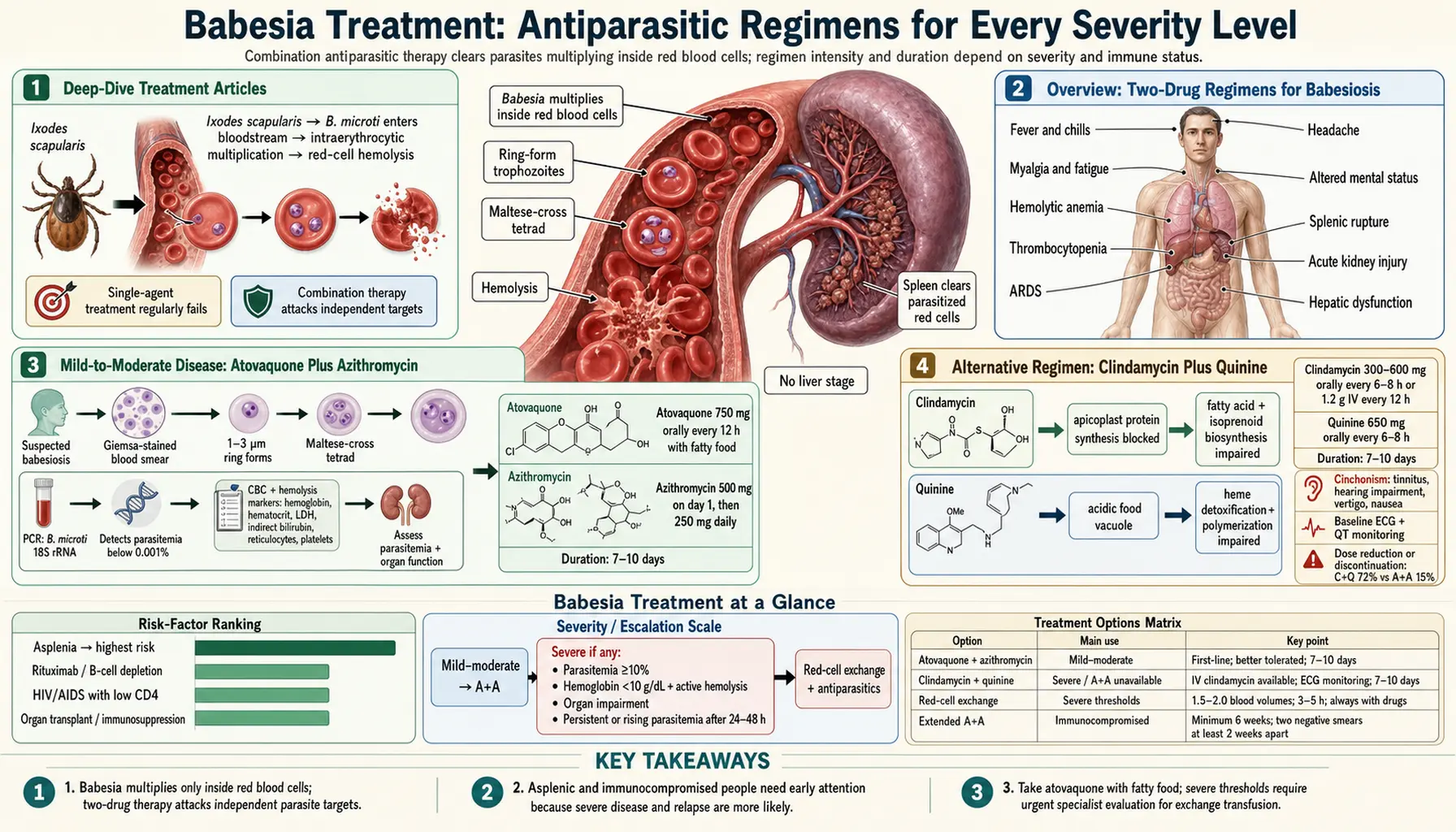
The three sub-articles below break out specific treatment scenarios in full clinical detail. Each page covers dosing tables, contraindications, monitoring parameters, and real patient scenarios. Whether you are navigating a mild summer infection caught after a Cape Cod camping trip or managing a hospitalized asplenic patient with 15% parasitemia, there is a dedicated guide for your situation.
- Atovaquone & Azithromycin Treatment — The standard first-line regimen: adult and pediatric dosing, food requirements, QT monitoring, and what to do when parasitemia does not clear within 7 days.
- Exchange Transfusion & Severe Disease — Indications for red-cell exchange, procedural details, ICU co-management with clindamycin-quinine, and outcomes data from case series.
- Tick Prevention & Environmental Control — DEET and permethrin application, tick-check protocols, yard management, blood-bank screening, and lifetime counseling for asplenic patients.
Overview: Two-Drug Regimens for Babesiosis
Babesiosis is caused by intraerythrocytic protozoa of the genus Babesia. In North America, B. microti transmitted by the deer tick Ixodes scapularis accounts for nearly all cases; in Europe, B. divergens causes a rarer but more fulminant illness in asplenic individuals. Unlike malaria, where a single drug may suffice, babesiosis therapy is always combination therapy. The parasite's unique life cycle — it lacks a liver stage and multiplies solely inside red cells — means that single-agent treatment regularly fails, and relapses are well-documented with monotherapy.
The two established regimens are:
- Atovaquone plus azithromycin (A+A) — first-line for mild-to-moderate disease in immunocompetent adults and children. Better tolerated, equally effective for non-severe illness, and associated with fewer treatment-discontinuing side effects than the older regimen.
- Clindamycin plus quinine (C+Q) — the original regimen, now reserved for severe disease and situations where A+A cannot be used. Effective but poorly tolerated: quinine causes cinchonism (tinnitus, hearing loss, vertigo, nausea) in a large proportion of patients.
In very severe disease — typically defined as parasitemia above 10%, severe hemolytic anemia with hemoglobin below 10 g/dL, or organ failure — either drug regimen is combined with red-cell exchange transfusion. Exchange transfusion rapidly reduces parasite burden and removes toxic hemolysis byproducts, buying time for the antiparasitics to work at the cellular level.
A third class of agents — artemisinins — has shown promise in animal models and scattered human case reports but has not been evaluated in randomized trials. They are not currently part of standard guidelines but may be mentioned in specialist consultations for refractory cases.
Mild-to-Moderate Disease: Atovaquone Plus Azithromycin
Atovaquone-azithromycin became the preferred outpatient regimen after a randomized trial published in 2000 (Krause et al., New England Journal of Medicine) demonstrated equivalent clinical cure rates with significantly fewer adverse effects compared to clindamycin-quinine. This combination is now the standard of care recommended by the Infectious Diseases Society of America (IDSA) for non-severe babesiosis.
Mechanism
Atovaquone blocks the mitochondrial electron transport chain at cytochrome bc1, collapsing the mitochondrial membrane potential that Babesia parasites depend on for ATP synthesis and pyrimidine biosynthesis. Azithromycin acts synergistically by inhibiting protein synthesis at the 50S ribosomal subunit. The two drugs attack the parasite through independent mechanisms, which explains why their combination is dramatically more effective than either drug alone.
Adult Dosing
- Atovaquone 750 mg orally every 12 hours (with food; fatty food doubles absorption)
- Azithromycin 500 mg orally on day 1, then 250 mg orally daily
- Duration: 7 to 10 days for immunocompetent patients; see the immunocompromised section for longer courses
Pediatric Dosing
- Atovaquone 20 mg/kg (maximum 750 mg) orally every 12 hours
- Azithromycin 10 mg/kg (maximum 500 mg) orally on day 1, then 5 mg/kg (maximum 250 mg) daily
Food Requirement
Atovaquone has notoriously poor and variable oral bioavailability when taken fasted — absorption can drop by more than half. Patients should take it with the highest-fat meal of the day. In practice, this means a scrambled egg breakfast, a lunch with avocado, or a dinner with meat. This is not optional: under-dosing from fasted administration is a real cause of treatment failure and the first question to ask when a patient is not clearing parasitemia on schedule.
When to Escalate
If a patient started on A+A fails to show a declining peripheral blood parasitemia by day 5, re-examine three questions: Is the patient taking atovaquone with fatty food? Is there an immunocompromising condition that was not initially apparent? Does the peripheral smear show a high-density infection that should have prompted exchange transfusion? Persistent high parasitemia on day 7 of A+A therapy is an indication to switch to or add clindamycin-quinine and reassess for exchange transfusion.
Alternative Regimen: Clindamycin Plus Quinine
Clindamycin-quinine was the only available regimen before the atovaquone-azithromycin era, and the clinical evidence supporting it comes primarily from case series rather than randomized trials. It remains important for several reasons: it is used in severe disease, it can be administered intravenously in patients who cannot take oral medications, and in regions or settings where atovaquone is unavailable it may be the only option.
Mechanism
Clindamycin inhibits protein synthesis in the Babesia apicoplast, a plastid organelle that is essential for fatty acid and isoprenoid biosynthesis. Quinine is a quinoline alkaloid that accumulates in the acidic food vacuole of the parasite, interfering with heme detoxification and polymerization. The two drugs attack different essential organelles, providing complementary antiparasitic pressure.
Adult Dosing
- Clindamycin 300–600 mg orally every 6–8 hours, or 1.2 g intravenously every 12 hours in severe disease
- Quinine 650 mg orally every 6–8 hours (sulfate salt)
- Duration: 7 to 10 days for immunocompetent patients
Tolerability and Cinchonism
Quinine causes a dose-related syndrome called cinchonism in the majority of patients who take full therapeutic doses: tinnitus (ringing in the ears) is nearly universal, accompanied by varying degrees of hearing impairment, visual disturbances, headache, dizziness, nausea, and abdominal cramps. Most patients find this extremely uncomfortable. In clinical trials comparing C+Q to A+A, drug-related adverse events requiring dose reduction or discontinuation occurred in 72% of C+Q patients versus 15% of A+A patients. This toxicity profile is the primary reason A+A became first-line therapy.
Quinine also prolongs the QT interval and has been associated with serious cardiac arrhythmias, including ventricular tachycardia and torsades de pointes. Baseline ECG and monitoring are required, particularly in patients with preexisting conduction abnormalities or those on other QT-prolonging agents.
When Clindamycin-Quinine Is Preferred
- Severe disease requiring IV therapy (clindamycin available IV; atovaquone is not)
- True treatment failure after an adequate trial of A+A with confirmed food administration
- Documented atovaquone resistance (rare but reported in immunocompromised patients on prolonged A+A)
- Unavailability of atovaquone in resource-limited settings
Severe Disease: When Exchange Transfusion Is Needed
Red-cell exchange transfusion is one of the more dramatic interventions in infectious disease — it involves removing the patient's own blood and replacing it with donor red cells, simultaneously reducing the circulating parasite load and correcting the hemolytic anemia. In babesiosis, it is lifesaving in the right patient at the right time.
Indications
The standard indications for exchange transfusion in babesiosis, as summarized in IDSA guidelines and supported by case series, are:
- Peripheral blood parasitemia of 10% or higher
- Severe hemolytic anemia: hemoglobin below 10 g/dL with active hemolysis
- Organ impairment: acute kidney injury, respiratory failure (ARDS), hepatic dysfunction, or altered mental status
- Persistent or rising parasitemia despite 24–48 hours of appropriate antiparasitic therapy
These are not always present simultaneously — a patient with 12% parasitemia but normal kidney function and stable hemoglobin still meets the parasitemia threshold. Clinical judgment applies, and early infectious disease and hematology consultation is important in any case approaching these thresholds.
How Exchange Transfusion Works
Red-cell exchange (erythrocytapheresis) is performed using automated apheresis equipment in centers experienced with the procedure. The patient's blood is withdrawn in aliquots while donor packed red cells are simultaneously infused, maintaining intravascular volume and hematocrit. A typical exchange targets 1.5 to 2.0 total blood volumes, which can reduce parasitemia from 10–15% to below 1% in a single procedure. The process takes 3–5 hours and requires IV access, ideally central venous access.
In hospitals without apheresis capability, manual exchange — sequential phlebotomy with transfusion of packed red cells — can achieve similar reductions with more effort and less precise volume management. Outcomes data comparing automated to manual exchange in babesiosis specifically are limited; for practical purposes, rapid institution of the procedure matters more than the technical method.
Antiparasitic Therapy During Exchange
Exchange transfusion does not replace antiparasitic drug therapy — it is always combined with clindamycin plus quinine (or atovaquone plus azithromycin in milder concurrent disease). Drug therapy should begin before or immediately concurrent with the transfusion procedure. The drugs eliminate residual parasites inside red cells that escape removal during exchange and prevent re-establishment of high-density infection from the smaller parasite reservoir that remains after the procedure.
Outcomes
Case series of exchange transfusion in severe babesiosis report mortality rates of 5–10% even with the procedure, compared to historical rates above 50% in similar patients managed with antibiotics alone before exchange transfusion was adopted. Survival correlates with the speed of intervention — patients in whom exchange transfusion is delayed while the team debates indications do uniformly worse than those in whom the procedure is initiated promptly at parasitemia above 10%.
Immunocompromised Patients: Extended Treatment
Immunocompromised patients — including those with HIV/AIDS with low CD4 counts, organ transplant recipients on immunosuppression, patients receiving rituximab or other B-cell-depleting therapies, and asplenic individuals — face a fundamentally different disease course than immunocompetent patients. Standard 7–10 day courses of atovaquone-azithromycin frequently fail to clear the parasite, leading to chronic relapsing babesiosis that can persist for months or years.
The Problem of Relapse
In immunocompetent patients, the immune system clears residual parasites after antiparasitic therapy ends. In immunocompromised patients, this immune-mediated clearance is impaired, and parasites suppressed below the detection threshold of peripheral blood smear can persist in the reticuloendothelial system and re-emerge weeks to months later. Relapse manifests as recurrence of fever, worsening anemia, and return of detectable parasitemia on smear or PCR.
The key principle for immunocompromised patients: do not stop treatment based on symptom resolution alone. Treatment should continue until two consecutive peripheral blood smears taken at least two weeks apart are negative for parasites.
Extended A+A Regimens
For immunocompromised patients, the IDSA recommends extending atovaquone-azithromycin therapy for a minimum of 6 weeks, with the endpoint defined by parasitemia clearance confirmed on smear (not just clinical improvement). Patients on rituximab or with ongoing B-cell depletion may require treatment for the entire period of immune suppression, since the immune system that would normally prevent relapse is pharmacologically disabled.
For HIV-positive patients with CD4 counts below 50 cells/μL, suppressive (maintenance) therapy after initial treatment is sometimes considered, analogous to maintenance therapy for other opportunistic infections in advanced HIV disease. This practice is based on case reports and expert opinion rather than clinical trial data.
Atovaquone Resistance in Immunocompromised Patients
A concerning finding in immunocompromised patients on prolonged A+A therapy is the emergence of atovaquone-resistant B. microti. Resistance mutations in the cytochrome b gene (the drug's target) have been documented in patients failing prolonged courses, confirmed by sequencing of parasite DNA from blood. This resistance is clinically significant — drug-resistant strains cause genuine treatment failure, not just insufficient treatment duration. Switching to clindamycin-quinine (which attacks a different target) is the appropriate response to suspected or confirmed resistance.
Asplenic Patients: Highest Risk Group
Asplenic patients — whether from surgical splenectomy for trauma or disease, or functional asplenia from sickle cell disease — are at highest risk for severe babesiosis because the spleen is the primary organ responsible for clearing parasitized red cells from the circulation. Without a functioning spleen, parasitemia can reach 85% in the most extreme reported cases, compared to a typical peak of 1–5% in immunocompetent patients. Asplenic patients with babesiosis require aggressive treatment from the outset, with low threshold for exchange transfusion.
Monitoring Treatment Response
Objective monitoring of babesiosis treatment is essential — clinical improvement (defervescence, reduced fatigue) precedes parasitological clearance, and treating physicians who rely on symptoms alone will underestimate the ongoing parasite burden. The three main monitoring tools are peripheral blood smear, PCR, and hematologic parameters.
Peripheral Blood Smear
Giemsa-stained peripheral blood smear with an experienced microscopist is the standard monitoring tool. The smear detects parasitemia above approximately 0.01–0.1% depending on examiner experience and time spent reviewing the slide. In patients with initial high parasitemia (above 5%), daily smears during the first week of treatment document the trajectory of response. In mild disease where initial parasitemia is low (below 1%), weekly smears suffice.
What to look for on the monitoring smear: B. microti trophozoites appear as ring forms 1–3 μm in diameter inside red cells. The Maltese-cross (tetrad) form — four merozoites arranged in a cross pattern within a single cell — is pathognomonic for Babesia and distinguishes it from Plasmodium falciparum. Declining ring counts over serial smears confirm treatment response.
PCR
PCR for B. microti 18S rRNA is more sensitive than smear and can detect parasitemia below 0.001% — well below the smear detection threshold. PCR is the preferred endpoint marker in immunocompromised patients, where sub-smear-threshold parasitemia can persist and re-emerge. A negative PCR at treatment completion provides stronger evidence of clearance than a negative smear. PCR can remain positive for weeks after clinical cure in immunocompetent patients, so a single positive result after day 14 of treatment should not prompt panic — trend and clinical context matter.
Hematologic Parameters
Hemoglobin and hematocrit reflect the cumulative hemolytic burden. In mild disease, hemoglobin often drops several grams per deciliter before recovering — a nadir around day 5–7 is common even in patients responding well to treatment. Lactate dehydrogenase (LDH) and indirect bilirubin are markers of ongoing hemolysis; their normalization confirms that red-cell destruction has stopped. Reticulocyte count rises as the bone marrow responds to the anemia, typically peaking in the second week. Platelet count, which is frequently suppressed acutely, recovers early in the treatment course and is a useful early marker of systemic improvement.
Liver and Kidney Function
Transaminases (AST, ALT) are mildly elevated in most patients with symptomatic babesiosis, reflecting hepatic involvement from hemolysis and parasitic damage. They should trend toward normal within the first week of treatment. Creatinine reflects renal perfusion and the impact of hemoglobin-induced tubular injury — rising creatinine in a patient on treatment is a red flag for severity progression, not treatment failure per se. Both azithromycin and clindamycin are hepatically metabolized and may require dose adjustment in significant hepatic failure.
Drug Interactions and Side Effects
Atovaquone: Key Interactions
- Rifampin/rifabutin: These potent inducers of drug metabolism dramatically reduce atovaquone plasma levels — co-administration can reduce atovaquone AUC by more than 50%, potentially causing treatment failure. Avoid co-administration when possible; if unavoidable, higher atovaquone doses have been used but are not standardized.
- Metoclopramide: This antiemetic accelerates gastric emptying and reduces atovaquone absorption. Use alternative antiemetics (ondansetron) in patients with babesiosis-related nausea who need antiemetic support.
- Tetracycline: Reduces atovaquone levels by approximately 40% through unknown mechanism. Avoid co-administration; this is particularly relevant in co-infected Lyme disease patients where doxycycline might otherwise be used.
Azithromycin: Key Interactions and Cautions
- QT prolongation: Azithromycin prolongs the cardiac QT interval and can trigger torsades de pointes in susceptible individuals. Risk is higher in patients with hypokalemia, hypomagnesemia, underlying cardiac disease, or those on other QT-prolonging drugs (fluoroquinolones, antipsychotics, antiarrhythmics). Baseline ECG is recommended.
- Drug interactions: Azithromycin is an inhibitor of CYP3A4 and can increase levels of co-administered drugs metabolized by this pathway, including tacrolimus (transplant patients) and some statins. Check for interactions with the patient's full medication list.
Quinine: Side Effects in Detail
Quinine's side-effect profile deserves special attention because it is one of the most poorly tolerated drugs in the infectious disease formulary and managing side effects often determines whether patients complete treatment:
- Cinchonism: Tinnitus, hearing loss (usually reversible), vertigo, visual disturbance, headache, nausea, and vomiting occur in the majority of patients. These are dose-related and can sometimes be managed by dose reduction, though this risks underdosing.
- QT prolongation and arrhythmia: Quinine prolongs QT more potently than azithromycin. Combined with clindamycin-induced arrhythmia risk (rare), ECG monitoring is mandatory, especially at initiation and any dose change.
- Hypoglycemia: Quinine stimulates insulin secretion from pancreatic beta cells, causing hypoglycemia — sometimes severe — particularly in patients who are not eating well. Blood glucose monitoring during IV quinine therapy is standard ICU protocol.
- Hemolysis: In patients with glucose-6-phosphate dehydrogenase (G6PD) deficiency, quinine can precipitate acute hemolytic anemia. G6PD testing before initiating quinine is important in high-risk populations (men of African, Mediterranean, or Southeast Asian descent).
- Thrombocytopenia: Immune-mediated quinine-induced thrombocytopenia is well-documented and can be severe. The platelet count should be monitored during therapy; a sudden drop in platelets in a recovering patient suggests this complication rather than disease progression.
Clindamycin: Side Effects
- Clostridioides difficile colitis: Clindamycin is one of the antibiotics most strongly associated with C. difficile infection. Any patient who develops diarrhea during or after babesiosis treatment with clindamycin should be tested for C. difficile. This risk is not theoretical — severe, recurrent C. difficile infection has complicated babesiosis treatment in the published literature.
- Gastrointestinal side effects: Nausea, vomiting, and diarrhea occur in 10–30% of patients on oral clindamycin; they are more common and severe than with azithromycin but less so than with quinine.
Treatment Duration: Determining the End Point
Knowing when to stop treatment is one of the most practically important and poorly standardized aspects of babesiosis management. The right answer differs dramatically between immunocompetent and immunocompromised patients, and the consequences of stopping too early — relapse requiring retreatment — are significant.
Immunocompetent Adults: Standard Duration
The IDSA 2006 guidelines and subsequent updates recommend 7 to 10 days of treatment for mild-to-moderate babesiosis in immunocompetent adults. The endpoint is clinical resolution of symptoms combined with clearance of parasitemia on peripheral blood smear. Most immunocompetent patients with B. microti infection treated with A+A will have cleared detectable parasitemia on smear by day 7–10; a negative end-of-treatment smear provides reasonable assurance that treatment can stop.
In practice, many clinicians extend to a full 10 days even when patients improve rapidly, recognizing that 7 days may be sufficient only when initial parasitemia was low and the patient is clearly immunocompetent.
Immunocompromised Adults: Prolonged Until Clearance
The rule for immunocompromised patients is fundamentally different: duration is determined by parasitological clearance, not by time. The minimum duration is 6 weeks of atovaquone-azithromycin, but treatment should continue until at least two peripheral blood smears taken at least 2 weeks apart are both negative. PCR negativity at treatment completion provides additional confidence, especially in patients at highest relapse risk (rituximab-treated, CD4 below 50, organ transplant).
What this means practically: a rituximab-treated lymphoma patient who still has positive PCR at week 8 should continue treatment, not have it stopped at an arbitrary time point. The goal is confirmed clearance, not elapsed calendar time.
Children
Pediatric treatment duration follows the same logic as adult immunocompetent treatment: 7 to 10 days of weight-based A+A dosing with confirmation of symptom resolution and parasitemia clearance. Severe pediatric babesiosis (rare in immunocompetent children, more common in those with asplenia or sickle cell disease) requires the same exchange transfusion considerations as adults, scaled to the child's blood volume.
Special Scenario: Asymptomatic Parasitemia on PCR
PCR for B. microti can remain positive for weeks to months after successful treatment and clinical cure in immunocompetent patients. A patient with a negative smear, normal hemoglobin, normal LDH, no symptoms, and a positive PCR at week 12 does not need retreatment — this represents residual PCR signal from cleared infection, not active disease. The decision to retreat should be based on clinical signs of relapse (recurrent fever, worsening anemia, positive smear) rather than on PCR positivity in isolation.
After Treatment: Return Precautions
Patients who have had babesiosis should be counseled that they can be reinfected — prior infection does not confer complete protective immunity, particularly against high-dose tick challenge or B. divergens in asplenic patients. They should be told to seek evaluation promptly if they develop fever after tick exposure in subsequent summers, and they should not donate blood for life (FDA now permanently defers blood donors with a positive babesiosis test). Asplenic patients who have had babesiosis require permanent preventive counseling about tick avoidance and the lifetime risk of rapid-onset severe disease.
Key Research Papers
Connections
- All Parasites
- Babesia Overview
- Babesia Symptoms Hub
- Hemolytic Anemia & Flu Symptoms
- Severe Babesiosis & Immunocompromised
- Diagnosis: Blood Smear & PCR
- Atovaquone & Azithromycin Treatment
- Exchange Transfusion & Severe Disease
- Tick Prevention & Environmental Control
- Babesiosis — the general infectious-disease overview of the tick-borne illness these regimens treat.