⚠ Evidence warning: Clinical trials or other evidence do not support the claim that two to three cups of coffee a day is a low-risk intervention with strong supporting evidence for fatty liver, chronic viral hepatitis and alcoholic liver disease. This page keeps it as a report of what people, websites or other media say.
Coffee and Liver Disease: Cirrhosis, Non-Alcoholic Fatty Liver Disease (NAFLD), and Liver Cancer
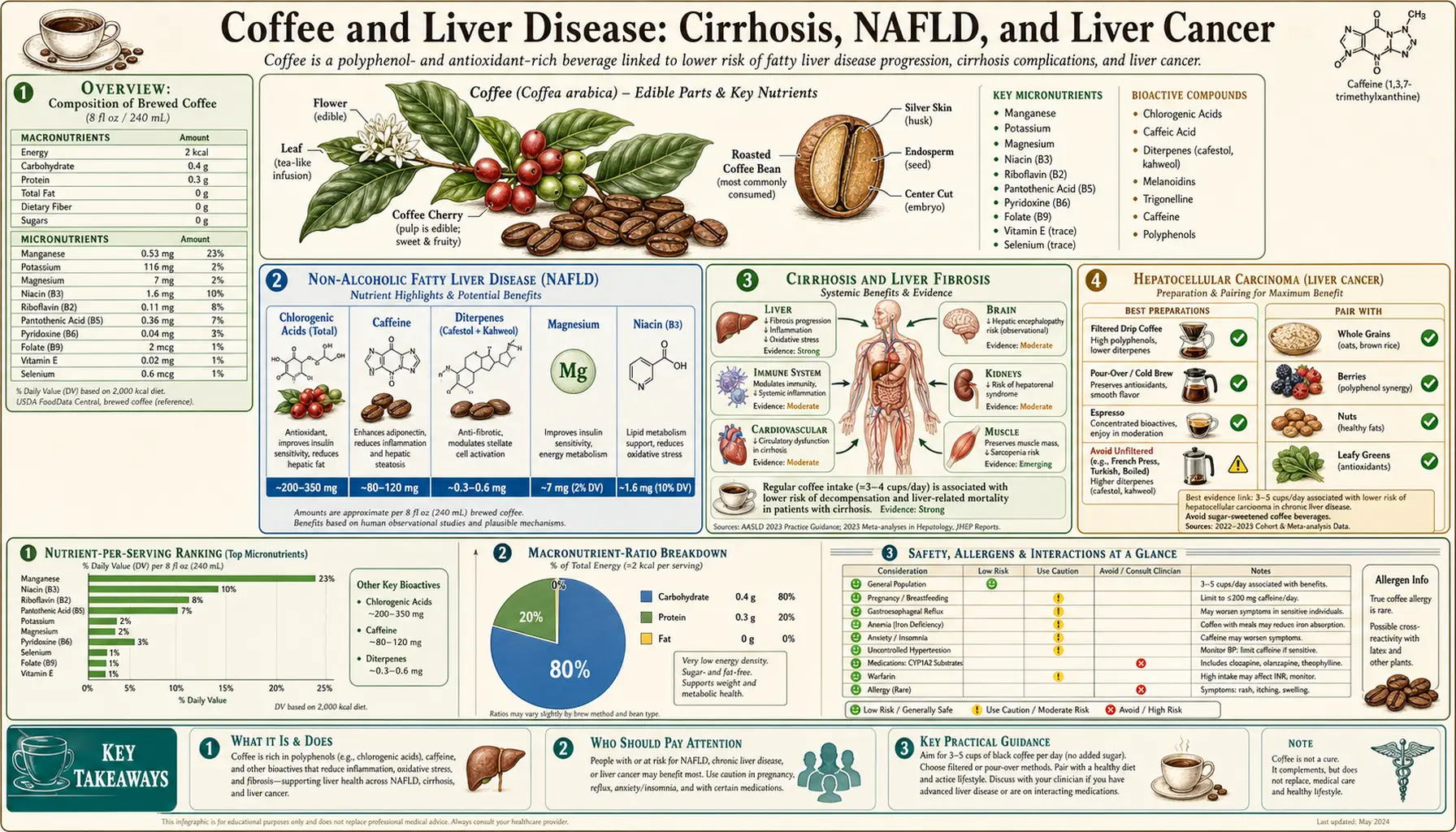
Table of Contents
Overview
Coffee has one of the strongest and most reproducible protective associations with liver disease of any dietary factor studied in modern hepatology. Across dozens of prospective cohorts and meta-analyses, regular coffee drinkers show lower rates of abnormal liver enzymes, slower progression from fatty liver to fibrosis, reduced risk of cirrhosis decompensation, and a substantially lower incidence of hepatocellular carcinoma (HCC). The effect appears in both caffeinated and decaffeinated coffee, which points to compounds beyond caffeine, including chlorogenic acids, cafestol, kahweol, and melanoidins.
The American Association for the Study of Liver Diseases (AASLD) 2023 practice guidance on non-alcoholic fatty liver disease states that coffee consumption, independent of caffeine content, “may also be beneficial”, and that coffee (caffeinated or not) at 3 or more cups daily is associated with less advanced liver disease. The 2016 European guidelines for non-alcoholic fatty liver disease (from the European liver, diabetes and obesity associations, EASL–EASD–EASO) list coffee drinking as having “no liver-related limitations” and describe it as protective in non-alcoholic fatty liver disease, as in liver disease of other causes.
Non-Alcoholic Fatty Liver Disease (NAFLD)
Non-alcoholic fatty liver disease, now often called metabolic dysfunction-associated steatotic liver disease (MASLD), affects roughly 25 percent of the global adult population and is the leading chronic liver condition in high-income countries. It ranges from simple fat accumulation to non-alcoholic steatohepatitis (NASH) with inflammation, fibrosis, and eventual cirrhosis.
A 2019 systematic review and dose-response meta-analysis by Chen and colleagues pooled seven studies on coffee intake and non-alcoholic fatty liver disease. Compared with less than one cup a day, one to two cups or more than two cups a day were not significantly associated with the disease; comparing the highest with the lowest intake gave a relative risk of 0.94, and in the dose-response analysis only more than three cups a day lowered the risk significantly. The authors wrote that the relationship “may not be very close”. A 2021 umbrella review and meta-analysis by Kositamongkol and colleagues pooled nine studies (147,875 people) and found that coffee consumption was not associated with a lower incidence of non-alcoholic fatty liver disease in the general population. Among people who already had the disease (five studies, 3,752 people), coffee consumption was associated with less liver fibrosis (odds ratio 0.67).
Mechanistic work suggests coffee reduces hepatic fat accumulation by improving insulin sensitivity, downregulating lipogenic transcription factors such as SREBP-1c, increasing fatty-acid oxidation via AMP-activated protein kinase (AMPK) activation, and reducing oxidative stress in hepatocytes.
Cirrhosis and Liver Fibrosis
The association between coffee and reduced cirrhosis risk is among the most striking findings in nutritional epidemiology. Kennedy and colleagues' 2016 meta-analysis in Alimentary Pharmacology and Therapeutics pooled nine studies and found that each daily increase of two cups of coffee was associated with a 44 percent lower cirrhosis risk (relative risk 0.56). For alcoholic cirrhosis, the only cause of cirrhosis it analysed separately, the relative risk for the same two-cup increase was 0.62.
In patients with established chronic liver disease, regular coffee consumption is associated with lower serum alanine aminotransferase (ALT) and gamma-glutamyl transferase (GGT), slower histologic fibrosis progression in hepatitis C, and reduced rates of decompensation events such as ascites, variceal bleeding, and hepatic encephalopathy. These benefits appear even in patients who are already in advanced stages of liver disease, suggesting coffee acts not just as a preventive but also as a disease-modifying factor.
Hepatocellular Carcinoma (Liver Cancer)
Hepatocellular carcinoma is the most common primary liver cancer and one of the leading causes of cancer death worldwide. Kennedy and colleagues' 2017 meta-analysis in BMJ Open pooled 18 cohort studies and 8 case-control studies and found that each additional two cups per day of coffee was associated with a 35 percent reduction in HCC risk (relative risk 0.65). The association was weaker in the cohort studies (relative risk 0.71), and the authors rated the quality of the evidence “very low” under the GRADE criteria. A separate 2020 meta-analysis by Bhurwal and colleagues (20 studies) found an overall relative risk of 0.69 for coffee drinkers compared with non-drinkers. Occasional coffee or up to one cup a day did not significantly lower the odds of liver cancer, two cups a day gave minimal significant protection, and three or more cups a day lowered the odds significantly.
In Kennedy’s 2017 analysis the association was not significantly altered by stage of liver disease or by hepatitis B or C infection. It was weaker for decaffeinated coffee: an extra two cups a day was linked to a 27 percent lower risk for caffeinated coffee (2 cohort studies) and a 14 percent lower risk for decaffeinated coffee (3 cohort studies; relative risk 0.86, 95% confidence interval 0.74 to 1.00, at the edge of statistical significance). The decaffeinated result suggests that non-caffeine compounds—particularly diterpenes such as cafestol and kahweol and polyphenols like chlorogenic acid—may also contribute to the association.
Proposed Mechanisms
- Antioxidant activity: Chlorogenic acids and melanoidins reduce oxidative stress in hepatocytes, preventing lipid peroxidation and mitochondrial damage.
- Anti-inflammatory effects: Coffee reduces the inflammatory cytokines tumor necrosis factor-alpha and interleukin-6 (IL-6) and suppresses NF-kB signaling in hepatic stellate cells, the cell type responsible for fibrosis.
- Induction of phase II detoxification enzymes: Cafestol and kahweol upregulate glutathione S-transferase and other enzymes that detoxify carcinogens such as aflatoxin B1.
- Improved insulin sensitivity: Lower hepatic insulin resistance reduces de novo lipogenesis and fat accumulation in the liver.
- Inhibition of hepatic stellate cell activation: Caffeine and its metabolite paraxanthine antagonize adenosine A2A receptors on stellate cells, blocking the profibrogenic cascade.
Dose and Brewing Method
Observational evidence consistently points to two to four cups per day as the range where hepatoprotective benefits are maximized. Benefits appear to plateau or slightly diminish at higher intakes, though no clear upper-limit harm for the liver has been established in otherwise healthy individuals.
Brewing method matters. Unfiltered coffee (French press, Turkish, Scandinavian boiled) retains more cafestol and kahweol, the diterpenes most directly linked to anti-cancer effects. Paper-filtered drip coffee removes most diterpenes but still provides chlorogenic acids, melanoidins, caffeine, and other bioactive compounds. Espresso falls in the middle. A 1997 review by Urgert and Katan explains the trade-off: cafestol and kahweol are the factors that raise blood total and low-density lipoprotein (LDL) cholesterol, and a paper filter holds them back, which is why filtered coffee does not affect cholesterol while Scandinavian boiled, cafetière (French press) and Turkish coffees do.
Clinical Guidance
For adults with or at risk for non-alcoholic fatty liver disease, chronic viral hepatitis, or alcoholic liver disease, regular coffee consumption of two to three cups per day is a low-cost, low-risk intervention with strong supporting evidence. In its guidance on managing non-alcoholic fatty liver disease, the 2023 AASLD document states that drinking 3 or more cups a day “could be recommended in the absence of contraindications”, based on the lower risk of the disease and of liver fibrosis seen in epidemiological studies and meta-analyses. The evidence on coffee and liver disease is observational; Kennedy’s 2017 liver-cancer review, for example, rated its evidence “very low” quality under GRADE because there are no randomised controlled trials, publication bias is possible and there is no accepted definition of coffee. Decaffeinated coffee is the form people with caffeine sensitivity or anxiety disorders turn to; the AASLD guidance describes the benefit as independent of caffeine content, while Kennedy’s liver-cancer analysis found a weaker association for decaffeinated coffee. On pregnancy, the American College of Obstetricians and Gynecologists (Committee Opinion 462, 2010) states that moderate caffeine consumption (less than 200 mg per day) does not appear to be a major contributing factor in miscarriage or preterm birth, and that the relationship of caffeine to growth restriction remains undetermined.
Coffee is not a substitute for the measures with proven effects, such as weight loss, alcohol abstinence, antiviral therapy for hepatitis C, or management of metabolic syndrome; the AASLD guidance lists it alongside diet and lifestyle measures. In advanced cirrhosis the body clears caffeine much more slowly: a 2022 study found the elimination rate of caffeine was 51 percent lower in people with severe (Child C) cirrhosis than in matched control subjects, so caffeine from the same cup stays in the blood longer.
Sources
- Kennedy OJ et al. (2017). "Coffee, including caffeinated and decaffeinated coffee, and the risk of hepatocellular carcinoma: a systematic review and dose-response meta-analysis." BMJ Open. PMID: 28490552
- Kennedy OJ et al. (2016). "Systematic review with meta-analysis: coffee consumption and the risk of cirrhosis." Alimentary Pharmacology and Therapeutics. PMID: 26806124
- Bhurwal A et al. (2020). "Inverse association of coffee with liver cancer development: an updated systematic review and meta-analysis." Journal of Gastrointestinal and Liver Diseases. PMID: 32830818
- Chen YP et al. (2019). "A systematic review and a dose-response meta-analysis of coffee dose and nonalcoholic fatty liver disease." Clinical Nutrition. PMID: 30573353
- Kositamongkol C et al. (2021). "Coffee consumption and non-alcoholic fatty liver disease: an umbrella review and a systematic review and meta-analysis." Frontiers in Pharmacology. PMID: 34966282
- Wijarnpreecha K et al. (2017). "Coffee consumption and risk of nonalcoholic fatty liver disease: a systematic review and meta-analysis." European Journal of Gastroenterology and Hepatology. PMID: 27824642
- Rinella ME et al. (2023). "AASLD Practice Guidance on the clinical assessment and management of nonalcoholic fatty liver disease." Hepatology. PMID: 36727674
- European Association for the Study of the Liver (EASL), European Association for the Study of Diabetes (EASD), European Association for the Study of Obesity (EASO) (2016). "EASL-EASD-EASO Clinical Practice Guidelines for the management of non-alcoholic fatty liver disease." Journal of Hepatology. PMID: 27062661
- Duthaler U et al. (2022). "Liver Cirrhosis Affects the Pharmacokinetics of the Six Substrates of the Basel Phenotyping Cocktail Differently." Clinical Pharmacokinetics. PMID: 35570253
- American College of Obstetricians and Gynecologists (2010). "ACOG Committee Opinion No. 462: Moderate caffeine consumption during pregnancy." Obstetrics and Gynecology. PMID: 20664420
- Urgert R, Katan MB (1997). "The cholesterol-raising factor from coffee beans." Annual Review of Nutrition. PMID: 9240930
- Hayat U et al. (2021). "The effect of coffee consumption on the non-alcoholic fatty liver disease and liver fibrosis: a meta-analysis of 11 epidemiological studies." Annals of Hepatology. PMID: 32920163
Connections
- All Food
- Caffeine, Adenosine & Why Coffee Stops Working — interactive animation
- Coffee
- Coffee (Food)
- Cirrhosis
- Liver Disease
- Non-Alcoholic Fatty Liver Disease
- Cancer
- Hepatitis
- Hepatitis C
- Liver Cleansing
- Oxidative Stress
- Resistant Starches & Fatty Liver
- Gamma-Glutamyl Transferase
- Metabolic Syndrome
- Gerson Detoxification
- Coffee & Cancer Prevention
- Coffee Health Benefits
- Hepatitis B
- Liver Health