Black Ginger (Kaempferia parviflora)
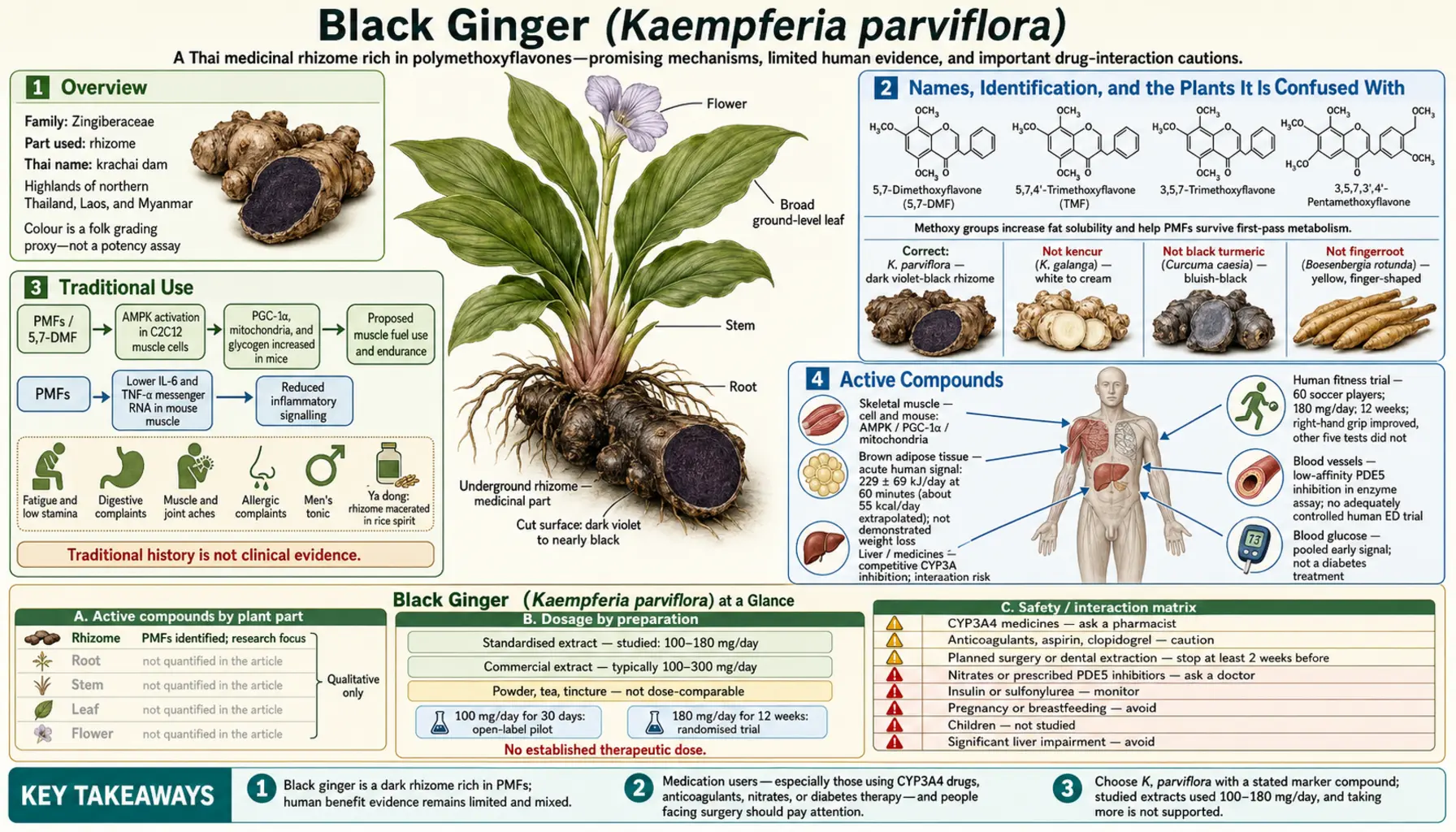
Black ginger is the deep purple-black rhizome of Kaempferia parviflora, a small ginger-family plant of the highlands of northern Thailand, Laos and Myanmar, where it is called krachai dam (Thai กระชายดำ, literally "black krachai"). Cut one open and the flesh is genuinely dark — violet to nearly black — which is how it earned every one of its names. It is sold across Thailand and, increasingly, online as an energy and vitality tonic, and its chemistry is unusual and real: it is loaded with polymethoxyflavones, the same class of compounds that gives dried citrus peel its pharmacology.
The human evidence is a set of small trials, and it points in more than one direction. Several randomised, placebo-controlled trials report a benefit on some measures and not others (grip strength, abdominal fat on CT scans, laboratory measures of erectile response), a single-dose crossover trial found no effect at all on sprint or endurance performance, and the most-cited sexual-health study had no placebo group. Several of the trials were run or sponsored by companies that make K. parviflora extracts. The frequently repeated claim that it "works like Viagra" traces back to an enzyme-assay finding: the paper that reported it describes the methoxyflavones in its title as low-affinity PDE5 inhibitors, measured in vitro.
Table of Contents
- Overview
- Names, Identification, and the Plants It Is Confused With
- Traditional Use
- Active Compounds
- Energy, Exercise Performance, and Muscle
- Blood Sugar, Body Fat, and Metabolic Syndrome
- Blood Flow, Blood Vessels, and the PDE5 Claim
- Inflammation and Antioxidant Activity
- Culinary and Beverage Use
- Forms and Preparations
- Dosage
- Cautions and Contraindications
- Key Research Papers
- Connections
- Featured Videos
Overview
Kaempferia parviflora Wall. ex Baker is a low-growing perennial herb in the Zingiberaceae — the ginger family, which also contains ginger, turmeric, galangal, cardamom and kencur. The plant is small and unassuming: broad ground-level leaves, a modest pale-violet flower, and an underground rhizome that rarely exceeds the size of a walnut. Almost nothing about the plant above ground signals what is below it.
The rhizome is the part used. In the trade, the colour of the cut surface is commonly treated as a quality marker, and darker rhizomes are graded higher. That is a folk grading standard, not a validated measure of the methoxyflavone content that the research is about.
The plant grows wild and semi-wild in cool, well-drained hill country, particularly in Loei, Phitsanulok and Phetchabun provinces of Thailand and across the Lao and Shan uplands. Harvest is in the dry season, after the leaves die back. From there it reaches consumers by three quite different routes. The oldest is ya dong — sliced rhizome macerated in rice spirit and sold by the shot glass from roadside jars. The second is the domestic Thai health-drink and capsule market, where "krachai dam" is a mainstream category alongside ginseng. The third, and the one most readers will meet, is the export supplement channel, where standardised ethanol extracts are sold under trade names and marketed for energy, blood flow and male sexual health.
The human trials discussed on this page are summarised in the figure below: what each measured, its design and size, what it found, and who ran or sponsored it.
Figure: the human studies of K. parviflora described on this page. Green marks a reported benefit; "run by" is taken from each paper's affiliations, funding or disclosure statement, or marked not stated.
Names, Identification, and the Plants It Is Confused With
Binomial: Kaempferia parviflora Wall. ex Baker. Family: Zingiberaceae. Part used: rhizome.
Local names: Thai กระชายดำ (krachai dam); also krachai dum, kra chai dam in transliteration. Lao kachai dam. In English-language trade it appears as black ginger, Thai black ginger, and — unhelpfully — as "black turmeric" and "Thai ginseng", neither of which it is. Japanese supplement labels use ブラックジンジャー (burakku jinjā) or the Thai-derived kurachai damu.
This is a plant defined as much by what it is not as by what it is. Three different species are routinely sold, described or written about as though they were black ginger. They are chemically distinct and they are not interchangeable.
- Kencur — Kaempferia galanga. Same genus, different species. Kencur's rhizome flesh is white to cream, not black, and its dominant compound is ethyl p-methoxycinnamate, a camphorous aromatic that makes it a kitchen spice across Java and a staple of Indonesian jamu. If a rhizome smells sharply of camphor and cuts pale, it is kencur. See Kencur.
- Black turmeric — Curcuma caesia. A different genus entirely. Its flesh is bluish-black, which is exactly why the names collide, but it is a Curcuma: it contains curcuminoids and a camphor-rich essential oil, and its traditional home is north-eastern India and Bangladesh rather than Thailand. Buying "black turmeric" and expecting polymethoxyflavones is a category error. See Black Turmeric.
- Fingerroot — Boesenbergia rotunda. In Thailand this is plain krachai, without the dam. Drop one syllable and you have a completely different plant: yellow, finger-shaped rhizomes used by the handful in Thai fish curries and pad cha, with pinostrobin and panduratin rather than methoxyflavones as its signature compounds. Recipes translated from Thai frequently render both as "krachai", which is how the confusion enters English cookbooks. See Fingerroot.
In the research, identification rests on the binomial Kaempferia parviflora; the cut rhizome is dark violet to black throughout rather than only at the skin, and several of the trials used extracts standardised to their methoxyflavone content. A product labelled only "black ginger" with no binomial cannot be matched to the plant that was studied, and many dark rhizomes circulate in this trade.
Traditional Use
In Thai traditional medicine krachai dam belongs to the category of warming, invigorating remedies. It has been used for fatigue and low stamina, for digestive complaints including flatulence and colic, for muscular and joint aches, for allergic complaints, and — most prominently in how it is sold today — as a men's tonic. Hill communities in Loei and neighbouring provinces have long macerated the sliced rhizome in rice spirit and taken it as a daily dram, a preparation that doubles as a village medicine and a social drink.
Among the Mong hill people of northern Thailand it is widely believed to reduce perceived effort and improve physical work capacity, and it is taken before the day's work (as described by Wasuntarawat and colleagues, who then tested that belief in a trial, below). That "keeps you going" framing survives intact in the modern sports-supplement marketing.
All of this is history, not evidence. Long use tells us that a plant is broadly tolerated by the people who used it and that it was valued; it does not tell us that it works, and traditional dosing (a shot of infused spirit) bears little resemblance to a standardised capsule of concentrated extract. Where black ginger differs from many traditional herbs is that some of the traditional claims — stamina, blood flow — have actually been taken into a clinic and tested. The results of those tests are covered below, and they are mixed.
Active Compounds
The defining chemistry of black ginger is its polymethoxyflavones (PMFs), and this is what makes the plant genuinely distinctive rather than just another aromatic rhizome.
A flavonoid is a plant pigment built on a two-ring-plus-linker skeleton; quercetin in onions and catechins in tea are the familiar examples. Most dietary flavonoids carry free hydroxyl (–OH) groups, which the body treats as a handle: gut and liver enzymes attach sulfate or glucuronide to those handles within minutes and excrete the result. That is why swallowing large amounts of quercetin produces disappointingly small blood levels.
A polymethoxyflavone is a flavonoid in which those hydroxyls have been capped with methyl groups (–OCH3). Capping does two things: it removes the handles that conjugating enzymes grab, and it makes the molecule considerably more fat-soluble. In principle, that is expected to help PMFs survive first-pass metabolism and cross membranes more readily than ordinary flavonoids. This is the same structural trick behind nobiletin and tangeretin in dried citrus peel — the traditional Chinese medicine chen pi — and it is why the two plants keep appearing in the same research conversations despite being botanically unrelated.
The methoxyflavones identified in K. parviflora rhizome include:
- 5,7-Dimethoxyflavone (5,7-DMF) — one of the major components of the rhizome, and the most potent PDE5 inhibitor among the eight methoxyflavones Temkitthawon and colleagues tested. Much of the mechanistic work on this plant is work on this molecule.
- 3,5,7,3',4'-Pentamethoxyflavone — named with 5,7-DMF as a main ingredient in the CYP3A study by Kashiwabuchi and colleagues.
- 5,7,4'-Trimethoxyflavone (TMF) — used, with 3,5,7,3',4'-pentamethoxyflavone, as a blood marker in the human pharmacokinetic study.
- 3,5,7-Trimethoxyflavone and related tri- and tetramethoxyflavones — reported in the rhizome, less studied.
Chen and colleagues' 2018 review maps this chemistry and the activities reported for it, and names a limit: the clinical use of K. parviflora and its methoxyflavones "may be limited due to their low bioavailability". The one human pharmacokinetic study fits that caution. Sripanidkulchai and colleagues (2019) found that after the extract only 5,7,4'-TMF and 3,5,7,3',4'-pentamethoxyflavone could be detected in human blood — 5,7-dimethoxyflavone, the compound behind most of the mechanism studies, could not — and the two that were detected had half-lives of 2–3 hours. Because methoxyflavones are lipophilic, the extracts used in trials are ethanol or ethanol-water extracts; a traditional water infusion and a standardised ethanolic extract are not chemically equivalent products.
Energy, Exercise Performance, and Muscle
The proposed mechanism. In cultured C2C12 muscle cells, black ginger extract and its purified PMFs activate AMP-activated protein kinase (AMPK). AMPK is the cell's fuel gauge: it switches on when energy is scarce and pushes the cell toward burning fuel and building mitochondria rather than storing fat. In mice given the extract orally for four weeks, Toda and colleagues (all employees of an extract manufacturer) reported longer forced-swimming times, better movement after swimming and greater grip strength, alongside lower IL-6 and TNF-α messenger RNA in the soleus muscle and higher PGC-1α expression, more mitochondria and more stored glycogen. That is a coherent story: less inflammatory signalling in the muscle, more mitochondrial machinery, more fuel on hand. It is a cell-culture and mouse story.
The human trials. Four randomised trials have tested exercise or fitness outcomes, and they do not all agree.
- Single dose, no effect (Wasuntarawat 2010). Two randomised, double-blind, placebo-controlled crossover studies in college men, run by a Thai university group: 90 minutes after one dose of K. parviflora or a starch placebo, 19 men did three 30-second sprint cycling tests and 16 cycled to exhaustion. There were no detectable differences in any measure, and no effect on time to exhaustion, perceived exertion or heart rate. The authors note that effects of longer use, or in other groups, were not excluded.
- Older adults, 8 weeks (Wattanathorn 2012). 45 healthy elderly volunteers were randomised to placebo or 25 or 90 mg of extract once daily. The extract improved the 30-second chair-stand test and the 6-minute walk test, alongside serum antioxidant-enzyme activity. Funded in part by the National Research Council of Thailand and Khon Kaen University.
- Soccer players, 12 weeks (Promthep 2015). Sixty players at a sports school were randomised double-blind to 180 mg of extract daily or placebo, with six fitness tests repeated every four weeks: sit-and-reach flexibility, hand-grip strength, back-and-leg strength, a 40-yard technical test, a 50-metre sprint, and cardiorespiratory fitness. Right-hand grip strength was significantly higher than placebo at weeks 4, 8 and 12, and left-hand grip strength at week 8 only. The other five tests showed no significant difference from placebo. Supported by a Khon Kaen University herbal-products research centre.
- Adolescent athletes, 12 weeks (Sripanidkulchai 2022). 194 male sport-school students were randomised double-blind (97 per group) to 360 mg/day of a standardized Kaempferia parviflora extract or placebo. The extract group improved on four of the six fitness tests — right-hand grip strength, back-and-leg strength, VO2 max and 50-metre sprint time — with no change in sit-and-reach or the 40-yard technical test. Run from the same Khon Kaen University centre.
Read together: one dose did nothing measurable, and twelve weeks of daily use improved some fitness measures and not others, with the larger, higher-dose trial reporting more positives than the smaller one. Three of the four trials come from one university research group, and none has been repeated by an independent team at scale. When many tests are run at several time points, some comparisons cross the significance threshold by chance, which is why the measures that did not move matter as much as the ones that did. The 2015 abstract's conclusion ("may significantly enhance some physical fitness components") is worded more broadly than its results.
Blood Sugar, Body Fat, and Metabolic Syndrome
Energy expenditure. Matsushita and colleagues (2015) gave healthy men a single oral dose of an ethanol extract or placebo and measured whole-body energy expenditure by indirect calorimetry. Energy expenditure rose, with a maximal increase of 229 ± 69 kJ/d at 60 minutes, while placebo produced no change. The subjects then had FDG-PET scanning to grade brown adipose tissue activity; the response was greater in the high-brown-fat group (351 ± 50 kJ/d at 60 minutes), with no response in the low-brown-fat group. Brown fat burns fuel to make heat, so the finding fits a real physiological mechanism. The abstract does not give the number of men or the funding source.
The figure is expressed as a daily rate but was measured over the first hour after one dose. The study did not test whether the effect lasts through a day or across weeks, and it did not measure body weight. It is an acute measurement in people who had active brown fat.
Body fat. Two randomised, double-blind, placebo-controlled trials in overweight Japanese adults were sponsored by the manufacturer of the material tested, and several authors are its employees. In the first (Yoshino 2018), 76 adults with a BMI of 24 to under 30 took 150 mg of extract or placebo once daily for 12 weeks; visceral, subcutaneous and total abdominal fat area on CT scanning, and triglycerides, fell significantly compared with placebo, with no adverse events related to the test food. In the second (Yoshino 2021), 80 adults took a polymethoxyflavone fraction purified from K. parviflora (12 mg of polymethoxyflavone per day) or placebo for 12 weeks; visceral fat area was significantly lower than placebo at 8 and 12 weeks. The primary outcome in both was fat area on a CT scan rather than body weight, and neither has been repeated by an independent team in the sources cited here.
Blood glucose. The 2024 systematic review and meta-analysis by Na Takuathung, Klinjan and Koonrungsesomboon screened 664 articles and included 57, combining animal experiments with randomised placebo-controlled human trials. Black ginger extract significantly lowered fasting blood glucose in animal studies (standardised mean difference −0.88, 95% CI −1.63 to −0.14) and in human studies (SMD −0.51, 95% CI −0.98 to −0.05). The human confidence interval runs from a moderate effect to one close to nothing — its upper bound is −0.05.
A placebo-controlled study in healthy volunteers by Sripanidkulchai and colleagues (2019) gave 90 or 180 mg/day of extract for 28 days and ran an oral glucose tolerance test before and after: the extract had no effect on glucose tolerance. It was funded by the National Research Council of Thailand and Khon Kaen University.
Where this leaves blood sugar: no trial among the sources cited here tested black ginger as a treatment for diabetes, or alongside glucose-lowering medicines.
Blood Flow, Blood Vessels, and the PDE5 Claim
This is the section where black ginger is most oversold, so it is worth walking through carefully.
What was actually found. Temkitthawon and colleagues published a paper in 2011 whose title carries the key phrase: "Kaempferia parviflora, a plant used in traditional medicine to enhance sexual performance contains large amounts of low affinity PDE5 inhibitors." PDE5 — phosphodiesterase type 5 — is the enzyme that breaks down cyclic GMP in the smooth muscle of blood vessels, including those of the penis; sildenafil works by blocking it. The study was an in vitro enzyme assay: 41 plant extracts and eight methoxyflavones from K. parviflora were screened against PDE5 prepared from mouse lung and PDE6 from chicken retina. The most potent was 5,7-dimethoxyflavone, with an IC50 of 10.64 ± 2.09 µM and a selectivity for PDE5 over PDE6 of 3.71. The authors' own conclusion calls the activity "moderate", and the title calls the compounds "low affinity" inhibitors. "Large amounts of weak inhibitors" is a different statement from "a natural Viagra."
Why the distinction matters: an effect in a test tube depends on whether the compound reaches that concentration in the tissue. No study among the sources cited here measured methoxyflavone levels in penile tissue. In human blood, 5,7-dimethoxyflavone was not detected after the extract, and the two methoxyflavones that were detected peaked at 71.2 ± 11.3 and 63.0 ± 18.0 ng/mL at 180 mg/day (Sripanidkulchai 2019). An in vitro IC50 is not a clinical effect.
Vascular tissue work. Tep-Areenan and colleagues showed that isolated 5,7-DMF (1–100 µM) relaxes pre-contracted rat aortic rings, partly through the NO-cGMP and cyclooxygenase pathways and mainly through potassium efflux and reduced calcium influx. That is isolated animal tissue in an organ bath — genuine pharmacology, no human relevance established.
Blood fluidity. Murata and colleagues reported that the rhizome shortened blood passage time through a micro-slit device in a disseminated-intravascular-coagulation model, and attributed it to activation of fibrinolysis (clot breakdown), with methoxyflavones as the active principles. This is a laboratory and animal-model finding, and it is the basis for the bleeding question raised under Cautions below; no human bleeding study was found.
The human sexual-health data. Two human studies have been published. Wannanon and colleagues (2012), a Thai university group, gave 45 healthy elderly men placebo or an ethanolic extract at 25 or 90 mg once daily for 2 months. At 90 mg/day the abstract reports significant improvement in every measured parameter after 1 and 2 months — response latency to visual erotic stimuli, and penile size and length in the flaccid and erect states — and no significant change in testosterone, FSH or LH. The abstract does not say whether allocation was randomised or blinded, the outcomes were laboratory measures rather than a validated questionnaire such as the IIEF, funding is not stated, and the journal is not indexed in PubMed.
The second, Stein and colleagues (2018), was an open-label, one-arm study in 14 generally healthy men aged 50–68 with self-reported mild erectile dysfunction, who took 100 mg of a standardized Kaempferia parviflora extract daily for 30 days and completed the International Index of Erectile Function (IIEF) and a Global Assessment Question. Thirteen finished, and IIEF erectile-function, intercourse-satisfaction and total scores improved significantly. There was no placebo group, no randomisation and no blinding, the outcomes were self-reported, and the authors were affiliated with a supplement company. Placebo alone moves this kind of score: a 2020 meta-analysis of 63 placebo-controlled PDE5-inhibitor trials (12,564 men) found that erectile function improved significantly in the placebo arms (Hedges g 0.35). The authors describe their study as a pilot and state that longer, placebo-controlled trials are needed.
The 2024 meta-analysis states that the extract "markedly improved sexual function", but its abstract gives no separate human figure for that outcome; its pool mixes animal experiments with the small human trials described above.
Testosterone. The one human study that measured hormones (Wannanon 2012) found no significant change in testosterone, FSH or LH. In rats the results depend on the model: in castrated immature rats given 1,000 mg/kg for 5 days, serum testosterone rose, yet the authors concluded there was no testosterone-like effect on the reproductive organs (Trisomboon 2007); in adult male rats given 1,000 mg/kg/day for 45 days there was no significant change in testosterone, FSH, LH or mating behaviour (Trisomboon 2008). No human study among these sources found a rise in testosterone.
Summary of the evidence: PDE5 inhibition in an enzyme assay, relaxation of isolated rat aorta, one placebo-controlled human study with laboratory measures that is not indexed in PubMed, and one 14-man uncontrolled pilot. No large, independently run, randomised trial using a validated questionnaire was found. Separately, a 2013 meta-analysis of 14 cohort studies (92,757 participants) found that men with erectile dysfunction had a higher risk of cardiovascular events (pooled relative risk 1.44), which is why erectile dysfunction is studied as an early marker of cardiovascular disease.
Inflammation and Antioxidant Activity
Black ginger extracts and isolated methoxyflavones suppress inflammatory signalling in cultured cells — reduced nitric oxide production in stimulated macrophages, reduced expression of inflammatory cytokines, and interference with the NF-κB pathway that switches those genes on. In the mouse exercise work, IL-6 and TNF-α messenger RNA fell in skeletal muscle. These findings, gathered in Chen and colleagues' review, are entirely pre-clinical: cell culture and rodents.
The traditional Thai use for allergy and for aches and stiffness maps onto this anti-inflammatory profile neatly enough to be worth investigating, and the compound class is a reasonable place to look. But no human trial has shown that black ginger reduces pain, stiffness or allergic symptoms. Reduced NF-κB activity in a dish is a hypothesis about a person, not a result in one.
On antioxidant capacity: methoxyflavones perform respectably in DPPH and FRAP assays, but these are chemistry tests in a test tube, and a test-tube antioxidant score is not a health outcome. In the 8-week trial in older adults, serum antioxidant-enzyme activity rose and malondialdehyde fell (Wattanathorn 2012) — a biomarker change, not a clinical one.
Culinary and Beverage Use
Black ginger is a marginal culinary plant. Unlike fingerroot or kencur, which are genuine kitchen staples, K. parviflora is bitter and astringent and is not a usual curry ingredient. Its everyday form is a drink.
- Ya dong. Sliced or crushed rhizome steeped in rice spirit for weeks to months, often with honey and other roots, and drunk in small glasses. This is the traditional preparation and it is worth noting that the vehicle is high-proof alcohol — a factor in both the extraction of the lipophilic methoxyflavones and in some of the perceived effect.
- Herbal tea and instant drinks. Dried sliced rhizome brewed as a dark, earthy, slightly bitter tea, and commercial instant sachets blended with sugar, ginger or cocoa to cover the bitterness. A water infusion extracts far fewer methoxyflavones than an alcoholic one.
- Energy and functional beverages. Black ginger also appears in ready-to-drink tonics; when it is combined with caffeine or other stimulants, any felt effect cannot be attributed to the black ginger itself.
Forms and Preparations
- Standardised ethanol extract (capsules). The form used in essentially all the human research. Trial doses ranged from 12 mg/day of a purified polymethoxyflavone fraction to 360 mg/day of extract (listed under Dosage).
- Dried rhizome powder. Cheaper, unstandardised, and highly variable in methoxyflavone content. There is no reliable conversion between a gram of powder and a milligram of standardised extract.
- Sliced dried rhizome for tea. Traditional, pleasant, and the weakest form for the lipophilic actives.
- Tincture / macerated spirit. Alcohol extracts the lipophilic methoxyflavones well; the alcohol itself is part of what is consumed.
- Topical and transdermal preparations. Transdermal permeation of the methoxyflavones has been studied in the laboratory (reviewed by Chen and colleagues); these are research formulations, not established consumer products.
Because dark rhizomes of other species are sold under overlapping names, a product that does not state the species and a marker compound cannot be matched to the material used in the trials.
Dosage
There is no established therapeutic dose for black ginger, because there is no established therapeutic effect. What exists are the doses used in the published human studies, which is a different and more modest thing:
- A single dose — the acute energy-expenditure study (Matsushita 2015) and the sprint and endurance crossover trial (Wasuntarawat 2010).
- 12 mg/day of a purified polymethoxyflavone fraction for 12 weeks — the visceral-fat trial (Yoshino 2021).
- 25 or 90 mg/day for 8 weeks or 2 months — the two trials in older adults (Wattanathorn 2012; Wannanon 2012); the reported effects were at 90 mg/day.
- 90 or 180 mg/day for 28 days — the glucose-tolerance and pharmacokinetic study (Sripanidkulchai 2019), which found no effect on glucose tolerance.
- 100 mg/day for 30 days — the open-label sexual-health pilot (Stein 2018).
- 150 mg/day for 12 weeks — the abdominal-fat trial (Yoshino 2018).
- 180 mg/day for 12 weeks — the soccer-player trial (Promthep 2015), one positive measure out of six.
- 360 mg/day for 12 weeks — the adolescent-athlete trial (Sripanidkulchai 2022), four positive measures out of six.
No study among these compared doses for safety above these ranges. The CYP3A inhibition described below was concentration-dependent in human liver microsomes (Kashiwabuchi 2022).
Traditional preparations are not dose-comparable: a shot of ya dong delivers an unknown and highly variable quantity of methoxyflavones plus a measurable quantity of ethanol.
Cautions and Contraindications
The drug-interaction findings are the most specific safety signal for this plant. They come from human liver microsomes and rodents; no human drug-interaction study was found.
- CYP3A inhibition. Kashiwabuchi and colleagues (2022) showed in human liver
microsomes that black ginger extract and its main compounds (5,7-dimethoxyflavone and
3,5,7,3',4'-pentamethoxyflavone) inhibit CYP3A-mediated midazolam metabolism, the
extract competitively and in a time-, NADPH- and concentration-dependent manner. In rats, a single
oral dose of extract (135 mg/kg) 2 hours before midazolam raised midazolam's area under the curve
2.3-fold and its peak concentration 1.9-fold; given 18 hours before, the effect was weaker. Ochiai and
colleagues (2018) gave mice 5,7-DMF for 10 days: midazolam's area under the curve rose by 130%, its
half-life lengthened by about 100 minutes, and liver expression of CYP3A11 and CYP3A25 fell —
an effect of repeated use, not only of a single dose.
CYP3A4 metabolises a large share of prescription drugs: many statins (simvastatin, atorvastatin), calcium-channel blockers, several benzodiazepines, immunosuppressants such as tacrolimus and cyclosporine, certain anticoagulants, many antivirals, and sildenafil and tadalafil themselves. Inhibiting CYP3A4 raises blood levels of these drugs, which for a statin means a higher risk of muscle injury and for an immunosuppressant can mean toxicity — the same mechanism behind the labelled grapefruit-juice interactions. The research raises a concern for people taking CYP3A-metabolised medicines; decisions about combining a supplement with prescription medicines belong with a clinician or pharmacist. - Other liver enzymes and acetaminophen. In mice, Mekjaruskul and colleagues (2012) found that 250 mg/kg of extract induced CYP1A1, CYP1A2, CYP2B and CYP2E1 activity but did not affect CYP3A activity. In rats given acetaminophen daily, adding 250 mg/kg of extract on days 4–9 lowered acetaminophen's area under the curve from 1.68 to 0.34 mg·min/mL and shortened its half-life from 21.29 to 10.81 minutes (Mekjaruskul 2020) — an animal finding the authors link to CYP2E1 induction.
- Bleeding and surgery. The blood-fluidity work attributes the effect to activation of fibrinolysis in a laboratory and animal model, and in the 90-day rat toxicology study platelet counts rose at the low dose while staying within the normal range. No human bleeding data and no surgery-specific guidance for black ginger were found. The question the laboratory data raise concerns people taking warfarin, a direct oral anticoagulant, aspirin or clopidogrel, and people facing surgery.
- Blood pressure and nitrates. Prescription PDE5 inhibitors carry a labelled interaction with nitrate medicines (nitroglycerin, isosorbide): the combination can cause a dangerous fall in blood pressure. Black ginger's PDE5 activity is low-affinity and was measured in vitro; no study has tested it with nitrates or with a prescribed PDE5 inhibitor, so whether the concern applies, and how strongly, is unknown.
- Diabetes medication. Given the fasting-glucose signal in the meta-analysis, additive glucose lowering with insulin or a sulfonylurea is a theoretical concern. No interaction study was found, and in healthy volunteers the extract did not change glucose tolerance.
- Pregnancy and breastfeeding. No safety data in pregnancy or lactation were found.
- Children. Not studied in children; the youngest trial participants were the adolescent male sport-school students of the 2022 fitness trial.
- General toxicity. Yoshino and colleagues (2019; employees of an extract manufacturer, with the testing done at contract laboratories) found a standardised extract was not mutagenic in the bacterial reverse-mutation panel, and a 90-day oral study in Sprague-Dawley rats found no toxicologically relevant biochemical, macroscopic or histopathological changes; increased salivation at the high dose (249 mg/kg/day) and higher platelet levels at the low dose (25 mg/kg/day), within normal ranges, were the main observations. The authors conclude it has a high safety margin; these are animal data. In people, the 12-week fat trial reported no adverse events related to the test food and no clinically relevant laboratory abnormalities (Yoshino 2018), and the 12-week adolescent trial reported normal blood biochemistry (Sripanidkulchai 2022). Human safety data beyond 12 weeks were not found.
- Liver and kidney disease. No published case report of liver injury attributed to K. parviflora was found in PubMed (searched October 2026). Its liver-related findings are effects on drug-metabolising enzymes, described above. No study has been done in people with liver or kidney disease.
- Identity. Given the number of dark rhizomes sold under overlapping names, an unlabelled "black ginger" powder may not be K. parviflora at all.
Key Research Papers
- Chen D, Li H, Li W, Feng S, et al. Kaempferia parviflora and its methoxyflavones: chemistry and biological activities. Evidence-Based Complementary and Alternative Medicine. 2018;2018:4057456. — PubMed PMID: 30643531
- Promthep K, Eungpinichpong W, Sripanidkulchai B, Chatchawan U. Effect of Kaempferia parviflora extract on physical fitness of soccer players: a randomized double-blind placebo-controlled trial. Medical Science Monitor Basic Research. 2015;21:100–108. — PubMed PMID: 25957542
- Matsushita M, Yoneshiro T, Aita S, Kamiya T, et al. Kaempferia parviflora extract increases whole-body energy expenditure in humans: roles of brown adipose tissue. Journal of Nutritional Science and Vitaminology. 2015;61(1):79–83. — PubMed PMID: 25994142
- Na Takuathung M, Klinjan P, Koonrungsesomboon N. A systematic review and meta-analysis of animal and human studies demonstrates the beneficial effects of Kaempferia parviflora on metabolic syndrome and erectile dysfunction. Nutrition Research. 2024;122:80–91. — PubMed PMID: 38194854
- Temkitthawon P, Hinds TR, Beavo JA, Viyoch J, et al. Kaempferia parviflora, a plant used in traditional medicine to enhance sexual performance contains large amounts of low affinity PDE5 inhibitors. Journal of Ethnopharmacology. 2011;137(3):1437–1441. — PubMed PMID: 21884777
- Stein RA, Schmid K, Bolivar J, Swick AG, et al. Kaempferia parviflora ethanol extract improves self-assessed sexual health in men: a pilot study. Journal of Integrative Medicine. 2018;16(4):249–254. — PubMed PMID: 29880257
- Toda K, Hitoe S, Takeda S, Shimoda H. Black ginger extract increases physical fitness performance and muscular endurance by improving inflammation and energy metabolism. Heliyon. 2016;2(5):e00115. — PubMed PMID: 27441286
- Sripanidkulchai B, Mekjaruskul C, Areemit R, Cheawchanwattana A, et al. Glucose tolerance test and pharmacokinetic study of Kaempferia parviflora extract in healthy subjects. Nutrients. 2019;11(5):1176. — PubMed PMID: 31130666
- Kashiwabuchi Y, Nishimura Y, Kurata N, Iwase M, et al. Inhibition of CYP3A-mediated midazolam metabolism by Kaempferia parviflora. Food Safety (Tokyo). 2022;10(1):32–41. — PubMed PMID: 35510070
- Ochiai W, Kobayashi H, Kitaoka S, Kashiwada M, et al. Effect of the active ingredient of Kaempferia parviflora, 5,7-dimethoxyflavone, on the pharmacokinetics of midazolam. Journal of Natural Medicines. 2018;72(3):607–614. — PubMed PMID: 29550915
- Mekjaruskul C, Jay M, Sripanidkulchai B. Modulatory effects of Kaempferia parviflora extract on mouse hepatic cytochrome P450 enzymes. Journal of Ethnopharmacology. 2012;141(3):831–839. — PubMed PMID: 22465145
- Yoshino S, Awa R, Ohto N, Miyake Y, et al. Toxicological evaluation of standardized Kaempferia parviflora extract: sub-chronic and mutagenicity studies. Toxicology Reports. 2019;6:544–549. — PubMed PMID: 31249788 (a 2021 erratum, PMID 33391997, added the missing competing-interest statement)
- Tep-Areenan P, Sawasdee P, Randall M. Possible mechanisms of vasorelaxation for 5,7-dimethoxyflavone from Kaempferia parviflora in the rat aorta. Phytotherapy Research. 2010;24(10):1520–1525. — PubMed PMID: 20878704
- Murata K, Deguchi T, Fujita T, Matsuda H. Improvement in blood fluidity by Kaempferia parviflora rhizome. Journal of Natural Medicines. 2013;67(4):719–724. — PubMed PMID: 23212284
- Wasuntarawat C, Pengnet S, Walaikavinan N, Kamkaew N, et al. No effect of acute ingestion of Thai ginseng (Kaempferia parviflora) on sprint and endurance exercise performance in humans. Journal of Sports Sciences. 2010;28(11):1243–1250. — PubMed PMID: 20845210
- Wattanathorn J, Muchimapura S, Tong-Un T, Saenghong N, et al. Positive modulation effect of 8-week consumption of Kaempferia parviflora on health-related physical fitness and oxidative status in healthy elderly volunteers. Evidence-Based Complementary and Alternative Medicine. 2012;2012:732816. — PubMed PMID: 22899957
- Sripanidkulchai B, Promthep K, Tuntiyasawasdikul S, Tabboon P, Areemit R. Supplementation of Kaempferia parviflora extract enhances physical fitness and modulates parameters of heart rate variability in adolescent student-athletes: a randomized, double-blind, placebo-controlled clinical study. Journal of Dietary Supplements. 2022;19(2):149–167. — PubMed PMID: 33272042
- Yoshino S, Awa R, Miyake Y, Fukuhara I, et al. Daily intake of Kaempferia parviflora extract decreases abdominal fat in overweight and preobese subjects: a randomized, double-blind, placebo-controlled clinical study. Diabetes, Metabolic Syndrome and Obesity. 2018;11:447–458. — PubMed PMID: 30214264
- Yoshino S, Tagawa T, Awa R, Ogasawara J, et al. Polymethoxyflavone purified from Kaempferia parviflora reduces visceral fat in Japanese overweight individuals: a randomised, double-blind, placebo-controlled study. Food & Function. 2021;12(4):1603–1613. — PubMed PMID: 33475663
- Wannanon P, Wattanathorn J, Tong-Un T, Pangphukiew P, et al. Efficacy assessment of Kaempferia parviflora for the management of erectile dysfunction. OnLine Journal of Biological Sciences. 2012;12(4):149–155. — doi:10.3844/ojbsci.2012.149.155
- Trisomboon H, Watanabe G, Wetchasit P, Taya K. Effect of daily treatment with Thai herb, Kaempferia parviflora, in Hershberger assay using castrated immature rats. Journal of Reproduction and Development. 2007;53(2):351–356. — PubMed PMID: 17179656
- Trisomboon H, Tohei A, Malaivijitnond S, Watanabe G, et al. Oral administration of Kaempferia parviflora did not disturb male reproduction in rats. Journal of Reproduction and Development. 2008;54(5):375–380. — PubMed PMID: 18594126
- Mekjaruskul C, Sripanidkulchai B. In vivo effect of Kaempferia parviflora extract on pharmacokinetics of acetaminophen. Drug and Chemical Toxicology. 2020;43(6):602–608. — PubMed PMID: 31195843
- Stridh A, Pontén M, Arver S, Kirsch I, et al. Placebo responses among men with erectile dysfunction enrolled in phosphodiesterase 5 inhibitor trials: a systematic review and meta-analysis. JAMA Network Open. 2020;3(3):e201423. — PubMed PMID: 32196105
- Vlachopoulos CV, Terentes-Printzios DG, Ioakeimidis NK, Aznaouridis KA, Stefanadis CI. Prediction of cardiovascular events and all-cause mortality with erectile dysfunction: a systematic review and meta-analysis of cohort studies. Circulation: Cardiovascular Quality and Outcomes. 2013;6(1):99–109. — PubMed PMID: 23300267
PubMed Topic Searches
- PubMed: Kaempferia parviflora — all results
- PubMed: Kaempferia parviflora clinical trials
- PubMed: 5,7-Dimethoxyflavone
- PubMed: Polymethoxyflavone metabolism
- PubMed: Kaempferia parviflora and CYP3A
- PubMed: Kaempferia parviflora and exercise performance
- PubMed: Kaempferia parviflora and erectile function
- PubMed: Kaempferia parviflora and brown adipose tissue
- PubMed: Plant-derived PDE5 inhibitors
- PubMed: Kaempferia parviflora toxicity and safety
Connections
- All Herbs
- Kencur (Kaempferia galanga) — the same genus, a pale rhizome and a completely different chemistry; the most common mix-up.
- Black Turmeric (Curcuma caesia) — the other black rhizome, a Curcuma rather than a Kaempferia.
- Fingerroot (Boesenbergia rotunda) — plain "krachai" in Thai, without the dam.
- Chen Pi (Aged Citrus Peel) — botanically unrelated, but the other great dietary source of polymethoxyflavones.
- Ginger (Zingiber officinale) — the reference plant of the family, and a useful comparison for how much stronger the human evidence can be.
- Conditions on this site that reference this page: Atherosclerosis · Coronary Artery Disease (CAD) · Liver Disease · Erectile Dysfunction · Low Testosterone and Testosterone Replacement Therapy (TRT)