Hiatal Hernia
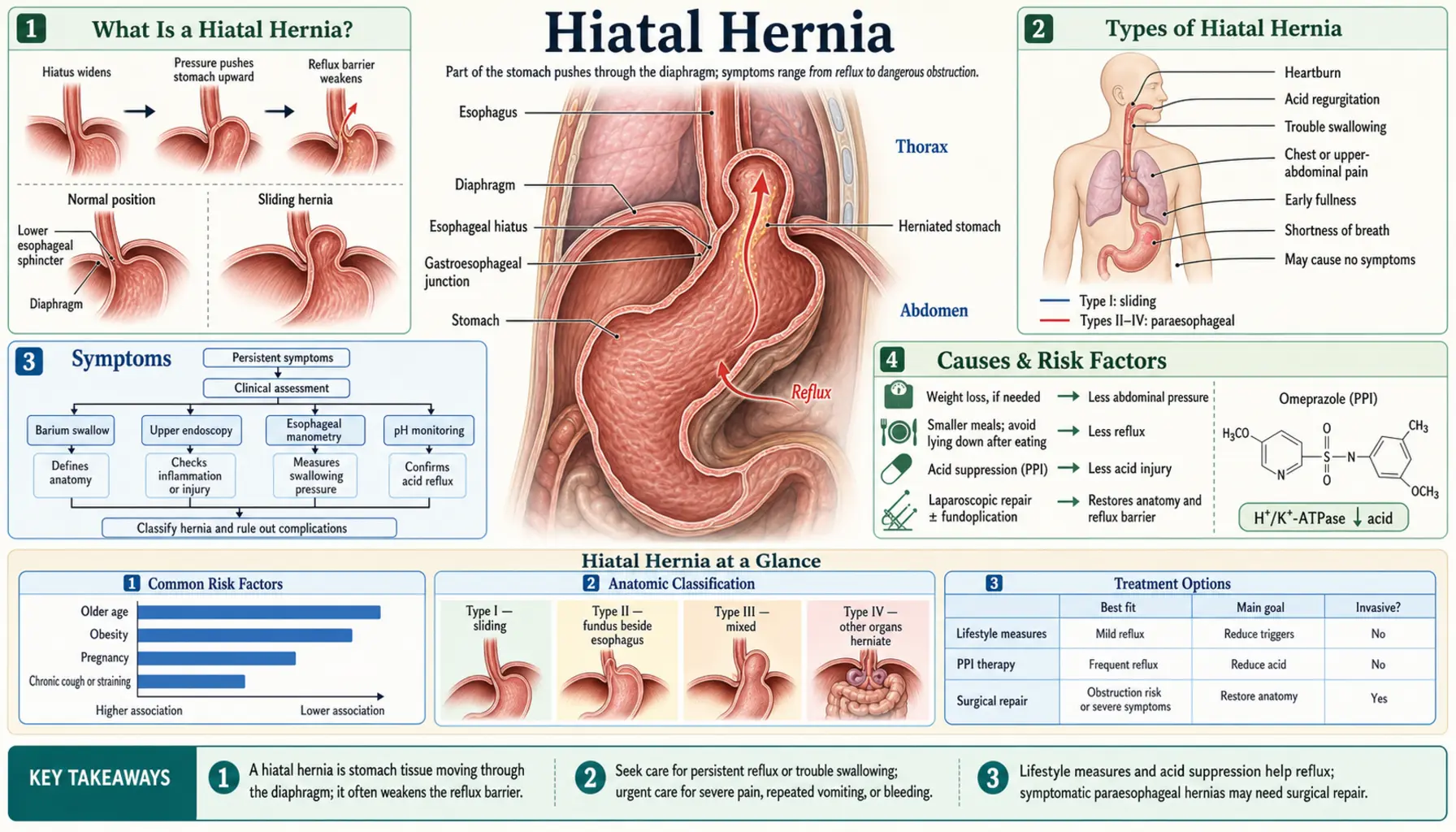
A hiatal hernia is one of the most common findings in all of gastroenterology, and for most people who have one it is also one of the most harmless. The word sounds alarming — a hernia in the chest — but in the great majority of cases it simply means that a small part of the stomach has slipped a little higher than usual, through the natural opening in the diaphragm where the esophagus passes. Many people live their entire lives with a hiatal hernia and never know it; it is often discovered by accident during a test done for another reason, causes no symptoms, and needs no treatment. When it does cause trouble, that trouble is usually heartburn and acid reflux, which respond well to simple measures. There is only one uncommon variety — the large paraesophageal hernia — that can, rarely, become a true emergency, and this page will tell you plainly how to recognize it. But it is worth saying up front: if a doctor has told you that you have a hiatal hernia, the odds are overwhelming that it is the ordinary, benign kind.
Table of Contents
- What Is a Hiatal Hernia?
- Types of Hiatal Hernia
- Symptoms
- Causes & Risk Factors
- How It Relates to GERD
- Diagnosis
- Treatment
- Diet & Lifestyle Management
- Complications
- When to Seek Urgent Care
- Key Research Papers
- Connections
- Featured Videos
What Is a Hiatal Hernia?
To understand a hiatal hernia, picture the diaphragm — the broad, dome-shaped sheet of muscle that separates your chest from your abdomen and does most of the work of breathing. The esophagus, the muscular tube that carries food from your throat to your stomach, has to pass from the chest down into the belly to reach the stomach. It does this through a small opening in the diaphragm called the esophageal hiatus (Latin hiatus simply means “gap”).
Normally the junction where the esophagus meets the stomach — the gastroesophageal junction — sits right at this opening, held snugly in place. This spot is guarded by two overlapping structures that together keep stomach acid from washing back up: the lower esophageal sphincter, a ring of muscle in the esophagus wall, and the muscular pinch of the diaphragm itself, whose crura (the leg-like bands of muscle around the hiatus) squeeze the area from the outside like a second sphincter. When the two line up, they reinforce each other into a strong one-way valve.
A hiatal hernia occurs when part of the stomach pushes upward through that opening into the chest. In the common form, the junction and the top of the stomach simply slide up above the diaphragm, so the two sphincter mechanisms come apart and no longer back each other up. In the less common form, the junction stays put but a pocket of stomach balloons up alongside the esophagus. Either way, the tidy anatomy that normally keeps acid down is disturbed — which is why hiatal hernia and heartburn so often travel together, even though a hernia is not the same thing as reflux and one can occur without the other.
Types of Hiatal Hernia
Doctors sort hiatal hernias into four types. This is not just academic — the type is what determines whether a hernia is a harmless bystander or something that needs closer watching.
Type I — Sliding Hernia (the common, generally harmless one)
This is the overwhelming majority — roughly 19 out of every 20 hiatal hernias. The gastroesophageal junction and a bit of the upper stomach slide up through the hiatus into the chest and often slide back down again, which is why it is called “sliding.” The stomach stays in its normal orientation; nothing is trapped. A sliding hernia does not strangulate and is not dangerous in itself. Its only real consequence is that it tends to promote acid reflux. Most sliding hernias are small and silent.
Types II–IV — Paraesophageal Hernias (the uncommon ones to respect)
In a paraesophageal hernia (“para” = beside), the anatomy behaves differently and, in a large hernia, potentially more dangerously.
- Type II (pure paraesophageal): The gastroesophageal junction stays anchored in its normal place, but a pocket of the stomach’s upper curve (the fundus) rolls up beside the esophagus into the chest. Pure Type II hernias are actually quite rare.
- Type III (mixed): A combination — both the junction and a portion of the stomach have moved up into the chest. This is the most common form of paraesophageal hernia.
- Type IV: The hernia is large enough that another organ — a loop of colon, the spleen, part of the pancreas, or small intestine — has slipped up into the chest cavity alongside the stomach.
The concern with larger paraesophageal hernias is mechanical: a big pocket of stomach sitting in the chest can twist on itself (a gastric volvulus), become trapped so it cannot slide back (incarceration), or have its blood supply pinched off (strangulation). These events are uncommon, but they are the reason paraesophageal hernias are taken more seriously than sliding ones. The great majority of people with a paraesophageal hernia still never experience an emergency — but they should know the warning signs, which are described in the urgent-care section below.
Symptoms
The single most important thing to know about hiatal hernia symptoms is that most hernias are silent. Small sliding hernias in particular usually produce no symptoms at all and are discovered incidentally. When symptoms do occur, they fall into two broad patterns.
Reflux-type symptoms (most common)
Because the antireflux valve is disrupted, a symptomatic sliding hernia usually announces itself the way reflux does:
- Heartburn — a burning discomfort behind the breastbone, often worse after meals or when lying down.
- Acid regurgitation — a sour or bitter fluid rising into the throat or mouth, especially when bending over or reclining.
- Chest discomfort or pressure that can mimic other conditions (see the caution below).
- A lump-in-the-throat sensation, chronic cough, hoarseness, or a sour taste from acid reaching the upper airway.
Mechanical symptoms (more typical of larger paraesophageal hernias)
- Fullness or bloating after small meals, and feeling full quickly (early satiety), because the displaced stomach cannot fill or empty normally.
- Difficulty swallowing or a sense that food sticks.
- Shortness of breath or chest pressure after eating, if a large stomach pocket crowds the lungs and heart.
- Unexplained iron-deficiency anemia. Large hernias can develop small linear erosions where the stomach rubs against the diaphragm — called Cameron lesions — that ooze blood slowly over time. A hiatal hernia is a well-recognized and easily missed cause of low iron with no obvious bleeding.
An important caution about chest pain: reflux and hiatal-hernia discomfort can feel very much like heart trouble, and heart trouble can feel like reflux. Never assume that new, severe, or exertional chest pain is “just my hernia.” Chest pain deserves prompt medical evaluation until a cardiac cause has been ruled out.
Causes & Risk Factors
A hiatal hernia develops when the tissues that normally hold the gastroesophageal junction in place weaken or stretch, and when pressure inside the abdomen pushes the stomach upward against that weakened opening. The common contributors are:
- Age. This is the biggest single factor. The membrane that tethers the esophagus to the diaphragm (the phrenoesophageal membrane) loosens and the hiatus tends to widen over the decades, which is why hiatal hernias become steadily more common in middle age and beyond.
- Obesity and increased abdominal pressure. Extra weight around the midsection raises the pressure in the abdomen and pushes the stomach up through the hiatus. Higher body weight is one of the most consistent risk factors and, importantly, one of the few that can be changed.
- Repeated straining and sudden pressure spikes. Chronic constipation with heavy straining, frequent heavy lifting, persistent coughing, and repeated vomiting all transmit force upward against the diaphragm.
- Pregnancy. The growing uterus raises abdominal pressure; hernias that appear or worsen during pregnancy often settle afterward.
- An inherently large or weak hiatus. Some people are simply born with a wider opening or laxer connective tissue, and hernias can also follow surgery in the area.
Smoking and factors that weaken connective tissue may contribute as well. In practice, most hiatal hernias reflect the ordinary combination of getting older and carrying some extra abdominal pressure — not any single dramatic cause.
How It Relates to GERD
Hiatal hernia and gastroesophageal reflux disease (GERD) are closely linked but not the same thing. You can have a hiatal hernia without reflux, and reflux without a hernia — yet the two reinforce each other, and larger hernias are associated with more severe reflux.
The reason lies in that two-part valve described earlier. Normally the lower esophageal sphincter and the diaphragm’s muscular pinch sit at the same level and work as a team. In a sliding hiatal hernia, the sphincter is pulled up into the chest and separated from the diaphragm, so the two no longer overlap. Classic manometry studies by Kahrilas and colleagues showed that this separation measurably weakens the barrier and makes acid far more likely to escape upward.
A hernia also creates a small reservoir of acid — the so-called acid pocket — that sits above the diaphragm, right at the doorway to the esophagus, poised to reflux after meals. And because the herniated segment traps refluxed acid instead of letting the esophagus sweep it back down promptly, acid lingers longer against the esophageal lining. The result is that people with larger hiatal hernias tend to have more frequent reflux, more erosive esophagitis, and a higher chance of complications such as Barrett’s esophagus. This is also why simply treating a hernia’s acid without addressing the anatomy sometimes falls short in severe cases.
Diagnosis
Hiatal hernias are often found by chance — on a chest X-ray, a CT scan, or an endoscopy done for some other reason. When a hernia is suspected or needs to be characterized, a few tests are used, often in combination:
- Upper endoscopy (EGD). A thin, flexible camera is passed into the esophagus and stomach. It is the most common way a hernia is confirmed, lets the doctor measure how far the junction has moved, and — crucially — shows whether reflux has caused inflammation, ulcers, Cameron lesions, or Barrett’s changes.
- Barium swallow (upper GI series). You swallow a chalky contrast liquid while X-rays are taken. This is especially good at outlining the anatomy of a hernia — how large it is, whether it is sliding or paraesophageal, and whether the stomach has rotated — making it the go-to study for planning surgery on larger hernias.
- High-resolution esophageal manometry. A slim pressure-sensing catheter measures the muscle activity of the esophagus and pinpoints the separation between the lower esophageal sphincter and the diaphragm. It is used mainly before antireflux surgery and to rule out swallowing disorders such as achalasia that can masquerade as reflux.
- CT scan. Reserved for large or complex paraesophageal hernias, and the test of choice when an acute complication such as volvulus or strangulation is suspected.
Treatment
Treatment depends almost entirely on the type of hernia and whether it is causing symptoms. The guiding principle is reassuring: a hernia that causes no trouble usually needs no treatment.
Small sliding hernias
If there are no symptoms, nothing needs to be done — no medication, no monitoring, no surgery. When a sliding hernia causes reflux, the reflux is what gets treated, not the hernia itself:
- Lifestyle measures (detailed in the next section) are the foundation and, for mild symptoms, are sometimes all that is needed.
- Acid-suppressing medication. Antacids give quick, short-lived relief. H2 blockers (such as famotidine) reduce acid moderately. Proton pump inhibitors (PPIs) — omeprazole, pantoprazole, esomeprazole and others — are the most effective at healing acid-related inflammation and controlling symptoms. These are best used at the lowest effective dose and reviewed periodically with your doctor.
When surgery is considered
Surgery is not the routine answer for a hiatal hernia. It is generally reserved for two situations:
- Reflux that stays severe despite good medical treatment, or reflux complications such as bleeding, strictures, or Barrett’s changes. Here the standard operation is a fundoplication, in which the surgeon pulls the stomach back into the abdomen, tightens (repairs) the widened hiatus, and wraps the upper stomach around the lower esophagus to rebuild the valve. A full 360-degree wrap is called a Nissen fundoplication; partial wraps (Toupet, Dor) are used when a gentler valve is preferred. Most of these are done laparoscopically, through a few small incisions.
- Symptomatic paraesophageal hernias. A large paraesophageal hernia that causes fullness, difficulty swallowing, breathlessness, anemia, or pain is usually repaired surgically: the stomach and any other organs are eased back into the abdomen, the hernia sac is removed, the hiatus is closed (a cruroplasty, sometimes reinforced with mesh), and a fundoplication is often added. For a completely symptom-free paraesophageal hernia, careful watchful waiting is now considered reasonable for many patients, because the yearly risk of a sudden emergency is low and elective repair carries its own risks — a shift supported by decision-analysis work by Stylopoulos and colleagues. That decision is individualized with a surgeon.
An acute emergency — a twisted or strangulated hernia — is different: that requires urgent, sometimes immediate, surgery, as described below.
Diet & Lifestyle Management
Lifestyle changes do not push a hernia back into place or repair the anatomy — but they are genuinely effective at reducing reflux symptoms and lowering the pressure that aggravates a hernia. For most people with a symptomatic sliding hernia, these steps make a real difference:
- Lose excess weight. Because abdominal pressure is a driver of both hernia and reflux, even modest weight loss is one of the most powerful things you can do — often reducing symptoms more than any single food change.
- Eat smaller, earlier meals. Large meals distend the stomach and worsen reflux. Smaller portions, and finishing eating at least 2 to 3 hours before lying down, keep the stomach from being full at bedtime.
- Raise the head of your bed. Elevating the head of the bed by about 6 to 8 inches (using blocks or a wedge, not just extra pillows) uses gravity to keep acid down overnight.
- Identify and limit trigger foods. Common culprits include large fatty or fried meals, chocolate, peppermint, coffee, alcohol, carbonated drinks, and very spicy or acidic foods. Triggers are individual — it is worth noticing your own rather than avoiding everything.
- Stop smoking and avoid tight belts or waistbands that squeeze the abdomen.
- Prevent straining. Manage constipation with fiber and fluids so you are not bearing down, and use good technique (and help) with heavy lifting.
These measures are safe, cost little, and complement medication rather than replacing it when medication is needed.
Complications
Most hiatal hernias never cause a complication. When problems do arise, they come in two categories — the common acid-related ones and the rare mechanical ones.
Acid-related (mostly with sliding hernias):
- Reflux esophagitis — inflammation and erosions of the lower esophagus.
- Esophageal strictures — narrowing from long-term acid scarring, causing swallowing trouble.
- Barrett’s esophagus — a change in the esophageal lining after years of reflux that slightly raises esophageal-cancer risk and warrants monitoring.
- Cameron lesions — erosions within a large hernia that cause slow blood loss and iron-deficiency anemia.
Mechanical (with large paraesophageal hernias, uncommon but serious):
- Gastric volvulus — the herniated stomach twists on itself.
- Incarceration — the stomach becomes trapped and cannot slide back.
- Strangulation — the blood supply to the trapped stomach is cut off, which can cause tissue death and is a surgical emergency.
- Obstruction of the stomach, and rarely breathing or heart symptoms from a very large intrathoracic stomach pressing on the lungs.
When to Seek Urgent Care
This is the part that matters most to commit to memory, precisely because it is rare. The everyday hiatal hernia is not an emergency — but a large paraesophageal hernia that twists or strangulates is, and it needs care within hours, not days.
Seek emergency care immediately if you develop:
- Sudden, severe pain in the chest or upper abdomen, especially after a meal, that does not ease.
- Retching or a desperate urge to vomit but being unable to bring anything up. The combination of severe upper-abdominal pain, retching without vomiting, and difficulty swallowing or passing a stomach tube is a classic warning sign of gastric volvulus (known to clinicians as Borchardt’s triad).
- Sudden inability to swallow even your own saliva, or food and liquid coming straight back up.
- Vomiting blood, or material that looks like coffee grounds, or passing black, tarry stools — signs of significant bleeding.
- New breathlessness with chest pressure.
And separately, because hernia and reflux pain can imitate a heart attack: treat any new, severe, crushing, or exertional chest pain — particularly with sweating, nausea, or pain spreading to the arm or jaw — as a possible cardiac emergency and call for help rather than assuming it is your hernia. It is always better to be checked and reassured.
Key Research Papers
- Roman S, Kahrilas PJ. The diagnosis and management of hiatus hernia. BMJ. 2014;349:g6154.
- Kahrilas PJ, Kim HC, Pandolfino JE. Approaches to the diagnosis and grading of hiatal hernia. Best Practice & Research Clinical Gastroenterology. 2008;22(4):601-616.
- Hyun JJ, Bak YT. Clinical significance of hiatal hernia. Gut and Liver. 2011;5(3):267-277.
- Kahrilas PJ, Lin S, Chen J, Manka M. The effect of hiatus hernia on gastro-oesophageal junction pressure. Gut. 1999;44(4):476-482.
- Gordon C, Kang JY, Neild PJ, Maxwell JD. The role of the hiatus hernia in gastro-oesophageal reflux disease. Alimentary Pharmacology & Therapeutics. 2004;20(7):719-732.
- Pandolfino JE, El-Serag HB, Zhang Q, et al. Obesity: a challenge to esophagogastric junction integrity. Gastroenterology. 2006;130(3):639-649.
- Weber C, Davis CS, Shankaran V, Fisichella PM. Hiatal hernias: a review of the pathophysiologic theories and implication for research. Surgical Endoscopy. 2011;25(10):3149-3153.
- Siegal SR, Dolan JP, Hunter JG. Modern diagnosis and treatment of hiatal hernias. Langenbeck’s Archives of Surgery. 2017;402(8):1145-1151.
- Sfara A, Dumitrascu DL. The management of hiatal hernia: an update on diagnosis and treatment. Medicine and Pharmacy Reports. 2019;92(4):321-325.
- Kohn GP, Price RR, DeMeester SR, et al. Guidelines for the management of hiatal hernia (SAGES). Surgical Endoscopy. 2013;27(12):4409-4428.
- Stylopoulos N, Gazelle GS, Rattner DW. Paraesophageal hernias: operation or observation? Annals of Surgery. 2002;236(4):492-501.
- Oelschlager BK, Pellegrini CA, Hunter JG, et al. Biologic prosthesis to prevent recurrence after laparoscopic paraesophageal hernia repair: long-term follow-up from a multicenter, prospective, randomized trial. Journal of the American College of Surgeons. 2011;213(4):461-468.
Live PubMed Searches
- Hiatal hernia — PubMed search
- Paraesophageal hernia repair — PubMed search
- Hiatal hernia & reflux — PubMed search
- Nissen fundoplication — PubMed search
- Gastric volvulus — PubMed search
- Cameron lesions & anemia — PubMed search
Connections
- Gastroenterology
- GERD (Acid Reflux)
- Barrett’s Esophagus
- Peptic Ulcer Disease
- Gastritis
- Achalasia
- Gastroparesis
- Functional Dyspepsia
- Eosinophilic Esophagitis
- H. pylori Infection
- Irritable Bowel Syndrome
- Reflux & Heartburn
- Chest Pain
- Nausea & Vomiting
- Bloating
- Obesity
- Asthma