Alpha Lipoic Acid for Neuroprotection & Cognition
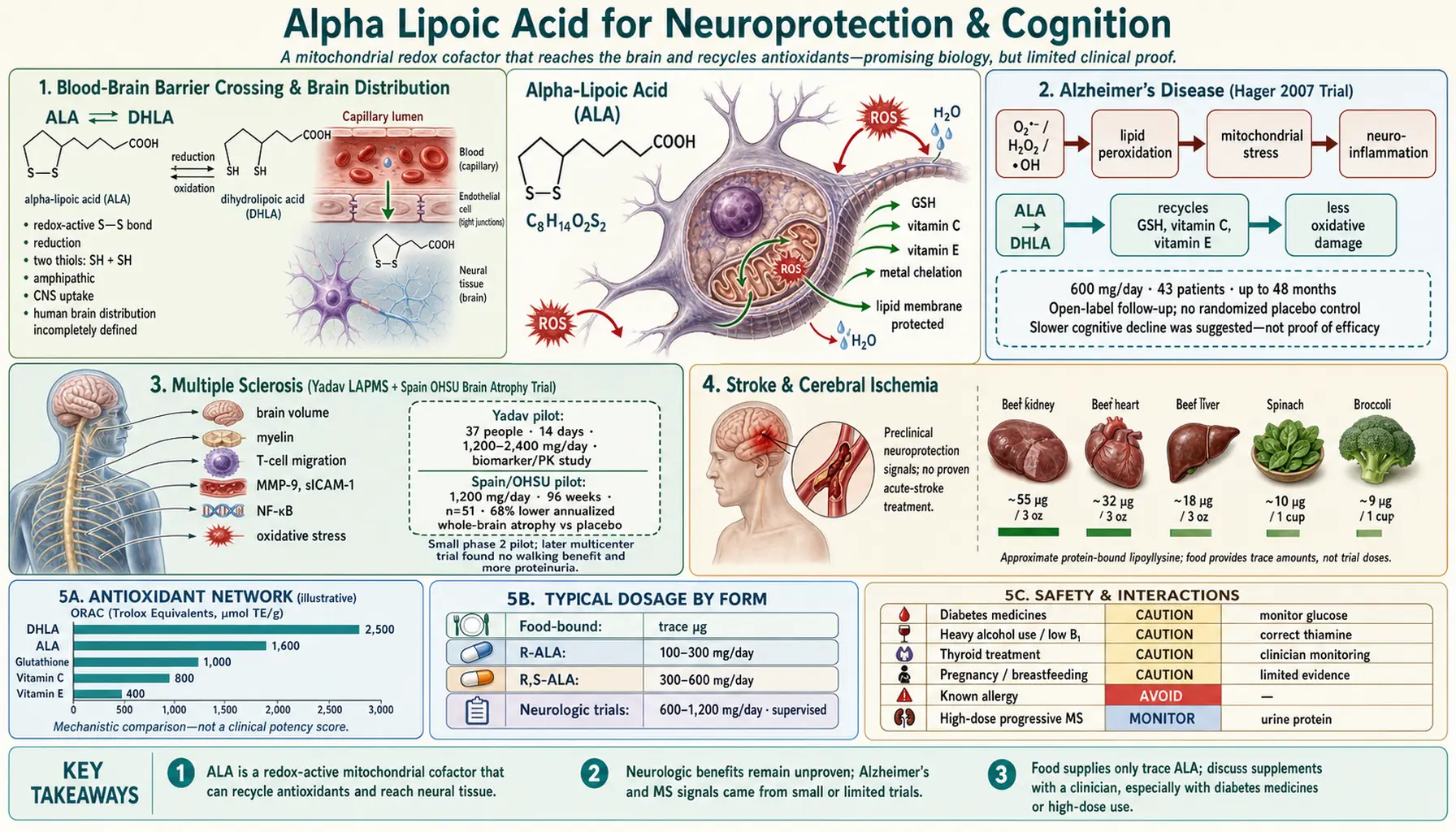
Reviews describe alpha lipoic acid (ALA) as absorbed from the diet and crossing the blood-brain barrier, and in vitro, animal and preliminary human studies as suggesting effects in neurodegenerative disorders (Packer 1997). The human results are mixed. Open, uncontrolled studies in Alzheimer's disease reported slow progression, while a controlled trial of ALA combined with vitamins E and C found faster decline on one cognitive test. In multiple sclerosis, a 2017 pilot trial found slower brain atrophy, but a larger 2026 phase 2 trial found that ALA did not slow the decline in walking speed, with more discontinuations and more proteinuria. A randomized trial in chemotherapy-induced neuropathy (Guo 2014) found no benefit. Stroke, Parkinson's disease and the Ames–Hagen work with acetyl-L-carnitine rest mainly on animal research.
Interactive Visualization Free Radicals & Your Antioxidant Network Follow one superoxide radical down the whole relay — SOD, catalase, glutathione, vitamin E, vitamin C, NADPH — then release free iron and watch a membrane tear itself apart. Launch →
Table of Contents
- Blood-Brain Barrier Crossing
- Alzheimer's Disease (Hager Studies and Controlled Trials)
- Multiple Sclerosis (Yadav Pilot, Spain 2017 and 2026 Trials)
- Stroke & Cerebral Ischemia
- Chemotherapy-Induced Peripheral Neuropathy (CIPN)
- Parkinson's Disease
- Cognitive Aging & ALA + Acetyl-L-Carnitine
- Glutamate Excitotoxicity (Laboratory Research)
- Brain Fog & Post-COVID Symptoms
- Doses Used in Neurological Studies
- Cautions the Research Raises
- Key Research Papers
- Connections
- Featured Videos
Blood-Brain Barrier Crossing
The blood-brain barrier (BBB) limits which substances pass from the blood into the brain. Glutathione, the main thiol antioxidant of brain tissue, cannot be given directly to raise brain levels, which is one reason researchers became interested in ALA (Packer 1997).
Packer and colleagues (1997) describe ALA as a low-molecular-weight substance that is absorbed from the diet and crosses the blood-brain barrier. Cells take it up and reduce it to dihydrolipoic acid (DHLA), which is exported again, so protection is described both inside and outside cells. In laboratory studies ALA and DHLA act as antioxidants, interact with vitamin C and vitamin E, and raise intracellular glutathione levels.
How much ALA reaches particular brain regions in people at supplement doses is not well characterized. The trials below tested whether ALA changes clinical outcomes.
Alzheimer's Disease (Hager Studies and Controlled Trials)
Alzheimer's disease involves accumulation of beta-amyloid plaques and tau tangles, loss of neurons and progressive cognitive decline. Oxidative stress and neuronal energy depletion are described as biochemical hallmarks of the disease (Hager 2007).
The Hager open studies
- Hager 2001 — in an open study, 600 mg/day was given to nine patients already taking cholinesterase inhibitors for an average of about 337 days; their scores on two cognitive tests (MMSE and ADAScog) stayed constant.
- Hager 2007 — an extended open analysis of 43 patients over up to 48 months. In mild dementia the disease progressed slowly (ADAScog +1.2 points a year, MMSE −0.6 points a year); in moderate dementia it progressed at about twice that rate. The authors compared this with published data for untreated patients, stressed that the study was not double-blinded, placebo-controlled or randomized, and called for a phase II trial.
Open results like these cannot separate an effect of ALA from the natural variation of the disease. No placebo-controlled trial of ALA alone in Alzheimer's disease was found for this page; two small controlled trials tested it in combinations:
Controlled trials of combinations
- Galasko 2012 — 78 people with mild to moderate Alzheimer's disease were randomized for 16 weeks to vitamin E 800 IU/day + vitamin C 500 mg/day + ALA 900 mg/day, to CoQ10, or to placebo. Cerebrospinal-fluid markers of amyloid and tau did not change; an oxidative-stress marker (F2-isoprostanes) fell 19% in the vitamin E/C/ALA group, but that group showed faster decline on the MMSE, which the authors flagged as a potential safety concern.
- Shinto 2014 — a 12-month pilot in 39 people with Alzheimer's disease compared omega-3 fatty acids, omega-3 plus lipoic acid, and placebo. The primary outcome, an oxidative-stress marker, did not differ; ADAS-cog did not differ; the omega-3 + lipoic acid group showed less decline on the MMSE and on instrumental activities of daily living. The authors called for further evaluation because of the small sample.
Proposed mechanisms
Reviews by the same research group describe properties of lipoic acid that could bear on Alzheimer's pathology, from laboratory research (Holmquist 2007; Maczurek 2008):
- Increasing acetylcholine production by activating choline acetyltransferase, and increasing glucose uptake
- Chelating redox-active transition metals, which limits hydroxyl-radical formation
- Scavenging reactive oxygen species and raising reduced glutathione
- Scavenging lipid peroxidation products such as hydroxynonenal and acrolein
- Down-regulating redox-sensitive inflammatory processes
Multiple Sclerosis (Yadav Pilot, Spain 2017 and 2026 Trials)
Multiple sclerosis (MS) is an immune-mediated demyelinating disease of the central nervous system. In its progressive forms, disability accumulates with fewer relapses, and treatment options are more limited. Lipoic acid suppresses and treats experimental autoimmune encephalomyelitis, an animal model of MS (Yadav 2005).
The Yadav pilot study (2005)
At the Portland VA Medical Center, 37 people with MS were randomly assigned to placebo, lipoic acid 600 mg twice a day, 1,200 mg once a day or 1,200 mg twice a day for 14 days. The 1,200 mg doses gave substantially higher peak blood levels, which varied considerably between people. Higher peak levels correlated with larger falls in serum matrix metalloproteinase-9 (MMP-9), and soluble ICAM-1 fell in a dose-related way. The authors concluded that oral lipoic acid was generally well tolerated and proposed that it might act by inhibiting MMP-9 and interfering with T-cell migration into the central nervous system.
Spain et al. (2017): pilot trial in secondary progressive MS
A single-center, 2-year, double-blind trial randomized 51 people with secondary progressive MS (aged 40–70) to oral lipoic acid 1,200 mg/day or placebo.
- Brain atrophy (primary outcome) — the annualized change in whole-brain volume was −0.21% with lipoic acid versus −0.65% with placebo (P = 0.002), which the authors report as a 68% reduction.
- Walking — the Timed 25-Foot Walk was almost but not significantly better with lipoic acid (P = 0.06).
- Safety — more gastrointestinal upset and fewer falls occurred with lipoic acid; one case of unexpected renal failure and one of glomerulonephritis occurred in the lipoic acid group.
Spain et al. (2026): phase 2 trial in progressive MS
A larger multicenter phase 2 trial at 10 US sites (including 5 Veterans Affairs medical centers) and 1 Canadian site randomized 115 people with primary or secondary progressive MS to 1,200 mg/day of lipoic acid or placebo for 24 months; 55.7% were also taking a disease-modifying therapy.
- Walking speed (primary outcome) — lipoic acid did not slow the decline in walking speed, and other clinical outcomes did not differ from placebo.
- Brain volume — whole-brain and deep gray matter volume appeared more stable with lipoic acid.
- Safety — participants on lipoic acid discontinued more often (37% versus 17%), and laboratory monitoring was increased to every 3 months because of treatment-related proteinuria.
Taken together, the 2017 pilot's brain-atrophy result was not matched by a clinical benefit in the larger trial. A separate report from the same research group described biopsy-proven NELL1-associated membranous nephropathy after lipoic acid supplementation (Spain 2021).
Form and tolerability
In a small crossover trial in people with progressive MS (20 participants), 600 mg of R-lipoic acid gave R-lipoic acid blood levels bioequivalent to 1,200 mg of the racemic mixture, with fewer gastrointestinal complaints (Cameron 2020). Salinthone and colleagues (2008) review the laboratory research on lipoic acid in MS and other inflammatory diseases of the central nervous system.
Stroke & Cerebral Ischemia
Stroke damages neurons during the loss of blood flow and again when blood flow returns (reperfusion injury), a phase in which oxidative damage is studied. Packer and colleagues (1997) review animal studies reporting protective effects of ALA in cerebral ischemia-reperfusion.
Human data are limited. In a randomized trial in 90 older patients with type 2 diabetes and acute cerebral infarction, all on conventional treatment, those given ALA for 3 weeks had larger falls in a lipid-peroxidation marker and in NIH Stroke Scale scores than a control group given vitamin C, and no significant adverse reactions were reported in either group (Zhao 2014). A PubMed search for this page found no large randomized trial of ALA in stroke.
Blood-pressure and blood-vessel findings for ALA are covered in the cardiovascular section of the main Alpha Lipoic Acid page.
Chemotherapy-Induced Peripheral Neuropathy (CIPN)
Several chemotherapy drugs — platinum compounds (cisplatin, oxaliplatin), taxanes (paclitaxel, docetaxel) and vinca alkaloids (vincristine) — can damage peripheral nerves, and this neuropathy is frequently a dose-limiting factor in cancer treatment that may cause pain and lasting loss of function (Guo 2014). Because ALA reduced symptoms in diabetic neuropathy trials, it has been tested here too.
- Gedlicka 2002 and 2003 — two short letters described improvement in small groups of patients given ALA after neuropathy from oxaliplatin, or from docetaxel and cisplatin, had developed; they had no placebo group.
- Guo 2014 — a randomized, double-blind, placebo-controlled trial in 243 patients receiving cisplatin or oxaliplatin gave oral ALA 600 mg three times daily or placebo for 24 weeks. Neuropathy scores, pain scores and functional outcomes did not differ between the groups, and only 70 patients (29%) completed the study, with similar drop-out in both arms. The authors concluded that this strategy was ineffective at preventing neurotoxicity and that the high attrition showed a lack of feasibility.
The one placebo-controlled prevention trial was therefore negative.
Parkinson's Disease
Parkinson's disease involves loss of dopamine-producing neurons in the substantia nigra, and mitochondrial complex I dysfunction and oxidative damage are features of its pathology. Laboratory and animal research on ALA in neurodegenerative disorders is reviewed by Packer and colleagues (1997), and Bilska and Włodek (2005) review lipoic acid in neurodegenerative and other diseases.
A PubMed search for this page found no randomized trial of ALA alone in Parkinson's disease. Large trials of another mitochondrial nutrient, CoQ10, in Parkinson's disease found no benefit (see the CoQ10 page).
Cognitive Aging & ALA + Acetyl-L-Carnitine
In Bruce Ames's laboratory, feeding old rats acetyl-L-carnitine together with R-lipoic acid improved performance on memory tasks and reduced oxidized RNA in the hippocampus (Liu, Head 2002), and in a companion study improved the activity and substrate-binding affinity of a brain enzyme, carnitine acetyltransferase (Liu, Killilea 2002). These studies are covered on the Mitochondria page.
A 2008 review of this work concluded that, in animal research, giving lipoic acid together with other mitochondrial nutrients such as acetyl-L-carnitine and CoQ10 appeared more effective than lipoic acid alone in improving cognitive dysfunction (Liu 2008). A PubMed search for this page found no randomized, placebo-controlled trial of ALA with acetyl-L-carnitine for cognition in older adults; the evidence for this combination in people is therefore not established.
Glutamate Excitotoxicity (Laboratory Research)
Glutamate is the brain's main excitatory neurotransmitter. When it rises excessively — for example during stroke or brain injury — overactivation of NMDA receptors drives calcium into neurons and can kill them, a process called excitotoxicity. Oxidative stress is part of this cascade.
Packer and colleagues (1997) list protective effects of ALA and DHLA in experimental excitotoxic amino acid brain injury among the laboratory findings they review. These are cell and animal results; no human trial has tested ALA against excitotoxic injury.
Brain Fog & Post-COVID Symptoms
"Brain fog" describes reduced concentration, slowed thinking, word-finding difficulty and mental fatigue reported in chronic fatigue syndrome, fibromyalgia, long COVID and other conditions. Mitochondrial dysfunction and neuroinflammation are among the proposed contributors.
The human evidence for ALA here is limited:
- Long COVID — in a prospective observational study in Italy, 116 people with chronic COVID syndrome who took a CoQ10 + ALA combination had a complete response on the Fatigue Severity Scale more often (53.5%) than 58 untreated people (3.5%). The study was not randomized or blinded, and its authors called for confirmation in a double-blind, placebo-controlled trial (Barletta 2023).
- Fibromyalgia — a randomized, placebo-controlled crossover trial in 24 people found no difference between ALA and placebo in pain or several other outcomes (Gilron 2021).
No randomized trial of ALA alone for brain fog was found for this page.
Doses Used in Neurological Studies
These are the doses and schedules the cited studies used, not instructions.
- Alzheimer's disease — 600 mg/day, added to cholinesterase inhibitors, in open, uncontrolled studies (Hager 2001, 2007); 900 mg/day with vitamins E and C for 16 weeks (Galasko 2012).
- Multiple sclerosis, pilot — 600 mg twice a day, 1,200 mg once a day or 1,200 mg twice a day for 14 days (Yadav 2005).
- Progressive multiple sclerosis — 1,200 mg/day for 2 years (Spain 2017; Spain 2026, where the primary outcome was not improved).
- R-ALA versus racemic — 600 mg R-ALA and 1,200 mg racemic ALA gave bioequivalent R-ALA levels (Cameron 2020).
- Chemotherapy-induced neuropathy — 600 mg three times daily for 24 weeks, with no benefit (Guo 2014).
- Fibromyalgia — a median maximal tolerated dose of 1,663 mg/day, with no benefit over placebo (Gilron 2021).
- Ames–Hagen studies — rat studies that added R-lipoic acid to food and acetyl-L-carnitine to drinking water; they did not establish human doses.
Cautions the Research Raises
- Cognition in a combination trial — vitamin E + vitamin C + ALA was followed by faster MMSE decline over 16 weeks in people with Alzheimer's disease, a potential safety concern in the authors' words (Galasko 2012).
- Kidney — in the 2026 progressive MS trial, laboratory monitoring was increased because of treatment-related proteinuria; the 2017 pilot had one case each of renal failure and glomerulonephritis in the lipoic acid group; and investigators described biopsy-proven NELL1-associated membranous nephropathy after lipoic acid supplementation, remitting after it was stopped (Spain 2021).
- Discontinuation and stomach upset — more participants on lipoic acid discontinued in the 2026 trial (37% versus 17%), and gastrointestinal upset was more common at 1,200 mg/day in the 2017 pilot. R-lipoic acid at 600 mg caused fewer gastrointestinal complaints than 1,200 mg of the racemic mixture (Cameron 2020).
- Blood sugar — ALA modestly lowered fasting glucose in meta-analyses; see the blood sugar page.
- Insulin autoimmune syndrome (IAS) — a rare immune-mediated cause of hypoglycemia, associated in Japanese people with HLA-DRB1*04:06 and also reported in white European patients taking ALA (Gullo 2014); EFSA's 2021 opinion reviewed 49 case reports, all resolving after ALA was stopped.
- Pregnancy and breastfeeding — human safety data are limited; the Linus Pauling Institute cites research in which 600 mg/day during pregnancy was not associated with adverse effects in mothers or newborns.
- Biotin and thiamine — the concerns rest on animal studies: lipoic acid lowered biotin-dependent enzyme activity in rats (Zempleni 1997), and thiamine reversed a toxicity of (−)-alpha-lipoic acid in thiamine-deficient rats (Gal 1965).
- Medicines for neurological conditions — the Hager patients were taking cholinesterase inhibitors, and over half of the 2026 MS trial participants were on a disease-modifying therapy; these studies did not report drug interactions, and they were not designed to test them.
Decisions about medicines and supplements belong with a clinician.
Key Research Papers
- Packer L, Tritschler HJ, Wessel K (1997). Neuroprotection by the metabolic antioxidant alpha-lipoic acid. Free Radical Biology & Medicine 22(1-2):359-78. — PubMed PMID: 8958163
- Hager K, Marahrens A, Kenklies M, Riederer P, Münch G (2001). Alpha-lipoic acid as a new treatment option for Alzheimer [corrected] type dementia. Archives of Gerontology and Geriatrics 32(3):275-82. — PubMed PMID: 11395173
- Hager K, Kenklies M, McAfoose J, Engel J, Münch G (2007). Alpha-lipoic acid as a new treatment option for Alzheimer's disease--a 48 months follow-up analysis. Journal of Neural Transmission. Supplementum (72):189-93. — PubMed PMID: 17982894
- Galasko DR, Peskind E, Clark CM, Quinn JF, Ringman JM, Jicha GA, et al. (2012). Antioxidants for Alzheimer disease: a randomized clinical trial with cerebrospinal fluid biomarker measures. Archives of Neurology 69(7):836-41. — PubMed PMID: 22431837
- Shinto L, Quinn J, Montine T, Dodge HH, Woodward W, Baldauf-Wagner S, et al. (2014). A randomized placebo-controlled pilot trial of omega-3 fatty acids and alpha lipoic acid in Alzheimer's disease. Journal of Alzheimer's Disease 38(1):111-20. — PubMed PMID: 24077434
- Holmquist L, Stuchbury G, Berbaum K, Muscat S, Young S, Hager K, et al. (2007). Lipoic acid as a novel treatment for Alzheimer's disease and related dementias. Pharmacology & Therapeutics 113(1):154-64. — PubMed PMID: 16989905
- Maczurek A, Hager K, Kenklies M, Sharman M, Martins R, Engel J, et al. (2008). Lipoic acid as an anti-inflammatory and neuroprotective treatment for Alzheimer's disease. Advanced Drug Delivery Reviews 60(13-14):1463-70. — PubMed PMID: 18655815
- Yadav V, Marracci G, Lovera J, Woodward W, Bogardus K, Marquardt W, et al. (2005). Lipoic acid in multiple sclerosis: a pilot study. Multiple Sclerosis 11(2):159-65. — PubMed PMID: 15794388
- Spain R, Powers K, Murchison C, Heriza E, Winges K, Yadav V, et al. (2017). Lipoic acid in secondary progressive MS: A randomized controlled pilot trial. Neurology: Neuroimmunology & Neuroinflammation 4(5):e374. — PubMed PMID: 28680916
- Spain RI, Paz Soldán MM, Freedman MS, Repovic P, Solomon AJ, Rinker JR, et al. (2026). Lipoic Acid for Treatment of Progressive Multiple Sclerosis: A Phase 2 Randomized Clinical Trial. Neurology 106(1):e214454. — PubMed PMID: 41397213
- Spain RI, Andeen NK, Gibson PC, Samuels MH, Morris CD, Solomon AJ, et al. (2021). Lipoic acid supplementation associated with neural epidermal growth factor-like 1 (NELL1)-associated membranous nephropathy. Kidney International 100(6):1208-1213. — PubMed PMID: 34662650
- Cameron M, Taylor C, Lapidus J, Ramsey K, Koop D, Spain R (2020). Gastrointestinal Tolerability and Absorption of R- Versus R,S-Lipoic Acid in Progressive Multiple Sclerosis: A Randomized Crossover Trial. Journal of Clinical Pharmacology 60(8):1099-1106. — PubMed PMID: 32212340
- Salinthone S, Yadav V, Bourdette DN, Carr DW (2008). Lipoic acid: a novel therapeutic approach for multiple sclerosis and other chronic inflammatory diseases of the CNS. Endocrine, Metabolic & Immune Disorders Drug Targets 8(2):132-42. — PubMed PMID: 18537699
- Zhao L, Hu FX (2014). α-Lipoic acid treatment of aged type 2 diabetes mellitus complicated with acute cerebral infarction. European Review for Medical and Pharmacological Sciences 18(23):3715-9. — PubMed PMID: 25535146
- Gedlicka C, Scheithauer W, Schüll B, Kornek GV (2002). Effective treatment of oxaliplatin-induced cumulative polyneuropathy with alpha-lipoic acid. Journal of Clinical Oncology 20(15):3359-61. — PubMed PMID: 12149316
- Gedlicka C, Kornek GV, Schmid K, Scheithauer W (2003). Amelioration of docetaxel/cisplatin induced polyneuropathy by alpha-lipoic acid. Annals of Oncology 14(2):339-40. — PubMed PMID: 12562664
- Guo Y, Jones D, Palmer JL, Forman A, Dakhil SR, Velasco MR, et al. (2014). Oral alpha-lipoic acid to prevent chemotherapy-induced peripheral neuropathy: a randomized, double-blind, placebo-controlled trial. Supportive Care in Cancer 22(5):1223-31. — PubMed PMID: 24362907
- Bilska A, Włodek L (2005). Lipoic acid - the drug of the future? Pharmacological Reports 57(5):570-7. — PubMed PMID: 16227639
- Liu J, Head E, Gharib AM, Yuan W, Ingersoll RT, Hagen TM, Cotman CW, Ames BN (2002). Memory loss in old rats is associated with brain mitochondrial decay and RNA/DNA oxidation: partial reversal by feeding acetyl-L-carnitine and/or R-alpha -lipoic acid. Proceedings of the National Academy of Sciences of the USA 99(4):2356-61. — PubMed PMID: 11854529
- Liu J, Killilea DW, Ames BN (2002). Age-associated mitochondrial oxidative decay: improvement of carnitine acetyltransferase substrate-binding affinity and activity in brain by feeding old rats acetyl-L-carnitine and/or R-alpha-lipoic acid. Proceedings of the National Academy of Sciences of the USA 99(4):1876-81. — PubMed PMID: 11854488
- Liu J (2008). The effects and mechanisms of mitochondrial nutrient alpha-lipoic acid on improving age-associated mitochondrial and cognitive dysfunction: an overview. Neurochemical Research 33(1):194-203. — PubMed PMID: 17605107
- Barletta MA, Marino G, Spagnolo B, Bianchi FP, Falappone PCF, Spagnolo L, et al. (2023). Coenzyme Q10 + alpha lipoic acid for chronic COVID syndrome. Clinical and Experimental Medicine 23(3):667-678. — PubMed PMID: 35994177
- Gilron I, Robb S, Tu D, Holden R, Towheed T, Ziegler D, et al. (2021). Double-blind, randomized, placebo-controlled crossover trial of alpha-lipoic acid for the treatment of fibromyalgia pain: the IMPALA trial. Pain 162(2):561-568. — PubMed PMID: 32773602
- Gullo D, Evans JL, Sortino G, Goldfine ID, Vigneri R (2014). Insulin autoimmune syndrome (Hirata Disease) in European Caucasians taking α-lipoic acid. Clinical Endocrinology 81(2):204-9. — PubMed PMID: 24111525
- EFSA Panel on Nutrition, Novel Foods and Food Allergens (NDA); Turck D, Castenmiller J, de Henauw S, Hirsch-Ernst KI, Kearney J, Knutsen HK, et al. (2021). Scientific opinion on the relationship between intake of alpha-lipoic acid (thioctic acid) and the risk of insulin autoimmune syndrome. EFSA Journal 19(6):e06577. — PubMed PMID: 34122657
- Zempleni J, Trusty TA, Mock DM (1997). Lipoic acid reduces the activities of biotin-dependent carboxylases in rat liver. Journal of Nutrition 127(9):1776-81. — PubMed PMID: 9278559
- Gal EM (1965). Reversal of selective toxicity of (-)-alpha-lipoic acid by thiamine in thiamine-deficient rats. Nature 207(996):535. — PubMed PMID: 5328673
PubMed Topic Searches
Connections
- Free Radicals & Your Antioxidant Network — interactive animation
- Alpha Lipoic Acid Overview
- ALA Benefits Hub
- ALA for Neuropathy
- ALA for Mitochondria
- ALA for Blood Sugar
- CoQ10
- PQQ
- Glutathione
- NAD+ & NMN
- Methylene Blue
- Neurology
- Alzheimer's Disease
- Multiple Sclerosis
- Parkinson's Disease
- Peripheral Neuropathy
- Chronic Fatigue Syndrome
- Brain Fog
- Headache & Migraine
- Vitamin B12
- Vitamin D3
- Omega-3 Fatty Acids
- Creatine
- Longevity Protocols
- History