Alpha Lipoic Acid for Mitochondrial Function & Bioenergetics
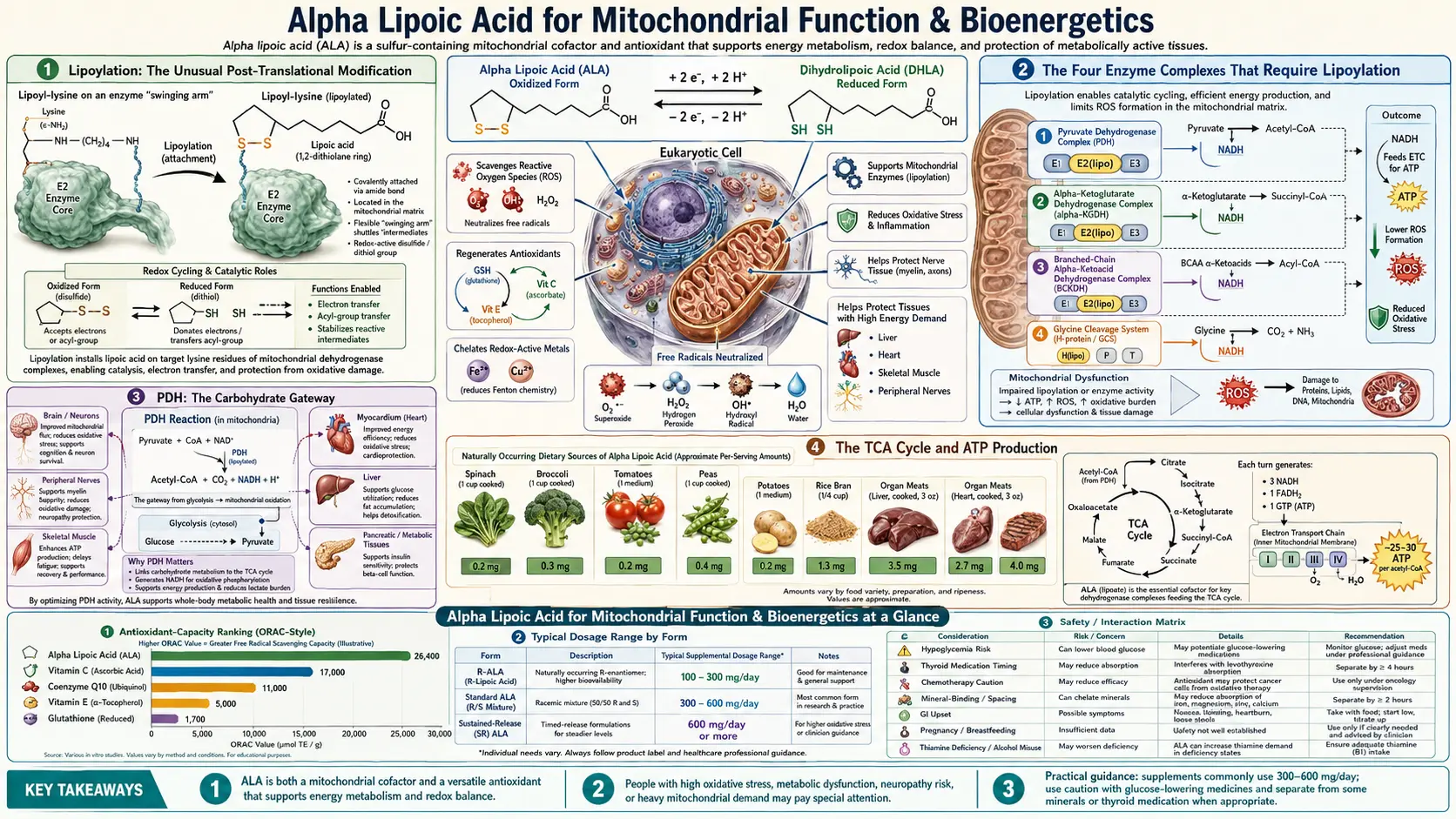
Protein-bound lipoic acid is the cofactor of five mitochondrial enzyme systems in humans — pyruvate dehydrogenase (PDH), alpha-ketoglutarate dehydrogenase (α-KGDH), branched-chain α-keto acid dehydrogenase (BCKDH), 2-oxoadipate dehydrogenase (OADH) and the glycine cleavage system. The body builds this cofactor on its enzymes inside mitochondria, where it works as a swinging arm that carries reaction intermediates between active sites; supplemental free alpha lipoic acid (ALA) is studied mainly for its own chemistry. In Bruce Ames's laboratory, feeding old rats acetyl-L-carnitine with R-lipoic acid partially reversed age-related declines in mitochondrial function and activity. In people, a randomized trial in fibromyalgia found no benefit, and no trial of ALA for chronic fatigue syndrome or statin muscle symptoms was found for this page. This page covers the biochemistry, the animal research and what the human studies show.
Interactive Visualization Free Radicals & Your Antioxidant Network Follow one superoxide radical down the whole relay — SOD, catalase, glutathione, vitamin E, vitamin C, NADPH — then release free iron and watch a membrane tear itself apart. Launch →
Table of Contents
- Lipoylation: How the Body Builds the Cofactor
- The Five Enzyme Systems That Use Lipoic Acid
- PDH: The Carbohydrate Gateway
- The TCA Cycle and ATP Production
- The Bruce Ames + Tory Hagen Rat Studies
- The ALA + Acetyl-L-Carnitine Combination: What Was Studied
- Mitochondrial Aging: What Is Known
- Fatigue, Fibromyalgia, Statin Muscle Symptoms: What Trials Show
- R-ALA vs Racemic: What the Studies Measured
- Combinations With Other Mitochondrial Nutrients: What Was Studied
- Cautions the Research Raises: Thiamine, Biotin, Blood Sugar
- Key Research Papers
- Connections
- Featured Videos
Lipoylation: How the Body Builds the Cofactor
Most antioxidants work as free small molecules — vitamin C in watery fluids, vitamin E in membranes. Lipoic acid made by the body is different: it is covalently attached to specific lysine residues of mitochondrial enzymes, a modification called lipoylation.
The body makes lipoic acid inside mitochondria. Synthesis starts from octanoic acid produced by the mitochondrial fatty-acid synthesis pathway; the enzyme lipoic acid synthetase (LIAS), an iron-sulfur enzyme, inserts the two sulfur atoms, and transferase enzymes (LIPT2 and LIPT1) move the lipoyl group onto its target enzymes (Mayr 2014; Solmonson and DeBerardinis 2018). Unusually for a cofactor, lipoic acid is assembled on its target proteins rather than made free and then attached; in mammals the pathway probably runs through the H protein of the glycine cleavage system (Cronan 2016).
The finished lipoyl group sits on a flexible lysine arm that swings between the active sites of its enzyme complex, carrying reaction intermediates from one to the next.
Free, unbound ALA — the form in supplements — behaves differently. Reviews describe it being absorbed, taken up by cells, reduced to dihydrolipoic acid (DHLA) and exported again, and crossing the blood-brain barrier (Packer 1997). In mammals the enzyme-bound cofactor is made inside mitochondria (Solmonson and DeBerardinis 2018), so supplemental ALA is studied mainly for the free compound's own chemistry.
The Five Enzyme Systems That Use Lipoic Acid
Protein-bound lipoic acid is the cofactor of five mitochondrial enzyme systems in humans — four 2-oxoacid dehydrogenases and the glycine cleavage system (Mayr 2014):
- Pyruvate dehydrogenase complex (PDH) — converts pyruvate (from glycolysis) to acetyl-CoA, the entry point of carbohydrate carbon into the citric acid (TCA) cycle. The lipoyl group sits on its E2 subunit (dihydrolipoyl transacetylase).
- α-Ketoglutarate dehydrogenase complex (α-KGDH) — converts α-ketoglutarate to succinyl-CoA inside the TCA cycle, again with the lipoyl arm on its E2 subunit (dihydrolipoyl succinyltransferase).
- Branched-chain α-keto acid dehydrogenase (BCKDH) — breaks down the branched-chain amino acids leucine, isoleucine and valine; inherited deficiency causes maple syrup urine disease.
- 2-Oxoadipate dehydrogenase (OADH) — part of amino acid breakdown.
- Glycine cleavage system (GCS) — breaks down glycine and feeds one-carbon metabolism; its lipoylated component is the H protein.
Each reaction leaves the lipoyl arm in its reduced (dihydrolipoyl) form; the enzyme dihydrolipoyl dehydrogenase (DLD) re-oxidizes it, passing the electrons on to NAD+ (Mayr 2014). Solmonson and DeBerardinis (2018) describe lipoic acid as also stabilizing and regulating these complexes, several of which are regulated by reactive oxygen species acting through the lipoyl disulfide. When lipoylation fails, as in rare inherited LIAS or LIPT1 defects, the result is severe disease of mitochondrial energy metabolism (Mayr 2014).
PDH: The Carbohydrate Gateway
The pyruvate dehydrogenase complex is one of the largest multi-enzyme assemblies known. It catalyzes the irreversible conversion of pyruvate to acetyl-CoA, releasing CO2 and reducing NAD+ to NADH:
Pyruvate + CoA + NAD+ → Acetyl-CoA + CO2 + NADH
PDH activity decides whether glucose-derived pyruvate enters the TCA cycle for full oxidation (about 30 ATP per glucose) or is converted to lactate (2 ATP per glucose). Inherited PDH deficiency is one cause of lactic acidosis in children.
PDH activity depends on:
- Lipoylation — the E2 subunit must carry its lipoyl arm; inherited lipoylation defects impair PDH and the other lipoate-dependent enzymes (Mayr 2014)
- Thiamine pyrophosphate — the E1 subunit needs this form of vitamin B1, as does α-KGDH; thiamine deficiency impairs both
- Phosphorylation — PDH kinases inactivate PDH and PDH phosphatases reactivate it, in response to acetyl-CoA, NADH and ATP levels
- Redox state — several lipoate-dependent complexes are regulated by reactive oxygen species acting through the lipoyl disulfide (Solmonson and DeBerardinis 2018)
One human study fits with these links: in 20 patients with type 2 diabetes, oral lipoic acid 600 mg twice daily for 4 weeks lowered serum lactate and pyruvate by about 45% before and after glucose loading (Konrad 1999). The study did not measure PDH activity directly.
The TCA Cycle and ATP Production
The TCA cycle (also called the Krebs or citric acid cycle) is the metabolic hub where acetyl-CoA from carbohydrate, fat and protein is oxidized to CO2, producing NADH and FADH2 that feed the electron transport chain. Approximate yield per glucose:
- Glycolysis (cytoplasm): 2 ATP + 2 NADH
- PDH (mitochondria): 2 NADH
- TCA cycle: 6 NADH + 2 FADH2 + 2 GTP
- Electron transport chain: about 26–28 ATP from the NADH and FADH2
- Total: about 30–32 ATP per glucose, compared with 2 ATP when glucose is converted to lactate
Two of the lipoate-dependent enzymes sit on this path: PDH at the entry and α-KGDH inside the cycle. Separately from the bound cofactor, a laboratory study found that free DHLA reduced ubiquinone (oxidized CoQ10) to ubiquinol and removed the ubisemiquinone radical, and the two together protected membranes against peroxidation more than either alone (Kozlov 1999). Whether supplemental ALA changes ATP production in people has not been shown.
The Bruce Ames + Tory Hagen Rat Studies
The best-known mitochondrial-aging work on lipoic acid comes from the laboratory of Bruce Ames at the University of California, Berkeley, with Tory Hagen and Jiankang Liu, published in Proceedings of the National Academy of Sciences in February 2002.
- Hagen 2002 — feeding old rats acetyl-L-carnitine together with R-lipoic acid for up to a month partially reversed the age-related decline in average mitochondrial membrane potential, raised liver-cell oxygen consumption and ambulatory activity, and lowered a lipid-peroxidation marker.
- Liu, Head 2002 — in old rats the combination improved performance on memory tasks and reduced oxidized RNA in the hippocampus.
- Liu, Killilea 2002 — feeding acetyl-L-carnitine and/or R-lipoic acid improved the activity and substrate-binding affinity of carnitine acetyltransferase, a mitochondrial enzyme, in the brains of old rats.
These are animal results. A 2008 review of this research concluded that, in animal studies, lipoic acid given together with other mitochondrial nutrients such as acetyl-L-carnitine and CoQ10 appeared more effective than lipoic acid alone (Liu 2008). A PubMed search for this page found no randomized, placebo-controlled trial of ALA with acetyl-L-carnitine for cognition or fatigue in older adults.
The ALA + Acetyl-L-Carnitine Combination: What Was Studied
The rationale for pairing the two compounds in the rat studies:
- Alpha lipoic acid — an antioxidant in laboratory studies, and in its bound form a cofactor of PDH and α-KGDH
- Acetyl-L-carnitine — carnitine carries long-chain fatty acids into mitochondria for oxidation, and the acetyl form also supplies acetyl groups
In the Ames-laboratory studies, the rats received R-lipoic acid in their food and acetyl-L-carnitine in their drinking water; the studies did not establish human doses. The combination has not been tested for fatigue or cognition in a randomized, placebo-controlled human trial found for this page.
Mitochondrial Aging: What Is Known
Several processes are described in mitochondrial decline with age:
- Oxidative damage — accumulates in aging tissues; the Ames-laboratory studies measured lipid-peroxidation and oxidized-RNA markers in old rats (Hagen 2002; Liu, Head 2002)
- Falling membrane potential and oxygen use — seen in mitochondria and liver cells from old rats (Hagen 2002)
- Mitochondrial DNA mutations — accumulate with age and can reduce respiratory chain capacity
- Reduced mitochondrial biogenesis — signaling through PGC-1α, the regulator of new mitochondria, declines
- Reduced mitophagy — damaged mitochondria are cleared less efficiently
Whether supplemental ALA slows any of these processes in people has not been tested in long-term trials. Other compounds studied for mitochondrial function are covered on their own pages: PQQ, CoQ10, glutathione and its precursors NAC and glycine, and creatine.
Fatigue, Fibromyalgia, Statin Muscle Symptoms: What Trials Show
ALA is discussed for conditions in which mitochondrial dysfunction is proposed. The human trial evidence:
Chronic fatigue syndrome (ME/CFS)
Mitochondrial dysfunction is one of the proposed contributors to ME/CFS. A PubMed search for this page found no randomized trial of ALA in ME/CFS.
Long COVID
In a prospective observational study in Italy, 116 people with chronic COVID syndrome who took a CoQ10 + ALA combination had a complete response on the Fatigue Severity Scale more often (53.5%) than 58 untreated people (3.5%). The study was not randomized or blinded, and its authors called for confirmation in a double-blind, placebo-controlled trial (Barletta 2023).
Fibromyalgia
In a randomized, placebo-controlled crossover trial (IMPALA; 24 participants completed both periods; median maximal tolerated dose 1,663 mg/day), pain intensity and several other outcomes did not differ between ALA and placebo. The authors concluded the results did not suggest promise for ALA as an effective treatment for fibromyalgia (Gilron 2021).
Statin-associated muscle symptoms
Statins block the mevalonate pathway that also makes CoQ10, and a meta-analysis of placebo-controlled trials found that statins lower plasma CoQ10 (Banach 2015, Pharmacological Research). Whether CoQ10 supplementation relieves statin muscle symptoms is contested: one meta-analysis found no significant effect on muscle pain or creatine kinase (Banach 2015, Mayo Clinic Proceedings; 6 trials, 302 patients), another found no benefit on myalgia or on staying on a statin (Kennedy 2020), and a third reported less muscle pain, weakness and cramps with CoQ10 (Qu 2018; 12 trials, 575 patients). No trial testing ALA, alone or with CoQ10, for statin muscle symptoms was found for this page. The CoQ10 page covers these trials.
Inherited mitochondrial disorders
In a randomized, double-blind, placebo-controlled crossover study in 16 patients with mitochondrial cytopathies (including MELAS and mitochondrial DNA deletions), a combination of creatine, CoQ10 and lipoic acid lowered resting plasma lactate and a urinary oxidative-stress marker and lessened the decline in ankle dorsiflexion strength. The authors described these as surrogate markers and called for larger studies to see whether such combinations change function and quality of life (Rodriguez 2007).
Chemotherapy
A placebo-controlled trial of oral ALA to prevent chemotherapy-induced neuropathy found no benefit (Guo 2014); see the Neuroprotection page.
R-ALA vs Racemic: What the Studies Measured
- R-ALA is the natural form — the R-isomer is the form the body makes and binds to its enzymes; the S-isomer arises from chemical synthesis. Supplements are sold both as the racemic 50/50 mixture and as R-ALA (Carlson 2007).
- Cell studies — in cultured muscle and fat cells, R-lipoic acid increased glucose uptake more than the S-isomer or the racemic mixture (Estrada 1996).
- Blood levels — in a small crossover trial in progressive multiple sclerosis (20 participants), 600 mg of R-ALA gave R-ALA blood levels bioequivalent to 1,200 mg of the racemic mixture, with fewer gastrointestinal complaints (31 versus 60 reports) (Cameron 2020). After a racemic dose, the Linus Pauling Institute summarizes, peak plasma R-lipoic acid was 40–50% higher than S-lipoic acid.
- Sodium R-lipoate — R-ALA tends to polymerize, is relatively unstable and dissolves poorly in water. In a pharmacokinetic study of 12 healthy adults (Carlson 2007, by a group that included a supplier of the ingredient), 600 mg of R-ALA given as the sodium salt dissolved in water produced higher peak levels and total exposure than R-ALA or racemic ALA.
- Tablets — in 24 healthy adults, three tablet forms of racemic ALA 600 mg reached peak levels within 0.33–0.5 hours, and their R-ALA exposure was 64–79% of that from an oral solution (Hermann 2014).
No trial on this page compared R-ALA with racemic ALA for a mitochondrial or clinical outcome; the neuropathy trials used racemic ALA.
Combinations With Other Mitochondrial Nutrients: What Was Studied
ALA is often discussed alongside other compounds studied for mitochondrial function. The controlled human studies of such combinations found for this page:
- Creatine + CoQ10 + lipoic acid — lowered resting lactate and an oxidative-stress marker and lessened a strength decline in 16 patients with mitochondrial cytopathies (Rodriguez 2007; surrogate markers).
- Vitamin E + vitamin C + ALA — in 78 people with mild to moderate Alzheimer's disease, this combination lowered a cerebrospinal-fluid oxidative-stress marker by 19% over 16 weeks but was followed by faster decline on the Mini-Mental State Examination, which the authors flagged as a potential safety concern (Galasko 2012).
- CoQ10 + ALA — an observational study in long COVID reported less fatigue with the combination; it was not randomized (Barletta 2023).
The individual compounds have their own pages: CoQ10, PQQ, creatine, carnitine, magnesium glycinate and methylene blue.
Cautions the Research Raises: Thiamine, Biotin, Blood Sugar
- Thiamine (vitamin B1) — PDH and α-KGDH, the enzymes that use lipoic acid, also need thiamine pyrophosphate. A 1965 study in thiamine-deficient rats reported a toxicity of (−)-alpha-lipoic acid that thiamine reversed (Gal 1965). The concern for people with thiamine deficiency, such as heavy drinkers, rests on this animal finding.
- Biotin — in rats given lipoic acid injections for 28 days, liver activities of two biotin-dependent carboxylases were 28–36% lower, and normal when biotin was given as well (Zempleni 1997); the Linus Pauling Institute notes that high concentrations of lipoic acid can compete with biotin for transport across cell membranes. That study did not measure effects in people.
- Blood sugar — ALA modestly lowered fasting glucose in meta-analyses; see the blood sugar page.
- Insulin autoimmune syndrome (Hirata disease) — a rare immune-mediated cause of hypoglycemia. In Japanese people it is associated with HLA-DRB1*04:06; it has also been reported in white European patients taking ALA, five of six carrying HLA-DRB1*04:03 (Gullo 2014). EFSA's 2021 opinion reviewed 49 case reports, all resolving after ALA was stopped (EFSA 2021).
- Kidney — biopsy-proven NELL1-associated membranous nephropathy has been described after lipoic acid supplementation, remitting after it was stopped (Spain 2021).
Decisions about medicines and supplements belong with a clinician.
Key Research Papers
- Mayr JA, Feichtinger RG, Tort F, Ribes A, Sperl W (2014). Lipoic acid biosynthesis defects. Journal of Inherited Metabolic Disease 37(4):553-63. — PubMed PMID: 24777537
- Solmonson A, DeBerardinis RJ (2018). Lipoic acid metabolism and mitochondrial redox regulation. Journal of Biological Chemistry 293(20):7522-7530. — PubMed PMID: 29191830
- Cronan JE (2016). Assembly of Lipoic Acid on Its Cognate Enzymes: an Extraordinary and Essential Biosynthetic Pathway. Microbiology and Molecular Biology Reviews 80(2):429-50. — PubMed PMID: 27074917
- Packer L, Tritschler HJ, Wessel K (1997). Neuroprotection by the metabolic antioxidant alpha-lipoic acid. Free Radical Biology & Medicine 22(1-2):359-78. — PubMed PMID: 8958163
- Packer L, Witt EH, Tritschler HJ (1995). alpha-Lipoic acid as a biological antioxidant. Free Radical Biology & Medicine 19(2):227-50. — PubMed PMID: 7649494
- Kozlov AV, Gille L, Staniek K, Nohl H (1999). Dihydrolipoic acid maintains ubiquinone in the antioxidant active form by two-electron reduction of ubiquinone and one-electron reduction of ubisemiquinone. Archives of Biochemistry and Biophysics 363(1):148-54. — PubMed PMID: 10049509
- Konrad T, Vicini P, Kusterer K, Höflich A, Assadkhani A, Böhles HJ, et al. (1999). alpha-Lipoic acid treatment decreases serum lactate and pyruvate concentrations and improves glucose effectiveness in lean and obese patients with type 2 diabetes. Diabetes Care 22(2):280-7. — PubMed PMID: 10333946
- Hagen TM, Liu J, Lykkesfeldt J, Wehr CM, Ingersoll RT, Vinarsky V, Bartholomew JC, Ames BN (2002). Feeding acetyl-L-carnitine and lipoic acid to old rats significantly improves metabolic function while decreasing oxidative stress. Proceedings of the National Academy of Sciences of the USA 99(4):1870-5. — PubMed PMID: 11854487
- Liu J, Head E, Gharib AM, Yuan W, Ingersoll RT, Hagen TM, Cotman CW, Ames BN (2002). Memory loss in old rats is associated with brain mitochondrial decay and RNA/DNA oxidation: partial reversal by feeding acetyl-L-carnitine and/or R-alpha -lipoic acid. Proceedings of the National Academy of Sciences of the USA 99(4):2356-61. — PubMed PMID: 11854529
- Liu J, Killilea DW, Ames BN (2002). Age-associated mitochondrial oxidative decay: improvement of carnitine acetyltransferase substrate-binding affinity and activity in brain by feeding old rats acetyl-L-carnitine and/or R-alpha-lipoic acid. Proceedings of the National Academy of Sciences of the USA 99(4):1876-81. — PubMed PMID: 11854488
- Liu J (2008). The effects and mechanisms of mitochondrial nutrient alpha-lipoic acid on improving age-associated mitochondrial and cognitive dysfunction: an overview. Neurochemical Research 33(1):194-203. — PubMed PMID: 17605107
- Shay KP, Moreau RF, Smith EJ, Smith AR, Hagen TM (2009). Alpha-lipoic acid as a dietary supplement: molecular mechanisms and therapeutic potential. Biochimica et Biophysica Acta 1790(10):1149-60. — PubMed PMID: 19664690
- Estrada DE, Ewart HS, Tsakiridis T, Volchuk A, Ramlal T, Tritschler H, et al. (1996). Stimulation of glucose uptake by the natural coenzyme alpha-lipoic acid/thioctic acid: participation of elements of the insulin signaling pathway. Diabetes 45(12):1798-804. — PubMed PMID: 8922368
- Cameron M, Taylor C, Lapidus J, Ramsey K, Koop D, Spain R (2020). Gastrointestinal Tolerability and Absorption of R- Versus R,S-Lipoic Acid in Progressive Multiple Sclerosis: A Randomized Crossover Trial. Journal of Clinical Pharmacology 60(8):1099-1106. — PubMed PMID: 32212340
- Carlson DA, Smith AR, Fischer SJ, Young KL, Packer L (2007). The plasma pharmacokinetics of R-(+)-lipoic acid administered as sodium R-(+)-lipoate to healthy human subjects. Alternative Medicine Review 12(4):343-51. — PubMed PMID: 18069903
- Hermann R, Mungo J, Cnota PJ, Ziegler D (2014). Enantiomer-selective pharmacokinetics, oral bioavailability, and sex effects of various alpha-lipoic acid dosage forms. Clinical Pharmacology: Advances and Applications 6:195-204. — PubMed PMID: 25506250
- Gilron I, Robb S, Tu D, Holden R, Towheed T, Ziegler D, et al. (2021). Double-blind, randomized, placebo-controlled crossover trial of alpha-lipoic acid for the treatment of fibromyalgia pain: the IMPALA trial. Pain 162(2):561-568. — PubMed PMID: 32773602
- Barletta MA, Marino G, Spagnolo B, Bianchi FP, Falappone PCF, Spagnolo L, et al. (2023). Coenzyme Q10 + alpha lipoic acid for chronic COVID syndrome. Clinical and Experimental Medicine 23(3):667-678. — PubMed PMID: 35994177
- Rodriguez MC, MacDonald JR, Mahoney DJ, Parise G, Beal MF, Tarnopolsky MA (2007). Beneficial effects of creatine, CoQ10, and lipoic acid in mitochondrial disorders. Muscle & Nerve 35(2):235-42. — PubMed PMID: 17080429
- Galasko DR, Peskind E, Clark CM, Quinn JF, Ringman JM, Jicha GA, et al. (2012). Antioxidants for Alzheimer disease: a randomized clinical trial with cerebrospinal fluid biomarker measures. Archives of Neurology 69(7):836-41. — PubMed PMID: 22431837
- Guo Y, Jones D, Palmer JL, Forman A, Dakhil SR, Velasco MR, et al. (2014). Oral alpha-lipoic acid to prevent chemotherapy-induced peripheral neuropathy: a randomized, double-blind, placebo-controlled trial. Supportive Care in Cancer 22(5):1223-31. — PubMed PMID: 24362907
- Banach M, Serban C, Ursoniu S, Rysz J, Muntner P, Toth PP, et al. (2015). Statin therapy and plasma coenzyme Q10 concentrations--A systematic review and meta-analysis of placebo-controlled trials. Pharmacological Research 99:329-36. — PubMed PMID: 26192349
- Banach M, Serban C, Sahebkar A, Ursoniu S, Rysz J, Muntner P, et al. (2015). Effects of coenzyme Q10 on statin-induced myopathy: a meta-analysis of randomized controlled trials. Mayo Clinic Proceedings 90(1):24-34. — PubMed PMID: 25440725
- Kennedy C, Köller Y, Surkova E (2020). Effect of Coenzyme Q10 on statin-associated myalgia and adherence to statin therapy: A systematic review and meta-analysis. Atherosclerosis 299:1-8. — PubMed PMID: 32179207
- Qu H, Guo M, Chai H, Wang WT, Gao ZY, Shi DZ (2018). Effects of Coenzyme Q10 on Statin-Induced Myopathy: An Updated Meta-Analysis of Randomized Controlled Trials. Journal of the American Heart Association 7(19):e009835. — PubMed PMID: 30371340
- Cremer DR, Rabeler R, Roberts A, Lynch B (2006). Safety evaluation of alpha-lipoic acid (ALA). Regulatory Toxicology and Pharmacology 46(1):29-41. — PubMed PMID: 16904799
- Gal EM (1965). Reversal of selective toxicity of (-)-alpha-lipoic acid by thiamine in thiamine-deficient rats. Nature 207(996):535. — PubMed PMID: 5328673
- Zempleni J, Trusty TA, Mock DM (1997). Lipoic acid reduces the activities of biotin-dependent carboxylases in rat liver. Journal of Nutrition 127(9):1776-81. — PubMed PMID: 9278559
- Gullo D, Evans JL, Sortino G, Goldfine ID, Vigneri R (2014). Insulin autoimmune syndrome (Hirata Disease) in European Caucasians taking α-lipoic acid. Clinical Endocrinology 81(2):204-9. — PubMed PMID: 24111525
- EFSA Panel on Nutrition, Novel Foods and Food Allergens (NDA); Turck D, Castenmiller J, de Henauw S, Hirsch-Ernst KI, Kearney J, Knutsen HK, et al. (2021). Scientific opinion on the relationship between intake of alpha-lipoic acid (thioctic acid) and the risk of insulin autoimmune syndrome. EFSA Journal 19(6):e06577. — PubMed PMID: 34122657
- Spain RI, Andeen NK, Gibson PC, Samuels MH, Morris CD, Solomon AJ, et al. (2021). Lipoic acid supplementation associated with neural epidermal growth factor-like 1 (NELL1)-associated membranous nephropathy. Kidney International 100(6):1208-1213. — PubMed PMID: 34662650
- Maczurek A, Hager K, Kenklies M, Sharman M, Martins R, Engel J, et al. (2008). Lipoic acid as an anti-inflammatory and neuroprotective treatment for Alzheimer's disease. Advanced Drug Delivery Reviews 60(13-14):1463-70. — PubMed PMID: 18655815
- Salinthone S, Yadav V, Bourdette DN, Carr DW (2008). Lipoic acid: a novel therapeutic approach for multiple sclerosis and other chronic inflammatory diseases of the CNS. Endocrine, Metabolic & Immune Disorders Drug Targets 8(2):132-42. — PubMed PMID: 18537699
PubMed Topic Searches
Connections
- Free Radicals & Your Antioxidant Network — interactive animation
- Alpha Lipoic Acid Overview
- ALA Benefits Hub
- ALA for Neuropathy
- ALA for Blood Sugar
- ALA for Neuroprotection
- CoQ10
- PQQ
- Glutathione
- Methylene Blue
- Vitamin B1 (Thiamine)
- Vitamin B2 (Riboflavin)
- Vitamin B3 (Niacin)
- Vitamin B7 (Biotin)
- Magnesium Glycinate
- Creatine
- Chronic Fatigue Syndrome
- Fibromyalgia
- Fatigue
- Brain Fog
- Longevity Protocols
- Carnitine — acetyl-L-carnitine was paired with R-lipoic acid in the Ames–Hagen rat studies.
- History