Alpha Lipoic Acid (ALA / Thioctic Acid)
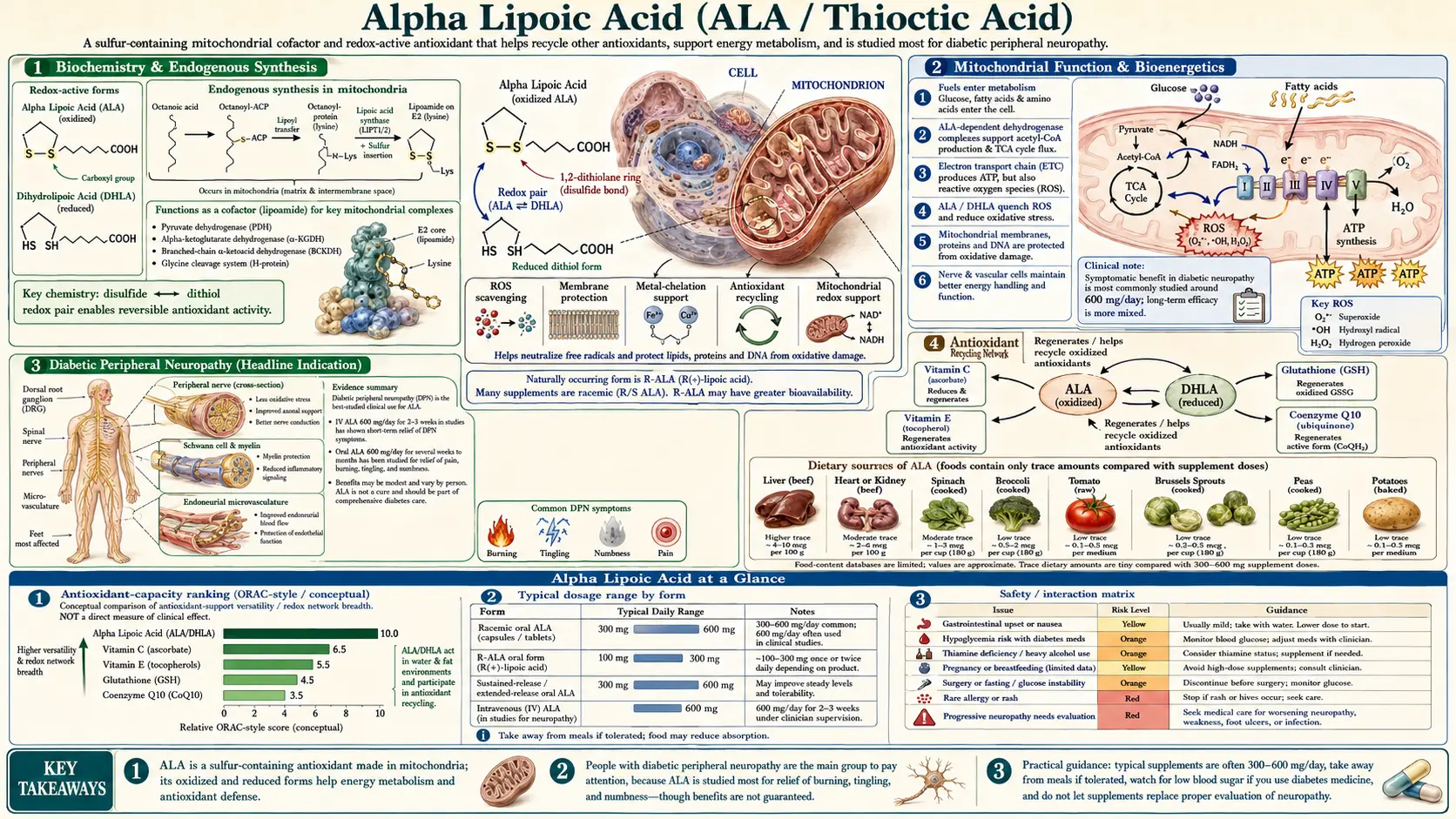
Alpha lipoic acid (ALA, also called thioctic acid) is a sulfur-containing compound that the body makes inside its mitochondria, where it stays bound to enzymes as an essential cofactor of energy metabolism. Taken as a supplement or drug, free ALA and its reduced form, dihydrolipoic acid (DHLA), act as antioxidants in laboratory studies, and reviews describe ALA as able to cross the blood-brain barrier. Its best-studied use is diabetic nerve pain: in Germany it is approved for diabetic neuropathy and available by prescription. Intravenous trials found short-term relief of symptoms, while a 4-year oral trial (NATHAN 1) missed its primary endpoint and improved some secondary measures.
Interactive Visualization Mitochondria & ATP — watch your cells make energy Follow electrons through the transport chain and watch the ATP-synthase motor spin — then block Complex IV and see the chain stall. Launch → Interactive Visualization Free Radicals & Your Antioxidant Network Follow one superoxide radical down the whole relay — SOD, catalase, glutathione, vitamin E, vitamin C, NADPH — then release free iron and watch a membrane tear itself apart. Launch →
Table of Contents
- Biochemistry & Endogenous Synthesis
- Mitochondrial Function & Bioenergetics
- Diabetic Peripheral Neuropathy (Most-Studied Use)
- Antioxidant Recycling Network
- Insulin Sensitivity, Blood Sugar & Weight
- Heavy Metal Chelation & Liver Protection
- Neuroprotection & Cognitive Function
- Cardiovascular Protection
- Skin Health & Anti-Glycation
- Forms: R-ALA vs Racemic, IV vs Oral
- Doses Used in Studies
- Cautions and Contraindications
- Key Research Papers
- Connections
- Featured Videos
Biochemistry & Endogenous Synthesis
Alpha lipoic acid is a short-chain fatty acid (1,2-dithiolane-3-pentanoic acid) with a five-membered ring containing two sulfur atoms joined in a disulfide bond. This ring is the redox-active center: it cycles between the oxidized form (alpha lipoic acid, or ALA) and the reduced form (dihydrolipoic acid, or DHLA), taking up or giving off two electrons each time it converts.
The body makes lipoic acid inside mitochondria. Synthesis starts from octanoic acid produced by the mitochondrial fatty-acid synthesis pathway; the enzyme lipoic acid synthetase (LIAS), an iron-sulfur enzyme, inserts the two sulfur atoms (iron-sulfur clusters draw their sulfur from the amino acid cysteine), and transferase enzymes (LIPT2 and LIPT1) move the lipoyl group onto specific lysine residues of its target enzymes — a modification called lipoylation (Mayr 2014; Solmonson and DeBerardinis 2018). Lipoic acid made this way is not free: it stays covalently bound to the enzyme proteins, where it works as a swinging arm that carries reaction intermediates between active sites.
Free, unbound ALA — the form in supplements — behaves differently. Reviews describe it being absorbed, taken up by cells, reduced to DHLA and exported again, and crossing the blood-brain barrier (Packer 1997). In food, lipoic acid is mostly bound to protein (as lipoyllysine); the Linus Pauling Institute lists kidney, heart and liver, and spinach and broccoli, as richer sources, and notes that lipoic acid from food has not been found to produce detectable increases of free lipoic acid in human plasma or cells.
ALA has two mirror-image forms. The R-isomer (R-LA) is the form the body makes and binds to its enzymes; the S-isomer arises from chemical synthesis. Supplements are sold both as the racemic 50/50 mixture and as R-ALA (Carlson 2007). After a racemic dose, the Linus Pauling Institute summarizes, peak plasma concentrations of R-lipoic acid were 40–50% higher than those of S-lipoic acid. In a small crossover trial in people with progressive multiple sclerosis (Cameron 2020, 20 participants), 600 mg of R-LA alone gave R-LA blood levels bioequivalent to those from 1,200 mg of the racemic mixture, with fewer gastrointestinal complaints. The SYDNEY neuropathy trial describes the ALA it infused as racemic (Ametov 2003).
Mitochondrial Function & Bioenergetics
Protein-bound lipoic acid is the cofactor of five mitochondrial enzyme systems in humans — four 2-oxoacid dehydrogenases and the glycine cleavage system (Mayr 2014):
- Pyruvate dehydrogenase complex (PDH) — converts pyruvate (from glycolysis) to acetyl-CoA, the entry point of carbohydrate carbon into the citric acid (TCA) cycle. The lipoyl group sits on its E2 subunit (dihydrolipoyl transacetylase).
- Alpha-ketoglutarate dehydrogenase complex (α-KGDH) — converts α-ketoglutarate to succinyl-CoA inside the TCA cycle, again with the lipoyl arm on its E2 subunit.
- Branched-chain α-keto acid dehydrogenase (BCKDH) — breaks down the branched-chain amino acids leucine, isoleucine and valine; inherited deficiency causes maple syrup urine disease.
- 2-Oxoadipate dehydrogenase (OADH) — part of amino acid breakdown.
- Glycine cleavage system (GCS) — breaks down glycine and feeds one-carbon metabolism.
Each reaction leaves the lipoyl arm in its reduced (dihydrolipoyl) form; the enzyme dihydrolipoyl dehydrogenase (DLD) re-oxidizes it, passing the electrons on to NAD+ (Mayr 2014). Solmonson and DeBerardinis (2018) describe lipoic acid as also stabilizing and regulating these complexes, several of which are regulated by reactive oxygen species acting through the lipoyl disulfide.
What happens when lipoylation fails is known from rare inherited defects: mutations in LIAS cause neonatal-onset seizures with a defect of mitochondrial energy metabolism, and LIPT1 deficiency causes a combined 2-oxoacid dehydrogenase deficiency (Mayr 2014). In mammals the enzyme-bound cofactor is made inside mitochondria (Solmonson and DeBerardinis 2018), so supplemental ALA is studied mainly for the free compound's own chemistry. In a laboratory study its reduced form, DHLA, reduced ubiquinone (oxidized CoQ10) to ubiquinol and removed the ubisemiquinone radical, and the two together protected membranes against peroxidation more than either alone (Kozlov 1999).
The best-known mitochondrial-aging work comes from Bruce Ames's laboratory, in rats. Feeding old rats acetyl-L-carnitine together with R-lipoic acid for up to a month partially reversed the age-related decline in average mitochondrial membrane potential, raised liver-cell oxygen consumption and ambulatory activity, and lowered a lipid-peroxidation marker (Hagen 2002). In a companion study the combination improved performance on memory tasks and reduced oxidized RNA in the hippocampus of old rats (Liu 2002). These are animal results.
Diabetic Peripheral Neuropathy (Most-Studied Use)
Diabetic peripheral neuropathy — burning, tingling, electric-shock pain and numbness, usually starting in the feet — is one of the common long-term complications of diabetes, and it is the condition in which ALA has been studied most. In Germany, lipoic acid is approved for diabetic neuropathies and available by prescription (Linus Pauling Institute). The main randomized trials — the ALADIN series, SYDNEY 1 and 2, DEKAN and NATHAN 1 — were run largely by European and Russian research groups.
The rationale came from experimental diabetes: the SYDNEY investigators cite work in which ALA prevented or improved nerve conduction, blood flow inside the nerve and nerve Na+/K+-ATPase activity (Ametov 2003). Oxidative stress is one of several proposed ways that high blood sugar damages nerves.
Key trial results
- ALADIN (1995, Ziegler et al., Diabetologia) — 328 patients with type 2 diabetes and symptomatic neuropathy received intravenous ALA at 1,200, 600 or 100 mg/day, or placebo, for 3 weeks. The foot Total Symptom Score (TSS) fell 63.5% with 600 mg and 58.6% with 1,200 mg, versus 38.4% with placebo (both significant). Adverse events were 32.6% with 1,200 mg, 18.2% with 600 mg and 20.7% with placebo; the authors concluded that 600 mg/day intravenously over 3 weeks was superior to placebo.
- ALADIN II (1999, Reljanovic et al., Free Radical Research) — a 2-year trial in type 1 and type 2 diabetes: 5 days of intravenous ALA, then oral 1,200 or 600 mg/day or placebo. After independent reviewers excluded patients with highly variable test data, 65 patients were analyzed. Sural sensory nerve conduction velocity improved with both doses compared with placebo; the Neuropathy Disability Score did not differ.
- ALADIN III (1999, Ziegler et al., Diabetes Care) — 509 patients with type 2 diabetes: intravenous ALA 600 mg/day for 3 weeks, then oral 600 mg three times daily for 6 months, or placebo. The symptom score did not differ significantly from placebo after 3 weeks or 7 months; the Neuropathy Impairment Score (NIS) improved at 19 days (P = 0.02) with a trend at 7 months (P = 0.09). The authors concluded there was no clinically meaningful effect on symptoms but a favorable effect on neuropathic deficits.
- SYDNEY (2003, Ametov et al., Diabetes Care) — 120 patients received intravenous ALA 600 mg or placebo 5 days a week for 14 treatments. The TSS improved by 5.7 points with ALA versus 1.8 with placebo (P < 0.001), with improvements also in the NIS and global assessment.
- SYDNEY 2 (2006, Ziegler et al., Diabetes Care) — 181 patients took oral ALA 600, 1,200 or 1,800 mg once daily, or placebo, for 5 weeks after a 1-week placebo run-in. The TSS fell 51%, 48% and 52% versus 32% with placebo; at least a 50% reduction occurred in 62%, 50% and 56% versus 26%. Nausea, vomiting and vertigo rose with dose, and the authors judged 600 mg once daily the best risk-to-benefit ratio.
- 3-week oral trial (1999, Ruhnau et al., Diabetic Medicine) — 24 patients with type 2 diabetes took 600 mg three times daily or placebo for 3 weeks; the TSS fell 47% versus 24% (P = 0.021). The authors called the findings preliminary.
- NATHAN 1 (2011, Ziegler et al., Diabetes Care) — 460 patients with mild-to-moderate neuropathy took oral ALA 600 mg/day or placebo for 4 years. The primary composite endpoint (NIS of the lower limbs plus seven neurophysiological tests) showed no significant difference (P = 0.105); the authors note that it did not worsen significantly in the placebo group either. Secondary measures — the NIS, NIS of the lower limbs and its muscle-weakness subscore — changed more favorably with ALA, and more patients improved and fewer progressed. Tolerability was similar, but serious adverse events were more frequent with ALA (38.1%) than placebo (28.0%).
- DEKAN (1997, Ziegler et al., Diabetes Care) — cardiac autonomic neuropathy: 73 patients with type 2 diabetes and reduced heart-rate variability took oral ALA 800 mg/day or placebo for 4 months. Two heart-rate-variability measures improved compared with placebo; autonomic symptoms did not differ. The authors concluded ALA "may slightly improve" the condition.
Meta-analyses
A 2004 meta-analysis by Ziegler and colleagues pooled four intravenous trials (ALADIN, ALADIN III, SYDNEY and NATHAN II; 1,258 patients) drawn from the drug manufacturer's trial database. After 3 weeks of 600 mg/day, the TSS was 24.1% better with ALA than placebo, and responder rates were 52.7% versus 36.9%. An independent 2012 meta-analysis (Mijnhout et al.) found a pooled TSS reduction favoring ALA (standardized mean difference −2.26) and concluded that intravenous ALA 600 mg/day for 3 weeks gives a clinically relevant reduction in neuropathic pain, while it was unclear whether the improvements after 3–5 weeks of oral treatment are clinically relevant. A 2023 meta-analysis of oral ALA (10 randomized trials, 1,242 patients; Hsieh et al.) found favorable results for the TSS, with a dose-related trend, and for the Neuropathy Disability Score and global satisfaction, but not for pain on a visual analogue scale, vibration perception, NIS of the lower limbs or nerve conduction.
In short: short courses of intravenous ALA, and oral doses of 600 mg/day or more over several weeks, reduced symptom scores in these trials; the one 4-year oral trial did not meet its primary endpoint.
Antioxidant Recycling Network
Laboratory research describes ALA and DHLA reacting with reactive oxygen species and interacting with other antioxidants (Packer 1995). Many antioxidants work mainly in one compartment — vitamin C in watery fluids, vitamin E in lipid membranes. Cells take up ALA, reduce it to DHLA and export DHLA again, so reviews describe protection both inside and outside cells (Packer 1997). The interactions reported in laboratory and animal studies:
- Vitamin C and glutathione — ALA and DHLA interact with vitamin C and glutathione, which may in turn recycle vitamin E (Packer 1995)
- Cellular glutathione — ALA raises intracellular glutathione levels in cell and animal studies (Packer 1997; Shay 2009)
- CoQ10 — DHLA reduced ubiquinone to ubiquinol in a laboratory study (Kozlov 1999)
- Direct scavenging — ALA or DHLA reacts with superoxide, hydroxyl radicals, hypochlorous acid, peroxyl radicals and singlet oxygen (Packer 1995)
- A possible pro-oxidant side — DHLA may also act as a pro-oxidant by reducing iron (Packer 1995)
How much of this happens in the human body is uncertain: the Linus Pauling Institute notes that whether dihydrolipoic acid effectively regenerates antioxidants under physiological conditions is unclear.
ALA also acts through cell signaling. A review of cell and animal research describes it activating phase II detoxification through the transcription factor Nrf2 and lowering NF-κB-driven expression of MMP-9 and VCAM-1, at low micromolar concentrations, which suggests some effects go beyond direct antioxidant action (Shay 2009). Nrf2 controls a large set of cytoprotective genes, including glutathione-synthesis enzymes (GCLC, GCLM), NADPH-quinone oxidoreductase (NQO1), heme oxygenase-1 (HO-1) and glutathione S-transferases.
Insulin Sensitivity, Blood Sugar & Weight
Cell and animal studies describe ALA improving glucose handling (Shay 2009). In human trials the effect on blood sugar is small.
A 2018 meta-analysis of 24 randomized trials in people with metabolic diseases (Akbari et al.) found reductions in fasting glucose, fasting insulin, insulin resistance (HOMA-IR) and HbA1c, and in triglycerides, total and LDL cholesterol, reported as standardized mean differences. A 2022 dose-response meta-analysis limited to oral ALA in type 2 diabetes (16 trials, 1,035 patients; Jibril et al.) also found statistically significant reductions in HbA1c, fasting glucose, body weight, triglycerides and C-reactive protein — but every point estimate was below the threshold the authors considered clinically important, and they concluded the effects were not clinically important.
Weight. A 2017 meta-analysis of 10 randomized, double-blind, placebo-controlled trials (Kucukgoncu et al.) found 1.27 kg greater mean weight loss with ALA than with placebo and a BMI difference of −0.43 kg/m². The authors described the effect as small and short-term, with no relationship to dose.
Other compounds studied for insulin resistance, such as berberine, are covered on their own pages.
Heavy Metal Chelation & Liver Protection
DHLA's two thiol groups can bind metals: reviews list metal chelation among ALA's properties (Shay 2009), and DHLA chelates free iron (Kozlov 1999). For toxic heavy metals such as mercury, arsenic, lead and cadmium, the Linus Pauling Institute's summary describes animal studies and no human clinical trials.
ALA is central to the oral chelation protocol described by Andy Cutler for people with suspected mercury toxicity, including from amalgam fillings or seafood. He described frequent small doses (12.5–50 mg every 3–4 hours, timed to ALA's short time in the blood), started only after amalgam removal, which he said avoided redistributing mercury to the brain. No clinical trial of the protocol appears in PubMed, and it is not part of mainstream toxicology.
Liver: ALA (as thioctic acid) has a long history in death-cap (Amanita phalloides) mushroom poisoning, but a 20-year retrospective analysis of 2,108 hospitalized amatoxin poisonings found no benefit for thioctic acid; silybin and N-acetylcysteine were associated with better outcomes (Enjalbert 2002). In non-alcoholic fatty liver disease, a 2026 meta-analysis of seven randomized trials (414 participants) found that ALA did not improve liver enzymes, lipid profiles, glycemic indices, adipocytokines or obesity measures (Li 2026).
Related pages cover detox protocols, liver support, NAC (a glutathione precursor), milk thistle (silymarin) and selenium.
Neuroprotection & Cognitive Function
The brain uses a large share of the body's oxygen and is rich in polyunsaturated fats, which is why oxidative damage is studied there. Reviews describe ALA as absorbed from the diet and crossing the blood-brain barrier, and in vitro, animal and preliminary human studies as suggesting effects in neurodegenerative disorders (Packer 1997).
Alzheimer's disease. In an open study, 600 mg/day was given to nine patients already taking cholinesterase inhibitors for an average of about 337 days, and their scores on two cognitive tests (MMSE and ADAScog) stayed constant (Hager 2001). An extended open analysis of 43 patients over up to 48 months reported slow progression in mild dementia; the authors stressed that the study was not double-blinded, placebo-controlled or randomized and called for a phase II trial (Hager 2007).
Multiple sclerosis. In a single-center, 2-year pilot trial in secondary progressive MS (51 patients; Spain 2017), 1,200 mg/day slowed the annualized rate of whole-brain atrophy compared with placebo (−0.21 versus −0.65 percent change in brain volume per year; the authors report a 68% reduction), with a non-significant trend on walking speed (P = 0.06); one case each of renal failure and glomerulonephritis occurred in the ALA group. A larger multicenter phase 2 trial in progressive MS (115 participants, 1,200 mg/day for 24 months; Spain 2026) found that ALA did not slow the decline in walking speed (its primary outcome) or change other clinical outcomes compared with placebo. Whole-brain and deep gray matter volume appeared more stable with ALA; participants on ALA discontinued more often (37% versus 17%) and had more proteinuria.
Stroke. Animal studies of cerebral ischemia-reperfusion report protective effects (reviewed by Packer 1997); human trials are limited.
Chemotherapy-induced neuropathy. In a randomized, placebo-controlled trial in 243 patients receiving cisplatin or oxaliplatin, oral ALA 600 mg three times daily for 24 weeks did not prevent neurotoxicity; only 29% of patients completed the study (Guo 2014).
Cardiovascular Protection
In the ISLAND trial (Sola 2005), 58 people with metabolic syndrome received irbesartan, ALA 300 mg/day, both, or placebo for 4 weeks. Endothelium-dependent flow-mediated dilation of the brachial artery rose 44% with ALA alone (67% with irbesartan and 75% with both) compared with placebo, and interleukin-6 and plasminogen activator inhibitor-1 fell; blood pressure did not change significantly in any group. Flow-mediated dilation depends on nitric oxide, which the body makes from the amino acid arginine.
A 2023 meta-analysis of 11 randomized trials (674 participants; Vajdi et al.) found that ALA lowered systolic blood pressure by 5.46 mmHg and diastolic by 3.36 mmHg, with the significant effects at doses below 800 mg/day given for 12 weeks or less; the authors called for larger, longer studies. Effects on blood lipids are described in the blood-sugar section above.
The trials above measured blood-vessel function, blood pressure and blood markers rather than heart attacks or strokes; see cardiovascular disease for the wider topic.
Skin Health & Anti-Glycation
In a randomized, double-blind split-face study (Beitner 2003), 33 women (mean age 54.4) applied a 5% ALA cream to one half of the face and an identical cream without ALA to the other, twice daily for 12 weeks. All four assessment methods favored the ALA side; laser profilometry showed skin roughness fell 50.8% on the ALA side versus 40.7% on the control side (P < 0.001).
On glycation, a laboratory review notes that ALA and DHLA bind to proteins such as albumin, which can prevent glycation reactions (Packer 1995). Whether this explains the skin results was not tested.
Forms: R-ALA vs Racemic, IV vs Oral
- Racemic alpha lipoic acid — a 50/50 mixture of R-ALA and S-ALA, the form infused in the SYDNEY trial and sold widely as a supplement (Carlson 2007). In the Cameron 2020 crossover trial, 1,200 mg of the racemic mixture gave R-ALA blood levels bioequivalent to 600 mg of R-ALA alone.
- R-alpha lipoic acid (R-ALA, R-LA) — the natural enantiomer alone. In the same trial, 600 mg of R-ALA caused fewer gastrointestinal complaints than 1,200 mg of the racemic mixture (31 versus 60 reports).
- Sodium R-lipoate — a sodium salt of R-ALA. R-ALA tends to polymerize, is relatively unstable and dissolves poorly in water. In a pharmacokinetic study of 12 healthy adults (Carlson 2007, by a group that included a supplier of the ingredient), 600 mg of R-ALA given as the sodium salt dissolved in water produced higher peak levels and total exposure than R-ALA or racemic ALA.
- Intravenous ALA — 600 mg a day by infusion in the ALADIN and SYDNEY trials (SYDNEY describes it as racemic). In Germany lipoic acid is a prescription medicine for diabetic neuropathy.
- Tablets and solutions — in a crossover study in 24 healthy adults (Hermann 2014), three tablet forms of racemic ALA 600 mg reached peak levels within 0.33–0.5 hours, and their R-ALA exposure (AUC) was 64–79% of that from an oral solution. Women had 20–32% higher exposure than men, which the authors judged not to require a dose adjustment.
- Topical creams — the controlled skin trial used a 5% cream (Beitner 2003).
Doses Used in Studies
These are the doses and schedules the cited studies used, not instructions.
- Diabetic neuropathy, intravenous — 600 mg/day for about 3 weeks (ALADIN; SYDNEY gave 14 infusions, 5 days a week). The 1,200 mg/day arm of ALADIN had more adverse events.
- Diabetic neuropathy, oral — 600, 1,200 or 1,800 mg once daily for 5 weeks (SYDNEY 2, whose authors judged 600 mg the best risk-to-benefit ratio); 600 mg three times daily for 3 weeks (Ruhnau 1999) or 6 months (ALADIN III); 600 mg/day for 4 years (NATHAN 1).
- Cardiac autonomic neuropathy — 800 mg/day for 4 months (DEKAN).
- Metabolic syndrome, endothelial function — 300 mg/day for 4 weeks (ISLAND).
- Multiple sclerosis — 1,200 mg/day for 2 years (Spain 2017; Spain 2026, where the primary outcome was not improved).
- Alzheimer's disease — 600 mg/day in open, uncontrolled studies (Hager 2001, 2007).
- Chemotherapy-induced neuropathy — 600 mg three times daily for 24 weeks, with no benefit (Guo 2014).
- Mitochondrial aging (Ames–Hagen) — rat studies that added R-lipoic acid to food and acetyl-L-carnitine to drinking water; they did not establish human doses.
- Cutler protocol — 12.5–50 mg every 3–4 hours as described by its author, not tested in trials.
- Topical — 5% cream twice daily for 12 weeks (Beitner 2003).
Food and timing. The Linus Pauling Institute summarizes that taking lipoic acid with food, rather than without, decreased peak plasma concentrations by about 30% and total plasma concentrations by about 20%, and that plasma concentrations generally peak within an hour or less and decline rapidly.
Cautions and Contraindications
ALA was generally well tolerated in the trials. The concerns the research raises:
- Blood sugar and diabetes medicines — ALA modestly lowered fasting glucose in meta-analyses. A single-dose study in 24 healthy volunteers found no drug interaction between ALA and glibenclamide (glyburide) or acarbose, in blood levels or in insulin and glucose (Gleiter 1999); longer combined use was not examined there.
- Insulin autoimmune syndrome (IAS, Hirata disease) — a rare, immune-mediated cause of hypoglycemia with high levels of insulin autoantibodies (Cappellani 2020). In Japanese people it is associated with the HLA-DRB1*04:06 allele and often follows exposure to sulfhydryl-containing compounds, including lipoic acid. It is not limited to East Asian people: a 2014 series described six white European patients taking ALA 600 mg/day whose hypoglycemia began 30–120 days after starting it; five carried HLA-DRB1*04:03 and one HLA-DRB1*04:06 (Gullo 2014). The European Food Safety Authority's 2021 opinion reviewed 49 case reports: in all of them IAS resolved within weeks to months after ALA was stopped. EFSA concluded that ALA added to foods, including supplements, is likely to increase IAS risk in people with certain genetic variants who cannot be identified without genetic testing, that no dose below which IAS is not expected could be set, and that incidence in Europe is low — likely lower than in Japan, estimated at 0.017 per 100,000 inhabitants in 2017–2018.
- Kidney (membranous nephropathy) — high-grade proteinuria was an unexpected adverse event in the ALA arm of an MS trial; the investigators then described four biopsy-proven cases of NELL1-associated membranous nephropathy, and a fifth suspected case, after ALA supplementation, all remitting after ALA was stopped (Spain 2021). The 2026 phase 2 MS trial also found more proteinuria with ALA.
- Biotin — in rats given lipoic acid injections for 28 days, liver activities of two biotin-dependent carboxylases were 28–36% lower, and normal when biotin was given as well (Zempleni 1997); the Linus Pauling Institute notes that high concentrations of lipoic acid can compete with biotin (vitamin B7) for transport across cell membranes. That study did not measure effects in people.
- Thiamine (vitamin B1) — PDH and α-KGDH, the enzymes that use lipoic acid, also need thiamine pyrophosphate. A 1965 study in thiamine-deficient rats reported a selective toxicity of (−)-alpha-lipoic acid that thiamine reversed (Gal 1965). The concern for people with thiamine deficiency, such as heavy drinkers, rests on this animal finding.
- Thyroid hormone — in a 1991 rat study, ALA given together with thyroxine (T4) suppressed the T4-induced rise in T3 generation by 56% (Segermann 1991). A PubMed search for this page found no human study of that interaction.
- Side effects — nausea, vomiting and vertigo rose with dose in SYDNEY 2; the Linus Pauling Institute lists allergic skin reactions (rashes, hives, itching) as the most frequently reported side effects of oral ALA. In NATHAN 1, serious adverse events were more frequent with ALA than with placebo (38.1% versus 28.0%).
- Pregnancy and breastfeeding — human safety data are limited; the Linus Pauling Institute cites research in which 600 mg/day during pregnancy was not associated with adverse effects in mothers or newborns.
- Children — safety data are limited.
Decisions about medicines and supplements belong with a clinician.
Key Research Papers
- Ziegler D, Hanefeld M, Ruhnau KJ, Meissner HP, Lobisch M, Schütte K, Gries FA (1995). Treatment of symptomatic diabetic peripheral neuropathy with the anti-oxidant alpha-lipoic acid. A 3-week multicentre randomized controlled trial (ALADIN Study). Diabetologia 38(12):1425-33. — PubMed PMID: 8786016
- Reljanovic M, Reichel G, Rett K, Lobisch M, Schuette K, Möller W, Tritschler HJ, Mehnert H (1999). Treatment of diabetic polyneuropathy with the antioxidant thioctic acid (alpha-lipoic acid): a two year multicenter randomized double-blind placebo-controlled trial (ALADIN II). Alpha Lipoic Acid in Diabetic Neuropathy. Free Radical Research 31(3):171-9. — PubMed PMID: 10499773
- Ziegler D, Hanefeld M, Ruhnau KJ, Hasche H, Lobisch M, Schütte K, Kerum G, Malessa R (1999). Treatment of symptomatic diabetic polyneuropathy with the antioxidant alpha-lipoic acid: a 7-month multicenter randomized controlled trial (ALADIN III Study). ALADIN III Study Group. Alpha-Lipoic Acid in Diabetic Neuropathy. Diabetes Care 22(8):1296-301. — PubMed PMID: 10480774
- Ametov AS, Barinov A, Dyck PJ, Hermann R, Kozlova N, Litchy WJ, et al. (2003). The sensory symptoms of diabetic polyneuropathy are improved with alpha-lipoic acid: the SYDNEY trial. Diabetes Care 26(3):770-6. — PubMed PMID: 12610036
- Ziegler D, Ametov A, Barinov A, Dyck PJ, Gurieva I, Low PA, et al. (2006). Oral treatment with alpha-lipoic acid improves symptomatic diabetic polyneuropathy: the SYDNEY 2 trial. Diabetes Care 29(11):2365-70. — PubMed PMID: 17065669
- Ruhnau KJ, Meissner HP, Finn JR, Reljanovic M, Lobisch M, Schütte K, et al. (1999). Effects of 3-week oral treatment with the antioxidant thioctic acid (alpha-lipoic acid) in symptomatic diabetic polyneuropathy. Diabetic Medicine 16(12):1040-3. — PubMed PMID: 10656234
- Ziegler D, Low PA, Litchy WJ, Boulton AJ, Vinik AI, Freeman R, et al. (2011). Efficacy and safety of antioxidant treatment with α-lipoic acid over 4 years in diabetic polyneuropathy: the NATHAN 1 trial. Diabetes Care 34(9):2054-60. — PubMed PMID: 21775755
- Ziegler D, Schatz H, Conrad F, Gries FA, Ulrich H, Reichel G (1997). Effects of treatment with the antioxidant alpha-lipoic acid on cardiac autonomic neuropathy in NIDDM patients. A 4-month randomized controlled multicenter trial (DEKAN Study). Deutsche Kardiale Autonome Neuropathie. Diabetes Care 20(3):369-73. — PubMed PMID: 9051389
- Ziegler D, Nowak H, Kempler P, Vargha P, Low PA (2004). Treatment of symptomatic diabetic polyneuropathy with the antioxidant alpha-lipoic acid: a meta-analysis. Diabetic Medicine 21(2):114-21. — PubMed PMID: 14984445
- Mijnhout GS, Kollen BJ, Alkhalaf A, Kleefstra N, Bilo HJ (2012). Alpha lipoic Acid for symptomatic peripheral neuropathy in patients with diabetes: a meta-analysis of randomized controlled trials. International Journal of Endocrinology 2012:456279. — PubMed PMID: 22331979
- Hsieh RY, Huang IC, Chen C, Sung JY (2023). Effects of Oral Alpha-Lipoic Acid Treatment on Diabetic Polyneuropathy: A Meta-Analysis and Systematic Review. Nutrients 15(16):3634. — PubMed PMID: 37630823
- Mayr JA, Feichtinger RG, Tort F, Ribes A, Sperl W (2014). Lipoic acid biosynthesis defects. Journal of Inherited Metabolic Disease 37(4):553-63. — PubMed PMID: 24777537
- Solmonson A, DeBerardinis RJ (2018). Lipoic acid metabolism and mitochondrial redox regulation. Journal of Biological Chemistry 293(20):7522-7530. — PubMed PMID: 29191830
- Hagen TM, Liu J, Lykkesfeldt J, Wehr CM, Ingersoll RT, Vinarsky V, Bartholomew JC, Ames BN (2002). Feeding acetyl-L-carnitine and lipoic acid to old rats significantly improves metabolic function while decreasing oxidative stress. Proceedings of the National Academy of Sciences of the USA 99(4):1870-5. — PubMed PMID: 11854487
- Liu J, Head E, Gharib AM, Yuan W, Ingersoll RT, Hagen TM, Cotman CW, Ames BN (2002). Memory loss in old rats is associated with brain mitochondrial decay and RNA/DNA oxidation: partial reversal by feeding acetyl-L-carnitine and/or R-alpha -lipoic acid. Proceedings of the National Academy of Sciences of the USA 99(4):2356-61. — PubMed PMID: 11854529
- Packer L, Witt EH, Tritschler HJ (1995). alpha-Lipoic acid as a biological antioxidant. Free Radical Biology & Medicine 19(2):227-50. — PubMed PMID: 7649494
- Packer L, Tritschler HJ, Wessel K (1997). Neuroprotection by the metabolic antioxidant alpha-lipoic acid. Free Radical Biology & Medicine 22(1-2):359-78. — PubMed PMID: 8958163
- Kozlov AV, Gille L, Staniek K, Nohl H (1999). Dihydrolipoic acid maintains ubiquinone in the antioxidant active form by two-electron reduction of ubiquinone and one-electron reduction of ubisemiquinone. Archives of Biochemistry and Biophysics 363(1):148-54. — PubMed PMID: 10049509
- Shay KP, Moreau RF, Smith EJ, Smith AR, Hagen TM (2009). Alpha-lipoic acid as a dietary supplement: molecular mechanisms and therapeutic potential. Biochimica et Biophysica Acta 1790(10):1149-60. — PubMed PMID: 19664690
- Akbari M, Ostadmohammadi V, Lankarani KB, Tabrizi R, Kolahdooz F, Khatibi SR, Asemi Z (2018). The effects of alpha-lipoic acid supplementation on glucose control and lipid profiles among patients with metabolic diseases: A systematic review and meta-analysis of randomized controlled trials. Metabolism: Clinical and Experimental 87:56-69. — PubMed PMID: 29990473
- Jibril AT, Jayedi A, Shab-Bidar S (2022). Efficacy and safety of oral alpha-lipoic acid supplementation for type 2 diabetes management: a systematic review and dose-response meta-analysis of randomized trials. Endocrine Connections 11(10):e220322. — PubMed PMID: 36006850
- Kucukgoncu S, Zhou E, Lucas KB, Tek C (2017). Alpha-lipoic acid (ALA) as a supplementation for weight loss: results from a meta-analysis of randomized controlled trials. Obesity Reviews 18(5):594-601. — PubMed PMID: 28295905
- Gullo D, Evans JL, Sortino G, Goldfine ID, Vigneri R (2014). Insulin autoimmune syndrome (Hirata Disease) in European Caucasians taking α-lipoic acid. Clinical Endocrinology 81(2):204-9. — PubMed PMID: 24111525
- Cappellani D, Macchia E, Falorni A, Marchetti P (2020). Insulin Autoimmune Syndrome (Hirata Disease): A Comprehensive Review Fifty Years After Its First Description. Diabetes, Metabolic Syndrome and Obesity 13:963-978. — PubMed PMID: 32308449
- EFSA Panel on Nutrition, Novel Foods and Food Allergens (NDA); Turck D, Castenmiller J, de Henauw S, Hirsch-Ernst KI, Kearney J, Knutsen HK, et al. (2021). Scientific opinion on the relationship between intake of alpha-lipoic acid (thioctic acid) and the risk of insulin autoimmune syndrome. EFSA Journal 19(6):e06577. — PubMed PMID: 34122657
- Uchigata Y (2007). The novel agent, alpha lipoic acid, can cause the development of insulin autoimmune syndrome. Internal Medicine 46(17):1321-2. — PubMed PMID: 17827827
- Spain RI, Andeen NK, Gibson PC, Samuels MH, Morris CD, Solomon AJ, et al. (2021). Lipoic acid supplementation associated with neural epidermal growth factor-like 1 (NELL1)-associated membranous nephropathy. Kidney International 100(6):1208-1213. — PubMed PMID: 34662650
- Zempleni J, Trusty TA, Mock DM (1997). Lipoic acid reduces the activities of biotin-dependent carboxylases in rat liver. Journal of Nutrition 127(9):1776-81. — PubMed PMID: 9278559
- Gal EM (1965). Reversal of selective toxicity of (-)-alpha-lipoic acid by thiamine in thiamine-deficient rats. Nature 207(996):535. — PubMed PMID: 5328673
- Segermann J, Hotze A, Ulrich H, Rao GS (1991). Effect of alpha-lipoic acid on the peripheral conversion of thyroxine to triiodothyronine and on serum lipid-, protein- and glucose levels. Arzneimittel-Forschung 41(12):1294-8. — PubMed PMID: 1815532
- Gleiter CH, Schreeb KH, Freudenthaler S, Thomas M, Elze M, Fieger-Büschges H, et al. (1999). Lack of interaction between thioctic acid, glibenclamide and acarbose. British Journal of Clinical Pharmacology 48(6):819-25. — PubMed PMID: 10594485
- Enjalbert F, Rapior S, Nouguier-Soulé J, Guillon S, Amouroux N, Cabot C (2002). Treatment of amatoxin poisoning: 20-year retrospective analysis. Journal of Toxicology. Clinical Toxicology 40(6):715-57. — PubMed PMID: 12475187
- Li T, Liu H, Zeng J (2026). Effects of alpha-lipoic acid supplementation on patients with nonalcoholic fatty liver disease: a systematic review and meta-analysis of randomized clinical trials. BMC Endocrine Disorders 26(1):133. — PubMed PMID: 41917882
- Hager K, Marahrens A, Kenklies M, Riederer P, Münch G (2001). Alpha-lipoic acid as a new treatment option for Alzheimer [corrected] type dementia. Archives of Gerontology and Geriatrics 32(3):275-82. — PubMed PMID: 11395173
- Hager K, Kenklies M, McAfoose J, Engel J, Münch G (2007). Alpha-lipoic acid as a new treatment option for Alzheimer's disease--a 48 months follow-up analysis. Journal of Neural Transmission. Supplementum (72):189-93. — PubMed PMID: 17982894
- Spain R, Powers K, Murchison C, Heriza E, Winges K, Yadav V, et al. (2017). Lipoic acid in secondary progressive MS: A randomized controlled pilot trial. Neurology: Neuroimmunology & Neuroinflammation 4(5):e374. — PubMed PMID: 28680916
- Spain RI, Paz Soldán MM, Freedman MS, Repovic P, Solomon AJ, Rinker JR, et al. (2026). Lipoic Acid for Treatment of Progressive Multiple Sclerosis: A Phase 2 Randomized Clinical Trial. Neurology 106(1):e214454. — PubMed PMID: 41397213
- Guo Y, Jones D, Palmer JL, Forman A, Dakhil SR, Velasco MR, et al. (2014). Oral alpha-lipoic acid to prevent chemotherapy-induced peripheral neuropathy: a randomized, double-blind, placebo-controlled trial. Supportive Care in Cancer 22(5):1223-31. — PubMed PMID: 24362907
- Sola S, Mir MQ, Cheema FA, Khan-Merchant N, Menon RG, Parthasarathy S, Khan BV (2005). Irbesartan and lipoic acid improve endothelial function and reduce markers of inflammation in the metabolic syndrome: results of the Irbesartan and Lipoic Acid in Endothelial Dysfunction (ISLAND) study. Circulation 111(3):343-8. — PubMed PMID: 15655130
- Vajdi M, Noshadi N, Hassanizadeh S, Bonyadian A, Seyedhosseini-Ghaheh H, Askari G (2023). The effects of alpha lipoic acid (ALA) supplementation on blood pressure in adults: a GRADE-assessed systematic review and dose-response meta-analysis of randomized controlled trials. Frontiers in Cardiovascular Medicine 10:1272837. — PubMed PMID: 37942070
- Beitner H (2003). Randomized, placebo-controlled, double blind study on the clinical efficacy of a cream containing 5% alpha-lipoic acid related to photoageing of facial skin. British Journal of Dermatology 149(4):841-9. — PubMed PMID: 14616378
- Cameron M, Taylor C, Lapidus J, Ramsey K, Koop D, Spain R (2020). Gastrointestinal Tolerability and Absorption of R- Versus R,S-Lipoic Acid in Progressive Multiple Sclerosis: A Randomized Crossover Trial. Journal of Clinical Pharmacology 60(8):1099-1106. — PubMed PMID: 32212340
- Hermann R, Mungo J, Cnota PJ, Ziegler D (2014). Enantiomer-selective pharmacokinetics, oral bioavailability, and sex effects of various alpha-lipoic acid dosage forms. Clinical Pharmacology: Advances and Applications 6:195-204. — PubMed PMID: 25506250
- Carlson DA, Smith AR, Fischer SJ, Young KL, Packer L (2007). The plasma pharmacokinetics of R-(+)-lipoic acid administered as sodium R-(+)-lipoate to healthy human subjects. Alternative Medicine Review 12(4):343-51. — PubMed PMID: 18069903
PubMed Topic Searches
- ALA and Nrf2 pathway activation — PubMed: alpha lipoic acid Nrf2
- ALA and heavy metal chelation (mercury, arsenic, lead) — PubMed: alpha lipoic acid mercury chelation
External Authoritative Resources
Connections
- Fluoride Chelation — regenerates glutathione during a protocol
- Free Radicals & Your Antioxidant Network — interactive animation
- Mitochondria & ATP — interactive animation
- All Antioxidants
- Diabetes
- Diabetic Complications
- Peripheral Neuropathy
- Oxidative Stress
- NAC (N-Acetylcysteine)
- NAD+ & NMN
- Methylene Blue
- Detox Protocols
- Liver Cleansing
- Longevity Protocols
- Blood Sugar
- Vitamin C
- Vitamin E
- Vitamin B7 (Biotin)
- Vitamin B1 (Thiamine)
- Selenium
- Sulfur
- Cysteine
- Glycine
- Methionine
- Taurine
- Arginine
- Berberine
- Milk Thistle
- Turmeric (Curcumin)
- Astragalus
- Quercetin
- Hemoglobin A1c
- Fasting Insulin
- Continuous Glucose Monitor
- Mercury
- Lead
- Arsenic
- Neurology
- Cardiovascular Disease
- Blood Sugar Remedies — the full index of herbs, nutrients, foods and practices that act on blood glucose