Lycopene for Heart & Cardiovascular Health
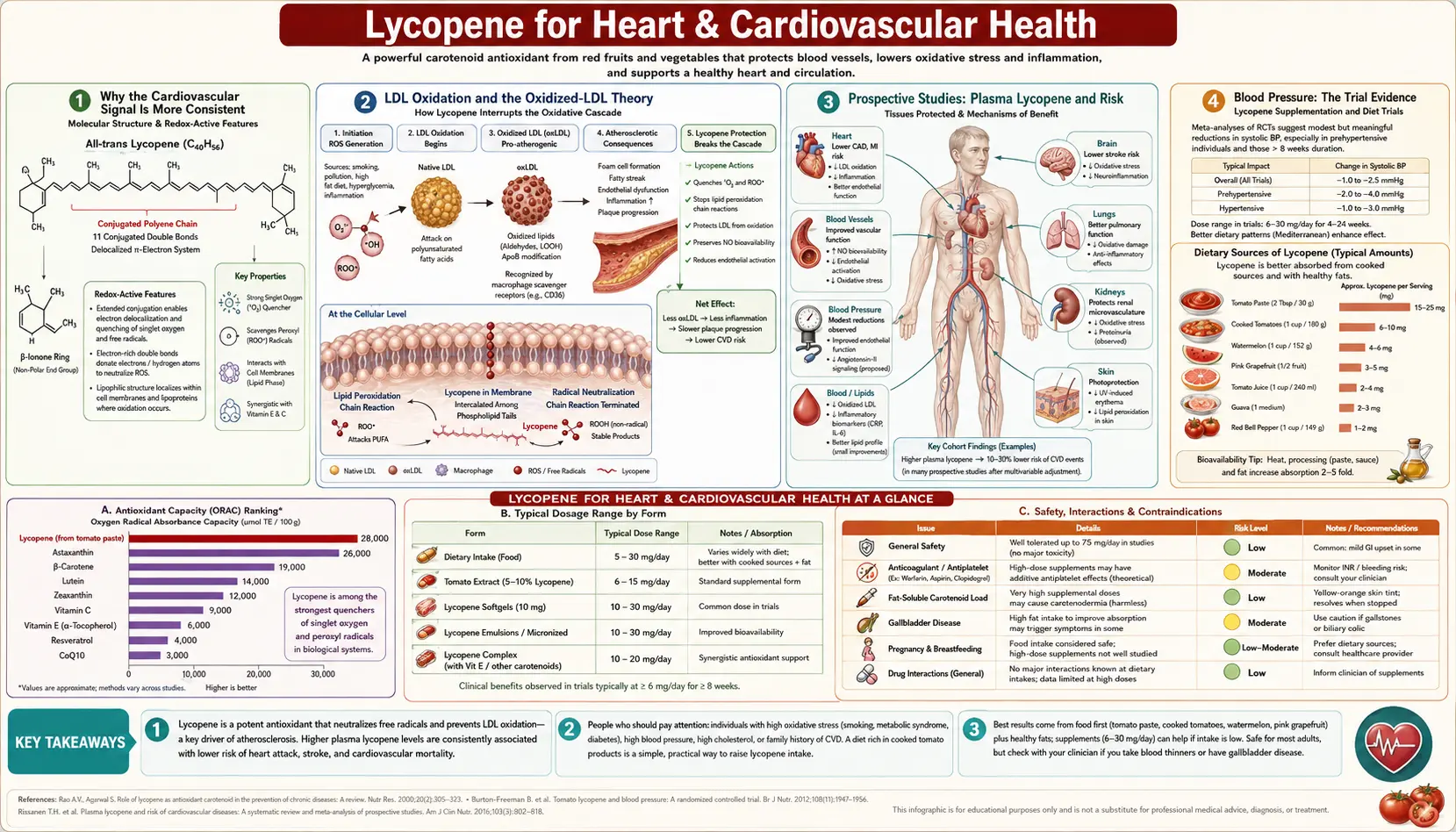
The cardiovascular evidence for lycopene is more consistent than the prostate evidence — though still modest and still tangled up with the general healthiness of a tomato-rich diet. The central idea is elegant: atherosclerosis is driven in part by the oxidation of LDL cholesterol inside artery walls, lycopene is one of the most efficient dietary antioxidants, and lycopene travels in the bloodstream packaged inside those very LDL particles. Prospective studies in thousands of women and men, randomized trials on blood pressure and endothelial function, and several meta-analyses converge on a small but real signal: higher lycopene status is associated with better cardiovascular markers. This page separates the reasonably-supported claims from the overstated ones.
Table of Contents
- Why the Cardiovascular Signal Is More Consistent
- LDL Oxidation and the Oxidized-LDL Theory
- Prospective Studies: Plasma Lycopene and Risk
- Blood Pressure: The Trial Evidence
- Cholesterol and Lipids
- Endothelial Function and Arterial Stiffness
- Inflammation and Oxidative-Stress Markers
- Where the Evidence Is Weak or Conflicting
- Practical Guidance
- Key Research Papers
- Connections
- Featured Videos
Why the Cardiovascular Signal Is More Consistent
Three features make the cardiovascular story more coherent than the cancer story. First, the outcome is measurable in the short term: instead of waiting decades for cancer to appear, researchers can measure blood pressure, LDL cholesterol, and blood-vessel function in weeks, which makes randomized trials feasible. Second, there is a clear, biologically plausible mechanism (LDL oxidation) that lycopene is well-suited to interrupt. Third, the effects that show up — small reductions in blood pressure and LDL, improved endothelial function — are exactly the kind of modest, cumulative benefits you would expect from a dietary antioxidant, rather than a dramatic drug-like effect.
None of this makes lycopene a heart medication. The honest framing is that lycopene is one contributor to why tomato-rich, plant-forward dietary patterns (like the Mediterranean diet) are cardioprotective — not a stand-alone treatment for heart disease.
LDL Oxidation and the Oxidized-LDL Theory
Atherosclerosis — the buildup of fatty plaque in artery walls that underlies most heart attacks and strokes — is not simply a matter of too much cholesterol. A pivotal step is the oxidation of LDL particles after they lodge in the artery wall. Oxidized LDL is far more damaging than native LDL: it is taken up by immune cells (macrophages) that swell into foam cells, it triggers inflammation, and it accelerates plaque growth. This “oxidative modification hypothesis” is one of the foundational ideas in cardiovascular biology and is discussed in more depth on the Atherosclerosis page.
Here is where lycopene fits neatly. Because lycopene is fat-soluble, it is carried through the blood packaged inside LDL and other lipoproteins — it physically rides along with the very particles that are vulnerable to oxidation. In laboratory studies, lycopene incorporated into LDL slows the oxidation of that LDL. The hypothesis is that a lycopene-rich diet loads circulating LDL with a built-in antioxidant escort, making the particles more resistant to the oxidative damage that starts atherosclerosis. Rao and Agarwal's widely-cited 2000 review laid out this rationale, and it remains the mechanistic backbone of the cardiovascular research.
Prospective Studies: Plasma Lycopene and Risk
Some of the most persuasive cardiovascular evidence comes from prospective cohort studies that measured blood lycopene — an objective biomarker — and then followed people for years to count cardiovascular events. Harvey Sesso and colleagues examined this in both the Women's Health Study (published 2004) and a companion analysis in men (published 2005). In women, higher plasma lycopene was associated with a lower risk of cardiovascular disease, with the strongest and most consistent findings in the subgroups examined; the men's analysis was more equivocal.
Across the broader literature, higher circulating lycopene has been repeatedly, though not universally, associated with lower rates of heart attack, stroke, and cardiovascular death. Because these are observational studies, they carry the same caveat as the prostate cohorts — association is not causation, and people with high blood lycopene tend to eat more vegetables and live healthier lives in general. But the use of an objective blood biomarker (rather than a diet questionnaire) makes these findings harder to dismiss than pure food-frequency data, and the direction of effect has been consistent.
Blood Pressure: The Trial Evidence
Blood pressure is where lycopene has been tested in actual randomized, placebo-controlled trials — the strongest study design. The most cited is Paran and colleagues' 2009 trial, which gave a standardized tomato extract to patients with hypertension that was being treated but remained above target. The tomato extract produced a modest but statistically significant reduction in systolic and diastolic blood pressure over the treatment period.
Pooling the trials, the 2011 meta-analysis by Ried and Fakler found that lycopene supplementation reduced systolic blood pressure, particularly in people with higher baseline blood pressure and at doses of roughly 12 mg/day or more. The effect size is small — on the order of a few millimeters of mercury — which is meaningful at the population level (small blood-pressure shifts across millions of people prevent many events) but is not a substitute for antihypertensive medication in someone with established hypertension. The honest summary: a real, small, dose-dependent blood-pressure effect, best viewed as one component of a heart-healthy diet.
Cholesterol and Lipids
The same 2011 Ried and Fakler meta-analysis examined serum cholesterol and found that lycopene at higher doses was associated with a reduction in total and LDL cholesterol. The proposed mechanism goes beyond antioxidant protection: lycopene may modestly inhibit HMG-CoA reductase — the same cholesterol-synthesis enzyme that statin drugs block, though far more weakly — and may enhance LDL clearance.
The more comprehensive 2017 systematic review and meta-analysis by Cheng and colleagues, which pooled tomato and lycopene supplementation trials, found beneficial effects on LDL cholesterol, on markers of inflammation such as interleukin-6, and on endothelial function (flow-mediated dilation), while the effects on some other lipid fractions were smaller or inconsistent. Notably, Cheng's analysis suggested tomato products (whole food) tended to produce broader benefits than isolated lycopene — echoing the whole-food theme that runs through all the lycopene research.
Endothelial Function and Arterial Stiffness
The endothelium is the single-cell lining of your blood vessels, and its ability to relax and dilate in response to blood flow (measured as flow-mediated dilation) is an early marker of vascular health that declines before overt heart disease appears. Kim and colleagues' 2011 randomized trial found that lycopene supplementation in healthy men improved markers of endothelial function and reduced oxidative-stress and inflammatory markers compared with placebo.
Improved endothelial function is significant because it is one of the earliest reversible steps in the atherosclerotic process. If lycopene genuinely improves flow-mediated dilation, that is a plausible mechanistic bridge between the antioxidant chemistry and the eventual reduction in cardiovascular events seen in cohort studies. That said, endothelial-function studies are small, use surrogate endpoints rather than heart attacks, and have not always agreed — so this remains supportive rather than conclusive evidence.
Inflammation and Oxidative-Stress Markers
Chronic low-grade inflammation is now understood to be central to atherosclerosis. Several trials report that tomato and lycopene supplementation lowers circulating markers of oxidative stress (such as oxidized LDL and lipid-peroxidation products) and inflammation (such as C-reactive protein and interleukin-6). Mordente and colleagues' 2011 update synthesized this mechanistic literature, concluding that lycopene's cardiovascular actions likely combine antioxidant, anti-inflammatory, and gene-signaling effects rather than a single pathway.
An important scientific shift is worth noting: newer research suggests lycopene may act less as a brute-force free-radical scavenger and more as a signaling molecule that activates the body's own antioxidant defense system (the Nrf2 pathway, which switches on protective enzymes like glutathione and superoxide dismutase). If true, this would help explain why modest dietary amounts produce measurable effects that pure antioxidant chemistry alone would not predict.
Where the Evidence Is Weak or Conflicting
- No hard-outcome trials. There is no large randomized trial showing that lycopene supplements prevent heart attacks, strokes, or cardiovascular death. All the trial evidence is on surrogate markers (blood pressure, cholesterol, endothelial function), and surrogate improvements do not always translate into fewer events.
- The antioxidant-supplement track record is humbling. Large trials of other antioxidant supplements (vitamin E, beta-carotene) largely failed to reduce cardiovascular events despite promising biomarkers — a cautionary precedent for lycopene pills specifically.
- Confounding by healthy diet. Much of the cohort evidence may reflect the overall healthiness of tomato-rich diets rather than lycopene itself.
- Dose and form inconsistency. Trials used everything from tomato juice to purified lycopene to tomato extract, at widely varying doses, making the literature hard to pool cleanly.
Practical Guidance
- Favor food over supplements. Cooked tomato products — sauce, paste, soup — with a little olive oil deliver well-absorbed lycopene alongside potassium, fiber, and other protective compounds. This is the form the evidence supports most.
- Think “contributor,” not “treatment.” Lycopene is one healthy piece of a Mediterranean-style pattern, not a replacement for blood-pressure or cholesterol medication.
- Doses in the trials clustered around 10–30 mg/day of lycopene — achievable from roughly a half-cup of tomato sauce or two tablespoons of tomato paste.
- Do not stop prescribed medication. If you have hypertension, high cholesterol, or established heart disease, lycopene is complementary to — never a substitute for — evidence-based medical therapy. Discuss changes with your clinician.
Key Research Papers
- Rao AV, Agarwal S (2000). Role of antioxidant lycopene in cancer and heart disease. Journal of the American College of Nutrition. — PMID 11022869
- Sesso HD, Buring JE, Norkus EP, Gaziano JM (2004). Plasma lycopene, other carotenoids, and retinol and the risk of cardiovascular disease in women. American Journal of Clinical Nutrition. — PMID 14684396
- Sesso HD, Buring JE, Norkus EP, Gaziano JM (2005). Plasma lycopene, other carotenoids, and retinol and the risk of cardiovascular disease in men. American Journal of Clinical Nutrition. — PMID 15883420
- Paran E, Novack V, Engelhard YN, Hazan-Halevy I (2009). The effects of natural antioxidants from tomato extract in treated but uncontrolled hypertensive patients. Cardiovascular Drugs and Therapy. — PMID 19052855
- Ried K, Fakler P (2011). Protective effect of lycopene on serum cholesterol and blood pressure: meta-analyses of intervention trials. Maturitas. — PMID 21163596
- Kim JY, Paik JK, Kim OY, et al. (2011). Effects of lycopene supplementation on oxidative stress and markers of endothelial function in healthy men. Atherosclerosis. — PMID 21194693
- Mordente A, Guantario B, Meucci E, et al. (2011). Lycopene and cardiovascular diseases: an update. Current Medicinal Chemistry. — PMID 21291369
- Cheng HM, Koutsidis G, Lodge JK, et al. (2017). Tomato and lycopene supplementation and cardiovascular risk factors: a systematic review and meta-analysis. Atherosclerosis. — PMID 28129549
- Giovannucci E (1999). Tomatoes, tomato-based products, lycopene, and cancer: review of the epidemiologic literature (background on lycopene biomarkers). Journal of the National Cancer Institute. — PMID 10050865
- van Breemen RB, Pajkovic N (2008). Multitargeted therapy of cancer by lycopene (mechanistic review of antioxidant and signaling actions). Cancer Letters. — PMID 18585855
PubMed Topic Searches
- PubMed: Lycopene and cardiovascular disease
- PubMed: Lycopene and blood pressure trials
- PubMed: Lycopene and LDL oxidation
- PubMed: Lycopene and endothelial function
- PubMed: Tomato/lycopene and cholesterol
External Authoritative Resources
- Linus Pauling Institute — Carotenoids and Cardiovascular Disease
- American Heart Association — Healthy Eating
- NHLBI — Heart-Healthy Living
- PubMed — Lycopene and cardiovascular (all results)
Connections
- Lycopene (Main Page)
- Lycopene Benefits Hub
- Lycopene Sources & Bioavailability
- Lycopene for Prostate Health
- Atherosclerosis
- Hypertension
- Coronary Artery Disease
- Cardiology
- Vitamin E
- CoQ10
- Resveratrol
- Olive Oil
- Tomatoes
- All Antioxidants