Lycopene Sources & Bioavailability
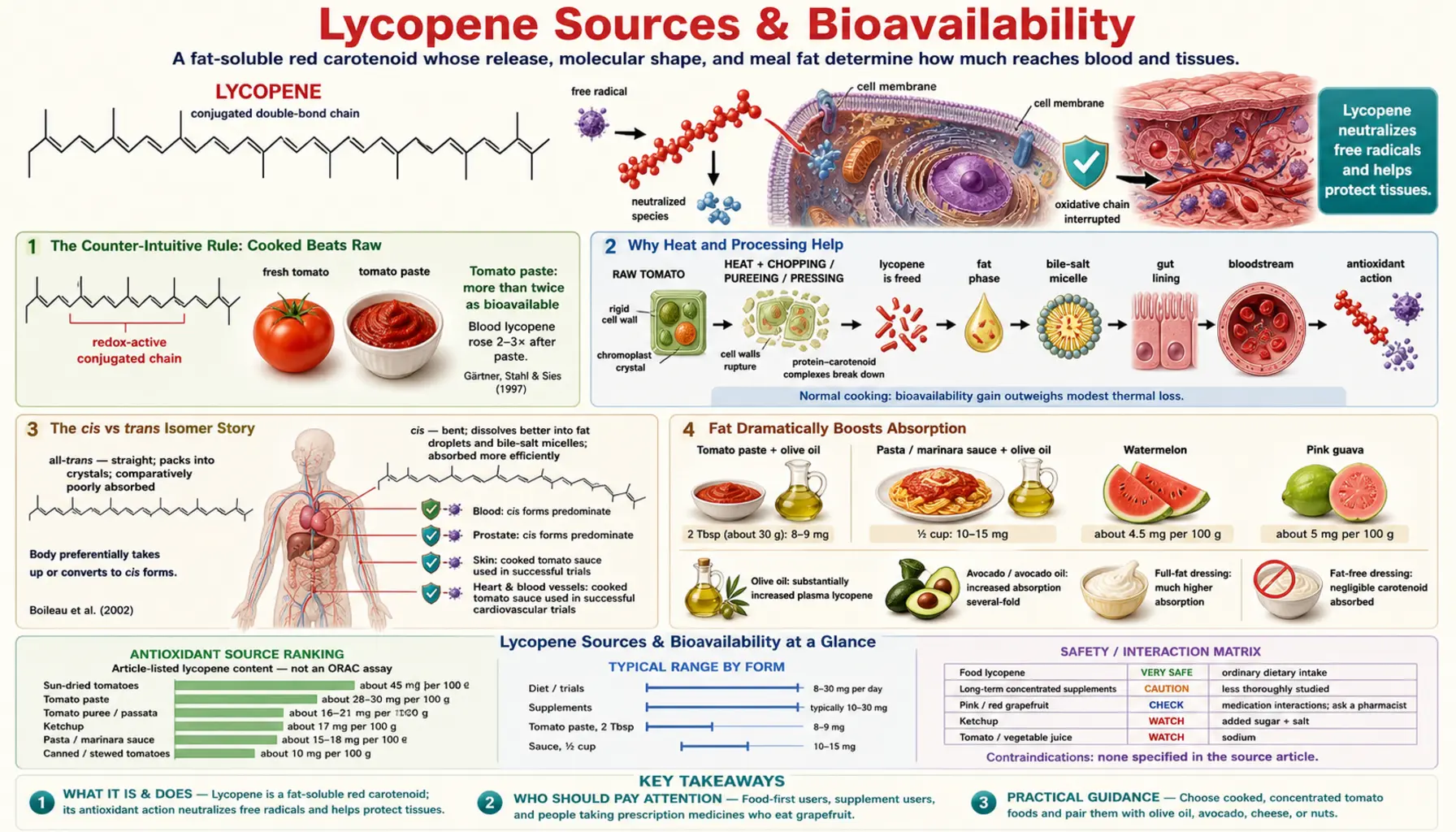
Lycopene breaks the usual “fresh and raw is best” rule of nutrition. A bowl of cooked tomato sauce delivers dramatically more absorbable lycopene than the same weight of raw tomato, because heat and processing break down the plant cell walls that trap the pigment and convert it into a form the body absorbs more readily. Add a little fat — olive oil, avocado — and absorption multiplies again. This page explains the surprising food science of getting lycopene from your diet: why tomato paste is the richest practical source, how cooking and fat transform bioavailability, and where watermelon and pink grapefruit fit as the best raw sources.
Table of Contents
- The Counter-Intuitive Rule: Cooked Beats Raw
- Why Heat and Processing Help
- The cis vs trans Isomer Story
- Fat Dramatically Boosts Absorption
- Lycopene Content of Common Foods
- Tomato Products, Ranked
- Beyond Tomatoes: Watermelon, Grapefruit, Guava
- How Much, and Practical Tips
- A Note on Supplements
- Key Research Papers
- Connections
- Featured Videos
The Counter-Intuitive Rule: Cooked Beats Raw
The single most important practical fact about dietary lycopene was established in a landmark 1997 study by Gärtner, Stahl, and Sies. They fed volunteers equal amounts of lycopene as either fresh tomatoes or tomato paste, and measured how much reached the bloodstream. Lycopene from tomato paste was more than twice as bioavailable as lycopene from fresh tomatoes — blood lycopene rose two to three times higher after the paste.
This flips the usual dietary intuition on its head. For most nutrients (vitamin C, folate, many polyphenols), raw and minimally-processed is best because heat degrades them. Lycopene is the opposite: the heating and mechanical processing that turns raw tomatoes into paste, sauce, and ketchup increases the amount your body can actually absorb. A fresh tomato is not a bad source, but pound for pound it is far from the best one — the richest practical sources are all cooked and concentrated.
Why Heat and Processing Help
In a raw tomato, lycopene is locked inside the cells, bound tightly within crystalline structures in the chromoplasts (the pigment-containing organelles) and hemmed in by rigid, indigestible cell walls. Human digestion is not very good at liberating it from this matrix. Two things happen when tomatoes are cooked and processed:
- Cell walls rupture. Heat and mechanical processing (chopping, pureeing, pressing) break down the plant cell walls and the protein–carotenoid complexes, physically freeing the lycopene so it can dissolve into the fatty phase of your meal and be absorbed.
- Concentration rises. Making paste or sauce removes water, concentrating the lycopene into far less volume — so a tablespoon of paste carries the lycopene of a large quantity of fresh tomato.
There is a real trade-off worth acknowledging honestly: prolonged high-heat cooking eventually degrades some lycopene, and very long exposure to air and light causes losses. But for normal home and commercial cooking, the gain in bioavailability far outweighs the modest thermal loss. The net effect strongly favors cooked and processed tomato products.
The cis vs trans Isomer Story
There is a second, more subtle reason cooking helps, and it involves the molecule's shape. In raw tomatoes, lycopene exists mostly in the all-trans configuration — a long, straight molecule. The all-trans form packs into tight crystals and is comparatively poorly absorbed. Heat isomerizes some of the lycopene into cis forms — bent, kinked shapes that do not crystallize as readily, dissolve better into fat droplets and bile-salt micelles, and are absorbed more efficiently.
Tellingly, the lycopene circulating in human blood and stored in tissues like the prostate is predominantly in cis forms, even though the diet is mostly all-trans — showing that the body preferentially takes up (or converts to) the cis isomers. Boileau and colleagues (2002) reviewed the evidence that cis-isomers of lycopene are more bioavailable than the all-trans form. So cooking does two favors at once: it frees lycopene from cell walls and shifts it toward the better-absorbed molecular shape.
Fat Dramatically Boosts Absorption
Lycopene is fat-soluble, so it needs dietary fat to be absorbed — fat stimulates bile release, forms the micelles that ferry carotenoids across the gut lining, and provides the oily phase lycopene dissolves into. Eating tomatoes with essentially no fat wastes much of their lycopene.
The magnitude of this effect is large and well-documented:
- Olive oil: Fielding and colleagues (2005) found that cooking tomatoes with olive oil substantially increased the rise in plasma lycopene compared with cooking without it — a natural pairing given that tomato sauces are traditionally made with olive oil.
- Avocado: Unlu and colleagues (2005) showed that adding avocado or avocado oil to tomato salsa and salad increased lycopene absorption several-fold.
- Full-fat dressing: Brown and colleagues (2004) demonstrated that carotenoid absorption from salads was much higher when eaten with full-fat salad dressing than with fat-free dressing — with fat-free dressing, negligible carotenoid was absorbed.
The practical lesson is simple and delicious: pair your tomatoes with a healthy fat. Sauté tomato sauce in olive oil, add avocado to salsa, drizzle olive oil over a caprese salad. This single habit can multiply the lycopene you actually absorb.
Lycopene Content of Common Foods
The figures below are approximate values (milligrams of lycopene per 100 grams of food) drawn from food-composition databases such as USDA FoodData Central. Actual content varies considerably with variety, ripeness, and processing — red, fully-ripe tomatoes contain far more than pale or under-ripe ones. Remember that content is only half the story: bioavailability (how much you absorb) can differ even more than the raw numbers suggest.
- Sun-dried tomatoes — approximately 45 mg per 100 g (very concentrated, but eaten in small amounts)
- Tomato paste — approximately 28–30 mg per 100 g (the richest practical everyday source)
- Tomato puree / passata — approximately 16–21 mg per 100 g
- Ketchup — approximately 17 mg per 100 g (though high in added sugar and salt)
- Pasta / marinara sauce — approximately 15–18 mg per 100 g
- Canned/stewed tomatoes — approximately 10 mg per 100 g
- Condensed tomato soup (prepared) — approximately 8–10 mg per 100 g
- Guava (pink) — approximately 5 mg per 100 g
- Watermelon — approximately 4.5 mg per 100 g (the best raw source; already well-absorbed)
- Fresh raw tomato — approximately 2.5–3 mg per 100 g (and poorly absorbed without cooking or fat)
- Pink / red grapefruit — approximately 1.5–3.4 mg per 100 g
- Papaya — approximately 1.8–2.5 mg per 100 g
Tomato Products, Ranked
For someone deliberately seeking dietary lycopene, tomato products rank roughly like this in practical value (balancing content, absorption, and typical serving size):
- Tomato paste — the best everyday choice. Concentrated, cooked, highly bioavailable. Two tablespoons (about 30 g) provide roughly 8–9 mg of well-absorbed lycopene. Stir into soups, stews, and sauces.
- Tomato/pasta sauce cooked with olive oil — combines cooked tomato with the fat needed for absorption; a half-cup can supply 10–15 mg. This is the exact form used in most of the successful skin and cardiovascular trials.
- Tomato soup and canned tomatoes — convenient, cooked, decent content; add a little olive oil.
- Tomato juice / vegetable juice — heat-processed and reasonably bioavailable, especially with a fat-containing meal; watch the sodium.
- Ketchup — genuinely lycopene-rich, but the sugar and salt make it a condiment, not a health strategy.
- Fresh raw tomatoes — healthy and worthwhile, but the least efficient lycopene delivery unless cooked and eaten with fat.
Beyond Tomatoes: Watermelon, Grapefruit, Guava
Tomatoes dominate lycopene intake in most Western diets, but they are not the only source — and a couple of the alternatives have a useful advantage.
- Watermelon is the standout non-tomato source, at roughly 4.5 mg per 100 g — often more than a raw tomato. Crucially, watermelon lycopene is already highly bioavailable even though the fruit is eaten raw and unheated: Edwards and colleagues (2003) showed that drinking watermelon juice raised plasma lycopene efficiently. The reason is that watermelon's soft, watery flesh does not lock lycopene into tough crystalline structures the way a firm raw tomato does, so it is released readily during digestion.
- Pink and red grapefruit supply a modest amount of lycopene (the red-fleshed varieties only; white grapefruit has little). A caution: grapefruit interacts with a number of medications — check with a pharmacist if you take prescription drugs.
- Pink guava is one of the richest fruit sources at around 5 mg per 100 g, where available.
- Papaya and, to a lesser extent, other red-orange fruits contribute smaller amounts.
Note that not everything red is a lycopene source — strawberries, cherries, and red apples get their color from anthocyanins, not lycopene. Lycopene's red is specific to tomatoes and a handful of red-fleshed fruits.
How Much, and Practical Tips
There is no official recommended intake for lycopene because it is not an essential nutrient, but the diets and trials associated with benefits generally involved somewhere between 8 and 30 mg per day — readily achievable from food. A few concrete habits capture nearly all the practical value:
- Cook your tomatoes and add olive oil. This is the highest-leverage habit: it improves both the release and the absorption of lycopene at once.
- Keep tomato paste on hand. A tube or can of paste is the most concentrated, shelf-stable, well-absorbed source; a spoonful enriches almost any savory dish.
- Enjoy watermelon in season as an easy, well-absorbed raw source.
- Pair with any fat you already enjoy — olive oil, avocado, cheese, nuts — rather than eating tomatoes fat-free.
- Don't obsess over exact milligrams. A Mediterranean-style pattern rich in cooked tomatoes and olive oil delivers ample lycopene without counting.
A Note on Supplements
Isolated lycopene capsules exist, typically providing 10–30 mg. As the Prostate Health and Heart pages detail, the human evidence consistently favors whole tomato foods over purified lycopene — in the strongest studies, tomato preparations outperformed the isolated compound. Supplements are also not needed to reach the intakes associated with benefit, since a few tablespoons of tomato paste or a bowl of sauce get you there deliciously and for pennies. If you do choose a supplement (for example, because you dislike tomatoes), take it with a fat-containing meal to aid absorption, and treat it as a minor dietary adjunct rather than a therapy. Lycopene is very safe, but concentrated long-term supplementation has not been studied as thoroughly as ordinary dietary intake.
Key Research Papers
- Gärtner C, Stahl W, Sies H (1997). Lycopene is more bioavailable from tomato paste than from fresh tomatoes. American Journal of Clinical Nutrition. — PMID 9209178
- Boileau TW, Boileau AC, Erdman JW Jr (2002). Bioavailability of all-trans and cis-isomers of lycopene. Experimental Biology and Medicine. — PMID 12424334
- Unlu NZ, Bohn T, Clinton SK, Schwartz SJ (2005). Carotenoid absorption from salad and salsa by humans is enhanced by the addition of avocado or avocado oil. Journal of Nutrition. — PMID 15735074
- Fielding JM, Rowley KG, Cooper P, O'Dea K (2005). Increases in plasma lycopene concentration after consumption of tomatoes cooked with olive oil. Asia Pacific Journal of Clinical Nutrition. — PMID 15927929
- Brown MJ, Ferruzzi MG, Nguyen ML, et al. (2004). Carotenoid bioavailability is higher from salads ingested with full-fat than with fat-reduced salad dressings as measured with electrochemical detection. American Journal of Clinical Nutrition. — PMID 15277161
- Edwards AJ, Vinyard BT, Wiley ER, et al. (2003). Consumption of watermelon juice increases plasma concentrations of lycopene and beta-carotene in humans. Journal of Nutrition. — PMID 12672916
- Giovannucci E (1999). Tomatoes, tomato-based products, lycopene, and cancer: review of the epidemiologic literature (dietary-source context). Journal of the National Cancer Institute. — PMID 10050865
- Rao AV, Agarwal S (2000). Role of antioxidant lycopene in cancer and heart disease (sources and intake background). Journal of the American College of Nutrition. — PMID 11022869
PubMed Topic Searches
- PubMed: Lycopene bioavailability and processing
- PubMed: Lycopene cis/trans isomers
- PubMed: Lycopene, dietary fat and absorption
- PubMed: Watermelon and plasma lycopene
- PubMed: Lycopene content of tomato products
External Authoritative Resources
- USDA FoodData Central — searchable lycopene content of tomato products, watermelon, and grapefruit
- Linus Pauling Institute — Carotenoids (Sources and Bioavailability)
- MyPlate — Vegetables
- PubMed — Lycopene bioavailability (all results)
Connections
- Lycopene (Main Page)
- Lycopene Benefits Hub
- Lycopene for Prostate Health
- Lycopene for the Heart
- Lycopene for Skin
- Tomatoes
- Olive Oil
- All Foods
- Beta-Carotene
- Lutein
- Astaxanthin
- Vitamin E
- Vitamin A
- All Antioxidants