Lycopene for Skin & Sun Protection
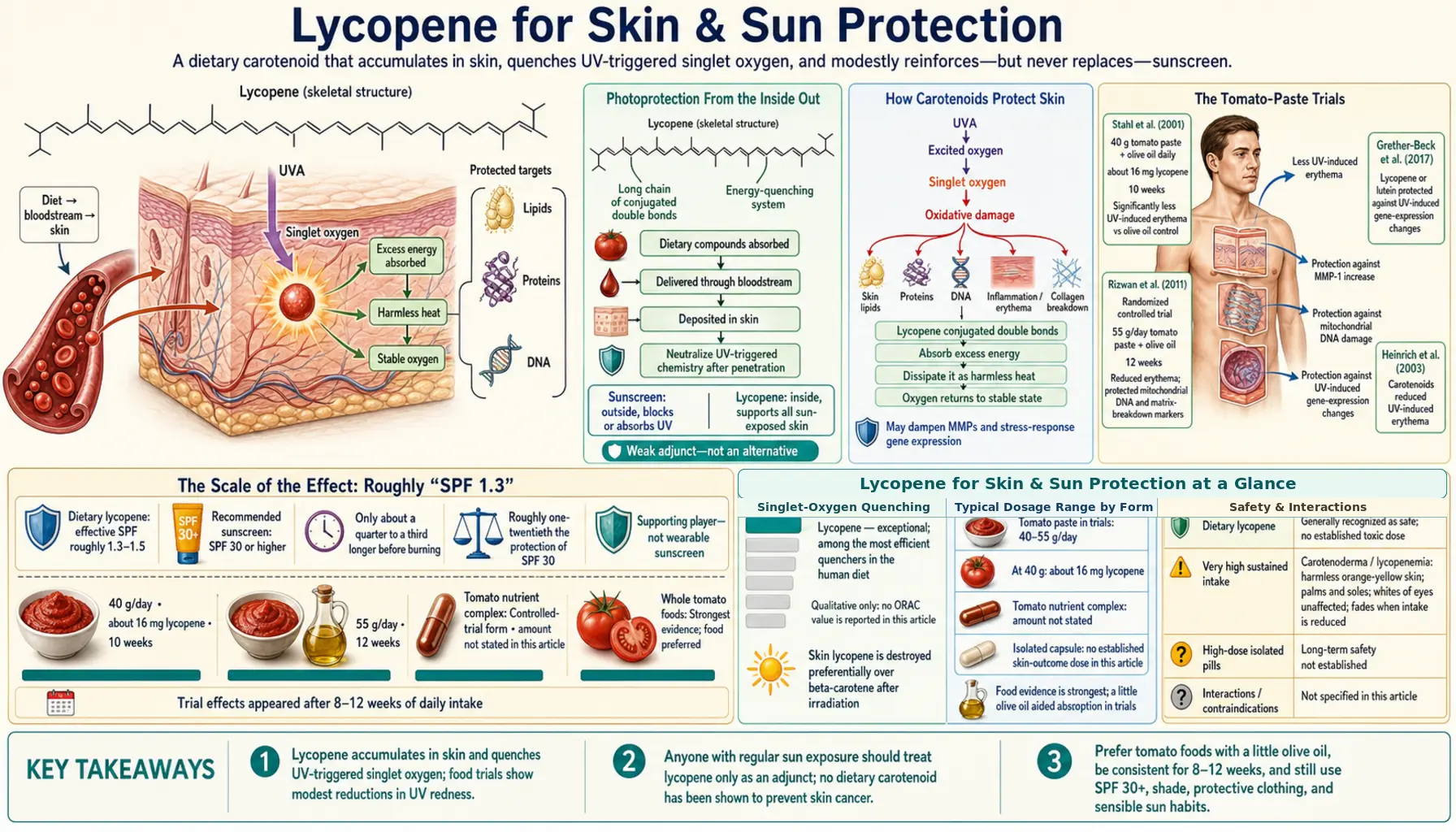
Lycopene accumulates in the skin, and there it does something genuinely measurable: several controlled trials show that people who eat lycopene-rich tomato paste for several weeks develop noticeably less redness when their skin is exposed to ultraviolet light. This is real, published, human evidence for “photoprotection from the inside out.” But it is essential to keep the scale honest. The protective effect is roughly equivalent to a sun protection factor of about 1.3 — a modest reinforcement, not a wearable sunscreen. Dietary lycopene is a supporting player in skin health, never a substitute for SPF, shade, and sensible sun habits. This page walks through what the research actually shows and where its limits are.
Table of Contents
- Photoprotection From the Inside Out
- How Carotenoids Protect Skin
- The Tomato-Paste Trials
- The Scale of the Effect: Roughly “SPF 1.3”
- Protection Against Photoaging
- Lycopene Is Consumed Defending the Skin
- Supplements vs Tomato Foods
- Carotenoderma and Safety
- The Essential Caveat: Never Replace Sunscreen
- Key Research Papers
- Connections
- Featured Videos
Photoprotection From the Inside Out
Sunscreen works from the outside, sitting on the skin surface to block or absorb ultraviolet radiation before it penetrates. “Systemic” or “nutritional” photoprotection works from the inside: dietary compounds are absorbed, delivered through the bloodstream, and deposited in the skin, where they neutralize some of the damaging chemistry that UV light triggers after it has already penetrated. Lycopene is one of the best-studied nutritional photoprotectants because it concentrates in skin tissue and is an exceptional quencher of the specific reactive molecule UV light produces.
The appeal of inside-out protection is that it covers all sun-exposed skin uniformly, cannot be sweated or washed off, and does not need to be reapplied. Its fundamental limitation is that it is weak — it can blunt UV damage by a modest percentage, but it cannot come close to the protection of a proper sunscreen. The two are complementary, and the research community is consistent on this point: nutritional photoprotection is an adjunct, not an alternative.
How Carotenoids Protect Skin
When ultraviolet light — especially UVA — strikes the skin, it excites oxygen molecules into a highly reactive, energy-loaded state called singlet oxygen. Singlet oxygen is a potent oxidant that damages skin lipids, proteins, and DNA, drives the inflammation we experience as sunburn, and over years contributes to wrinkling and skin cancer. Lycopene is, by a wide margin, one of the most efficient quenchers of singlet oxygen in the human diet: its long chain of conjugated double bonds absorbs the excess energy and dissipates it harmlessly as heat, returning the oxygen to its stable state.
This singlet-oxygen quenching is the core mechanism, described in Rao and Agarwal's antioxidant review and detailed in the carotenoid-photoprotection literature by Stahl and Sies. Beyond direct quenching, carotenoids also appear to dampen the downstream inflammatory and matrix-degrading signaling that UV sets off — reducing the enzymes (matrix metalloproteinases) that break down collagen and reducing the expression of stress-response genes. Böhm and colleagues and Stahl's 2012 review synthesized the chemistry of how dietary carotenoids interact with singlet oxygen and free radicals in skin.
The Tomato-Paste Trials
The landmark human evidence comes from a series of dietary intervention trials using tomato paste — a concentrated, well-absorbed lycopene source:
- Stahl et al. (2001) had volunteers eat 40 g of tomato paste (about 16 mg lycopene) in olive oil daily for 10 weeks. Compared with a control group eating only olive oil, the tomato-paste group developed significantly less UV-induced erythema (redness) when a standardized dose of UV light was applied to their skin. This was the first clean demonstration that a normal food, eaten for a couple of months, measurably reduces sunburn severity.
- Rizwan et al. (2011) conducted a randomized controlled trial giving 55 g/day of lycopene-rich tomato paste in olive oil for 12 weeks. The tomato-paste group showed reduced UV-induced erythema and, at the molecular level, protection against the mitochondrial DNA damage and matrix-breakdown markers that drive photoaging.
- Grether-Beck et al. (2017) compared oral lycopene, a tomato nutrient complex, and lutein in a controlled trial, finding that oral supplementation with lycopene or lutein protected against UV-induced gene expression changes in human skin at the molecular level.
Earlier work by Heinrich et al. (2003) established the same effect for carotenoids more broadly, showing that carotenoid supplementation reduced UV-induced erythema in humans. Together these trials make skin one of the better-supported lycopene benefit areas — the effect is small but has been reproduced with objective measurements in randomized designs.
The Scale of the Effect: Roughly “SPF 1.3”
Here is the honesty check that every discussion of lycopene and skin needs. In the tomato-paste trials, the reduction in UV-induced redness corresponded to an effective sun protection factor of roughly 1.3 to 1.5. For comparison, dermatologists recommend a sunscreen of SPF 30 or higher for meaningful sun protection.
An SPF of about 1.3 means dietary lycopene extends the time before your skin burns by only about a quarter to a third — helpful at the margins, but nowhere near enough to let you spend more time in strong sun safely. Framing it usefully: eating tomatoes may make your skin a little more resilient day to day, but it provides no license to skip sunscreen, and it will not prevent a sunburn during real sun exposure. Anyone who markets lycopene (or any carotenoid) as an “edible sunscreen” is overstating the science by more than an order of magnitude.
Protection Against Photoaging
Beyond acute sunburn, chronic UV exposure causes photoaging — wrinkles, loss of elasticity, and pigment changes — largely by generating reactive oxygen species that activate matrix metalloproteinases (MMPs), the enzymes that degrade the skin's collagen and elastin scaffolding. The Rizwan 2011 trial found that lycopene-rich tomato paste protected against the increase in MMP-1 and against mitochondrial DNA damage after UV exposure, providing a plausible mechanistic basis for a modest anti-photoaging effect.
Palombo and colleagues (2007) demonstrated that a combined oral and topical carotenoid regimen improved skin roughness and other parameters over 12 weeks, and reviews such as Balić et al. (2019) summarize the growing but still-modest evidence that dietary carotenoids support long-term skin resilience. As with sunburn, the realistic expectation is a subtle, cumulative supportive effect — a healthy-diet contribution to skin aging, not a replacement for retinoids, sun avoidance, or other proven dermatologic interventions.
Lycopene Is Consumed Defending the Skin
A striking piece of mechanistic evidence comes from Ribaya-Mercado and colleagues (1995), who showed that when human skin is exposed to UV light, lycopene is destroyed preferentially over beta-carotene — skin lycopene levels dropped sharply after irradiation while beta-carotene was relatively spared. This is exactly what you would expect if lycopene is on the front line, sacrificing itself to quench the singlet oxygen and free radicals generated by UV before they can damage skin structures.
This finding cuts two ways. It is direct evidence that lycopene is biologically active in the skin's response to sunlight. It also implies that sun exposure depletes your skin's lycopene, which is a reasonable argument for maintaining a steady dietary intake — you are continually restocking a defense that UV continually consumes.
Supplements vs Tomato Foods
As everywhere in the lycopene literature, whole tomato foods have the strongest evidence. Every one of the major skin trials used tomato paste (or a tomato nutrient complex), not isolated lycopene powder, and always paired it with a little olive oil to aid absorption. Tomato paste delivers lycopene alongside its cousins phytoene and phytofluene, which are colorless carotenoids that also absorb UV and may contribute to the skin effect. There is no strong evidence that an isolated lycopene capsule matches tomato paste for skin outcomes, and good reason (the whole-food pattern seen across all lycopene research) to prefer the food.
Carotenoderma and Safety
Lycopene is remarkably safe. The main cosmetic consideration at very high intakes is carotenoderma (specifically lycopenemia when lycopene is the cause) — a harmless orange-yellow tinting of the skin, most visible on the palms and soles, that appears with very large, sustained intakes of tomato or carotenoid-rich foods. It is entirely benign, does not tint the whites of the eyes (which distinguishes it from jaundice), and fades when intake is reduced. There is no established toxic dose of dietary lycopene, and it is generally recognized as safe as a food component. As with any concentrated supplement, extremely high-dose isolated lycopene pills have not been studied for long-term safety the way food intake has, which is another reason to favor food.
The Essential Caveat: Never Replace Sunscreen
- Lycopene is not a sunscreen. Its effective SPF of about 1.3 is roughly one-twentieth the protection of the SPF 30 dermatologists recommend. It cannot prevent sunburn during genuine sun exposure.
- Use it as an adjunct. A tomato-rich diet may modestly reinforce your skin's resilience; combine it with, never in place of, broad-spectrum sunscreen, protective clothing, shade, and avoiding peak-hour sun.
- Skin cancer prevention still rests on UV avoidance. No dietary carotenoid has been shown to prevent melanoma or non-melanoma skin cancer. See the site's Dermatology section for evidence-based skin-cancer prevention.
- Be patient and consistent. The trial effects appeared only after 8–12 weeks of daily intake — this is a slow, steady-state effect, not something that helps for a single day at the beach.
Key Research Papers
- Stahl W, Heinrich U, Wiseman S, et al. (2001). Dietary tomato paste protects against ultraviolet light-induced erythema in humans. Journal of Nutrition. — PMID 11340098
- Rizwan M, Rodriguez-Blanco I, Harbottle A, et al. (2011). Tomato paste rich in lycopene protects against cutaneous photodamage in humans in vivo: a randomized controlled trial. British Journal of Dermatology. — PMID 20854436
- Grether-Beck S, Marini A, Jaenicke T, et al. (2017). Molecular evidence that oral supplementation with lycopene or lutein protects human skin against ultraviolet radiation. British Journal of Dermatology. — PMID 27662341
- Heinrich U, Gärtner C, Wiebusch M, et al. (2003). Supplementation with beta-carotene or a similar amount of mixed carotenoids protects humans from UV-induced erythema. Journal of Nutrition. — PMID 12514275
- Ribaya-Mercado JD, Garmyn M, Gilchrest BA, Russell RM (1995). Skin lycopene is destroyed preferentially over beta-carotene during ultraviolet irradiation in humans. Journal of Nutrition. — PMID 7616301
- Stahl W, Sies H (2007). Carotenoids and flavonoids contribute to nutritional protection against skin damage from sunlight. Molecular Biotechnology. — PMID 17914160
- Sies H, Stahl W (2004). Nutritional protection against skin damage from sunlight. Annual Review of Nutrition. — PMID 15189118
- Stahl W, Sies H (2012). Photoprotection by dietary carotenoids: concept, mechanisms, evidence and future development. Molecular Nutrition & Food Research. — PMID 21953695
- Palombo P, Fabrizi G, Ruocco V, et al. (2007). Beneficial long-term effects of combined oral/topical antioxidant treatment with the carotenoids lutein and zeaxanthin on human skin. Skin Pharmacology and Physiology. — PMID 17446716
- Balić A, Mokos M (2019). Do we utilize our knowledge of the skin protective effects of carotenoids enough? Antioxidants (Basel). — PMID 31370257
- Rao AV, Agarwal S (2000). Role of antioxidant lycopene in cancer and heart disease (singlet-oxygen quenching background). Journal of the American College of Nutrition. — PMID 11022869
PubMed Topic Searches
- PubMed: Lycopene and skin photoprotection
- PubMed: Tomato paste and UV erythema
- PubMed: Carotenoids and singlet oxygen in skin
- PubMed: Lycopene and photoaging
- PubMed: Dietary carotenoids and sunburn
External Authoritative Resources
- Linus Pauling Institute — Carotenoids and Skin
- American Academy of Dermatology — Sun Protection
- Skin Cancer Foundation — Prevention
- PubMed — Lycopene and skin (all results)
Connections
- Lycopene (Main Page)
- Lycopene Benefits Hub
- Lycopene Sources & Bioavailability
- Lycopene for the Heart
- Astaxanthin
- Beta-Carotene
- Lutein
- Zeaxanthin
- Vitamin C
- Vitamin E
- Dermatology
- Melanoma
- Tomatoes
- All Antioxidants