Lycopene for Prostate Health
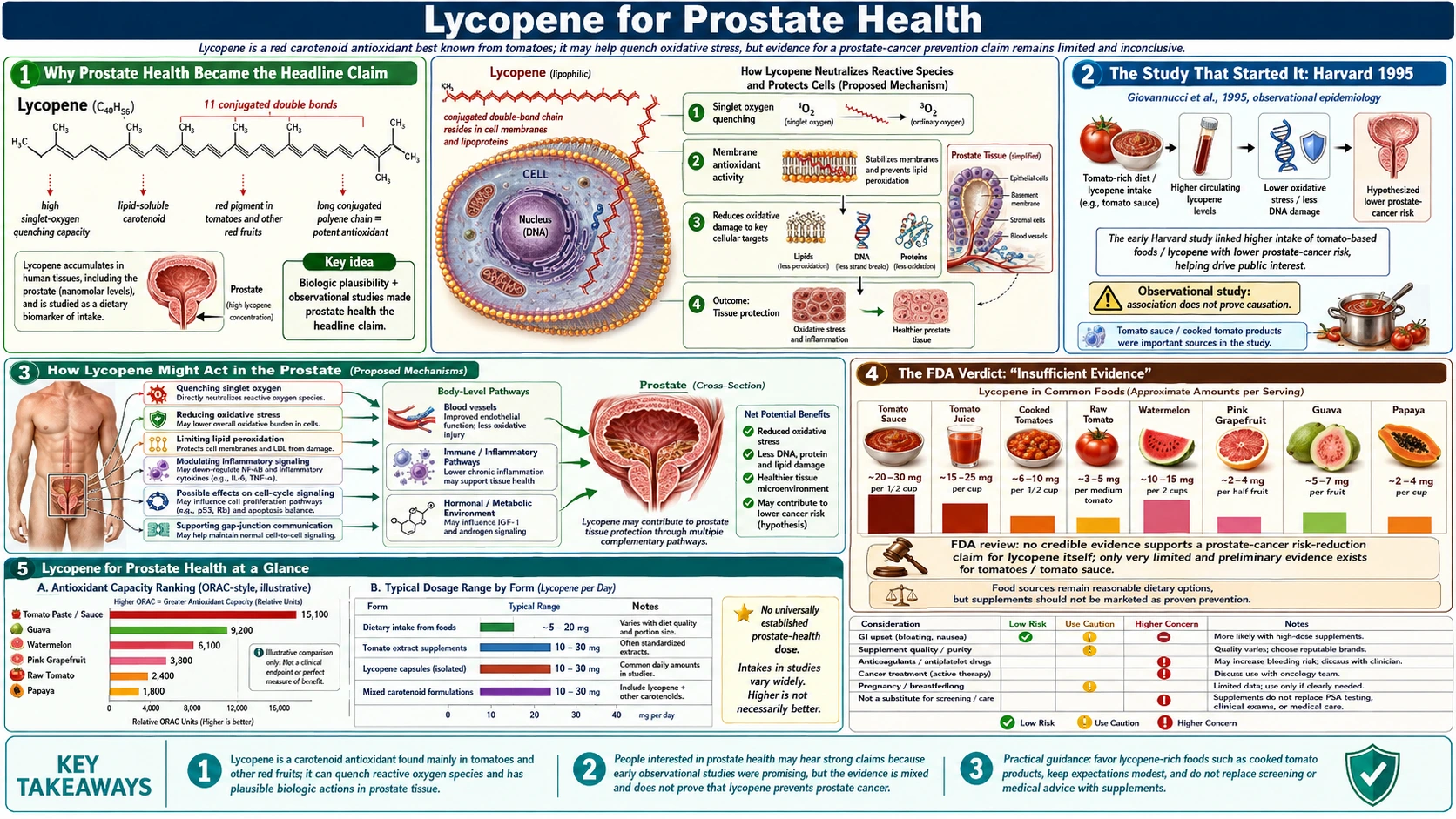
Prostate health is where lycopene became famous — and where the gap between hype and proof is widest. The story began with a genuinely striking 1995 Harvard cohort finding that men who ate the most tomato products had a lower risk of prostate cancer. Two decades of follow-up research told a more complicated story: some studies confirmed a modest association, others found nothing, the U.S. Food and Drug Administration reviewed the entire body of evidence in 2007 and concluded it was insufficient to support a health claim, and a large trial of serum lycopene found no protective association at all. This page presents that mixed evidence honestly, because you deserve the real picture, not a supplement-marketing version of it.
Table of Contents
- Why Prostate Health Became the Headline Claim
- The Study That Started It: Harvard 1995
- How Lycopene Might Act in the Prostate
- The FDA Verdict: “Insufficient Evidence”
- The Prostate Cancer Prevention Trial: A Null Result
- What the Meta-Analyses Actually Show
- Benign Prostatic Hyperplasia and Urinary Symptoms
- Whole Tomatoes vs Lycopene Pills
- The Honest Bottom Line
- Key Research Papers
- Connections
- Featured Videos
Why Prostate Health Became the Headline Claim
Prostate cancer is the most commonly diagnosed non-skin cancer in men in the United States, and the prostate happens to concentrate lycopene more than almost any other tissue in the body. Those two facts made the prostate an obvious place to look for a lycopene benefit, and in the late 1990s a wave of promising epidemiology, laboratory experiments, and a memorable “tomatoes fight cancer” media narrative turned lycopene into one of the best-selling single-nutrient supplements of its era.
It is worth stating clearly at the outset: eating tomatoes is good for you, and there is nothing wrong with enjoying them for prostate health. Tomatoes are low-calorie, nutrient-dense whole foods, and the dietary pattern that includes them (Mediterranean-style, plant-forward) is one of the best-supported eating patterns for overall health. The honest uncertainty in this page is narrower than it may first appear: it is specifically about whether isolated lycopene, or lycopene as a measurable biomarker, independently prevents or slows prostate cancer. On that narrow question, the evidence is genuinely mixed.
The Study That Started It: Harvard 1995
In 1995, Edward Giovannucci and colleagues published an analysis of the Health Professionals Follow-Up Study — a large prospective cohort of nearly 48,000 U.S. male health professionals whose diets had been tracked since 1986. Among 46 fruits and vegetables examined, tomato-based foods stood out. Men who ate the most tomato sauce, tomatoes, and pizza (the study's major tomato sources) had a meaningfully lower risk of prostate cancer. Combined intake of tomato products two or more times per week was associated with roughly a 20–35% lower risk of advanced prostate cancer, and lycopene was identified as the most plausible active constituent because tomatoes are its dominant dietary source.
This was a strong, carefully-done cohort study, and it launched an entire research field. But it is essential to understand what a study like this can and cannot prove. It is observational: it shows an association between a dietary pattern and an outcome, not that lycopene caused the lower risk. Men who eat a lot of tomato sauce may differ in dozens of other ways — overall diet quality, exercise, body weight, screening behavior — and while good cohort studies statistically adjust for many of these, they cannot rule out all of them. The 1995 finding was a compelling reason to investigate further, not a proof of benefit.
How Lycopene Might Act in the Prostate
Laboratory research has proposed several plausible mechanisms by which lycopene could influence prostate biology. These are real, published findings from cell and animal models — but a mechanism that works in a petri dish is a hypothesis about humans, not a demonstration.
- Antioxidant protection of DNA — oxidative damage to prostate-cell DNA is one route to malignant transformation. In a whole-food intervention, prostate cancer patients who ate tomato-sauce entrees before prostatectomy showed reduced oxidative DNA damage in their prostate tissue and blood (Chen L et al., 2001).
- IGF-1 signaling — insulin-like growth factor 1 is a growth-promoting hormone linked to prostate cancer risk. Some studies report that higher lycopene intake is associated with lower circulating IGF-1.
- Androgen and cell-cycle signaling — laboratory work suggests lycopene metabolites can down-regulate androgen-responsive genes and slow the cell cycle in prostate-cancer cell lines.
- Anti-angiogenesis — tumors need new blood vessels to grow. A 2014 prospective analysis (Zu K et al.) found that higher lycopene intake was associated with prostate tumors showing less angiogenic (blood-vessel-forming) potential, hinting that any protective effect might act specifically against aggressive, vascularized disease.
An important nuance comes from animal work. In a 2003 rat study designed to test the prostate hypothesis rigorously, Boileau and colleagues fed rats either tomato powder, purified lycopene, or a control diet during chemically-induced prostate carcinogenesis. Tomato powder reduced prostate cancer death; purified lycopene alone did not. This is one of the most important and most under-reported findings in the entire lycopene literature, and it directly challenges the “take a lycopene pill” approach in favor of eating whole tomatoes.
The FDA Verdict: “Insufficient Evidence”
In 2005, supplement manufacturers petitioned the U.S. Food and Drug Administration for permission to make qualified health claims linking tomatoes and lycopene to reduced cancer risk. The FDA convened an evidence-based review, and in 2007 Kavanaugh, Trumbo, and Ellwood published the agency's findings in the Journal of the National Cancer Institute.
The conclusion was sobering for the lycopene industry. The FDA found no credible evidence to support a claim linking lycopene intake to reduced risk of prostate, lung, colorectal, gastric, breast, ovarian, endometrial, or pancreatic cancer. For tomato consumption specifically, the agency allowed only very weak, heavily-qualified claims for prostate, ovarian, gastric, and pancreatic cancer — the kind of claim that must be accompanied by language such as “very limited and preliminary scientific research suggests … FDA concludes that there is little scientific evidence supporting this claim.”
In plain terms: the top U.S. food-safety regulator reviewed everything available and decided the science did not justify telling the public that lycopene prevents cancer. That regulatory judgment remains a key anchor of honesty for anyone evaluating lycopene supplements.
The Prostate Cancer Prevention Trial: A Null Result
Some of the strongest evidence against an independent lycopene effect came in 2011 from Kristal and colleagues, who used the Prostate Cancer Prevention Trial — a large, well-characterized study population — to test whether serum lycopene concentration (an objective blood biomarker, not a diet questionnaire) predicted prostate cancer risk. Blood biomarkers avoid much of the recall error and confounding that weakens food-frequency studies.
The result was clearly null: there was no association between blood lycopene concentration and prostate cancer risk, including no association with aggressive disease. This finding carried particular weight precisely because it used an objective biomarker rather than self-reported diet, and it substantially cooled scientific enthusiasm for lycopene as a stand-alone prostate cancer preventive.
What the Meta-Analyses Actually Show
Meta-analyses pool many studies to find the average signal. For lycopene and prostate cancer they have produced a genuinely mixed picture, which is itself the honest answer:
- Etminan et al. (2004) pooled the earlier observational studies and found a modest reduction in prostate cancer risk with higher tomato and lycopene intake — stronger for cooked tomato products than raw.
- Cochrane Review, Ilic et al. (2011) — the gold-standard systematic review focused on randomized and controlled evidence — concluded that the available trials were few, small, and of variable quality, and that there was insufficient evidence to recommend lycopene for prostate cancer prevention or treatment.
- Chen P et al. (2015) meta-analysis found a weak inverse association that was not consistent across dose levels and was sensitive to how studies were selected.
- Rowles et al. (2018) dose-response meta-analysis found that higher consumption of tomato products, and higher circulating lycopene, were associated with a modest reduction in prostate cancer risk — a more encouraging summary than the Cochrane view, and a reminder that reasonable experts still weigh this evidence differently.
How should a careful reader reconcile these? The most defensible summary is: higher tomato/lycopene intake is associated with a small reduction in prostate cancer risk in observational data, this association is weaker and less certain in the highest-quality studies (biomarker studies and randomized trials), and it has never been proven that lycopene itself is the cause. That is a real but modest and uncertain signal — not the “lycopene prevents prostate cancer” headline that supplements have long implied.
Benign Prostatic Hyperplasia and Urinary Symptoms
Prostate cancer is not the only prostate concern. Benign prostatic hyperplasia (BPH) — the non-cancerous enlargement of the prostate that causes urinary frequency, weak stream, and nighttime urination in a majority of older men — has been studied as a separate lycopene target.
A small randomized trial found that 15 mg/day of lycopene over six months slowed the rise in prostate-specific antigen (PSA) and appeared to halt prostate enlargement compared with placebo in men with BPH. More recent laboratory and translational work (Natali et al., 2023) has continued to explore whole-tomato preparations for benign prostate health. The BPH evidence is smaller and less mature than the cancer literature, but because BPH is a quality-of-life condition rather than a life-threatening one, the risk–benefit calculus for simply eating more tomatoes is very favorable. This is an area where the honest verdict is “promising but preliminary” rather than “proven.”
Whole Tomatoes vs Lycopene Pills
If there is one practical takeaway from the entire prostate literature, it is that whole tomato foods have consistently outperformed isolated lycopene supplements. The evidence points this way repeatedly:
- The Boileau rat study: tomato powder reduced cancer death; purified lycopene did not.
- The Chen whole-food intervention: tomato-sauce entrees reduced oxidative DNA damage in human prostate tissue before surgery.
- Meta-analyses generally find stronger associations for cooked tomato products than for lycopene intake estimated in isolation.
The likely explanation is that tomatoes contain a family of related compounds — lycopene plus phytoene, phytofluene, other carotenoids, and phenolic acids — that may act together, and that the food matrix and cooking dramatically change how much is absorbed (see the Sources & Bioavailability page). For prostate health, the science supports a plate of tomato sauce far more confidently than it supports a lycopene capsule.
The Honest Bottom Line
- Do eat tomatoes and tomato products. They are healthy whole foods, part of well-supported dietary patterns, and the cooked forms are the best lycopene sources. There is no downside.
- Do not rely on lycopene supplements to prevent prostate cancer. The FDA found the evidence insufficient, a large biomarker study found no association, and the Cochrane review found insufficient evidence. Isolated lycopene is not a proven cancer preventive.
- The signal that exists is modest and points to food, not pills. Where benefits appear, they are consistently stronger for whole tomato foods than for purified lycopene.
- BPH is a reasonable, lower-stakes reason to include tomatoes — the preliminary evidence is encouraging and the risk is nil.
- Never substitute lycopene for medical care. Prostate cancer screening decisions, PSA monitoring, and BPH treatment should be made with a physician. Lycopene is a dietary consideration, not a therapy.
Key Research Papers
- Giovannucci E, Ascherio A, Rimm EB, et al. (1995). Intake of carotenoids and retinol in relation to risk of prostate cancer. Journal of the National Cancer Institute. — PMID 7473833
- Giovannucci E (1999). Tomatoes, tomato-based products, lycopene, and cancer: review of the epidemiologic literature. Journal of the National Cancer Institute. — PMID 10050865
- Clinton SK, Emenhiser C, Schwartz SJ, et al. (1996). cis-trans lycopene isomers, carotenoids, and retinol in the human prostate. Cancer Epidemiology, Biomarkers & Prevention. — PMID 8896894
- Chen L, Stacewicz-Sapuntzakis M, Duncan C, et al. (2001). Oxidative DNA damage in prostate cancer patients consuming tomato sauce-based entrees as a whole-food intervention. Journal of the National Cancer Institute. — PMID 11752012
- Boileau TW, Liao Z, Kim S, et al. (2003). Prostate carcinogenesis in N-methyl-N-nitrosourea (NMU)-testosterone-treated rats fed tomato powder, lycopene, or energy-restricted diets. Journal of the National Cancer Institute. — PMID 14600090
- Etminan M, Takkouche B, Caamaño-Isorna F (2004). The role of tomato products and lycopene in the prevention of prostate cancer: a meta-analysis of observational studies. Cancer Epidemiology, Biomarkers & Prevention. — PMID 15006906
- Kavanaugh CJ, Trumbo PR, Ellwood KC (2007). The U.S. Food and Drug Administration's evidence-based review for qualified health claims: tomatoes, lycopene, and cancer. Journal of the National Cancer Institute. — PMID 17623802
- Kristal AR, Till C, Platz EA, et al. (2011). Serum lycopene concentration and prostate cancer risk: results from the Prostate Cancer Prevention Trial. Cancer Epidemiology, Biomarkers & Prevention. — PMID 21335507
- Ilic D, Forbes KM, Hassed C (2011). Lycopene for the prevention of prostate cancer. Cochrane Database of Systematic Reviews. — PMID 22071840
- Zu K, Mucci L, Rosner BA, et al. (2014). Dietary lycopene, angiogenesis, and prostate cancer: a prospective study in the prostate-specific antigen era. Journal of the National Cancer Institute. — PMID 24463248
- Chen P, Zhang W, Wang X, et al. (2015). Lycopene and risk of prostate cancer: a systematic review and meta-analysis. Medicine (Baltimore). — PMID 26287411
- Rowles JL 3rd, Ranard KM, Applegate CC, et al. (2018). Processed and raw tomato consumption and risk of prostate cancer: a systematic review and dose-response meta-analysis. Prostate Cancer and Prostatic Diseases. — PMID 29317772
- Natali PG, Piantelli M, Minacori M, et al. (2023). Improving whole tomato transformation for prostate health: benign prostate hypertrophy as an exploratory model. International Journal of Molecular Sciences. — PMID 36982868
- van Breemen RB, Pajkovic N (2008). Multitargeted therapy of cancer by lycopene. Cancer Letters. — PMID 18585855
PubMed Topic Searches
- PubMed: Lycopene and prostate cancer
- PubMed: Tomato/lycopene prostate meta-analyses
- PubMed: Lycopene and BPH
- PubMed: Lycopene and PSA
- PubMed: Lycopene, IGF-1 and prostate
External Authoritative Resources
- Linus Pauling Institute — Carotenoids and Cancer
- National Cancer Institute — Diet and Cancer Risk
- Prostate Cancer Foundation
- PubMed — Lycopene and prostate (all results)
Connections
- Lycopene (Main Page)
- Lycopene Benefits Hub
- Lycopene Sources & Bioavailability
- Lycopene for the Heart
- Prostate Conditions
- Benign Prostatic Hyperplasia
- Prostate Cancer
- Urology
- Tomatoes
- Selenium
- Zinc
- Beta-Carotene
- Vitamin E
- All Antioxidants