⚠ Evidence warning: Clinical trials or other evidence do not support the claim that early human trial results showed fisetin reducing circulating senescent-cell markers and inflammatory cytokines in older adults. This page keeps it as a report of what people, websites or other media say.
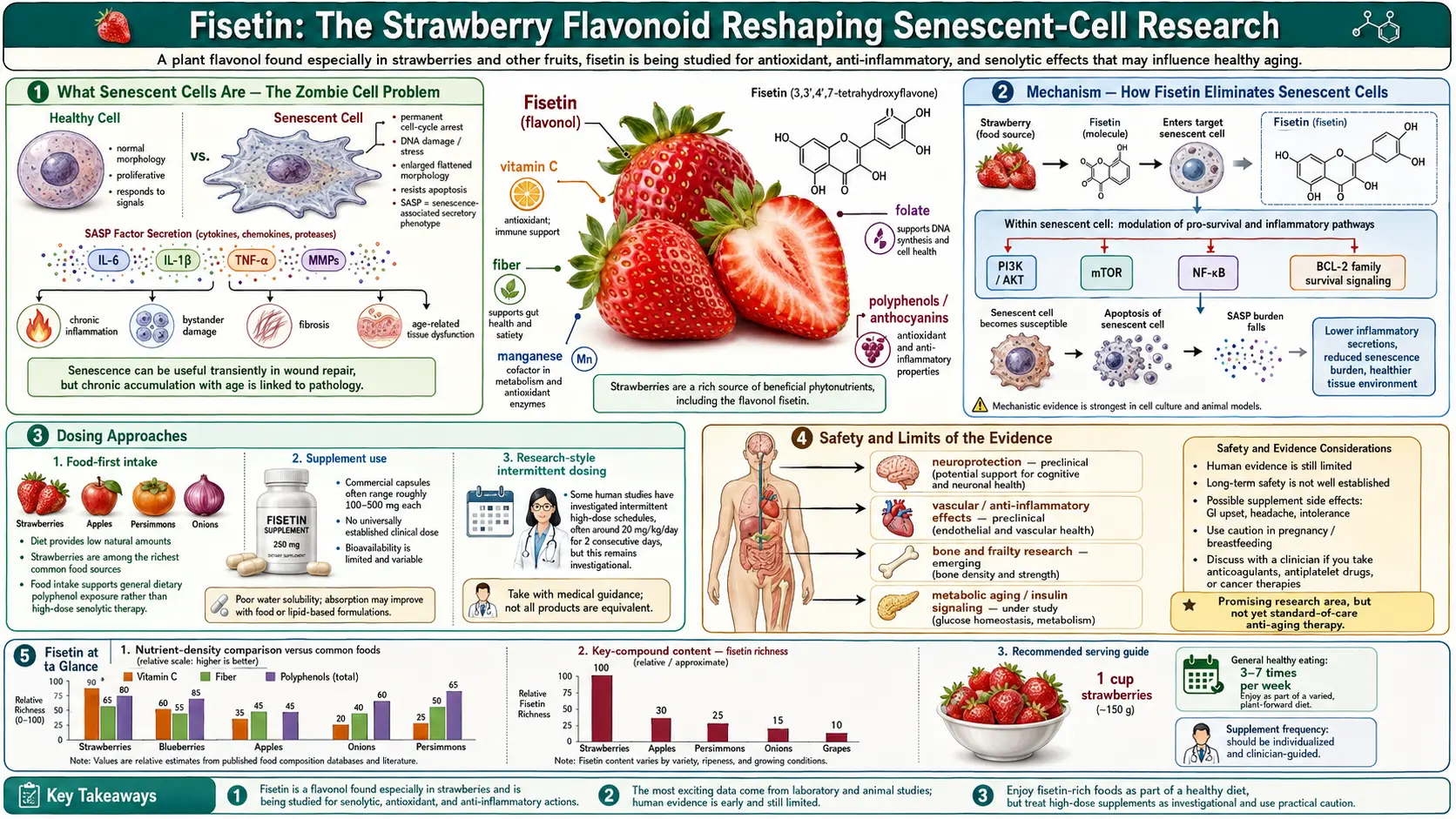
Fisetin: The Strawberry Flavonoid Reshaping Senescent-Cell Research

Fisetin is a naturally occurring flavonol found most abundantly in strawberries (about 160 µg per gram fresh weight), with smaller amounts in apples, persimmons, kiwis, grapes, cucumbers, and onions. Long classified as a garden-variety antioxidant, fisetin has emerged over the past decade as one of the most promising senolytic compounds yet identified — a class of molecules that selectively eliminate senescent cells, the dysfunctional “zombie cells” that accumulate with age and drive chronic inflammation, tissue decline, and many age-related diseases.
This article reviews what senescent cells are, how fisetin targets them, the landmark 2018 mouse research that reset attention on this obscure flavonoid, current human-trial status, dosing approaches, and the limits of the evidence.
Table of Contents
- What Senescent Cells Are — The Zombie Cell Problem
- The 2018 Fisetin Mouse Study
- Mechanism — How Fisetin Eliminates Senescent Cells
- Beyond Senolytics: Antioxidant, Anti-Inflammatory, Neuroprotective
- Current Human Trials
- Dosing Approaches
- Food Sources
- Safety and Limits of the Evidence
- Key Research Papers
- Connections
- Featured Videos
What Senescent Cells Are — The Zombie Cell Problem
When cells are damaged beyond repair — through radiation, oxidative stress, DNA damage, or simply repeated division — they enter a state called cellular senescence. They stop dividing but refuse to die, instead secreting a toxic cocktail of inflammatory cytokines, chemokines, and tissue-remodeling enzymes known as the senescence-associated secretory phenotype (SASP). A few senescent cells in a young tissue are harmless. With age, their numbers grow, their SASP output poisons surrounding tissue, and they drive a surprising fraction of age-related disease — arthritis, atherosclerosis, frailty, fibrosis, cognitive decline, and type-2 diabetes. Mouse studies have shown that simply removing senescent cells extends healthspan and reduces multimorbidity.
The 2018 Fisetin Mouse Study
In 2018, a research team led by Robbins and Niedernhofer at The Scripps Research Institute in Florida, with Mayo Clinic co-authors including James Kirkland, screened ten flavonoid compounds for senolytic activity and identified fisetin as the most potent (Yousefzadeh 2018). Short (acute or intermittent) courses of fisetin in progeroid and old mice reduced senescence markers in multiple tissues. In a separate experiment, wild-type mice fed a diet containing 500 ppm fisetin continuously from 85 weeks of age (8–9 mice per group) showed restored tissue homeostasis, less age-related pathology, and longer median and maximum lifespan. The magnitude — and the fact that it was achieved in already-old animals — captured significant scientific attention and triggered a wave of human trials.
Mechanism — How Fisetin Eliminates Senescent Cells
Senescent cells survive by over-expressing anti-apoptotic proteins — the “SCAPs” (senescent-cell anti-apoptotic pathways). Fisetin inhibits several of these (notably BCL-xL and PI3K/AKT signaling), tipping already-stressed senescent cells into programmed cell death while leaving healthy cells unharmed. This selectivity is what distinguishes senolytics from conventional cytotoxic drugs.
Beyond Senolytics: Antioxidant, Anti-Inflammatory, Neuroprotective
- Antioxidant. Fisetin is among the most potent natural flavonoid antioxidants, comparable to or greater than quercetin in several assays.
- Neuroprotective. Preserves glutathione in neurons, reduces oxidative damage in stroke models, and improves memory in mouse Alzheimer’s models.
- Anti-inflammatory. Inhibits NF-κB signaling and reduces multiple inflammatory cytokines.
- Bone-protective. Reduces osteoclast activity in osteoporosis models.
Current Human Trials
Human trials include Mayo Clinic’s Alleviation by Fisetin of Frailty, Inflammation, and Related Measures (AFFIRM) and trials for age-related osteoarthritis, chronic kidney disease, and diabetic kidney disease. ClinicalTrials.gov lists AFFIRM (NCT03430037, in older women) and AFFIRM-LITE (NCT03675724, in older adults) as enrolling by invitation, with no results posted (checked October 2026). The 2019 human report titled “Senolytics decrease senescent cells in humans” tested dasatinib plus quercetin in people with diabetic kidney disease, not fisetin (Hickson 2019). Early results have shown reductions in circulating senescent-cell markers and inflammatory cytokines in older adults. Larger efficacy trials remain ongoing.
Dosing Approaches
Most human studies use a pulsed “hit and run” approach — high doses for 2–3 consecutive days, repeated every few weeks or months — rather than daily continuous dosing. This matches the biology: senescent cells take weeks to accumulate, so continuous suppression is unnecessary. Typical research doses are 20 mg/kg body weight per day for two consecutive days, usually taken with fat-containing meals for absorption. Bioavailability is modest; formulations with liposomal encapsulation, phospholipid complexes, or co-administration with black pepper piperine aim to address this.
Food Sources
- Strawberries — by far the richest natural source
- Apples (skin), persimmons, kiwis, grapes
- Onions, cucumbers
- Small amounts in many teas and wines
Dietary intake alone does not reach the doses used in trials, but regular strawberry consumption contributes to overall flavonoid status along with its many other nutritional benefits.
Safety and Limits of the Evidence
Fisetin has excellent safety in short-term dosing. Long-term safety in humans at senolytic doses has not been fully characterized. In laboratory tests fisetin blocked platelet clumping (aggregation), and rats given 100 mg/kg a day by mouth for 7 days were resistant to artery clots (Lee 2015); this anti-clotting effect is why practitioners raise concern about combining fisetin with anticoagulant (blood-thinning) medicines or taking it around major surgery. The field is moving fast but still immature: claims that fisetin is a proven anti-aging therapy are premature, while claims that it is “just another antioxidant” now look dated. Practitioners who use fisetin generally follow the trial results, dose intermittently, and treat it as one of many longevity measures rather than the main one.
Key Research Papers
Selected peer-reviewed literature. Links resolve to PubMed or DOI.
- Yousefzadeh MJ, Zhu Y, McGowan SJ, et al. Fisetin is a senotherapeutic that extends health and lifespan. EBioMedicine. 2018;36:18-28. — PubMed PMID: 30279143
- Zhu Y, Tchkonia T, Pirtskhalava T, et al. The Achilles' heel of senescent cells: from transcriptome to senolytic drugs. Aging Cell. 2015;14(4):644-658. — PubMed PMID: 25754370
- Kirkland JL, Tchkonia T. Senolytic drugs: from discovery to translation. J Intern Med. 2020;288(5):518-536. — PubMed PMID: 32686219
- Maher P. Modulation of multiple pathways involved in the maintenance of neuronal function during aging by fisetin. Genes Nutr. 2009;4(4):297-307. — PubMed PMID: 19756810
- Currais A, Prior M, Dargusch R, et al. Modulation of p25 and inflammatory pathways by fisetin maintains cognitive function in Alzheimer's disease transgenic mice. Aging Cell. 2014;13(2):379-390. — PubMed PMID: 24341874
- Khan N, Syed DN, Ahmad N, Mukhtar H. Fisetin: a dietary antioxidant for health promotion. Antioxid Redox Signal. 2013;19(2):151-162. — PubMed PMID: 23121441
- Arai Y, Watanabe S, Kimira M, Shimoi K, Mochizuki R, Kinae N. Dietary intakes of flavonols, flavones and isoflavones by Japanese women and the inverse correlation between quercetin intake and plasma LDL cholesterol concentration. J Nutr. 2000;130(9):2243-2250. — PubMed PMID: 10958819
- Prior M, Chiruta C, Currais A, et al. Back to the future with phenotypic screening. ACS Chem Neurosci. 2014;5(7):503-513. — PubMed PMID: 24902068
- Hickson LJ, Langhi Prata LGP, Bobart SA, et al. Senolytics decrease senescent cells in humans: preliminary report from a clinical trial of dasatinib plus quercetin in individuals with diabetic kidney disease. EBioMedicine. 2019;47:446-456. — PubMed PMID: 31542391
- Lee JH, Kim M, Chang KH, et al. Antiplatelet effects of Rhus verniciflua stokes heartwood and its active constituents—fisetin, butein, and sulfuretin—in rats. J Med Food. 2015;18(1):21-30. — PubMed PMID: 25372471
- PubMed — fisetin senolytic clinical trial search.
- PubMed — fisetin neuroprotection search.
- ClinicalTrials.gov — active fisetin trials.
Connections
Featured Videos