⚠ Evidence warning: Clinical trials or other evidence do not support the claim that vitamin D has an immune-modulating rationale through the vitamin D receptor on mast cells. This page keeps it as a report of what people, websites or other media say.
Urticaria (Hives)
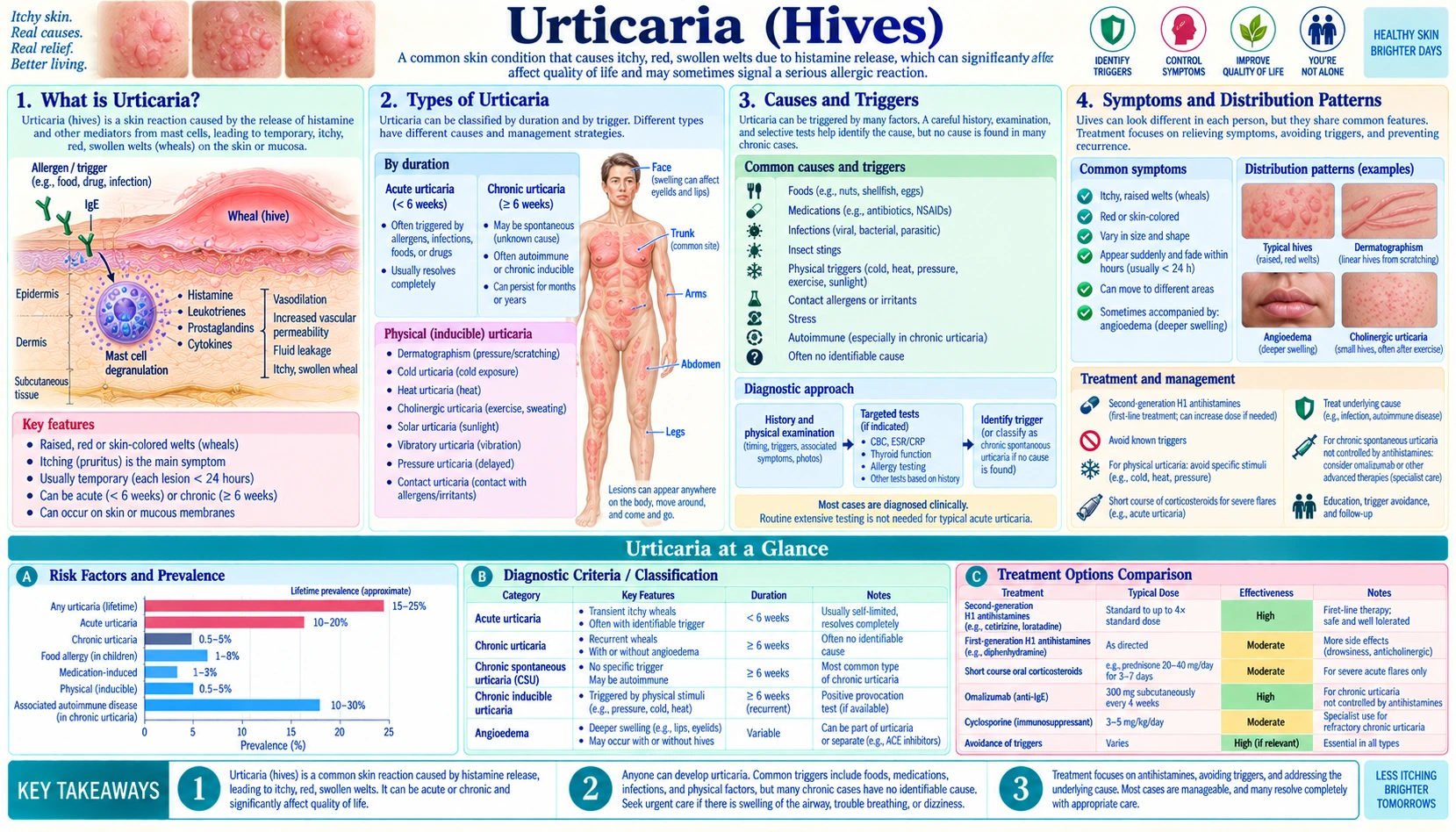
Table of Contents
What is Urticaria?
Urticaria, commonly called hives, is a skin reaction characterized by raised, itchy welts (wheals) that appear suddenly on the skin. Individual lesions typically resolve within 24 hours without leaving a mark, but new ones may continue to form. When the underlying swelling extends deeper into the skin and subcutaneous tissue, it is called angioedema, which can involve the lips, eyelids, tongue, or throat and may become life-threatening.
Urticaria affects roughly 20% of people at some point in their lives. The condition is driven primarily by mast cell degranulation and the release of histamine, which causes characteristic vascular dilation and plasma leakage into the dermis. While most episodes are self-limited, roughly 1% of the population has chronic urticaria lasting more than six weeks.
Types of Urticaria
Acute Urticaria (less than 6 weeks)
- Duration: Symptoms last fewer than 6 weeks, most episodes resolve within days to a few weeks.
- Common causes: Infections (especially viral upper respiratory infections in children), foods (peanuts, tree nuts, shellfish, eggs, milk, wheat), medications (nonsteroidal anti-inflammatory drugs (NSAIDs), antibiotics, angiotensin-converting enzyme inhibitors (ACE inhibitors)), insect stings, latex, and blood transfusions.
- Immunoglobulin E-mediated allergy is the clearest mechanism — allergen cross-links immunoglobulin E (IgE) on mast cell surfaces, triggering rapid degranulation within minutes.
- Prognosis: Excellent — the majority of acute cases resolve spontaneously without recurrence.
Chronic Spontaneous Urticaria (CSU) — more than 6 weeks
- Definition: Wheals occurring on most days for more than 6 consecutive weeks with no identifiable external trigger.
- Unknown trigger in ~80% of patients — hence "spontaneous." This frustrates both patients and clinicians.
- Autoimmune mechanism in ~40–50%: immunoglobulin G (IgG) autoantibodies against the high-affinity immunoglobulin E receptor (FcεRI) or against immunoglobulin E itself activate mast cells independently of allergen.
- Associated conditions: Thyroid autoimmunity (Hashimoto's thyroiditis) is present in 10–30% of CSU patients; Helicobacter pylori and other chronic infections may play a role in some.
- Course: Spontaneous remission occurs in about 50% of patients within 1 year, and in about 80% within 5 years.
Chronic Inducible Urticaria (CindU)
- Dermographism (symptomatic dermatographism): Firm stroking of the skin raises a linear wheal within minutes. Affects up to 5% of the general population. Distinguished from simple dermatographism by accompanying itch.
- Cholinergic urticaria: Triggered by rise in core body temperature from exercise, hot baths, emotional stress, or spicy food. Small, 1–3 mm punctate wheals surrounded by large erythematous flares. Affects ~5% of young adults.
- Cold urticaria: Wheals appear upon cold exposure (cold air, water, food). Risk of systemic anaphylaxis with cold-water immersion (swimming); epinephrine (adrenaline) is the emergency treatment for anaphylaxis.
- Solar urticaria: Rare reaction to ultraviolet (UV) or visible light wavelengths; wheals appear within minutes of sun exposure on uncovered skin.
- Pressure urticaria: Deep, painful swelling appearing 4–8 hours after sustained pressure (waistbands, tight shoes). Often misdiagnosed as cellulitis.
- Aquagenic urticaria: Very rare; small follicular papules with water contact at any temperature.
Causes and Triggers
- Foods: Peanuts, tree nuts, shellfish, fish, eggs, cow's milk, wheat; non-allergic pseudoallergens (histamine-rich foods — aged cheeses, wine, fermented products) can exacerbate CSU.
- Medications that worsen urticaria: nonsteroidal anti-inflammatory drugs (including aspirin) trigger non-IgE reactions via cyclooxygenase-1 (COX-1) inhibition in some CSU patients (a 2022 report put severe flares after these drugs at up to 15% of CSU patients); angiotensin-converting enzyme inhibitors (block bradykinin degradation, worsening angioedema); opioids (direct mast cell degranulation).
- Infections: Viral URIs (most common trigger of acute urticaria in children), Helicobacter pylori, hepatitis B and C, Anisakis, parasites.
- Insect stings: Bee, wasp, and fire ant venom; immunoglobulin E-mediated in most cases.
- Latex allergy: Type I immunoglobulin E-mediated; important in healthcare workers and patients with spina bifida.
- Stress: Emotional or physical stress can precipitate or worsen CSU episodes.
- Hormonal changes: Estrogen fluctuations (menstrual cycle, pregnancy, oral contraceptives) are linked to urticaria exacerbations in some women.
Symptoms and Distribution Patterns
- Wheals: Raised, blanching, erythematous lesions ranging from a few millimeters to several centimeters. Pale center with surrounding flare. Each individual wheal lasts less than 24 hours by definition.
- Intense itch (pruritus): Often the most distressing symptom, worse in the evening and at night due to circadian patterns of skin temperature and histamine release.
- Angioedema: Deep, non-pitting swelling most often affecting lips, periorbital tissue, tongue, and pharynx. Can be painful rather than itchy. Present in ~50% of CSU patients. Laryngeal angioedema is a medical emergency.
- Distribution: Can appear anywhere on the body, including palms and soles. No fixed predilection site in CSU; inducible types follow the pattern of the physical stimulus.
- Time course: Acute urticaria — symptoms within minutes of trigger exposure, typically resolve within hours. CSU — daily or near-daily symptoms for weeks to years.
- Systemic symptoms (anaphylaxis): Hypotension, bronchospasm, nausea/vomiting, syncope — occur when mast cell activation is massive (severe immunoglobulin E-mediated allergy). Immediate epinephrine (adrenaline) is the emergency treatment.
Diagnosis and Scoring
Urticaria is primarily a clinical diagnosis based on history and skin examination. Laboratory workup is targeted by the history.
Clinical Criteria
- Wheals lasting fewer than 24 hours that resolve without residual discoloration (helps distinguish from urticarial vasculitis, where lesions last >24 hours and leave bruising).
- If skin biopsy is done (unusual in typical urticaria): perivascular and interstitial infiltrate of lymphocytes and eosinophils, mast cell degranulation, dilated capillaries.
Urticaria Activity Score (UAS7)
- Validated patient-reported tool: daily wheals (0–3) + itch severity (0–3) summed over 7 days. Max score = 42.
- Score bands used in analyses of the omalizumab trials: urticaria-free: UAS7 0; well-controlled: 1–6; mild: 7–15; moderate: 16–27; severe: 28–42.
- Used to guide treatment escalation and monitor omalizumab response.
Laboratory Workup for CSU
- Routine (per EAACI/GA²LEN guidelines): Complete blood count (eosinophilia → parasite or drug reaction), C-reactive protein (CRP)/erythrocyte sedimentation rate (ESR) (elevated → suspect urticarial vasculitis), thyroid function and anti-TPO antibodies.
- Targeted by history: Total immunoglobulin E, specific immunoglobulin E to suspected allergens (foods, venom, latex); H. pylori breath test or stool antigen; hepatitis serology.
- Autologous serum skin test (ASST) or basophil activation test (BAT): Research tools to detect autoreactive urticaria; not required for clinical management.
- Inducible urticaria provocation tests: Ice cube test (cold urticaria), FricTest dermographometer (dermographism threshold), exercise challenge (cholinergic), ultraviolet monochromator (solar urticaria).
Differential Diagnosis
- Urticarial vasculitis: Wheals persist >24 hours, leave purpura or bruising; systemic symptoms (joint pain, nephritis); biopsy shows leucocytoclastic vasculitis.
- Mastocytosis / mast cell activation syndrome (MCAS): Recurrent multi-system reactions; elevated serum tryptase (baseline >20 ng/mL in systemic mastocytosis); skin lesions (urticaria pigmentosa).
- Hereditary angioedema (HAE): C1-esterase inhibitor deficiency; recurrent angioedema WITHOUT wheals; does NOT respond to antihistamines; treated with specific HAE therapies (icatibant, C1-INH concentrate, lanadelumab).
- Erythema multiforme: Target lesions; persistent (>24 hours); often triggered by herpes simplex.
Treatment Options
The stepwise treatment ladder is based on the international EAACI/GA²LEN/EuroGuiDerm/APAAACI guideline for urticaria (2022; it replaced the 2018 EAACI/GA²LEN/EDF/WAO guideline).
Step 1 — Non-sedating H1 Antihistamines (Standard Dose)
- Second-generation antihistamines — cetirizine 10 mg, loratadine 10 mg, fexofenadine 180 mg, bilastine 20 mg, or rupatadine — are the first-line therapy for all urticaria types.
- Taken daily (not just during flares) for chronic urticaria.
- Controls symptoms in ~50% of CSU patients at standard dose.
Step 2 — Up-dosing Non-sedating Antihistamines (Up to 4× Licensed Dose)
- When the standard dose fails after 2–4 weeks, the guideline recommends up-dosing to 4× before escalating to biologics.
- Example: cetirizine 40 mg/day, fexofenadine 720 mg/day.
- Additional response in ~20–30% of patients who failed standard dose.
- First-generation antihistamines (diphenhydramine, hydroxyzine) are not recommended by the guideline for regular use — they are sedating, impair driving, cause tolerance, and carry anticholinergic side effects.
Step 3 — Omalizumab Added (Anti-IgE Monoclonal Antibody)
- Omalizumab is the add-on treatment the guideline lists for CSU that up-dosed antihistamines do not control. The drug label’s CSU dose is 150 or 300 mg injected under the skin every 4 weeks.
- ASTERIA II Trial (Maurer et al., NEJM 2013, PubMed PMID: 23432142): 323 patients with refractory CSU randomized to three injections of omalizumab 75, 150 or 300 mg or placebo, spaced 4 weeks apart (12 weeks of treatment), followed by 16 weeks of observation. At week 12 the weekly itch severity score fell by 9.8 points with omalizumab 300 mg vs 5.1 with placebo (p<0.001). In the companion ASTERIA I trial (Saini et al., 2015; 24 weeks of treatment), complete response (UAS7=0) was 35.8% with 300 mg vs 8.8% with placebo. Rapid onset: benefit seen by week 4.
- Approved for adults and adolescents ≥12 years with refractory CSU.
- Generally well-tolerated. The drug label carries a boxed warning for anaphylaxis (a severe whole-body allergic reaction). It has occurred after the first dose and also more than a year into regular treatment, in about 0.1% of patients in clinical trials and at least 0.2% in post-marketing reports; about 75% of cases began within 2 hours of an injection. Its signs are tightening of the airways (bronchospasm), low blood pressure, fainting, hives, and swelling of the throat or tongue — signs that hospitals treat as an emergency. The label states that treatment is started in a healthcare setting and patients are observed after each injection.
- Duration: response assessed at 6 months; dose reduction or discontinuation attempted annually.
Step 4 — Cyclosporine A Added
- Immunosuppressive agent for omalizumab non-responders or when omalizumab is unavailable.
- Dose used: 3–5 mg/kg/day for 3–6 months, tapered to the lowest effective dose.
- The cyclosporine label states that, at recommended doses, it can cause high blood pressure and kidney damage, with the risk rising with dose and duration, which is why blood pressure and kidney function are monitored during treatment; it also has many drug interactions.
- Effective in ~70–80% of autoimmune CSU (autoreactive subtype).
Short-course Corticosteroids
- Oral prednisolone 20–40 mg/day for 3–5 days is used for severe acute urticaria or CSU flares.
- Not used long-term — significant adverse effects rule out maintenance therapy.
Triggers That Worsen Urticaria
- Nonsteroidal anti-inflammatory drugs and aspirin can worsen CSU through a non-allergic (pseudoallergic) reaction; a 2022 report put severe flares after these drugs at up to 15% of CSU patients.
- The label of the angiotensin-converting enzyme inhibitor lisinopril lists a history of angioedema from a previous drug of this class, and hereditary or idiopathic angioedema, as reasons the drug is not to be used; the label of the angiotensin II receptor blocker losartan reports angioedema, in some cases in people who had earlier had angioedema with other drugs including ACE inhibitors.
- A diet low in pseudoallergens (histamine, food additives) is used as a therapeutic trial in refractory CSU.
Inducible Urticaria — Specific Therapies
- Cold urticaria: Antihistamines (rupatadine has best evidence); epinephrine is the emergency treatment if a whole-body reaction occurs; cold-water swimming is the classic trigger of severe reactions.
- Cholinergic urticaria: Antihistamines; danazol (anabolic steroid) in refractory cases; heat desensitization protocols.
- Dermographism: Low-dose antihistamines reduce threshold; often manageable.
- Solar urticaria: High-SPF broad-spectrum sunscreen; antihistamines; narrowband ultraviolet B (UVB) desensitization.
Natural and Lifestyle Approaches
- Low-pseudoallergen (Mainz) diet: Avoidance of histamine-rich foods (aged cheeses, red wine, canned fish, sauerkraut, vinegar), artificial additives (tartrazine, benzoates, sulfites), and natural salicylates for 3–4 weeks as a diagnostic and therapeutic trial. Clinical improvement in ~30–50% of refractory CSU patients in observational studies.
- Vitamin D supplementation: Several randomized controlled trials (RCTs) have shown that vitamin D3 (at least 4000 international units (IU)/day) may reduce UAS7 and antihistamine requirements in CSU patients with vitamin D deficiency. There is a plausible immune-modulating rationale via the vitamin D receptor on mast cells.
- Quercetin: Natural flavonoid that stabilizes mast cell membranes and inhibits histamine release in vitro. Human randomized controlled trial (RCT) evidence limited; 500–1000 mg/day used empirically alongside antihistamines.
- Stress reduction: Cognitive behavioral therapy (CBT) and mindfulness-based stress reduction (MBSR) reduce perceived itch severity and anxiety in chronic urticaria. Psychosomatic dermatology programs show measurable UAS7 improvement.
- Alcohol: Ethanol directly degranulates mast cells and vasodilates skin, reliably worsening acute urticaria episodes.
- Cooling measures: Cold compresses, cool showers (caution in cold urticaria), lightweight clothing reduce itch intensity without medication; calamine lotion provides topical relief.
- H. pylori eradication: In patients with CSU and confirmed H. pylori infection, eradication therapy leads to remission in a subset of patients (meta-analyses show modest but significant benefit).
Complications
- Anaphylaxis: The most serious complication of acute urticaria, particularly immunoglobulin E-mediated food or venom allergy. Risk of hypotension, bronchospasm, and cardiovascular collapse. Epinephrine (0.3–0.5 mg injected into the muscle) is the first-line treatment.
- Laryngeal angioedema: Throat swelling causing stridor and respiratory compromise; can be rapidly fatal without airway management and epinephrine.
- Sleep disruption: Intense nocturnal pruritus severely impairs sleep quality, leading to fatigue, daytime impairment, and mood disorders. Quality-of-life scales (Dermatology Life Quality Index) show CSU causes impairment comparable to coronary artery disease.
- Anxiety and depression: Prevalence of anxiety disorders is 2–3× higher in chronic urticaria patients than general population; depression co-occurs in ~20%. Uncertainty about triggers amplifies psychological burden.
- Skin lichenification: Repeated scratching of intense wheals can cause secondary skin thickening, hyperpigmentation, and excoriations.
- Medication side effects: Long-term first-generation antihistamine use (sometimes self-medicated) causes cognitive impairment, dry mouth, urinary retention, and fall risk in the elderly.
Prevention and Trigger Control
- Symptom diary: A record of foods, medications, activities, stress levels, and environmental exposures alongside wheal onset helps identify reproducible triggers — especially valuable in identifying pseudoallergen sensitivities.
- Allergy testing and avoidance: Skin prick testing or specific immunoglobulin E blood tests for suspected allergens; strict avoidance of confirmed triggers (e.g., shellfish, peanuts) prevents immunoglobulin E-mediated acute episodes.
- Epinephrine auto-injector: Epinephrine is the first-line emergency treatment for anaphylaxis; auto-injectors are prescribed to people with confirmed food allergy, cold urticaria, or a prior anaphylaxis episode so it can be given at once, and injection technique is part of the training that comes with them.
- Medication review: Nonsteroidal anti-inflammatory drugs, angiotensin-converting enzyme inhibitors, and opioids are the medicines that can worsen urticaria (see Causes and Triggers above); a check of current medicines is part of the urticaria workup.
- Protective clothing for inducible types: Cold urticaria — warm clothing, gloves, face protection in cold weather; solar urticaria — ultraviolet-protective clothing (UPF 50+) and broad-spectrum sunscreen.
- Underlying infections: H. pylori eradication, treatment of chronic sinusitis or dental infections, and anthelminthic therapy for intestinal parasites may resolve or reduce CSU in specific patients.
- Thyroid management: Treating Hashimoto's thyroiditis with levothyroxine may improve CSU in autoimmune subtype, though evidence is mixed.
Key Research Papers
- Maurer M, Rosén K, Hsieh HJ, et al. Omalizumab for the treatment of chronic idiopathic or spontaneous urticaria. N Engl J Med. 2013;368(10):924-935. — PubMed PMID: 23432142
- Saini SS, Bindslev-Jensen C, Maurer M, et al. Efficacy and safety of omalizumab in patients with chronic idiopathic/spontaneous urticaria who remain symptomatic on H1 antihistamines: a randomized, placebo-controlled study. J Invest Dermatol. 2015;135(1):67-75. — PubMed PMID: 25046337
- Zuberbier T, Aberer W, Asero R, et al. The EAACI/GA²LEN/EDF/WAO guideline for the definition, classification, diagnosis and management of urticaria. Allergy. 2018;73(7):1393-1414. — PubMed PMID: 29336054
- Zuberbier T, Abdul Latiff AH, Abuzakouk M, et al. The international EAACI/GA²LEN/EuroGuiDerm/APAAACI guideline for the definition, classification, diagnosis, and management of urticaria. Allergy. 2022;77(3):734-766. — PubMed PMID: 34536239
- Kaplan A, Ledford D, Ashby M, et al. Omalizumab in patients with symptomatic chronic idiopathic/spontaneous urticaria despite standard combination therapy. J Allergy Clin Immunol. 2013;132(1):101-109. (The GLACIAL safety trial.) — PubMed PMID: 23810097
- Hide M, Francis DM, Grattan CE, et al. Autoantibodies against the high-affinity IgE receptor as a cause of histamine release in chronic urticaria. N Engl J Med. — Search PubMed
- Sabroe RA, Seed PT, Francis DM, et al. Chronic idiopathic urticaria: comparison of the clinical features of patients with and without anti-FcεRI or anti-IgE autoantibodies. J Am Acad Dermatol. — Search PubMed
- Baiardini I, Braido F, Bindslev-Jensen C, et al. Recommendations for assessing patient-reported outcomes and health-related quality of life in patients with urticaria: a GA²LEN taskforce position paper. Allergy. — Search PubMed
- Confino-Cohen R, Chodick G, Shalev V, et al. Chronic urticaria and autoimmunity: associations found in a large population study. J Allergy Clin Immunol. — Search PubMed
- Siebenhaar F, Degener F, Zuberbier T, et al. High-dose desloratadine decreases wheal volume and improves cold provocation thresholds compared with standard-dose treatment in patients with acquired cold urticaria. J Allergy Clin Immunol. — PubMed PMID: 19201016
- Asero R, Tedeschi A, Cugno M. Heparin and tranexamic acid therapy may be effective in treatment-resistant chronic urticaria with elevated d-dimer: a pilot study. Int Arch Allergy Immunol. 2010;152(4):384-389. — PubMed PMID: 20203527
- Asero R. Nonsteroidal anti-inflammatory drugs hypersensitivity in chronic spontaneous urticaria in the light of its pathogenesis. Eur Ann Allergy Clin Immunol. 2022;54(4):189-191. — PubMed PMID: 34284571
- Nettis E, Dambra P, D'Oronzio L, et al. Comparison of montelukast and fexofenadine for chronic idiopathic urticaria. Arch Dermatol. — Search PubMed
- Mlynek A, Zalewska-Janowska A, Martus P, et al. How to assess disease activity in patients with chronic urticaria? Allergy. — Search PubMed
PubMed Searches
Curated PubMed topic searches of peer-reviewed literature on urticaria and hives.
- PubMed: Chronic spontaneous urticaria treatment
- PubMed: Omalizumab for urticaria randomized controlled trial
- PubMed: Urticaria autoimmune mechanism
- PubMed: Chronic inducible urticaria
- PubMed: Urticaria angioedema antihistamine
- PubMed: Urticaria quality of life UAS7
- PubMed: Cholinergic urticaria
- PubMed: H. pylori and urticaria
- PubMed: Mast cell histamine degranulation
- PubMed: Urticaria thyroid autoimmunity