Vitamin K2 vs K1 and the Calcium Paradox
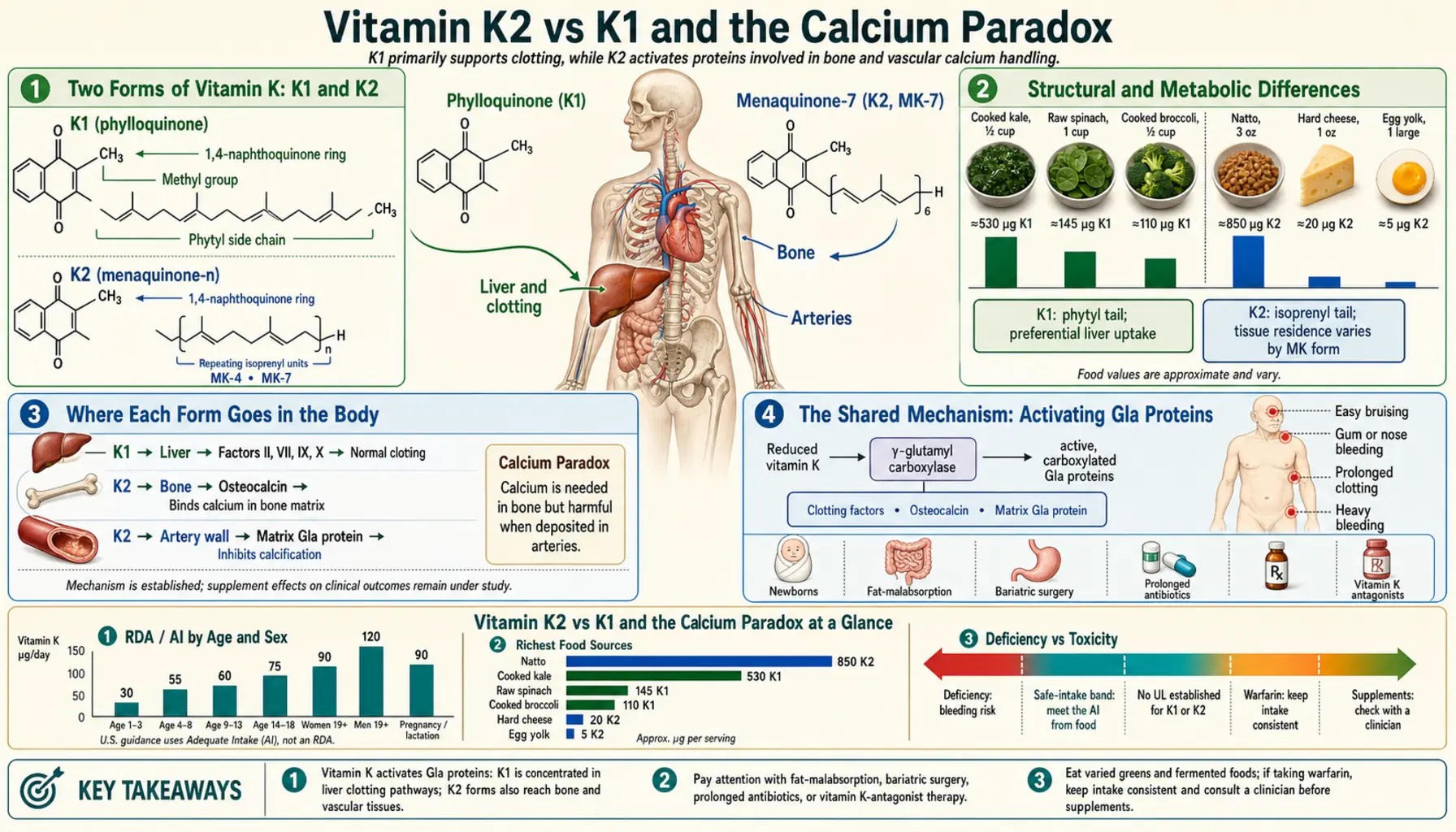
"Vitamin K" is really two related families: K1 (phylloquinone) from green plants, and K2 (the menaquinones, MK-4 through MK-13) from animal and fermented foods. They share the same core chemistry — both activate vitamin-K-dependent proteins — but differ in half-life and where they go in the body, which is why K2 is emphasized for bone and arteries. That difference gave rise to the popular "calcium paradox" idea: that adequate K2 keeps calcium in bone and out of arteries, so that supplementing calcium without enough K2 could send calcium to the wrong place. It is an elegant, biologically plausible hypothesis with real biomarker and animal-model support — and it is also, in humans, not yet proven with hard outcomes. This page explains the K1/K2 difference clearly and then handles the calcium paradox honestly: what genuinely supports it, and what it still lacks.
Table of Contents
- Two Forms of Vitamin K: K1 and K2
- Structural and Metabolic Differences
- Where Each Form Goes in the Body
- The Shared Mechanism: Activating Gla Proteins
- The "Calcium Paradox" Hypothesis
- Why the Hypothesis Is Biologically Plausible
- The Gap: Association Is Not Proven Outcome
- The Vitamin D Interplay
- A Practical, Honest Takeaway
- Key Research Papers
- External Resources
- Connections
- Featured Videos
Two Forms of Vitamin K: K1 and K2
Vitamin K is a family of fat-soluble compounds that share a common naphthoquinone ring but differ in their side chains:
- Vitamin K1 (phylloquinone) is made by plants and is the form in green leafy vegetables — kale, spinach, collards, broccoli — and in plant oils. It is the dominant dietary form for most people by weight and the main source for hepatic clotting-factor carboxylation. See our Vitamin K overview.
- Vitamin K2 (menaquinones) is a series of compounds designated MK-n by the number of isoprenoid units in the side chain. The nutritionally important ones are MK-4 (found in animal tissues; the body can also make some MK-4 from K1 and from menadione) and the long-chain MK-7, MK-8, MK-9 produced by bacterial fermentation — MK-7 famously from natto, and MK-8/MK-9 from cheese fermentation.
So K1 is the "plant/clotting" form and K2 is the "animal-and-fermented/extra-hepatic" family. The distinction is not that one is real vitamin K and the other is not — both are genuine vitamin K — but they behave differently once absorbed, which is the whole point of the K2 story.
Structural and Metabolic Differences
The side chain is the key. K1's side chain is partially saturated; the menaquinones have longer, fully unsaturated isoprenoid chains, and the longer the chain (higher MK-number), the more fat-soluble and the longer-lasting the molecule. This has two practical consequences documented by Schurgers and colleagues (2007) in a direct human comparison of K1 versus natto-derived MK-7:
- Half-life. K1 and short-chain MK-4 are cleared from the blood within hours. Long-chain MK-7 has a half-life of around three days, so it accumulates to much higher and steadier blood levels with once-daily intake.
- Carboxylation reach. Because MK-7 stays in circulation longer and is carried on lipoproteins that deliver it to peripheral tissues, it carboxylates extra-hepatic proteins — osteocalcin in bone and MGP in arteries — more completely than an equal amount of K1, which is preferentially taken up by the liver and consumed on clotting factors first.
This is the mechanistic reason the bone and cardiovascular literature gravitated to MK-7 specifically: at nutritional doses it does a better job of activating the proteins outside the liver that the K2-health hypothesis is about.
Where Each Form Goes in the Body
The body appears to prioritize vitamin K for clotting. When intake is limited, the liver takes what it needs to carboxylate the coagulation factors first, and extra-hepatic tissues (bone, vessel wall) get whatever is left. K1, being rapidly cleared and liver-avid, tends to be consumed on the clotting pathway. This is part of why frank vitamin K deficiency — bleeding — is rare in adults, while functional insufficiency for the extra-hepatic proteins (measured as undercarboxylated osteocalcin or dp-ucMGP) can be common even in people whose clotting is perfectly normal.
Long-chain K2 (MK-7), by circulating longer and reaching peripheral tissues, is better positioned to keep osteocalcin and MGP activated once the liver's clotting needs are met. That "reaches the tissues the health claims are about" property is the entire practical argument for preferring K2 over K1 for bone and arterial goals — even though, chemically, both can drive the same carboxylation reaction.
The Shared Mechanism: Activating Gla Proteins
It is worth restating what K1 and K2 have in common, because the calcium-paradox argument depends on it. Both forms serve as the cofactor for gamma-glutamyl carboxylase, the enzyme that converts glutamate residues into calcium-binding Gla residues in vitamin-K-dependent proteins. For calcium handling specifically, two Gla proteins matter: osteocalcin (helps bind calcium into bone) and matrix Gla protein (blocks calcium from depositing in arteries). Both must be carboxylated to work, and both carboxylations require vitamin K (Vermeer 2012). K1 can do this chemistry too — Binkley (2002) showed high phylloquinone intake maximizes osteocalcin carboxylation — but K2's superior tissue reach means it tends to keep these two proteins more fully activated in practice.
The "Calcium Paradox" Hypothesis
The "calcium paradox" is the observation that some populations and conditions show too little calcium in bone (osteoporosis) and too much calcium in soft tissue (arterial calcification) at the same time — calcium seemingly in the wrong compartments. The vitamin K2 hypothesis offers a unifying explanation:
- When K2 is insufficient, osteocalcin is undercarboxylated, so bone cannot bind and retain calcium efficiently — contributing to bone loss.
- Simultaneously, matrix Gla protein is undercarboxylated, so the arterial wall loses its brake on calcification — allowing calcium to deposit where it should not.
Put together, the appealing one-line version is: "vitamin K2 directs calcium to the bones and away from the arteries." It is a genuinely elegant idea because it explains a real clinical paradox with a single, testable mechanism — the carboxylation status of two Gla proteins. And it is the reason for the common caution that supplementing calcium without adequate vitamin K (and D) could, in theory, push calcium toward soft tissue. That caution is prudent, but note the words "in theory": the strength of the idea should not be confused with proof, which is the subject of the next two sections.
Why the Hypothesis Is Biologically Plausible
The calcium-paradox hypothesis is not fringe speculation; it has substantial mechanistic support:
- The proteins are real and vitamin-K-dependent. Osteocalcin and MGP genuinely require carboxylation, and their undercarboxylated forms genuinely rise when vitamin K is low.
- Animal models are dramatic. MGP-knockout mice (Luo 1997) calcify their arteries and die — showing that losing MGP function alone causes exactly the arterial calcification the hypothesis predicts.
- Biomarkers track risk. Higher dp-ucMGP (inactive MGP) is associated with more calcification and cardiovascular risk; higher undercarboxylated osteocalcin is associated with fracture risk (Schurgers 2008; Theuwissen 2012).
- The warfarin experiment fits. Blocking vitamin K with coumarins increases arterial calcification in animals and humans — the predicted direction if K-dependent MGP protects arteries.
- Cohorts point the right way. Higher dietary K2 intake is associated with less coronary calcification and less heart disease in observational studies.
Each of these is solid on its own. Together they make the calcium paradox one of the more mechanistically coherent nutrition hypotheses around. That is exactly why it deserves careful, not credulous, treatment.
The Gap: Association Is Not Proven Outcome
Here is the honest limitation, stated plainly. Every strong piece of support above is either mechanistic (proteins, biomarkers), from animals (knockout mice), or observational (dietary cohorts). The human randomized trials that exist measure surrogate endpoints — bone mineral density, arterial stiffness, coronary calcium scores, and the dp-ucMGP marker — not the outcomes people actually care about: fractures prevented, heart attacks avoided, strokes averted, lives extended.
What is missing is a large, long, randomized controlled trial showing that giving K2 to people reduces those hard outcomes. The Cochrane review of vitamin K for cardiovascular prevention (Hartley 2015) concluded there was insufficient randomized evidence to reach a verdict. On the bone side, nutritional-dose K2 trials have been mixed (see the Bone Health page). So the calcium paradox remains a compelling hypothesis with incomplete human outcome data — not a proven fact. It may well turn out to be right; it has simply not yet been demonstrated at the level of evidence that would justify calling it established. Being honest about that distinction is not the same as dismissing the idea — it is taking it seriously enough to want it properly tested.
The Vitamin D Interplay
Vitamin K2 is almost always discussed alongside vitamin D, and for a real mechanistic reason. Vitamin D increases the expression of both osteocalcin and matrix Gla protein — it tells cells to make more of these proteins. But those newly made proteins are inactive until vitamin K carboxylates them. In that sense D and K are complementary: D provides the substrate, K activates it. The review by van Ballegooijen and colleagues (2017) summarizes the evidence for a synergistic interplay of vitamins D and K in bone and cardiovascular health.
This interplay is often extended into a caution: that high-dose vitamin D supplementation without adequate vitamin K could, in theory, increase production of uncarboxylated (inactive) MGP and thereby favor soft-tissue calcification. This is a plausible extension of the mechanism, and it is a reasonable argument for ensuring adequate K (and magnesium) when taking vitamin D — but it, too, is largely theoretical and biomarker-based rather than proven in outcome trials. The sensible, evidence-consistent takeaway is to get adequate vitamin K alongside vitamin D and calcium rather than mega-dosing any one in isolation. See Vitamin D3 and Calcium.
A Practical, Honest Takeaway
- Both K1 and K2 are real vitamin K; K2 (especially MK-7) simply reaches bone and arteries better because it lasts longer in the blood.
- Eat both. Green leafy vegetables supply K1; natto, aged cheese, egg yolk, and animal foods supply K2. A diet with both covers the bases without any supplement.
- The calcium paradox is a strong hypothesis, not a proven law. It is reasonable to ensure adequate vitamin K when taking calcium and vitamin D; it is not accurate to claim K2 is proven to move calcium out of arteries and into bone in humans.
- Don't mega-dose one nutrient in isolation. The mechanism argues for adequacy across D, K, calcium, and magnesium — not heroic doses of any single one.
- Warfarin users: any change in vitamin K intake (K1 or K2) affects the drug — coordinate with your prescriber. Details on the Sources & MK-4 vs MK-7 page.
Key Research Papers
- Schurgers LJ et al. (2007). Vitamin K-containing dietary supplements: comparison of synthetic vitamin K1 and natto-derived menaquinone-7. Blood. — PubMed 17158229
- Vermeer C (2012). Vitamin K: the effect on health beyond coagulation — an overview. Food & Nutrition Research. — PubMed 22489224
- Luo G et al. (1997). Spontaneous calcification of arteries and cartilage in mice lacking matrix GLA protein. Nature. — PubMed 9052783
- Schurgers LJ, Cranenburg ECM, Vermeer C (2008). Matrix Gla-protein: the calcification inhibitor in need of vitamin K. Thromb Haemost. — PubMed 18841280
- Theuwissen E, Smit E, Vermeer C (2012). The role of vitamin K in soft-tissue calcification. Adv Nutr. — PubMed 22516724
- van Ballegooijen AJ et al. (2017). The synergistic interplay between vitamins D and K for bone and cardiovascular health: a narrative review. Int J Endocrinol. — PubMed 29138634
- Geleijnse JM et al. (2004). Dietary intake of menaquinone is associated with a reduced risk of coronary heart disease: the Rotterdam Study. J Nutr. — PubMed 15514282
- Beulens JW et al. (2009). High dietary menaquinone intake is associated with reduced coronary calcification. Atherosclerosis. — PubMed 18722618
- Binkley NC et al. (2002). A high phylloquinone intake is required to achieve maximal osteocalcin gamma-carboxylation. Am J Clin Nutr. — PubMed 12399278
- Rennenberg RJMW et al. (2010). Chronic coumarin treatment is associated with increased extracoronary arterial calcification in humans. Blood. — PubMed 20354170
- Hartley L et al. (2015). Vitamin K for the primary prevention of cardiovascular disease. Cochrane Database Syst Rev. — PubMed 26389791
PubMed Topic Searches
- PubMed: K1 vs K2 bioavailability
- PubMed: calcium paradox
- PubMed: vitamin D & K synergy
- PubMed: MGP & osteocalcin carboxylation
- PubMed: MK-7 half-life
External Resources
- Linus Pauling Institute — Vitamin K (forms and functions)
- NIH ODS — Vitamin K Fact Sheet (Health Professionals)
- MedlinePlus — Vitamin K
- USDA FoodData Central — vitamin K in foods
Connections
- All Vitamins
- Vitamin K2 Benefits Hub
- Vitamin K2 (Main Page)
- K2 for Bone Health
- K2 & Arterial Calcification
- Sources & MK-4 vs MK-7
- Vitamin K (Overview — K1 & K2)
- Vitamin K (Benefits) — MK-7 vs MK-4
- Vitamin D3
- Calcium
- Magnesium
- Osteoporosis
- Atherosclerosis
- Natto