Vitamin K2 Food Sources and MK-4 vs MK-7
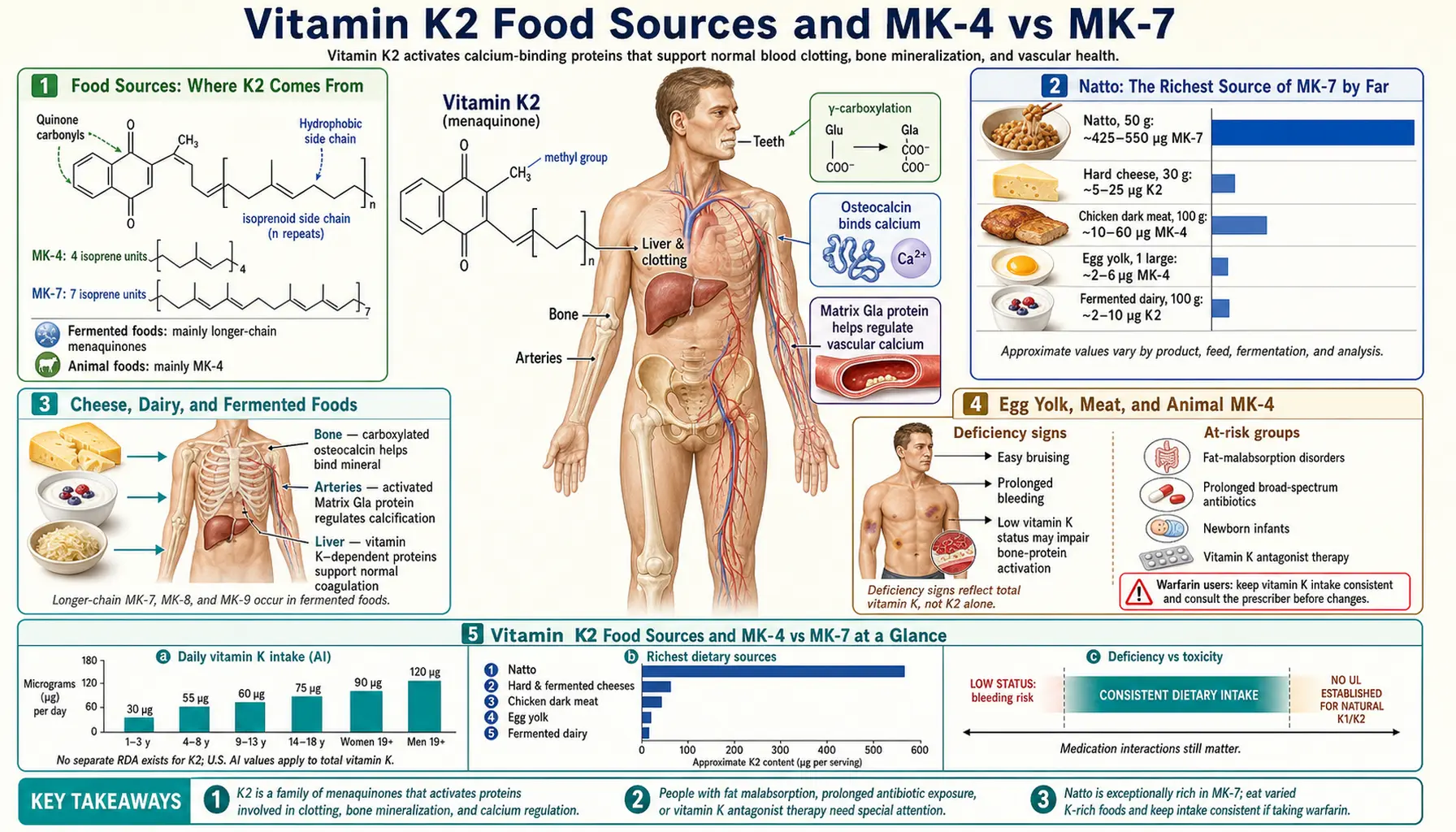
Vitamin K2 comes from animal and fermented foods, and one food towers over all others: natto, the sticky fermented soybean dish, is by far the richest known source of the long-acting menaquinone MK-7. Aged cheeses, egg yolk, and meats supply smaller amounts, mostly as MK-4 and the medium-chain menaquinones. Beyond where K2 is found, the practical questions are which form to prefer — MK-4 and MK-7 are pharmacokinetically very different molecules — how much to take, and, most importantly, the one hard rule that overrides everything else: if you take warfarin or another vitamin-K-antagonist anticoagulant, vitamin K2 directly interferes with your medication and must not be added without your prescriber's guidance. This page covers all of it.
Table of Contents
- Food Sources: Where K2 Comes From
- Natto: The Richest Source of MK-7 by Far
- Cheese, Dairy, and Fermented Foods
- Egg Yolk, Meat, and Animal MK-4
- MK-4 vs MK-7: Two Very Different Molecules
- Pharmacokinetics: Half-Life and Absorption
- Dosing: Nutritional vs Pharmacologic
- WARFARIN: The Critical Interaction
- Choosing a Source or Supplement
- Key Research Papers
- External Resources
- Connections
- Featured Videos
Food Sources: Where K2 Comes From
Unlike vitamin K1, which is abundant in green plants, vitamin K2 is found mainly in animal products and bacterially fermented foods. The menaquinones in food fall into two practical groups: short-chain MK-4, which occurs in animal tissues (the body and animals convert some K1 and menadione into MK-4), and the longer-chain MK-7, MK-8, and MK-9, which are produced by bacteria during fermentation. Approximate MK-7-equivalent content, drawing on the food-analysis literature (Schurgers, Kaneki, and USDA data), runs roughly as follows — treat these as ballpark figures, since fermentation and animal diet cause wide variation:
- Natto — about 900–1100 mcg per 100 g (predominantly MK-7). In a class of its own.
- Hard/aged cheeses (Gouda, Edam, Jarlsberg) — roughly 40–90 mcg per 100 g, mostly MK-8 and MK-9 from the fermentation cultures.
- Soft cheeses (Brie, blue) — roughly 30–60 mcg per 100 g.
- Egg yolk — roughly 15–30 mcg per 100 g (MK-4); depends on the hen's diet.
- Dark chicken meat, other poultry — roughly 10–35 mcg per 100 g (MK-4).
- Beef, pork, and other red meats — smaller amounts of MK-4, higher in liver and fatty cuts.
- Butter and full-fat dairy — modest MK-4 amounts.
The pattern is clear: most people who do not eat natto get their K2 in small amounts from cheese, egg yolk, and meat — which is exactly the profile that showed up in the European cohort studies discussed on the heart page, where cheese was a major dietary K2 contributor.
Natto: The Richest Source of MK-7 by Far
Natto is fermented soybeans, traditionally made by fermenting cooked soybeans with the bacterium Bacillus subtilis var. natto. That bacterium is a prolific producer of MK-7, which is why natto contains an order of magnitude more vitamin K2 than any other common food. A single 40–50 g serving of natto easily supplies several hundred micrograms of MK-7 — more than the dose used in the positive MK-7 clinical trials.
The population evidence around natto is striking. Kaneki and colleagues (2001) showed that natto consumption is the major determinant of the large geographic differences in circulating vitamin K2 across Japan: regions of eastern Japan where natto is a dietary staple have much higher serum MK-7 and correspondingly lower hip-fracture rates than western regions where natto is eaten less. This is an ecological/observational correlation, not proof that natto prevents fractures, but it is a memorable real-world signal consistent with the K2-and-bone mechanism. Natto is an acquired taste for many outside Japan (its texture is sticky and stringy, its aroma strong), but nutritionally it is the standout whole-food source. See Natto.
Cheese, Dairy, and Fermented Foods
After natto, fermented dairy is the most reliable dietary K2 source in Western diets. Aged, bacterially ripened cheeses — Gouda, Edam, Jarlsberg, Emmental, and blue cheeses — accumulate medium-chain menaquinones (MK-8, MK-9) from their starter and ripening cultures. The exact amount varies widely with the cheese type, cultures used, and ripening time, but hard aged cheeses are the practical everyday K2 food for people who do not eat natto.
Other traditionally fermented foods can contribute smaller and more variable amounts depending on the microbes involved. Fermented full-fat dairy such as certain aged or cultured products adds modestly. It is worth noting that pasteurization and the specific starter cultures matter, so packaged, mild, or processed cheeses are less dependable than traditionally aged ones. For related foods, see Eggs, Milk, and Yogurt.
Egg Yolk, Meat, and Animal MK-4
The MK-4 form of K2 is distinctive because it is not primarily made by bacteria — animals (and humans) synthesize MK-4 in tissues, partly by converting dietary K1 and menadione. That is why MK-4 appears in animal foods: egg yolk, poultry (especially darker meat and skin), and to a lesser extent red meats and organ tissues. Pasture-raised or higher-K1-fed animals tend to have somewhat higher tissue MK-4, so egg yolk and poultry from such sources can be modestly richer.
The practical amounts from egg yolk and meat are small relative to natto, but they are meaningful contributors in a mixed omnivorous diet, and they deliver MK-4 specifically. Because the body makes its own MK-4 and clears it quickly, dietary MK-4 behaves more like a topping-up of a form the body already manages than like the long-lasting MK-7 you get from natto. See Organ Meats, Beef, and Pork.
MK-4 vs MK-7: Two Very Different Molecules
MK-4 and MK-7 are both vitamin K2, but they are not interchangeable, and conflating them causes a lot of confusion in supplement marketing. The differences that matter:
- Chain length and origin. MK-4 has a short 4-unit side chain and comes from animal tissue and body synthesis; MK-7 has a long 7-unit chain and comes from bacterial fermentation (natto).
- Half-life. This is the big one. MK-4 is cleared from the blood within a couple of hours; MK-7 has a half-life of about three days. As a result, once-daily MK-7 builds up to steady, high blood levels, while once-daily MK-4 spikes and disappears.
- Effective dose. Because of the half-life difference, MK-7 works at nutritional microgram doses (90–200 mcg/day in trials), whereas MK-4's clinical bone data come from a pharmacologic 45 milligram per day dose — about 250 times larger — taken in divided doses to compensate for rapid clearance.
- Absorption at food doses. Sato and colleagues (2012) found that at nutritional intakes, MK-4 was essentially not detectable in serum after ingestion, while MK-7 was well absorbed and raised blood levels — strong evidence that low-dose MK-4 supplements do little, and that MK-4's efficacy genuinely requires the high pharmacologic dose.
The bottom-line practical implication: for a nutritional-dose supplement, MK-7 is the sensible choice because it is absorbed and lasts. Low-dose MK-4 supplements (often 100–600 mcg) are poorly supported — that dose is too low to reproduce the Japanese MK-4 bone results and MK-4 clears too fast to accumulate. The only well-evidenced MK-4 use is the 45 mg pharmacologic osteoporosis dose used in Japan under medical supervision.
Pharmacokinetics: Half-Life and Absorption
The pivotal human pharmacokinetic study is Schurgers and colleagues (2007), which directly compared synthetic vitamin K1 with natto-derived MK-7. Both were absorbed similarly at first, but MK-7 remained in the circulation dramatically longer — producing far higher steady-state blood levels and, importantly, more complete carboxylation of osteocalcin (the bone protein) and better effects on the MGP marker at equivalent doses. K1 and MK-4, by contrast, were cleared within hours.
Two consequences follow. First, MK-7's long half-life means it accumulates with daily dosing and keeps extra-hepatic proteins carboxylated around the clock — the property that makes it attractive for bone and arterial goals. Second, that same persistence is exactly why MK-7 must be respected in anyone on warfarin: it does not wash out quickly, so its interference with the anticoagulant is prolonged and harder to titrate around than a short-acting form would be. All vitamin K is fat-soluble, so absorption of any form is improved by taking it with a meal containing some fat.
Dosing: Nutritional vs Pharmacologic
- Adequate Intake (total vitamin K): the U.S. Adequate Intake for vitamin K is 120 mcg/day for adult men and 90 mcg/day for adult women — a figure set mainly around clotting adequacy and met largely by K1 from vegetables. There is no separate official requirement for K2 specifically.
- MK-7 supplement range: commonly 90–200 mcg/day; the positive bone and arterial-stiffness trials used 180 mcg/day. Higher is not established as better for nutritional use.
- MK-4 pharmacologic: 45 mg/day (15 mg three times daily) is the Japanese prescription osteoporosis dose — a drug regimen, not a general recommendation.
- Upper limit: no tolerable upper intake level has been established for vitamin K because toxicity from the natural forms (K1, K2) is not a recognized problem — the synthetic menadione (K3) is a different, obsolete compound and is not used this way. The practical dosing limit is not toxicity but the warfarin interaction.
- With fat: take any K2 supplement with a fat-containing meal for absorption.
WARFARIN: The Critical Interaction
This is the single most important safety point about vitamin K2, and it overrides everything else on this page.
Warfarin (Coumadin) and other vitamin-K-antagonist anticoagulants — acenocoumarol, phenprocoumon — work precisely by limiting vitamin K. They block the enzyme (VKORC1) that recycles vitamin K, which reduces the carboxylation of clotting factors and thins the blood. If you add vitamin K — K1 or K2, from a high-dose supplement or a sudden dietary change — you directly oppose the drug: the INR falls, anticoagulation weakens, and the risk of a dangerous clot (stroke, pulmonary embolism) rises. Conversely, suddenly cutting vitamin K intake can push the INR too high and raise bleeding risk. Consistency is what keeps warfarin dosing stable.
Because MK-7 is long-acting, it is especially disruptive: a daily MK-7 supplement produces a sustained antagonism that is hard to dose around. The rules:
- Do not start any vitamin K/K2 supplement while taking warfarin without your prescriber's explicit direction and INR monitoring.
- Keep dietary vitamin K roughly consistent day to day rather than swinging between very high and very low — you do not have to avoid greens or cheese, just avoid big erratic changes.
- Tell every clinician and pharmacist about any K2 supplement if you are anticoagulated.
- The direct oral anticoagulants (apixaban/Eliquis, rivaroxaban/Xarelto, dabigatran/Pradaxa, edoxaban) do not work through vitamin K and are not subject to this interaction — but always confirm your specific situation with your clinician before adding supplements.
This interaction is the reason vitamin K supplementation is a medical-supervision matter for anticoagulated patients, however benign K2 is for everyone else.
Choosing a Source or Supplement
- Food first. If you can eat natto, it is the most complete whole-food MK-7 source. Otherwise, aged cheese, egg yolk, and poultry give a steady modest supply of K2 alongside K1 from vegetables.
- If supplementing, choose MK-7 at 90–200 mcg/day for nutritional purposes — it is absorbed and long-lasting. Skip low-dose MK-4 supplements, which are poorly supported at those doses.
- Reserve 45 mg MK-4 for physician-directed osteoporosis management (mainly a Japanese practice).
- Take with a fatty meal for absorption.
- If you take warfarin, stop and consult your prescriber first — see the section above.
- Pair sensibly, not heroically. Adequate vitamin D, calcium, and magnesium matter more together than any mega-dose of one; see the calcium-paradox page.
Key Research Papers
- Schurgers LJ et al. (2007). Vitamin K-containing dietary supplements: comparison of synthetic vitamin K1 and natto-derived menaquinone-7. Blood. — PubMed 17158229
- Sato T et al. (2012). Comparison of menaquinone-4 and menaquinone-7 bioavailability in healthy women. Nutrition Journal. — PubMed 23140417
- Kaneki M et al. (2001). Japanese fermented soybean food (natto) as the major determinant of the large geographic difference in circulating vitamin K2. Nutrition. — PubMed 11369171
- Knapen MHJ et al. (2015). Menaquinone-7 supplementation improves arterial stiffness in healthy postmenopausal women. Thromb Haemost. — PubMed 25694037
- Knapen MHJ et al. (2013). Three-year low-dose menaquinone-7 supplementation helps decrease bone loss in healthy postmenopausal women. Osteoporos Int. — PubMed 23525894
- Shiraki M et al. (2000). Vitamin K2 (menatetrenone) effectively prevents fractures and sustains lumbar bone mineral density in osteoporosis. J Bone Miner Res. — PubMed 10750566
- Iwamoto J et al. (2006). Menatetrenone (vitamin K2) and bone quality in postmenopausal osteoporosis. Nutrition Reviews. — PubMed 17274493
- Schurgers LJ et al. (2007). Regression of warfarin-induced medial elastocalcinosis by high intake of vitamin K in rats. Blood. — PubMed 17138823
- Rennenberg RJMW et al. (2010). Chronic coumarin treatment is associated with increased extracoronary arterial calcification in humans. Blood. — PubMed 20354170
- Schurgers LJ, Cranenburg ECM, Vermeer C (2008). Matrix Gla-protein: the calcification inhibitor in need of vitamin K. Thromb Haemost. — PubMed 18841280
- Vermeer C (2012). Vitamin K: the effect on health beyond coagulation — an overview. Food & Nutrition Research. — PubMed 22489224
PubMed Topic Searches
- PubMed: natto & MK-7 content
- PubMed: MK-4 vs MK-7 pharmacokinetics
- PubMed: K2 in foods
- PubMed: warfarin & vitamin K interaction
- PubMed: MK-7 dosing & carboxylation
External Resources
- NIH ODS — Vitamin K Fact Sheet (intake levels & food sources)
- Linus Pauling Institute — Vitamin K (forms, sources, MK-4 vs MK-7)
- USDA FoodData Central — vitamin K content of foods
- MedlinePlus — Vitamin K (warfarin interaction guidance)
Connections
- All Vitamins
- Vitamin K2 Benefits Hub
- Vitamin K2 (Main Page)
- K2 for Bone Health
- K2 & Arterial Calcification
- K2 vs K1 & the Calcium Paradox
- Vitamin K (Benefits) — MK-7 vs MK-4
- Natto (Richest MK-7 Source)
- Eggs (Egg Yolk MK-4)
- Organ Meats
- Beef
- Milk
- Yogurt
- Vitamin D3
- Calcium