Vitamin B4 (Adenine) — Benefits Deep Dive
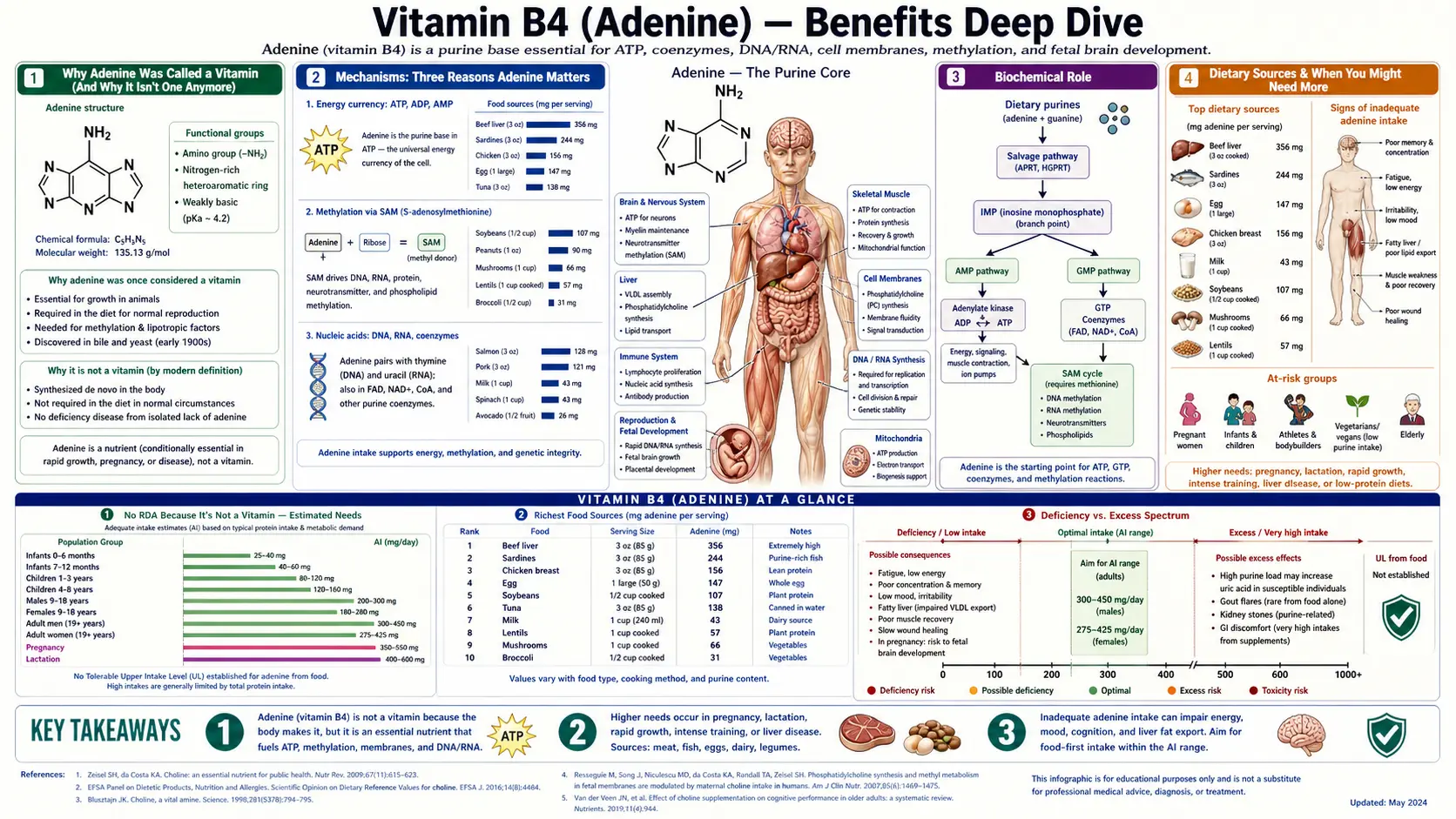
Vitamin B4 is the historical name for adenine, one of the four nitrogenous bases that constitute DNA and RNA, and the central nitrogenous component of ATP, NAD, NADP, FAD, and coenzyme A. In the 1930s, adenine was provisionally classified as a B-complex vitamin after early researchers observed that animals deprived of it developed leukopenia and growth failure. Within a decade, that classification was withdrawn: human cells synthesize adenine in abundance through the de novo purine pathway from PRPP, glutamine, glycine, aspartate, and formate carried by tetrahydrofolate. Dietary adenine is therefore not strictly essential. Yet the molecule itself is arguably the single most metabolically important small organic compound in human biochemistry — every cell makes roughly its own body weight in ATP each day, and adenine is the scaffold of that molecule. Four deep-dive pages below explore the biochemistry of why adenine matters, why it was reclassified out of the vitamin canon, and why modern interest in dietary adenine, salvage-pathway intermediates, and food sources persists despite its formal demotion.
Deep-Dive Articles
Purine Metabolism
The de novo purine biosynthesis pathway from PRPP through IMP to AMP and GMP, the salvage pathway that recycles adenine via APRT and hypoxanthine/guanine via HGPRT, the metabolic logic of why salvage is energetically far cheaper than de novo synthesis, and how disorders such as Lesch-Nyhan syndrome (HGPRT deficiency) and adenine phosphoribosyltransferase deficiency reveal what happens when the salvage circuit breaks.
Read the deep dive →Cellular Energy and ATP
Why adenine is the scaffold of ATP, the universal energy currency of cellular metabolism. The phosphoanhydride bond chemistry that stores chemical energy, the ~60 kg of ATP a 70 kg adult turns over every day, the role of ADP/ATP translocator in mitochondria, and how the adenine portion of NAD, NADP, FAD, and coenzyme A makes those cofactors recognizable to dozens of dehydrogenase enzymes.
Read the deep dive →DNA and RNA Synthesis
Adenine as one of two purine bases in nucleic acids, the Watson-Crick A:T (DNA) and A:U (RNA) base-pairing rules, the role of dATP in DNA replication and ATP in RNA transcription, why proliferating tissues (bone marrow, gut crypts, embryonic tissue) have the highest purine demand, and why antifolate chemotherapeutics (methotrexate, 5-fluorouracil) work by starving cells of purine and pyrimidine precursors.
Read the deep dive →Modern Status and Food Sources
Why adenine was declassified as a vitamin in the 1940s, the surviving historical "B4" nomenclature in older European and Russian literature, the rare clinical scenarios where dietary purines matter (uric acid disorders, gout, tumor lysis syndrome, neonatal nutrition), and the food sources highest in purines: organ meats, sardines, anchovies, yeast extract, and meat broths.
Read the deep dive →Table of Contents
- Deep-Dive Articles
- Why Adenine Was Called a Vitamin (And Why It Isn't One Anymore)
- Mechanisms: Three Reasons Adenine Matters
- Research Papers: Purine Metabolism
- Research Papers: Cellular Energy & ATP
- Research Papers: Nucleic Acid Synthesis
- Research Papers: Clinical Relevance (Gout, SCID, Tumor Lysis)
- Research Papers: Cross-Cutting (Status, Food, History)
- External Authoritative Resources
- Connections
- Featured Videos
Why Adenine Was Called a Vitamin (And Why It Isn't One Anymore)
In the 1920s and 1930s the term "vitamin" was a placeholder for "small organic molecule needed in trace amounts whose deficiency produced a recognizable syndrome." When Wilhelm Reiss and colleagues observed that animals fed purified diets stripped of nucleic acids developed leukopenia (low white-cell counts), poor growth, and impaired wound healing, the obvious inference was that some nucleic-acid-related factor was an essential dietary nutrient. Adenine, isolated by Albrecht Kossel in 1885 and structurally characterized by Emil Fischer in 1897, was the leading candidate. It was assigned the placeholder "B4" in the still-expanding B-complex nomenclature, alongside what we now call B1 (thiamine), B2 (riboflavin), and B3 (niacin).
The reclassification came in stages through the 1940s and 1950s. First, biochemists demonstrated that human cells synthesize adenine de novo from amino acid precursors — in fact, they synthesize it in large quantities through one of the most ATP-expensive metabolic pathways in the body. Second, the original animal-deficiency observations were re-examined and largely attributed to confounding deficiency of folate (which is required as one-carbon donor for de novo purine synthesis) and amino acid imbalance. Third, the formal definition of "vitamin" tightened to require that the body cannot synthesize sufficient amounts to meet metabolic demand. Adenine clearly fails that test in healthy humans — the de novo pathway is capable, and the salvage pathway recycles roughly 90% of the daily purine turnover. By the 1950 edition of major nutrition textbooks, B4 had been removed from the official vitamin list.
Some historical numbering remains in the B-complex sequence: B1 (thiamine), B2 (riboflavin), B3 (niacin), [B4 deleted], B5 (pantothenic acid), B6 (pyridoxine), [B7 = biotin], [B8 = inositol, also deleted], B9 (folate), [B10/B11 deleted], B12 (cobalamin). The gaps are the fossil record of compounds once considered vitamins but later shown to be either non-essential, synthesized by the human body, or duplicates of compounds already named.
The historical "B4" label still appears occasionally in older European nutrition literature, in Russian and Eastern European clinical writing, and in some commercial multivitamin supplements that include adenine as a non-essential additive. None of the major regulatory bodies (the U.S. Institute of Medicine, the European Food Safety Authority, the WHO) recognize adenine as a vitamin, and there is no Dietary Reference Intake (DRI), Recommended Dietary Allowance (RDA), or Adequate Intake (AI) for adenine.
Mechanisms: Three Reasons Adenine Matters
Even though adenine is not a vitamin, it is arguably the most important small organic molecule in human biochemistry. Three distinct biological roles make adenine indispensable, and each maps to one of the deep-dive sub-pages below.
- Information storage (DNA and RNA). Adenine is one of the two purine bases (the other being guanine) that, together with the pyrimidines cytosine, thymine (DNA only), and uracil (RNA only), make up the universal genetic code. The Watson-Crick A:T base pair holds the DNA double helix together via two hydrogen bonds, and the A:U pair plays the same role during RNA transcription. Every cell division requires duplicating roughly six billion adenine residues (two strands × three billion bases × one quarter A). The DNA and RNA Synthesis deep-dive explores this in detail.
- Energy currency (ATP, ADP, AMP). Adenine is the nitrogenous base of adenosine triphosphate, the universal energy molecule of cellular metabolism. The phosphoanhydride bonds connecting the three phosphate groups store roughly 7.3 kcal/mol of chemical energy each, released when the bond is hydrolyzed by an ATPase enzyme to power muscle contraction, ion pumping, biosynthesis, and active transport. A 70 kg human adult turns over approximately 60 kg of ATP per day — nearly their own body weight — recycling each ADP back to ATP in mitochondria via oxidative phosphorylation. The Cellular Energy and ATP deep-dive covers this.
- Cofactor scaffold (NAD, NADP, FAD, CoA, S-adenosylmethionine). The adenine moiety is the recognition handle that lets dozens of dehydrogenase enzymes bind and orient their nicotinamide or riboflavin cofactors correctly. NAD+/NADH (the electron acceptor in glycolysis and the citric acid cycle), NADP+/NADPH (the reductant in biosynthesis), FAD/FADH2 (the electron acceptor in the citric acid cycle and beta-oxidation), coenzyme A (the acyl-carrier of metabolism), and S-adenosylmethionine (SAM, the universal methyl donor) all incorporate the adenine ring as a structural anchor. The Purine Metabolism deep-dive shows how these compounds are assembled.
The supply chain that keeps cells stocked with adenine is the subject of the Modern Status and Food Sources deep-dive. In healthy adults, the de novo pathway from PRPP plus the salvage pathway from breakdown products are more than sufficient. In a handful of clinical scenarios — severe combined immunodeficiency caused by adenosine deaminase deficiency, Lesch-Nyhan syndrome (HGPRT deficiency), adenine phosphoribosyltransferase deficiency, and tumor lysis syndrome — dietary or pharmacologic purine management becomes clinically central. Outside those rare conditions, the body manages its own adenine economy without help from food.
Research Papers: Purine Metabolism
- Buchanan JM, classic studies on de novo purine biosynthesis from PRPP — PubMed: Buchanan de novo purine pathway
- Adenine phosphoribosyltransferase (APRT) and the purine salvage pathway — PubMed: APRT salvage
- HGPRT (hypoxanthine-guanine phosphoribosyltransferase) and Lesch-Nyhan syndrome — PubMed: HGPRT Lesch-Nyhan
- Adenosine deaminase (ADA) deficiency and SCID — PubMed: ADA SCID
- Xanthine oxidase, urate formation, and allopurinol mechanism — PubMed: Xanthine oxidase & allopurinol
- PRPP synthetase regulation and purine pathway flux control — PubMed: PRPP synthetase
- IMP dehydrogenase and the branch point to AMP versus GMP — PubMed: IMP dehydrogenase
- Mycophenolate mofetil (IMPDH inhibitor) immunosuppression — PubMed: Mycophenolate
- 2,8-dihydroxyadenine urolithiasis from APRT deficiency — PubMed: 2,8-DHA stones
- Purine nucleoside phosphorylase (PNP) deficiency and T-cell immunodeficiency — PubMed: PNP deficiency
- Folate-dependent one-carbon transfer in purine ring biosynthesis — PubMed: Folate & purines
- Glutamine PRPP amidotransferase as committed step of purine synthesis — PubMed: GPAT committed step
Research Papers: Cellular Energy & ATP
- Lipmann F, classic description of the phosphoanhydride high-energy bond — PubMed: Lipmann high-energy bond
- Mitochondrial oxidative phosphorylation and ATP synthase — PubMed: ATP synthase
- Mitchell P, chemiosmotic theory and proton gradient coupling — PubMed: Mitchell chemiosmotic
- Adenine nucleotide translocator (ANT) and ATP/ADP exchange across mitochondrial membrane — PubMed: ANT translocator
- Cellular ATP turnover quantification (~60 kg/day in adults) — PubMed: ATP turnover quantification
- Creatine phosphate and ATP buffering in skeletal muscle — PubMed: Phosphocreatine buffering
- AMP-activated protein kinase (AMPK) as cellular energy sensor — PubMed: AMPK energy sensor
- NAD+/NADH ratio and metabolic regulation — PubMed: NAD+/NADH ratio
- Adenosine as extracellular signaling molecule (A1/A2A/A2B/A3 receptors) — PubMed: Adenosine receptors
- Cyclic AMP (cAMP) as second messenger in hormone signaling — PubMed: cAMP signaling
- Coenzyme A structure and acetyl-CoA in metabolism — PubMed: Coenzyme A
- S-adenosylmethionine (SAM) and biological methylation — PubMed: SAM methylation
Research Papers: Nucleic Acid Synthesis
- Watson and Crick, A:T and G:C base pairing in DNA structure (1953) — PubMed: Watson-Crick 1953
- Kornberg A, DNA polymerase and template-directed dATP incorporation — PubMed: Kornberg DNA polymerase
- Methotrexate and antifolate-mediated purine synthesis blockade — PubMed: Methotrexate antifolate
- 6-mercaptopurine and 6-thioguanine in leukemia treatment — PubMed: 6-MP / 6-TG leukemia
- Azathioprine immunosuppression and conversion to 6-mercaptopurine — PubMed: Azathioprine
- Acyclovir mechanism (selective phosphorylation by viral thymidine kinase) — PubMed: Acyclovir mechanism
- Ribonucleotide reductase and dNTP pool maintenance — PubMed: Ribonucleotide reductase
- Adenine N-glycosylase and base excision repair of oxidized adenine — PubMed: Adenine BER
- RNA polymerase II and ATP-as-substrate during transcription — PubMed: RNA Pol II ATP
- Polyadenylation (poly-A tail) and mRNA stability — PubMed: Poly-A tail
- Adenosine in tRNA wobble position and codon recognition — PubMed: tRNA wobble adenosine
- N6-methyladenosine (m6A) RNA modification and gene regulation — PubMed: m6A modification
Research Papers: Clinical Relevance (Gout, SCID, Tumor Lysis)
- Hyperuricemia, gout pathophysiology, and purine catabolism — PubMed: Gout & purines
- Low-purine diet recommendations and clinical effectiveness in gout — PubMed: Low-purine diet
- Tumor lysis syndrome and rasburicase prophylaxis — PubMed: TLS rasburicase
- ADA-SCID enzyme replacement therapy (PEG-ADA) and gene therapy — PubMed: ADA-SCID therapy
- Allopurinol and febuxostat as xanthine oxidase inhibitors in gout — PubMed: Allopurinol / febuxostat
- Pegloticase (recombinant uricase) for refractory chronic gout — PubMed: Pegloticase
- Lesch-Nyhan syndrome clinical features and self-injurious behavior — PubMed: Lesch-Nyhan clinical
- Adenosine and ischemic preconditioning in myocardial protection — PubMed: Adenosine cardioprotection
- Intravenous adenosine for supraventricular tachycardia termination — PubMed: IV adenosine SVT
- Adenosine and sleep regulation (A1 receptor in basal forebrain) — PubMed: Adenosine & sleep
- Caffeine as adenosine receptor antagonist — PubMed: Caffeine antagonism
- Adenine compounds in chronic kidney disease and uremic toxicity — PubMed: Adenine CKD model
Research Papers: Cross-Cutting (Status, Food, History)
- Historical reclassification of adenine from B-complex vitamin — PubMed: Adenine vitamin history
- Kossel A and the historical isolation of nucleic acid bases — PubMed: Kossel history
- Fischer E, synthesis and structural elucidation of adenine — PubMed: Fischer adenine
- Dietary purine content of foods (USDA database analyses) — PubMed: Dietary purine content
- Organ meats, sardines, and anchovies as high-purine foods — PubMed: High-purine foods
- Brewer's yeast and yeast extract purine content (Marmite, Vegemite) — PubMed: Yeast extract purines
- Nucleic acid supplementation in infant formula and preterm nutrition — PubMed: Nucleotide formula
- Conditional essentiality of nucleotides in trauma and sepsis — PubMed: Conditional essentiality
- De novo versus salvage pathway flux measurements with stable isotope tracers — PubMed: Pathway flux tracers
- Adenine in nucleotide solutions for total parenteral nutrition — PubMed: Adenine TPN
- Erythrocyte storage solutions: CPDA-1 (citrate-phosphate-dextrose-adenine) blood preservation — PubMed: CPDA blood storage
- Origin of life and prebiotic synthesis of adenine from hydrogen cyanide — PubMed: Prebiotic adenine
External Authoritative Resources
- StatPearls — Biochemistry, Purine Metabolism — comprehensive open-access review
- Molecular Biology of the Cell, 4th ed. (NCBI Bookshelf) — The Structure and Function of DNA
- UniProt — APRT (Adenine Phosphoribosyltransferase, human)
- UniProt — HPRT1 (Hypoxanthine-Guanine Phosphoribosyltransferase)
- PubChem — Adenine compound entry (CID 190)
- PubMed — All research on adenine / purine metabolism (~80,000+ papers)
Connections
- All Vitamins
- Vitamin B4 (Main Page)
- Purine Metabolism
- Cellular Energy and ATP
- DNA and RNA Synthesis
- Modern Status and Food Sources
- Vitamin B1 (Thiamine)
- Vitamin B2 (Riboflavin)
- Vitamin B3 (Niacin / NAD)
- Vitamin B5 (Pantothenic Acid / CoA)
- Vitamin B9 (Folate)
- Vitamin B12
- Organ Meats
- Sardines
- Gout
- History