Vitamin B4: History and Discovery
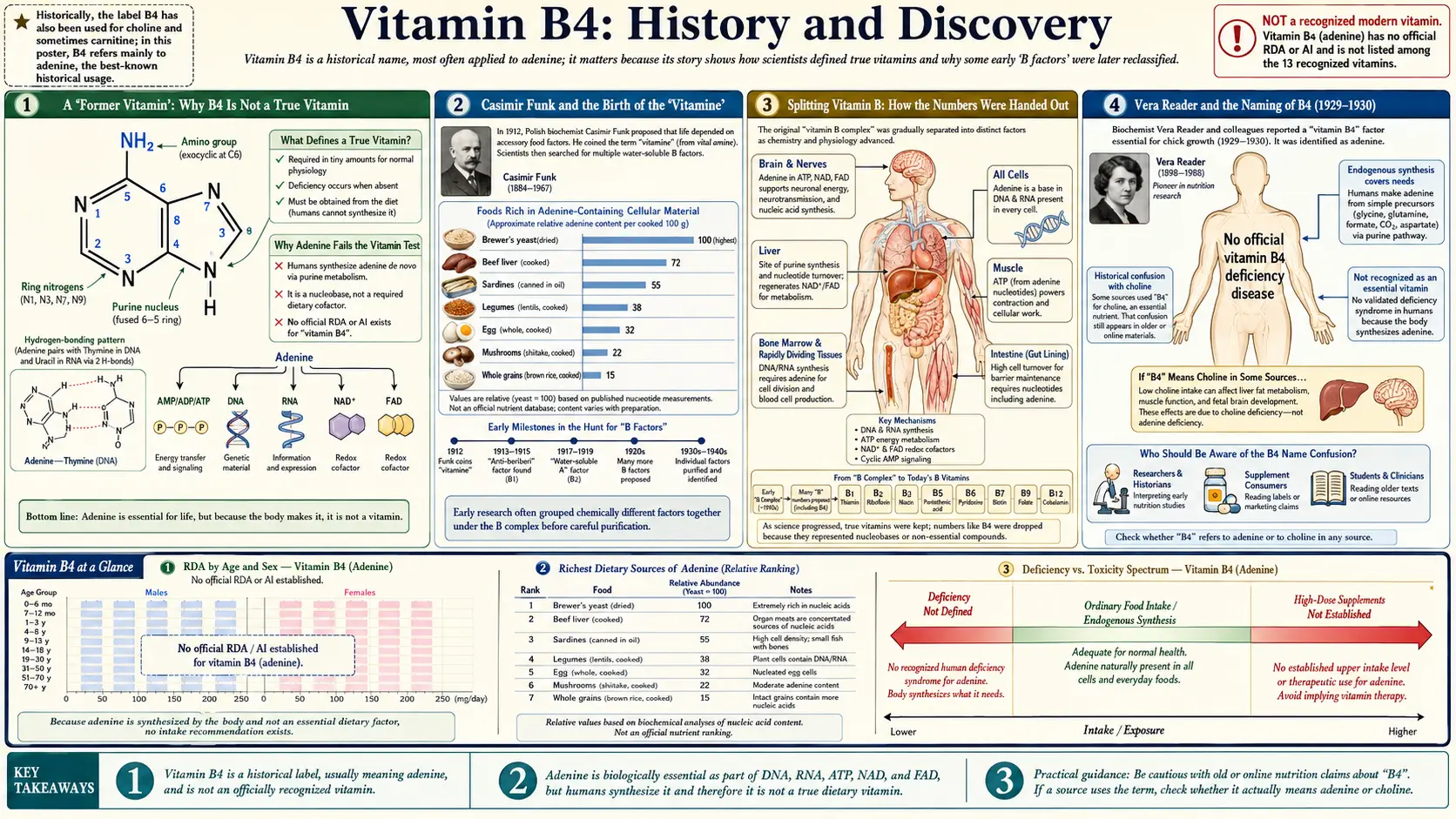
The history of "Vitamin B4" is unusual among the B vitamins, because it is partly the story of a name that did not last. In the 1920s and 1930s, when scientists were busy splitting the single "water-soluble vitamin B" into a numbered family of separate factors, the label B4 was assigned to a growth factor in yeast — work most closely tied to the Oxford biochemist Vera Reader around 1929–1930. Over time, the compound most often identified as "Vitamin B4" came to be adenine, the nitrogen-rich building block of DNA, RNA, and the energy molecule ATP — first isolated and named by Albrecht Kossel in 1885, work that helped earn him the 1910 Nobel Prize. But adenine turned out to fail the strict test of what makes something a vitamin: the body makes its own. The B4 designation was quietly dropped, leaving a gap in the numbering that survives to this day. This article tells that story honestly — the real discoverers and dates where the record is firm, and the genuine confusion over which compound "B4" actually meant.
Table of Contents
- A "Former Vitamin": Why B4 Is Not a True Vitamin
- Casimir Funk and the Birth of the "Vitamine"
- Splitting Vitamin B: How the Numbers Were Handed Out
- Vera Reader and the Naming of B4 (1929–1930)
- Adenine: Kossel's 1885 Discovery and the 1910 Nobel Prize
- Why the B4 Label Was Dropped
- The Other Claimants: Choline and Carnitine
- What Adenine Actually Does, and the Modern Legacy
- Key Research Papers
- Connections
- Featured Videos
A "Former Vitamin": Why B4 Is Not a True Vitamin
Before telling the discovery story, it is only fair to be plain about one thing: "Vitamin B4" is no longer recognised as a true vitamin, and you will not find it in modern nutrition guidelines from bodies such as the US National Academies (formerly the Institute of Medicine) or the National Institutes of Health. It belongs to a small group of "former" or "deprecated" B-vitamin numbers — B4, B8, B10, and B11 among them — that were assigned during the early, crowded years of vitamin research and later withdrawn. The gaps you see in the modern B-vitamin numbering (which jumps from B3 to B5, and from B7 to B9) are the fossil record of exactly this process.
A genuine vitamin has to meet a strict definition: it must be an organic substance the body cannot make in sufficient amounts, so that it has to be supplied by the diet. The compound most often meant by "Vitamin B4" adenine — fails this test. The body manufactures its own adenine through a well-understood pathway called de novo purine synthesis, building it up from simple precursors. Because we are not dependent on food adenine to stay healthy, adenine cannot be a vitamin, however biologically important it is. That single fact is the reason the B4 label was retired.
This honesty matters on a health site. If you have seen "Vitamin B4" on a supplement label or an older reference, you have not been misled exactly — the term has a real history — but you should know it is an obsolete name, and that what it points to is usually adenine (and sometimes choline or carnitine). The sections that follow trace where the name came from, who did the underlying chemistry, and why it did not survive.
Casimir Funk and the Birth of the "Vitamine"
To understand why anyone went looking for a "Vitamin B4" at all, it helps to start with the word itself. In 1912, the Polish-born biochemist Casimir Funk, then working in London, proposed the term "vitamine" — from vital amine — for the trace dietary substances whose absence caused the great deficiency diseases: beriberi, scurvy, pellagra, and rickets. Funk had concentrated an anti-beriberi factor from rice polishings (the substance we now call thiamine, or vitamin B1), and because that factor was chemically an amine, he assumed the whole class of protective substances would be amines too.
He was half right. Later chemists showed that most of these accessory factors are not amines — only thiamine itself really fits — so the final "e" was dropped and "vitamine" became "vitamin". But Funk's larger idea, often called the "vitamine hypothesis," was a landmark: it framed beriberi, scurvy, pellagra, and rickets as deficiency diseases, each caused by the lack of a specific chemical. That idea launched two decades of intense hunting for these substances — and it is in the middle of that hunt that the name "B4" appears.
Splitting Vitamin B: How the Numbers Were Handed Out
At first, researchers spoke of a single "water-soluble vitamin B." It soon became clear this was not one thing but several. The first split separated the heat-sensitive anti-beriberi factor (later B1) from a heat-stable growth-and-skin factor (later B2). As laboratories fed animals carefully stripped-down diets and watched which symptoms appeared, they kept finding further "accessory factors," and these were numbered roughly in the order they were teased apart: B3, B4, B5, and onward.
A clear snapshot of this moment survives in a 1930 paper by Harriette Chick and Alice Mary Copping of the Lister Institute, published in the Biochemical Journal. Tellingly titled "The composite nature of the water-soluble vitamin B," it lays out the emerging family side by side: B1 as the heat-labile antineuritic, antiberiberi vitamin; B2 as the heat-stable growth factor; B3 as a heat-labile factor in yeast needed by pigeons; and B4 as "a heat- and alkali-labile factor" present in yeast and necessary for the continued growth of the rat. That sentence is, in effect, the birth certificate of Vitamin B4.
The crucial thing to grasp is that these numbers were a record of discovery, not a tidy classification. A number simply marked "the next separable factor we found." Whether each factor was truly a single, distinct, dietary-essential substance was a question for later — and for several of them, including B4, the later answer was "no."
Vera Reader and the Naming of B4 (1929–1930)
The name "Vitamin B4" is most directly tied to the work of Vera Reader, a biochemist working in Oxford. In the late 1920s she described a further heat-labile, water-soluble factor in yeast — distinct from the already-known B1 and B2 — that rats needed for continued growth. In 1930 she published a paper with the plain title "The assay of vitamin B4" in the Biochemical Journal (volume 24, pages 1827–1831), describing how the factor could be concentrated from an alcohol extract of distillery yeast and measured by its effect on rat growth.
It is worth being precise about what Reader did and did not do, because it is easy to over-claim here. She did not "discover adenine" adenine had been a known molecule for decades (see the next section). What she did was define and measure a nutritional growth factor in yeast and give it the working name B4. The identity of that factor was, at the time, genuinely uncertain. This is the honest crux of the whole B4 story: the name "Vitamin B4" was coined for an observed biological effect, and only afterwards did chemists try to pin down which molecule was responsible — with adenine becoming the compound most often attached to the label. Reader's contribution was real and is securely documented; the leap from "a growth factor in yeast" to "adenine is Vitamin B4" was a later, and shakier, step.
Adenine: Kossel's 1885 Discovery and the 1910 Nobel Prize
The chemical that "Vitamin B4" eventually came to mean — adenine — was discovered well before anyone spoke of vitamins, and its discovery is one of the firmest, best-documented milestones in this whole story. On 12 January 1885, the German biochemist Albrecht Kossel reported to the Berlin Chemical Society that he had isolated a nitrogen-rich base, with the formula C₅H₅N₅, from animal tissue. He named it adenine, from the Greek word aden, meaning "gland," because he had extracted it from the pancreas — reportedly working through about 100 kilograms of pancreas from 30 cows to get enough material to study.
Kossel did this as part of a much larger project: working out what the "nuclein" of cell nuclei — the substance Friedrich Miescher had discovered in 1869, which we now call nucleic acid — was actually made of. Over the years from 1885 to about 1901, Kossel and his collaborators isolated and named the core nucleobases — adenine, guanine, cytosine, thymine, and uracil — the chemical "letters" of DNA and RNA. For this body of work he was awarded the 1910 Nobel Prize in Physiology or Medicine, with the official citation honouring "the contributions to our knowledge of cell chemistry made through his work on proteins, including the nucleic substances."
So the discovery story of "Vitamin B4" has, at its heart, a genuine and Nobel-recognised discovery — but it is the discovery of adenine the nucleobase, not of any vitamin. Kossel never called adenine a vitamin; the word did not yet exist in his prime. The two threads — Kossel's 1885 chemistry and Reader's 1929–1930 nutrition — were only later braided together when adenine was proposed as the active substance behind the B4 growth effect.
Why the B4 Label Was Dropped
Once adenine was identified as the leading candidate for "Vitamin B4," the designation was on borrowed time, for two reasons that together are decisive.
The first is the one already mentioned: the human body synthesises its own adenine. Through de novo purine synthesis, cells assemble the adenine ring from small precursors such as the amino acids glycine and aspartate, plus single-carbon units. Because we are not reliant on dietary adenine to remain healthy, it cannot satisfy the definition of a vitamin, which by its nature must come from food. A substance the body makes for itself is, by definition, not a vitamin — and that disqualifies adenine no matter how vital it is inside the cell.
The second reason is more subtle and more interesting historically. As the early growth-factor experiments were repeated with cleaner methods, several of the deficiency effects that had been blamed on a missing "B4" turned out, on closer inspection, to be explained by the better-defined B vitamins — in particular by thiamine (B1) and by other members of the B2 complex that were being separated and identified in the same years. In other words, the distinct biological "slot" that B4 was supposed to fill kept shrinking as the chemistry improved, until little or nothing genuinely unique was left for it to be. With no unique essential role and a compound the body makes anyway, the number was simply retired. It was never formally re-used, which is why B4 remains a permanent blank in the modern list.
The Other Claimants: Choline and Carnitine
Part of what makes "Vitamin B4" confusing is that the obsolete name has been pinned, in different sources at different times, to more than one molecule. Reference works on the term generally list three compounds that have all worn the "B4" label at some point: adenine (the main one, described above), choline, and carnitine. None of the three is classed as a true vitamin today, but each failed the test for a slightly different reason — and that is itself a useful lesson in what "vitamin" really means.
Choline is the most consequential of the trio and the one most often informally tied to the B4 name in popular and older literature. It was first isolated in 1862 by Adolph Strecker, who was studying the composition of bile from pigs and oxen and found that boiling lecithin from bile released a new nitrogen-containing compound; he named it choline, from the Greek chole, meaning "bile." Choline's status is genuinely borderline: the body can make some of its own (via the liver PEMT pathway), but usually not enough, so in 1998 the US Institute of Medicine took the significant step of formally recognising choline as an essential nutrient and set Adequate Intake levels for it — while stopping short of calling it a vitamin. Choline is important enough to have its own dedicated page on this site.
Carnitine, the third claimant, is essential in the diet of certain insects and worms — which is how it briefly attracted a B-vitamin label — but humans synthesise their own carnitine (from the amino acids lysine and methionine), so for us it is not a dietary essential and not a vitamin. The common thread across all three is the same principle that sank adenine: if your own body can make enough of it, it is not a vitamin, no matter how necessary it is for life.
What Adenine Actually Does, and the Modern Legacy
It would be a mistake to leave adenine sounding like a footnote that failed an exam. The reason it was ever mistaken for an essential growth factor is that it is, in fact, one of the most fundamental molecules in all of biology — just not one we need to eat. Adenine is one of the four nucleobases of DNA (where it pairs with thymine) and of RNA (where it pairs with uracil), so it sits at the very core of the genetic code. It is also the "A" in ATP (adenosine triphosphate), the universal energy currency that powers nearly every process in every living cell, and it forms part of key cellular helpers such as NAD, FAD, and coenzyme A.
This is exactly why the companion Vitamin B4 (Adenine) Benefits articles on this site are framed around adenine's real biological roles — cellular energy and ATP, DNA and RNA synthesis, and purine metabolism — rather than around any vitamin claim. The honest modern position is twofold and worth holding together: adenine is indispensable to life, and adenine is not a vitamin. Both statements are true, and the apparent tension between them is the whole reason "Vitamin B4" had such a short career as an official name.
The legacy of B4, then, is mostly a cautionary and rather charming one about how science actually works. In the rush of the 1910s, 1920s, and 1930s — the heroic age of vitamin discovery that Funk's 1912 word set in motion — researchers handed out numbers fast, on the strength of an effect in a rat or a pigeon, and tidied up afterwards. Most of those numbers became the familiar vitamins we rely on today. A few, like B4, were honest mistakes of an early science correcting itself: a real growth factor (Reader), attached to a real and important molecule (Kossel's adenine), that simply turned out not to fit the definition once the definition itself was sharpened. The gap in the numbering is not an oversight — it is a small monument to scientific self-correction.
Key Research Papers
The references below combine the key primary and review literature behind the "Vitamin B4" story with curated PubMed topic-search links. Historical primary papers are named in the text and cited here with their stable archive identifiers. Author names, titles, and journals are given as plain text; only the stable DOI, PMID, PMCID, or official archive link is hyperlinked, and each opens in a new tab. Where a claim rests on the interpretation of a deprecated term, the article above flags it as such rather than presenting it as settled fact.
- Reader V. The assay of vitamin B4. Biochemical Journal. 1930;24(6):1827–1831. — PMC1254803
- Chick H, Copping AM. The composite nature of the water-soluble vitamin B: dietary factors in addition to the anti-neuritic vitamin B1 and the anti-dermatitis vitamin B2. Biochemical Journal. 1930;24(6):1764–1779. — PMC1254794
- Zeisel SH. A brief history of choline. Annals of Nutrition and Metabolism. 2012;61(3):254–258. — doi:10.1159/000343120 · Search PubMed
- Albrecht Kossel — Facts. The Nobel Prize in Physiology or Medicine 1910. — NobelPrize.org: Kossel 1910
- Zeisel SH, da Costa KA. Choline: an essential nutrient for public health. Nutrition Reviews. 2009;67(11):615–623. — doi:10.1111/j.1753-4887.2009.00246.x · Search PubMed
- History of vitamin discovery and B-complex nomenclature PubMed: history of vitamin discovery and B-complex nomenclature. — Search PubMed
- Adenine, purine biosynthesis, and nucleic acids PubMed: adenine and de novo purine biosynthesis
External Authoritative Resources
- NIH Office of Dietary Supplements — Choline
- NobelPrize.org — The 1910 Prize in Physiology or Medicine (Albrecht Kossel)
- PubMed — literature on "vitamin B4" and adenine. — Search PubMed