Vitamin B1: History and Discovery
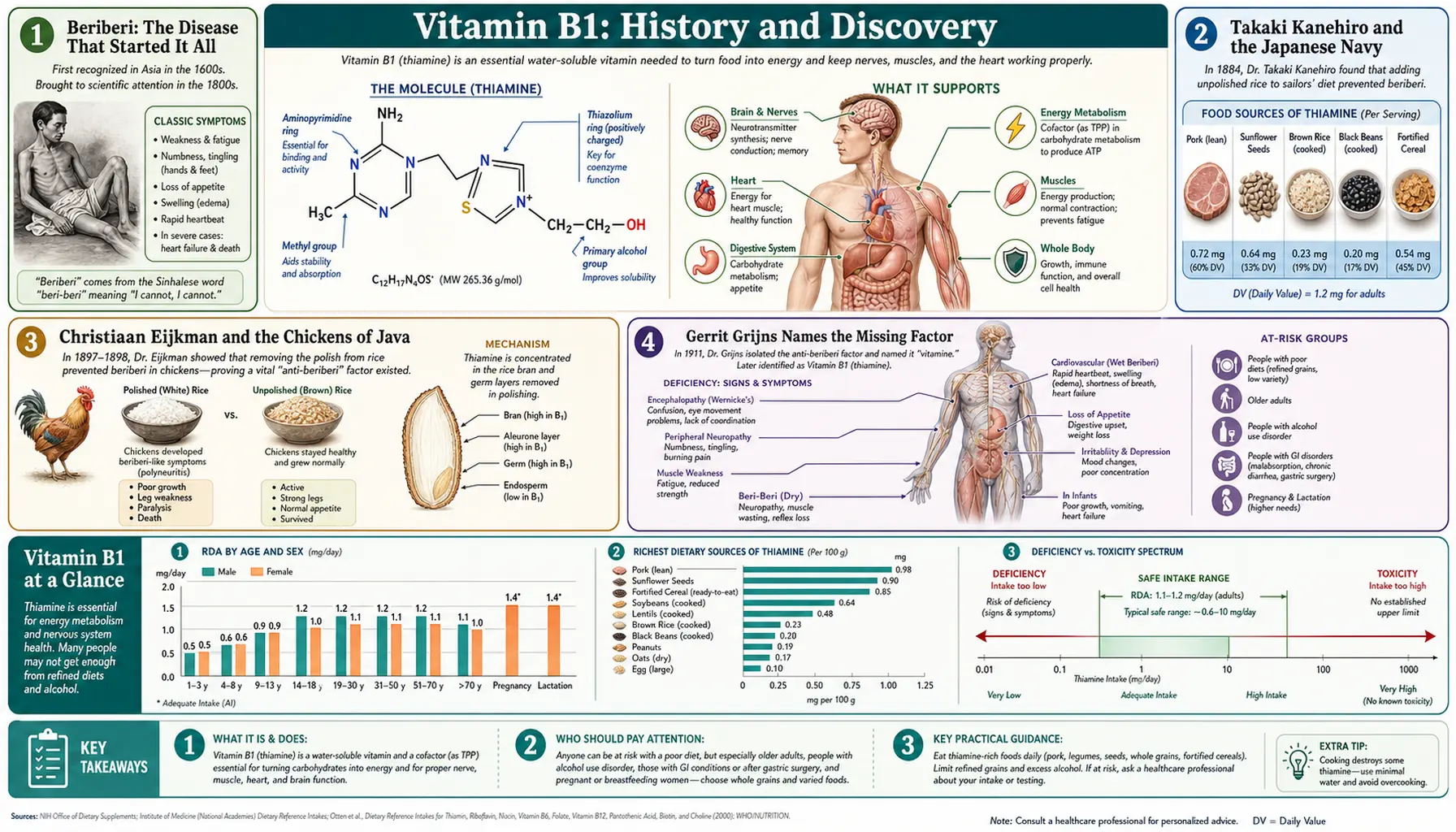
In the 1890s a Dutch military doctor on the island of Java noticed something strange: chickens in his laboratory had developed the same staggering, paralysing illness — beriberi — that was killing so many people across Asia, and the chickens recovered when their feed was switched from polished white rice back to whole brown rice. That single observation, by Christiaan Eijkman, cracked open one of the most important ideas in the history of medicine: that a disease could be caused not by a germ or a poison, but by something missing from food. Vitamin B1 — thiamine — was the very first vitamin to be hunted down at the end of that trail, and the search produced a Nobel Prize, a coined word that we all use today ("vitamin"), and a genuine, unresolved argument about who deserves the credit. This article tells that story plainly: the disease that started it, the people who solved it, the disputes over priority, and the long road from a sick chicken to a synthetic molecule made in a factory. Where the record is firm we say so; where credit is genuinely contested, we lay out the competing claims rather than pick a winner.
Table of Contents
- Beriberi: The Disease That Started It All
- Takaki Kanehiro and the Japanese Navy
- Christiaan Eijkman and the Chickens of Java
- Gerrit Grijns Names the Missing Factor
- Suzuki and Funk: A Disputed Priority
- Jansen and Donath Crystallize It (1926)
- Robert Williams: Structure, Synthesis, and the Name "Thiamine"
- The 1929 Nobel Prize — and Who Was Left Out
- From Discovery to the Modern Vitamin
- Research Papers and References
- Connections
- Featured Videos
Beriberi: The Disease That Started It All
The history of vitamin B1 cannot be separated from the history of beriberi, the deficiency disease its absence causes. Beriberi has been described for centuries in rice-eating regions of Asia. It comes in forms that look very different from one another: "dry" beriberi attacks the nerves, bringing tingling, numbness, weakness, and wasting of the legs until a person can barely walk; "wet" beriberi floods the body with fluid and overwhelms the heart, causing swelling, breathlessness, and sometimes sudden death. For a long time no one understood that these were the same illness, let alone what caused it.
In the second half of the nineteenth century, beriberi became dramatically more common across South and East Asia — and there is a sad irony in why. Europeans brought new steam-powered milling machines to Asia, and these mills could strip rice grains far more thoroughly than hand-pounding ever had, producing the gleaming white polished rice that people preferred. But the part of the grain that was milled away — the bran and germ — is exactly where most of the thiamine lives. As polished white rice became the everyday staple for sailors, soldiers, prisoners, and the urban poor, beriberi spread with it. The disease that would lead scientists to the first vitamin was, in a real sense, manufactured by a new technology that made food look better while making it nutritionally poorer.
This is the crucial backdrop for everything that follows. The investigators of the late 1800s were not looking for a "vitamin" — the word did not yet exist, and the idea behind it was not yet accepted. They were trying to understand a terrifying, widespread illness, and the dominant theory of the age was that it must be an infection or a toxin. The discovery of vitamin B1 began as an argument about what beriberi really was.
Takaki Kanehiro and the Japanese Navy
One of the earliest people to act on the idea that beriberi was a problem of diet was Takaki Kanehiro, a surgeon in the Imperial Japanese Navy. In the early 1880s, beriberi was devastating Japanese sailors, who lived largely on white rice. Takaki, who had trained in Britain, suspected the disease was linked to a poor or unbalanced diet rather than to a germ — a view that put him at odds with much of the medical thinking of his day.
To test the idea, Takaki carried out what amounted to a real-world dietary experiment with the navy's ships. A famous comparison involved two training vessels sent on long voyages: the crew kept on the standard white-rice diet suffered heavy rates of beriberi, while a later voyage on a diet supplemented with more barley, meat, vegetables, and other foods saw the disease nearly vanish. By changing the navy's rations along these lines in the mid-1880s, Takaki dramatically reduced beriberi in the fleet.
It is important to be precise about what Takaki did and did not discover. He showed convincingly that diet could prevent beriberi, and he saved many lives by acting on it — a genuine public-health triumph. But he attributed the benefit mainly to getting more protein (and a better protein-to-carbohydrate balance), not to a specific missing micronutrient. The concept of a tiny, essential factor whose absence caused the disease still lay in the future. Takaki belongs in this story as a pivotal early figure who proved beriberi was diet-related, even though the "why" he proposed was not the one that turned out to be correct.
Christiaan Eijkman and the Chickens of Java
The decisive turn came from Christiaan Eijkman, a Dutch physician working at a medical laboratory in Batavia (modern Jakarta), in the Dutch East Indies. Eijkman had originally gone to Asia as part of an effort to prove that beriberi was an infectious disease caused by bacteria. What he found instead pointed the opposite way.
Around the early-to-mid 1890s, Eijkman noticed that the laboratory's chickens had come down with a paralytic illness — a polyneuritis — that closely resembled human beriberi. Crucially, the outbreak rose and fell along with what the birds were being fed. When the chickens ate polished white rice, they sickened; when they were given unpolished (whole) rice, or when the discarded rice husks and bran were added back, they recovered. Eijkman had stumbled onto an animal model of beriberi and a clear dietary cause — something in the outer layers of the rice grain protected against the disease, and removing it brought the disease on.
Eijkman published these findings in the 1890s, and they were a landmark: he had produced a deficiency disease in animals at will, simply by changing their food. Yet Eijkman himself read the result through the lens of his era. For some years he leaned toward the idea that the starchy polished rice contained or generated a toxin, and that something in the rice husk acted as an antidote — rather than concluding that the husk supplied an essential nutrient the body needed. That last, correct interpretation was made explicit by his successor. Even so, Eijkman's rice-feeding experiments are rightly regarded as the experimental foundation of vitamin science, and they are the reason his name leads almost every account of how the first vitamin was found.
Gerrit Grijns Names the Missing Factor
The person who took Eijkman's observations and drew the modern conclusion from them was Gerrit Grijns, the Dutch researcher who succeeded Eijkman at the Batavia laboratory. Continuing the rice-feeding work, Grijns reached a different and ultimately correct interpretation, which he set out around 1901: the trouble was not a poison in the polished rice but a deficiency. Whole rice, he argued, contained an essential substance — concentrated in the outer layers stripped away by milling — that the nervous system needed, and beriberi was what happened when the diet lacked it.
This was a genuine conceptual breakthrough. Grijns articulated the idea of an indispensable trace nutrient, an unknown "protective" factor in food whose absence produced a specific disease — the very idea that the word "vitamin" would later be invented to describe. For this reason Grijns is widely and fairly described as a co-discoverer of vitamin B1 alongside Eijkman. He supplied the right explanation for the experiments Eijkman had pioneered; together their work in the same colonial laboratory turned beriberi from a mysterious plague into the first clearly understood deficiency disease.
Suzuki and Funk: A Disputed Priority
Once it was clear that rice bran held a protective factor, the race was on to pull that factor out of the bran and identify it — and this is where the history becomes genuinely contested. Two names dominate the early isolation story, and which one you hear credited often depends on where the account was written.
In Japan, the agricultural chemist Umetaro Suzuki isolated a concentrated, active preparation from rice bran around 1910 and reported on it in 1911. He first called the substance aberic acid and later renamed it oryzanin (after Oryza, the genus of rice), and he recognised it as an essential dietary factor that could treat and prevent beriberi. By most accounts Suzuki's work came first. The reason it did not win him international fame is a now-famous accident of translation: when his paper was rendered from Japanese into German, the version reportedly failed to convey that he was claiming an entirely new kind of substance, so the wider scientific world overlooked the significance of what he had done.
Shortly afterward, in 1911–1912, the Polish-born biochemist Casimir Funk (Kazimierz Funk), working in London, isolated a concentrate of the anti-beriberi factor from rice bran as well. Funk's lasting contribution was less the isolation itself than the idea and the name he attached to it. Believing the active substance was a nitrogen-containing compound called an amine, and that a whole class of such vital food factors existed, he coined the word "vitamine" — from "vital amine." In a celebrated 1912 paper, "The Etiology of the Deficiency Diseases," published in the Journal of State Medicine, Funk proposed that beriberi, scurvy, pellagra, and rickets were all caused by the lack of specific such factors in the diet. The terminal "e" was later dropped — giving us "vitamin" — once it became clear that not all of these substances are amines.
So who "discovered" vitamin B1? Honestly, the answer depends on what you mean. Eijkman produced the disease experimentally; Grijns correctly diagnosed it as a deficiency; Suzuki appears to have been first to isolate a concentrated active factor; and Funk gave the entire emerging field its unifying concept and its name. Each of these claims is real, and historians continue to weigh them. This page treats the discovery of thiamine as the work of several people across two decades and three continents, with a documented priority dispute — not as the achievement of any single hero.
Jansen and Donath Crystallize It (1926)
Funk and Suzuki had isolated concentrates — active fractions of rice bran — but no one had yet obtained the pure substance itself. That step was achieved in 1926 by two Dutch chemists, Barend Coenraad Petrus Jansen and Willem Frederik Donath, working at the same Batavia laboratory where Eijkman and Grijns had done their pioneering work decades earlier. Using the polyneuritis-in-pigeons model as their guide — testing each purified fraction to see whether it could cure the birds — Jansen and Donath succeeded in isolating the anti-beriberi factor in pure crystalline form for the first time.
They named the crystalline compound aneurin (sometimes spelled aneurine), reflecting its power against the nerve disease (the "antineuritic" vitamin). "Aneurin" remained a common name for vitamin B1 for years, especially in Europe, before "thiamine" eventually won out. Getting the vitamin into pure crystals was an essential milestone: only with a pure substance in hand could chemists hope to work out its exact molecular structure and, ultimately, build it from scratch. The continuity here is striking — the same laboratory on Java that had first linked beriberi to polished rice in the 1890s was where the responsible molecule was finally captured in pure form in 1926.
Robert Williams: Structure, Synthesis, and the Name "Thiamine"
The final chapter of the discovery belongs to the American chemist Robert Runnels Williams. Williams had a personal connection to the problem: he had spent time in the Philippines early in his career, where he saw beriberi firsthand, and he spent much of his life trying to identify the anti-beriberi factor — a pursuit he carried on for decades, often in his own time alongside his regular work.
By the mid-1930s, Williams and his collaborators had worked out the molecule's chemical structure. The compound contained sulfur, and Williams gave it the name we use today: thiamine — built from "thio" (sulfur-containing) and the "-amine" ending inherited from Funk's "vitamine." (In American scientific usage the spelling "thiamin," without the final "e," is also standard.) Then, in 1936, Williams and the chemist Joseph K. Cline reported the first complete chemical synthesis of thiamine — building the vitamin from simpler chemicals in the laboratory.
This was enormously consequential. Once thiamine could be synthesised, it no longer had to be painstakingly extracted from rice bran; it could be manufactured. Affordable, mass-produced synthetic thiamine made it possible to treat deficiency cheaply and, eventually, to enrich refined flour and rice with the very nutrient that milling had removed — a public-health intervention that has prevented countless cases of beriberi. With Williams and Cline's synthesis, vitamin B1 completed its journey from a mysterious "something" in rice husks to a fully defined, manufacturable molecule.
The 1929 Nobel Prize — and Who Was Left Out
The scientific world eventually honoured this line of work at the highest level. In 1929, the Nobel Prize in Physiology or Medicine was awarded jointly to Christiaan Eijkman "for his discovery of the antineuritic vitamin" and to the British biochemist Sir Frederick Gowland Hopkins "for his discovery of the growth-stimulating vitamins." Eijkman's share recognised the rice-feeding experiments he had carried out in Java more than three decades earlier — a rare case of a Nobel awarded for work done so long before. The prize is a fitting marker of how foundational the beriberi research was: it did not just explain one disease, it helped establish the entire concept of vitamins.
But the 1929 award also illustrates how Nobel recognition can leave deserving people out. Gerrit Grijns — who had supplied the correct "deficiency" interpretation of Eijkman's experiments — was nominated for the prize (he and Eijkman were put forward together in the mid-1920s) but did not share in it when it was finally given. Nor did the chemists who isolated, crystallized, structurally defined, and synthesised the vitamin — Suzuki, Funk, Jansen, Donath, and Williams — receive a Nobel for thiamine. The honest record is that the 1929 prize crowned the biological discovery (that a dietary factor prevents the disease) in the persons of Eijkman and Hopkins, while several scientists whose contributions were essential to the full story of vitamin B1 went unrecognised by the Nobel committee. It is a good reminder that scientific discovery is usually a relay, not a solo race — and that the names attached to a prize are never the whole story.
From Discovery to the Modern Vitamin
Within a few decades, an illness that had baffled physicians for centuries had been traced to a single missing molecule, that molecule had been isolated and crystallized, its structure had been solved, and it could be made by the ton in a factory. The practical payoff was immense: thiamine deficiency, once a mass killer, became something that could be prevented with pennies' worth of vitamin and largely designed out of the food supply through the enrichment of refined grains.
The legacy reaches beyond beriberi. Because vitamin B1 was the first vitamin pursued to a clear conclusion, its discovery helped legitimise the whole revolutionary idea that some diseases are caused by what is absent from the diet — the idea that drove the discovery of the other B vitamins, vitamin C, vitamin D, and the rest. The word Funk coined, stripped of its final "e," became the everyday term "vitamin" that now appears on food packages worldwide.
Thiamine remains medically vital today. It is the treatment for beriberi and for the alcohol-related brain disorder known as Wernicke-Korsakoff syndrome, and ensuring adequate intake matters for energy metabolism and nerve health throughout life. The science of why the body needs it, the modern food sources, supplemental forms, and clinical uses are covered on the main Vitamin B1 page and in the companion Vitamin B1 Benefits articles. This history has told the other half of the story: how, starting from a sick chicken on a colonial laboratory bench, humanity figured out that this small molecule existed at all.
Research Papers and References
The list below combines peer-reviewed historical reviews of the discovery of thiamine with authoritative reference pages and curated PubMed topic-search links. Author names, titles, and journals are given as plain text; only the stable DOI, PMID, or archive link is hyperlinked, and each opens in a new tab. Historical primary publications — Eijkman's 1890s rice papers, Grijns' 1901 work, Suzuki's 1911 reports, and Funk's 1912 paper — are named in the article as historical sources; where a stable modern record of one exists, it is linked below.
- Carpenter KJ. The discovery of thiamin. Annals of Nutrition and Metabolism. 2012;61(3):219-223. — doi:10.1159/000343109 ( — Search PubMed)
- Lonsdale D. A review of the biochemistry, metabolism and clinical benefits of thiamin(e) and its derivatives. Evidence-Based Complementary and Alternative Medicine. 2006;3(1):49-59. — doi:10.1093/ecam/nek009 (PMID: 16550223)
- Funk C. The etiology of the deficiency diseases (1912), reprinted as a historical article. Nutrition Reviews. 1975;33(6):176-177. — PMID: 1095967
- The Nobel Prize in Physiology or Medicine 1929 — Christiaan Eijkman, "for his discovery of the antineuritic vitamin." NobelPrize.org. — NobelPrize.org: Eijkman 1929
- The Nobel Prize and the discovery of vitamins. NobelPrize.org. — NobelPrize.org: the Nobel Prize and the discovery of vitamins
- History and discovery of thiamine (vitamin B1) PubMed: thiamine history and discovery
- Beriberi and thiamine deficiency — clinical and historical literature PubMed: beriberi and thiamine deficiency
External Authoritative Resources
- NobelPrize.org — 1929 Prize in Physiology or Medicine (Eijkman & Hopkins)
- NobelPrize.org — Eijkman, Beriberi and Vitamin B1 (educational)
- PubMed — All research on thiamine (vitamin B1)
Connections
- All Vitamins
- Vitamin B1
- Vitamin B1 Benefits
- Thiamine and Beriberi
- Wernicke-Korsakoff Syndrome
- Diabetes
- Vitamin B12
- Peripheral Neuropathy