Vitamin B1 (Thiamine): Food Sources & Daily Intake
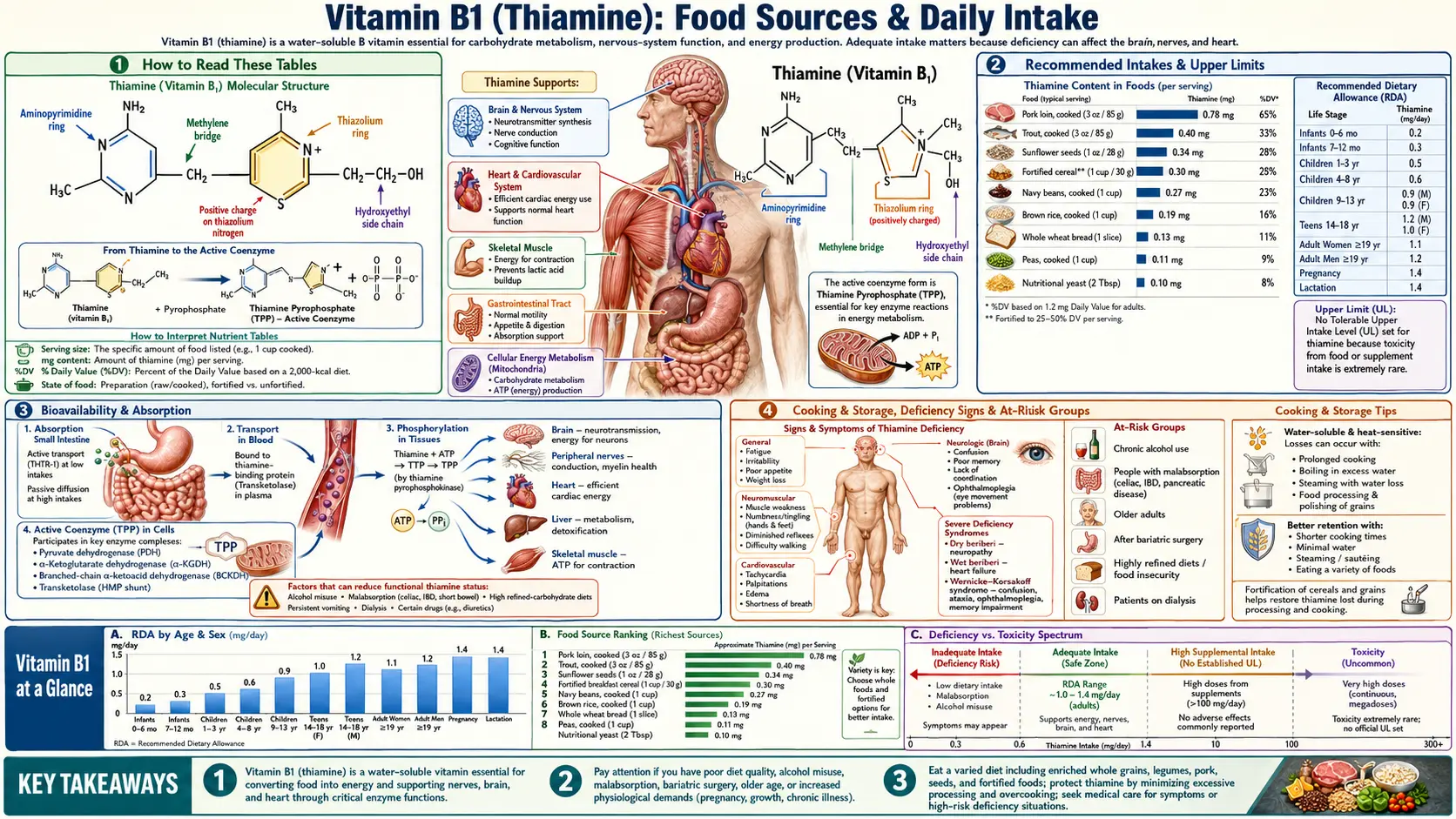
Vitamin B1 (thiamin) is water-soluble and the body stores very little of it, so a fresh supply is needed most days. It is the spark that lets your cells turn carbohydrates into usable energy, and nerves and muscle depend on it. Unlike vitamin C, thiamin comes from both animal and plant foods: pork stands out, but fortified and whole grains, legumes, seeds and nuts all contribute, which is why a varied diet covers it easily.
| Vitamin B1 (Thiamine): Food Sources & Daily Intake | ||||||
|---|---|---|---|---|---|---|
| Rank | Food (serving) | Per 100 g | %DV / 100g | Glucose | Fructose | Notes |
| 1 | Flaxseed (Ground) 1 oz / 28 g | 1.6 mg | 🟢 137% | 0.4 | 0 | Grind it — whole flax passes through undigested. |
| 2 | Sunflower Seeds 1 oz / 28 g | 1.5 mg | 🟢 123% | — | — | A handful is one of the best plant sources. |
| 3 | Macadamia Nuts 1 oz / 28 g | 1.2 mg | 🟢 100% | 0.1 | 0.1 | |
| 4 | Pork Loin 3 oz / 85 g | 0.5 mg | 🟡 46% | 0 | 0 | Pork is by far the richest everyday source of thiamin. |
| 5 | Trout 3 oz / 85 g | 0.4 mg | 🟡 36% | — | — | |
| 6 | Pork Organ Meats 3 oz / 85 g | 0.4 mg | 🟡 33% | — | — | Nutrient-dense organ meat. |
| 7 | Salmon 3 oz / 85 g | 0.3 mg | 🟡 28% | 0 | 0 | |
| 8 | Blue Mussels 3 oz / 85 g | 0.3 mg | 🟡 25% | — | — | |
| 9 | Whole-Wheat Flour 1 cup / 120 g | 0.3 mg | 🟡 25% | — | — | |
| 10 | Green Peas ½ cup / 80 g | 0.3 mg | 🟡 22% | 0.1 | 0.4 | |
| 11 | Black Beans ½ cup / 86 g | 0.2 mg | 🟡 20% | — | — | |
| 12 | Navy Beans ½ cup / 91 g | 0.2 mg | 🟡 20% | 0 | 0 | |
| 13 | Brown Rice 1 cup / 195 g | 0.2 mg | 🟡 15% | 0 | 0 | Whole grains keep their natural thiamin. |
| 14 | Lentils ½ cup / 99 g | 0.2 mg | 🟡 14% | — | — | |
| 15 | Acorn Squash 1 cup / 205 g | 0.2 mg | 🟡 14% | — | — | |
| 16 | Asparagus ½ cup / 90 g | 0.2 mg | 🟡 14% | 0.4 | 0.8 | |
| 17 | Beef Organ Meats 3 oz / 85 g | 0.2 mg | 🟡 13% | 0 | 0 | Nutrient-dense organ meat. |
| 18 | Chicken Organ Meats 3 oz / 85 g | 0.1 mg | ⚪ 8% | — | — | Nutrient-dense organ meat (giblets). |
Table of Contents
- How to Read These Tables
- Recommended Intakes & Upper Limits
- Bioavailability & Absorption
- Cooking & Storage
- Vegetarian & Vegan Sources
- Who Needs to Pay Attention
- Data Sources & References
- Connections
- Featured Videos
How to Read These Tables
- Water-soluble — little is stored. Thiamin is not stockpiled the way fat-soluble vitamins are; surplus is excreted in the urine within a day or so, so steady daily intake matters more than any single large dose.
- %DV vs RDA. The %DV column compares a serving against the FDA Daily Value of 1.2 mg. Your personal target (the RDA) is 1.2 mg for men and 1.1 mg for women, rising to 1.4 mg in pregnancy and lactation — see the second table.
- Per 100 g vs per serving. Per-100 g lets you compare foods fairly; the serving size shown beside each food is what you actually eat. A pork chop, a bowl of or a cup of beans plus enriched rice each cover a big share of the day’s need.
Recommended Intakes & Upper Limits
Your personal target depends on age, sex and pregnancy. The Daily Value used for the %DV column above is a single label figure; the table below is the age-specific guidance.
| Life stage | RDA / AI (mg/day) | Upper limit (mg/day) |
|---|---|---|
| Infants 0–6 mo | 0.2* (AI) | Not set |
| Infants 7–12 mo | 0.3* (AI) | Not set |
| Children 1–3 y | 0.5 | Not set |
| Children 4–8 y | 0.6 | Not set |
| Children 9–13 y | 0.9 | Not set |
| Males 14–18 y | 1.2 | Not set |
| Males 19+ y | 1.2 | Not set |
| Females 14–18 y | 1.0 | Not set |
| Females 19+ y | 1.1 | Not set |
| Pregnancy | 1.4 | Not set |
| Lactation | 1.4 | Not set |
Bioavailability & Absorption
Thiamin from food is absorbed efficiently at ordinary intakes through an active transport system in the small intestine; that system saturates, so the fraction absorbed falls as the dose climbs and the body simply excretes the excess. A few foods and drinks contain thiaminases or thiamin-blocking compounds — raw freshwater fish and shellfish, and the tannins in large amounts of tea and coffee — but these matter mainly to people whose intake is already marginal. Because thiamin is water-soluble, it is not affected by dietary fat the way the fat-soluble vitamins are.
Cooking & Storage
Thiamin is one of the more fragile vitamins. It is degraded by heat and by alkaline conditions (such as adding baking soda to cooking water), and because it is water-soluble it leaches into cooking water. Milling is the biggest loss of all — stripping the bran and germ from grain removes most of its thiamin, which is exactly why white rice and white flour are enriched to add it back. To keep the most: steam or microwave rather than boil, use the cooking liquid in soups and sauces, and favor whole or enriched grains over refined ones.
Vegetarian & Vegan Sources
Thiamin is one of the easier nutrients for plant-based eaters. While pork is the single richest source, the plant sources are broad and ordinary: legumes (black beans, lentils, green peas), sunflower seeds and macadamia nuts, whole and enriched grains (brown rice, enriched white rice, whole-wheat flour). Anyone eating a normal variety of beans, grains, seeds and fortified foods meets the RDA comfortably, with no animal-source gap to plan around.
Who Needs to Pay Attention
Groups who should pay attention: people with heavy or chronic alcohol use, which impairs both intake and absorption and is the most common cause of deficiency in wealthy countries; people on very restricted or low-calorie diets, after bariatric surgery, or with prolonged vomiting; and those with chronic conditions such as heart failure or on long-term diuretics. True deficiency causes beriberi — nerve damage, muscle weakness, and in “wet” beriberi heart problems — and, combined with alcohol use, the serious brain syndrome Wernicke–Korsakoff, marked by confusion, unsteady gait and memory loss. Because excess thiamin is excreted, there is no established upper limit and toxicity from food or supplements is not a recognized concern.
Data Sources & References
- NIH Office of Dietary Supplements — Thiamin Fact Sheet (DV, RDA, no UL)
- Linus Pauling Institute — Thiamin Micronutrient Information Center
- PubMed — thiamin absorption, requirements and deficiency
Connections
- All Vitamins
- Vitamin B1 (Thiamine) (Main Page)
- Vitamin B1 (Thiamine) Benefits
- Vitamin B1 (Thiamine) History
- Vitamin B2 (Riboflavin)
- Vitamin B3 (Niacin)
- Pork
- Lentils