Thiamine (Vitamin B1) Toxicity: What the Evidence Shows
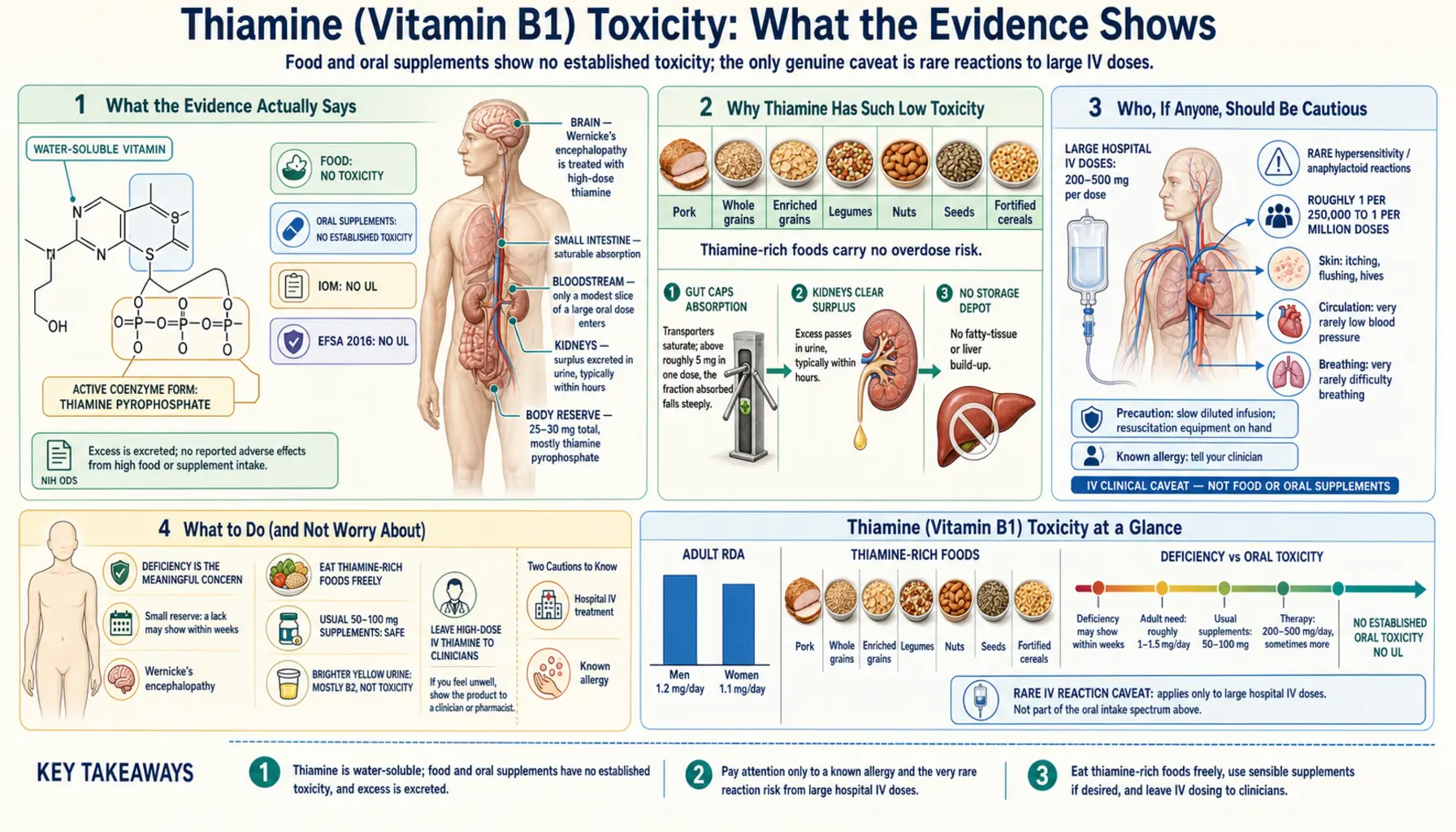
Here is the honest bottom line, stated up front: thiamine (vitamin B1) is not toxic from food, and it is essentially not toxic from oral supplements either. It is a water-soluble vitamin, which means your body does not stockpile a dangerous surplus — whatever you absorb beyond your needs, the kidneys simply filter out and pass in the urine. Because of this, no recognized "thiamine toxicity syndrome" exists, and the two bodies that set nutrient safety limits — the U.S. Institute of Medicine and the European Food Safety Authority — have not established a Tolerable Upper Intake Level for thiamine, specifically because the evidence for harm from high oral intake is too thin to support one. People have taken hundreds of milligrams a day — far above the roughly 1–1.5 mg an adult needs — in clinical trials without meaningful ill effects. The only genuine caveat is a narrow clinical one: rare hypersensitivity or anaphylactoid reactions to large intravenous doses given in a hospital, which is a procedural issue for clinicians, not something that happens from eating pork, whole grains, or taking a B-complex pill. This page explains what the evidence actually says, why thiamine behaves this way in the body, the few edge cases worth knowing, and a low-key, practical takeaway. This is not a common clinical problem, and the page is deliberately short because there is not a toxicity to describe.
Table of Contents
- What the Evidence Actually Says
- Why Thiamine Has Such Low Toxicity
- Who, If Anyone, Should Be Cautious
- What to Do (and Not Worry About)
- Related Topics
- Key Research Papers
- Connections
- Featured Videos
What the Evidence Actually Says
It is worth being clear and direct, because health writing often hedges where it does not need to: there is no established toxicity from oral thiamine, and none at all from thiamine in food. This is not an oversight or a gap waiting to be filled — it reflects decades of use and study. Thiamine is one of the safest vitamins known.
The clearest sign of this is what the expert bodies decided not to do. When scientists set nutrient guidelines, they publish two kinds of numbers: how much you need (the RDA or recommended intake) and, where the evidence justifies it, a ceiling above which harm becomes likely — the Tolerable Upper Intake Level (UL). For thiamine:
- The U.S. Institute of Medicine (IOM, now the National Academies) set an RDA of about 1.2 mg/day for adult men and 1.1 mg/day for adult women, but pointedly did not set a UL. Its reasoning was straightforward: there were no well-documented reports of harm from high oral thiamine intake on which to base a limit.
- The European Food Safety Authority (EFSA), in its 2016 review of dietary reference values for thiamin, likewise did not establish a Tolerable Upper Intake Level, concluding that the available data did not show adverse effects from high oral intakes.
- The U.S. National Institutes of Health Office of Dietary Supplements (NIH ODS) states plainly in its thiamin fact sheet that the body excretes excess thiamine in the urine and that there are no reports of adverse effects from consuming high amounts from food or supplements.
To put the numbers in perspective: an adult needs on the order of 1 to 1.5 mg of thiamine a day. Yet many B-complex and "stress" supplements contain 50 mg, 100 mg, or more — doses 50 to 100 times the requirement — and these are sold over the counter precisely because they are not associated with harm. In medicine, thiamine is given in still larger amounts: 200 to 500 mg a day, and sometimes more, is used to treat or prevent Wernicke's encephalopathy and has been tested in critical-care trials, generally without significant toxicity. One published case series even described patients taking very high oral doses for extended periods with no meaningful overdose effects. The consistent picture across food, supplements, and high-dose therapy is the same: thiamine simply does not build up to a harmful level when taken by mouth.
This is the opposite of the situation with the fat-soluble vitamins (A, D, E, and K), which the body stores in fat and the liver and which therefore can accumulate to toxic levels — vitamin A and vitamin D in particular have well-defined toxicity syndromes and firm upper limits. Thiamine, being water-soluble, behaves nothing like that. If you have arrived at this page worried that a supplement or a thiamine-rich diet might "overdose" you, the honest answer is that this is not a realistic concern.
Why Thiamine Has Such Low Toxicity
The reason thiamine is so hard to overdose comes down to two pieces of basic biology: how little of it the body can absorb at once, and how efficiently the kidneys clear the rest. Together these act like a pressure-release valve that prevents a dangerous build-up.
Absorption is self-limiting. In the small intestine, thiamine is taken up mainly by specific transporter proteins — a saturable system, meaning it has a maximum throughput. At ordinary dietary amounts this works efficiently, but when a large dose arrives all at once, the transporters become saturated and simply cannot move any more across the gut wall. Above roughly 5 mg in a single dose, the fraction absorbed falls off steeply; the excess passes through and is lost. So even if you swallow a 100 mg tablet, only a modest slice actually enters the bloodstream — the gut itself caps the dose. (This is also why some high-potency products use lipid-soluble derivatives such as benfotiamine, which bypass that bottleneck; even then, the surplus is still excreted.)
Think of it like a turnstile at a stadium: it lets people through at a steady pace no matter how big the crowd pushes from behind. A bigger crowd does not get through faster — it just means more people are left outside.
The kidneys clear the surplus. Whatever thiamine does get into the blood beyond what the body can immediately use or hold in its small functional pool is filtered by the kidneys and excreted in the urine, typically within hours. The body keeps only a small working reserve (on the order of 25–30 mg total, mostly in the form thiamine pyrophosphate, the active coenzyme), and it does not pad that reserve with a hazardous excess. There is no fatty tissue or liver depot quietly accumulating thiamine the way there is for vitamins A or D.
This combination — a gut that refuses to absorb a large bolus and kidneys that promptly flush what does get through — is exactly why the safety authorities could find no basis for an upper limit. The biology makes oral overdose self-correcting. (The flip side, covered on the Deficiency hub, is that because the body holds so little thiamine in reserve, a lack of it shows up within weeks — thiamine's water-solubility cuts both ways.)
Who, If Anyone, Should Be Cautious
If oral thiamine is essentially non-toxic, is there any real caveat? Yes — but it is narrow, clinical, and almost entirely about the intravenous (IV) route given in a hospital, not about diet or pills. It is worth understanding precisely so it is not over-interpreted.
- Rare hypersensitivity / anaphylactoid reactions to large IV doses. This is the one genuine, documented risk. When thiamine is injected directly into a vein — as is done to treat Wernicke's encephalopathy in hospital, often at 200–500 mg per dose — a small number of people have had allergic-type reactions, ranging from itching, flushing, or hives up to, very rarely, a severe anaphylactoid reaction with low blood pressure and difficulty breathing. Crucially, the most rigorous review of this question found these reactions to be very uncommon — on the order of roughly 1 per 250,000 to 1 per million doses in the data examined — and concluded that the well-established benefit of treating Wernicke's encephalopathy far outweighs this small risk. The practical response in medicine is sensible precaution, not avoidance: giving IV thiamine as a slow infusion diluted in fluid rather than a rapid push, and having resuscitation equipment on hand — standard practice for many injectable drugs. This is a clinician's procedural concern, not something that can happen from food or an oral supplement.
- People with a known allergy to thiamine or to a product's other ingredients. As with virtually any substance, a true allergy is possible, though genuine thiamine allergy is rare. Anyone who has reacted to a thiamine injection or supplement before should tell their clinician.
- A note on lab tests — thiamine is not the B vitamin that interferes with bloodwork. You may have heard that a B vitamin can throw off laboratory results; that is biotin (vitamin B7), not thiamine. High-dose biotin can distort certain immunoassays (for example, some thyroid and troponin tests). Thiamine does not have this effect. We mention it only to clear up a common mix-up — see Biotin (Vitamin B7).
Notably absent from this list is anything about high oral doses causing organ damage, nerve problems, or a build-up syndrome — because the evidence does not support such claims. Unlike vitamin B6 (pyridoxine), where chronically very high oral doses can cause nerve damage and therefore does have an upper limit, thiamine carries no comparable oral toxicity.
What to Do (and Not Worry About)
The practical guidance here is refreshingly simple, precisely because there is so little to manage.
- You do not need to limit thiamine in your diet. Thiamine-rich foods — pork, whole and enriched grains, legumes, nuts, seeds, and fortified cereals — carry no overdose risk. Eat them freely. For where thiamine comes from, see Vitamin B1 Food Sources.
- Over-the-counter B1 and B-complex supplements are safe at usual doses. The 50–100 mg amounts common in these products are far above the requirement, but that is by design and is not harmful — the surplus is excreted. There is no need to seek out the "lowest" dose to be safe. (As always with supplements, more is not the same as better; taking far more than you need mostly produces expensive urine, not extra benefit.)
- One harmless, expected effect: large oral doses of B vitamins, including thiamine in a B-complex, can give urine a brighter yellow tint (this is mostly riboflavin, vitamin B2) and can lend supplements a faint sulfur-like smell. Neither is a sign of toxicity — the color is simply the vitamins being excreted.
- Leave high-dose IV thiamine to clinicians. The therapeutic high doses used for Wernicke's encephalopathy or in critical care are given and monitored by medical professionals who manage the rare injection-reaction risk. This is not something to attempt or worry about at home.
- If you take a supplement and feel unwell, it is worth a check — but consider the alternatives first. Because thiamine itself so rarely causes problems, a symptom that appears after taking a B-complex is more often due to another ingredient, an unrelated cause, or coincidence. Bring the product to your clinician or pharmacist if you are concerned.
In short: enjoy thiamine-rich food, take a sensible supplement if you choose, and reserve the genuine (and small) caution for the hospital IV setting. The water-solubility that makes thiamine deficiency develop quickly is the very same property that makes its toxicity, for all practical purposes, a non-issue.
Related Topics
Because thiamine toxicity is not a real clinical entity, the more useful reading is about thiamine's actual roles and the conditions tied to its deficiency, where the meaningful health stakes lie:
- Thiamine (Vitamin B1) Deficiency — the side of the ledger that genuinely matters: who runs low, the warning signs, and how it is corrected.
- Thiamine and Beriberi — the classic deficiency disease, wet and dry forms, and its history.
- Thiamine and Brain Health — why the brain is so dependent on thiamine and what Wernicke-Korsakoff syndrome is.
- Vitamin B1 (Thiamine) overview — the full picture of what thiamine does in the body.
Key Research Papers
- EFSA Panel on Dietetic Products, Nutrition and Allergies (NDA) (2016). Dietary reference values for thiamin. EFSA Journal;14(12):4653. — DOI: 10.2903/j.efsa.2016.4653 (The European review that explicitly did not set a Tolerable Upper Intake Level for thiamin.)
- Thomson A, Guerrini I, Marshall EJ (2019). Incidence of Adverse Reactions to Parenteral Thiamine in the Treatment of Wernicke's Encephalopathy, and Recommendations. Alcohol and Alcoholism;54(6):609-614. — DOI: 10.1093/alcalc/agy091 (Quantifies the rare IV-thiamine reaction risk and concludes the benefit far outweighs it.)
- Donnino MW, Andersen LW, Chase M, et al. (2015). Thiamine as a metabolic resuscitator in septic shock: a randomized, double-blind, placebo-controlled, pilot trial. Critical Care;19(Suppl 1). — DOI: 10.1186/cc14472 (High-dose intravenous thiamine administered in a controlled trial without significant toxicity.)
- Costantini A (2018). Effects of Overdose of High-Dose Thiamine Treatment. Gerontology & Geriatrics Studies;4(2). — DOI: 10.31031/ggs.2018.04.000583
- Jackson R (2004). Oral or intravenous thiamine in the emergency department. Emergency Medicine Journal;21(4):501-502. — DOI: 10.1136/emj.2004.016550
- Whitfield KC, Bourassa MW, Adamolekun B, et al. (2018). Thiamine deficiency disorders: diagnosis, prevalence, and a roadmap for global control programs. Annals of the New York Academy of Sciences;1430(1):3-43. — DOI: 10.1111/nyas.13919 (Comprehensive review of thiamine biology and status; deficiency, not excess, is the clinical concern.)
- National Institutes of Health, Office of Dietary Supplements. Thiamin — Health Professional Fact Sheet. — PubMed: thiamine safety / upper intake level (The U.S. authority stating that excess thiamine is excreted and no adverse effects are reported from high oral intake.)
PubMed Topic Searches
- PubMed — Thiamine safety, adverse effects, and upper intake
- PubMed — Parenteral thiamine: anaphylaxis and hypersensitivity
- PubMed — High-dose thiamine clinical trials and tolerability
- PubMed — Thiamine intestinal absorption and saturable transport
- PubMed — Water-soluble vitamins, toxicity, and renal excretion
Connections
- All Vitamins
- Vitamin B1 (Thiamine) Overview
- Thiamine Deficiency Hub
- Vitamin B1 Benefits Hub
- Vitamin B1 Food Sources
- Vitamin B1 History & Discovery
- Thiamine and Beriberi
- Thiamine and Brain Health
- Biotin (Vitamin B7)
- Comprehensive Metabolic Panel
- Food Overview