Natamycin (E235): The Antibiotic Preservative on Your Cheese
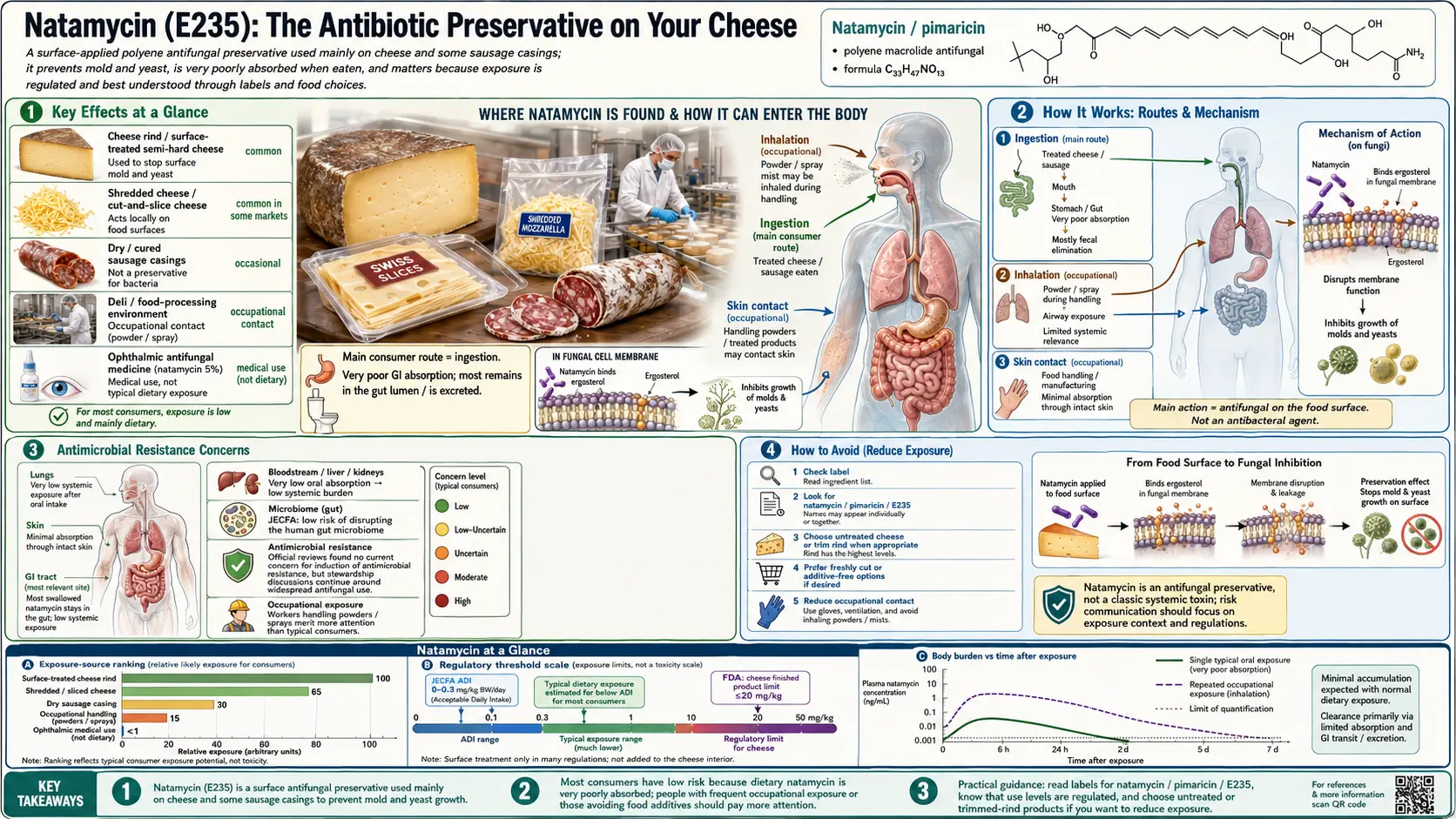
Table of Contents
Key Effects at a Glance
- Antifungal antibiotic food additive – A polyene macrolide from Streptomyces natalensis that binds ergosterol, the main fungal membrane sterol (te Welscher 2008).
- Very poorly absorbed – EFSA’s 2009 opinion describes natamycin as very poorly absorbed; a 2026 review describes negligible systemic absorption in humans and animals.
- Antimicrobial resistance – EFSA (2009) found no concern for the induction of antimicrobial resistance; a 2016 laboratory study raised tolerance in 13 of 20 fungal strains under prolonged, rising exposure; a 2015 review argued that uses mixing natamycin into yoghurt and beverages may foster polyene resistance in Candida.
- Gut microbiome – A 2026 review reports that no studies have examined natamycin’s effect on the gut microbiome when consumed in food.
- ADI – JECFA assigned 0.3 mg/kg body weight/day; the EFSA panel judged the data not robust enough to derive an ADI of its own.
1. Overview
Natamycin (E 235), also known as pimaricin, is a polyene macrolide antifungal antibiotic produced by the soil bacterium Streptomyces natalensis. It occupies an unusual position among food additives: it is used as a surface preservative on cheese and sausages, and it is also a topical drug for fungal infections of the eye (Bangeppagari 2026).
Pimaricin was described as “a new antifungal antibiotic” by Struyk and colleagues in the 1957–1958 volume of Antibiotics Annual. It is produced by strains of S. natalensis, and a 2021 review covers its production methods (Meena 2021).
Because the same molecule is a food additive and a medicine, natamycin has drawn attention in debates about antimicrobial use outside human medicine. Reviewers have asked whether food use could weaken the clinical value of polyene antifungals (Dalhoff 2015), while EFSA’s panel concluded in 2009 that there was no concern for the induction of antimicrobial resistance.
2. Where It's Found
Natamycin’s food uses are concentrated where surface mould is the problem:
- Cheese: US rules allow it on cheese at up to 20 mg/kg in the finished product (21 CFR 172.155). EU rules allow it only for surface treatment of hard, semi-hard and semi-soft ripened cheese (Regulation (EU) No 1129/2011).
- Sausages: EFSA’s 2009 opinion describes the earlier EU directive (95/2/EC) as permitting surface treatment of dry, cured sausage; reviews list sausages among its food uses (Meena 2021).
- Yogurt, juices and wine: A 2021 review lists yogurt, juices and wines among natamycin’s applications (Meena 2021). A 2015 review describes natamycin mixed homogeneously into yoghurt and natamycin–cyclodextrin complexes developed for beverages and wine (Dalhoff 2015).
Outside food, natamycin is an ophthalmic drug. A 2026 review describes natamycin as the only FDA-approved topical antifungal for fungal keratitis (corneal fungal infection), most effective against filamentous fungi, especially Fusarium (Bangeppagari 2026). This medical use is why resistance arising from food use is discussed as a medical question.
3. How It Works
Natamycin belongs to the same polyene class as amphotericin B and nystatin, but laboratory work shows it acts differently from the pore-forming polyenes:
- Ergosterol binding: Natamycin binds specifically to ergosterol, the main sterol in fungal membranes. Yeast mutants showed that the double bonds in ergosterol’s B-ring matter for this binding and for the block of fungal growth (te Welscher 2008).
- No membrane leakage: Unlike nystatin and filipin, natamycin did not change the permeability of the yeast plasma membrane at concentrations that blocked growth, and it did not make ergosterol-containing model membranes leaky (te Welscher 2008).
- Transport blockade: A 2012 study found that natamycin stops yeast and fungal growth by immediately inhibiting amino acid and glucose transport across the plasma membrane, through ergosterol-specific, reversible inhibition of membrane transport proteins (te Welscher 2012).
In the EU, natamycin is permitted only as a surface treatment, at no more than 1 mg/dm² of surface and not present at a depth of 5 mm (Regulation (EU) No 1129/2011).
4. Health Effects
Regulators’ assessments of the direct toxicology are reassuring, with stated gaps in the data:
- Absorption: EFSA’s 2009 opinion describes natamycin as very poorly absorbed. A 2026 review reports negligible systemic absorption in human and animal studies, attributed to its high molecular weight, low water solubility and instability in the gut (Bangeppagari 2026).
- Exposure and margin of safety: EFSA estimated the highest potential exposure at below 0.1 mg/kg body weight/day for children at the 97.5th percentile, and considered that this gave an adequate margin of safety. The panel judged the uses not of safety concern when limited to the rind of semi-hard and semi-soft cheese and the casings of certain sausages.
- Data gaps: The EFSA panel did not derive an ADI because of limitations in the database, including the design of the animal studies, the small number of animals, the lack of a carcinogenicity study and an inadequate description of the human data. A 2026 review adds that long-term, chronic and generational studies are lacking (Bangeppagari 2026).
- Allergy: A 2026 review reports no evidence of allergenicity or hypersensitivity reactions linked to foods containing natamycin (Bangeppagari 2026).
The open question concerns the gut microbiome, including its fungal members (the mycobiome):
- Because natamycin is largely unabsorbed, it stays in the gut, which a 2026 review notes suggests possible interactions with the microbiome. The same review reports that no studies have examined natamycin’s effect on the gut microbiome when it is consumed in food, and that direct measurements of natamycin concentrations in the colon are unavailable (Bangeppagari 2026).
- A 2015 review argues that food uses mixing natamycin into the whole product (such as yoghurt) and cyclodextrin complexes in beverages and wine produce high faecal natamycin concentrations, exposing intestinal Candida to the drug (Dalhoff 2015).
5. Antimicrobial Resistance Concerns
Antimicrobial resistance (AMR) is the most contested part of natamycin’s safety profile, because the food additive is also a medically used antifungal. The published findings point in different directions.
What Studies Have Found
- Cheese warehouses (1977): After several years of continuous natamycin use, no natamycin-insensitive moulds or yeasts were found in cheese warehouses, and sensitivity could not be lowered in 26 warehouse mould strains under laboratory conditions (de Boer 1977).
- Laboratory “training” (2016): When 20 fungal species from medical and food sources were exposed to rising natamycin concentrations for a prolonged time, the minimum inhibitory concentration rose in 13 of 20 strains (average 6.1 to 8.6 μM), and 4 strains showed a more than twofold increase in tolerance. The authors wrote that such a selection pressure “should be avoided in the technical application of natamycin” (Streekstra 2016).
- Fruit pathogens (2021): A study of seven post-harvest fruit pathogens found no resistant Penicillium digitatum isolates on natamycin gradients and noted that no resistance had been observed in its decades of food use (Chen 2021).
- Patients (as reviewed in 2015): A review reports that natamycin resistance has been observed in Candida colonising the intestinal tract of patients after natamycin treatment of fungal infections (Dalhoff 2015).
Cross-Resistance with Clinical Antifungals
In the 2016 training study, one Aspergillus ochraceus strain also became more tolerant to amphotericin B and nystatin, while two Fusarium strains showed similar or even lower tolerance to those polyenes (Streekstra 2016). A 2015 review asked whether food use of natamycin could jeopardise the clinical efficacy of amphotericin B, and concluded that it “cannot be denied” that preserving yoghurt and beverages with natamycin may foster polyene resistance in Candida (Dalhoff 2015). Altered sterol biosynthesis is one of the resistance mechanisms described for antifungals in general (Ghannoum 1999).
Regulators’ Assessments
EFSA’s food additives panel, asked by the European Commission to address antimicrobial resistance specifically, concluded in 2009 that there was no concern for the induction of antimicrobial resistance. The 2015 review by Dalhoff and Levy, by contrast, considered surface treatment of cheese and sausages “not of safety concern” but called for examination of natamycin’s effect on faecal flora as a reservoir for resistance where it is mixed into foods or beverages. The WHO list of critically important antimicrobials (6th revision, 2019) ranks medically important antimicrobials for managing the resistance risk from non-human use.
6. Regulatory Status
Natamycin’s permitted uses differ between jurisdictions:
- European Union: Authorised as E 235 under Regulation (EC) No 1333/2008. The Union list (Regulation (EU) No 1129/2011) permits it in ripened cheese for “only surface treatment of hard, semi-hard and semi-soft cheese”, at 1 mg/dm² of surface, not present at a depth of 5 mm. EFSA’s 2009 opinion describes the earlier Directive 95/2/EC as also covering the surface of dry, cured sausage.
- United States (FDA): Listed as a food additive at 21 CFR 172.155, “Natamycin (pimaricin)”, which permits it on cheese, as an antimycotic, at no more than 20 mg/kg (20 ppm) in the finished product, with purity of 97 ± 2 percent.
- JECFA (FAO/WHO): JECFA assigned an acceptable daily intake of 0.3 mg/kg body weight/day (1968, 1976, 2002), as summarised in EFSA’s 2009 opinion. EFSA’s panel considered the data not robust enough to derive an ADI, and noted that the EU Scientific Committee on Food in 1979 had found no safety concern but an inadequate basis for an ADI.
7. Organic Standards
Under the US National Organic Program, products sold as “organic” must be handled without nonagricultural substances other than those listed in 7 CFR 205.605 (7 CFR 205.105). Natamycin does not appear on the 205.605 list of nonagricultural substances allowed in or on processed products labeled “organic” or “made with organic” ingredients.
8. Labels and Product Rules
- Names on labels: The additive appears as “natamycin” or “pimaricin” (the two names used in 21 CFR 172.155) or, in the EU, as E 235.
- US organic products: Natamycin is not among the substances 7 CFR 205.605 allows in or on processed products labeled “organic”.
- Surface use in the EU: EU rules confine it to cheese surfaces, at no more than 1 mg/dm² and not present at a depth of 5 mm.
- Mixed-in uses: The concerns raised in the 2015 review centre on natamycin mixed throughout a food or drink (yoghurt, beverages, wine), rather than surface treatment of cheese and sausages (Dalhoff 2015).
Decisions about diet and food additives belong with each reader and, where health is involved, a clinician.
Connections
Key Research Papers
- te Welscher YM, ten Napel HH, Balagué MM, Souza CM, Riezman H, de Kruijff B, Breukink E. Natamycin blocks fungal growth by binding specifically to ergosterol without permeabilizing the membrane. Journal of Biological Chemistry. 2008;283(10):6393–6401. — doi:10.1074/jbc.M707821200
- EFSA Panel on Food Additives and Nutrient Sources added to Food (ANS). Scientific Opinion on the use of natamycin (E 235) as a food additive. EFSA Journal. 2009;7(12):1412. — doi:10.2903/j.efsa.2009.1412
- Streekstra H, Verkennis AE, Jacobs R, Dekker A, Stark J, Dijksterhuis J. Fungal strains and the development of tolerance against natamycin. International Journal of Food Microbiology. 2016;238:15–22. — PubMed PMID: 27589020
- Raab WP. Natamycin (Pimaricin): its properties and possibilities in medicine. Georg Thieme Verlag. Stuttgart; 1972.
- WHO. Critically Important Antimicrobials for Human Medicine, 6th Revision. World Health Organization; 2019. ISBN 978-92-4-151552-8.
- Dalhoff AA, Levy SB. Does use of the polyene natamycin as a food preservative jeopardise the clinical efficacy of amphotericin B? A word of concern. International Journal of Antimicrobial Agents. 2015;45(6):564–567. — PubMed PMID: 25862309
- Stark J, Tan HS. Natamycin. In: Russell NJ, Gould GW, eds. Food Preservatives. 2nd ed. Springer US; 2003:179–195. — doi:10.1007/978-0-387-30042-9_9
- Ghannoum MA, Rice LB. Antifungal agents: mode of action, mechanisms of resistance, and correlation of these mechanisms with bacterial resistance. Clinical Microbiology Reviews. 1999;12(4):501–517. — doi:10.1128/CMR.12.4.501
- European Commission. Regulation (EC) No 1333/2008 of the European Parliament and of the Council on food additives. Official Journal of the European Union. 2008;L354:16–33.
- FDA. Code of Federal Regulations, Title 21, § 172.155: Natamycin (pimaricin). — eCFR 21 CFR 172.155
- Codex Alimentarius Commission. General Standard for Food Additives (CODEX STAN 192-1995, amended 2023). FAO/WHO; 2023.
- Ellepola AN, Morrison CJ. Laboratory diagnosis of invasive candidiasis. Journal of Microbiology. 2005;43(Spec No):65–84. — PubMed PMID: 15765060
- Meis JF, Chowdhary A, Rhodes JL, Fisher MC, Verweij PE. Clinical implications of globally emerging azole resistance in Aspergillus fumigatus. Philosophical Transactions of the Royal Society B. 2016;371(1709):20150460. — doi:10.1098/rstb.2015.0460
- de Boer E, Stolk-Horsthuis M. Sensitivity to natamycin (pimaricin) of fungi isolated in cheese warehouses. Journal of Food Protection. 1977;40(8):533–536. — PubMed PMID: 30736220
- te Welscher YM, van Leeuwen MR, de Kruijff B, Dijksterhuis J, Breukink E. Polyene antibiotic that inhibits membrane transport proteins. Proceedings of the National Academy of Sciences of the USA. 2012;109(28):11156–11159. — PubMed PMID: 22733749
- Bangeppagari M, Jagadish P, Srinivasa A, Choi W, Tiwari P. Natamycin in food and ophthalmology: knowledge gaps and emerging insights from zebrafish models. Pharmaceuticals (Basel). 2026;19(1):86. — PubMed PMID: 41599684
- Meena M, Prajapati P, Ravichandran C, Sehrawat R. Natamycin: a natural preservative for food applications—a review. Food Science and Biotechnology. 2021;30(12):1481–1496. — PubMed PMID: 34868698
- Chen D, Förster H, Adaskaveg JE. Baseline sensitivities of major citrus, pome, and stone fruits postharvest pathogens to natamycin and estimation of the resistance potential in Penicillium digitatum. Plant Disease. 2021;105(8):2114–2121. — PubMed PMID: 33306429
- Struyk AP, Hoette I, Drost G, Waisvisz JM, van Eek T, Hoogerheide JC. Pimaricin, a new antifungal antibiotic. Antibiotics Annual. 1957–1958;5:878–885. — PubMed PMID: 13521908
- European Commission. Commission Regulation (EU) No 1129/2011 amending Annex II to Regulation (EC) No 1333/2008 by establishing a Union list of food additives. Official Journal of the European Union. 2011. — CELEX 32011R1129
- USDA Agricultural Marketing Service. Code of Federal Regulations, Title 7, § 205.605: Nonagricultural (nonorganic) substances allowed as ingredients in or on processed products labeled as “organic”. — eCFR 7 CFR 205.605