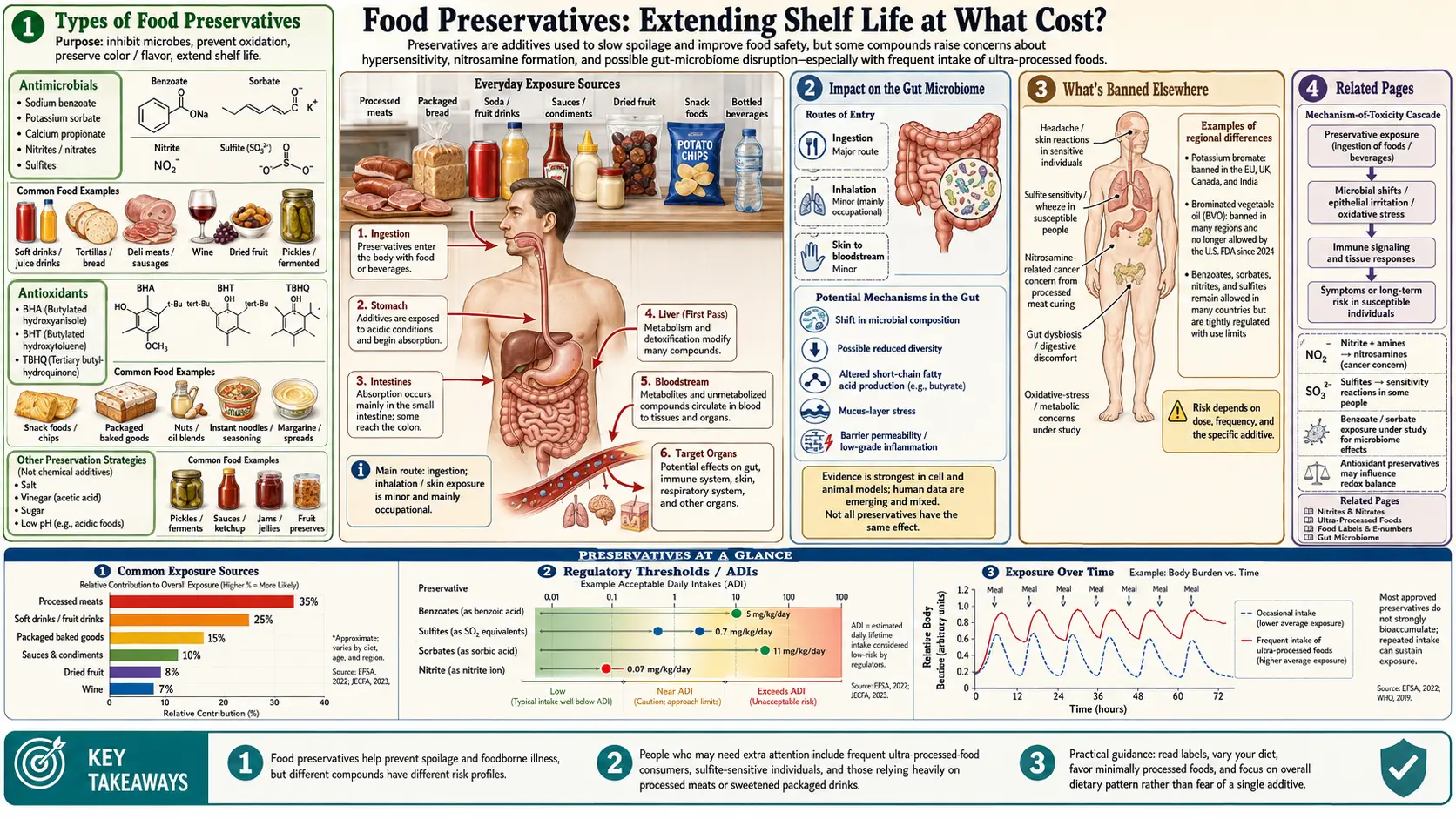
Food Preservatives: Extending Shelf Life at What Cost?
Table of Contents
- Types of Food Preservatives
- The Most Concerning Preservatives
- Cumulative Daily Exposure
- Children’s Exposure
- Impact on the Gut Microbiome
- Endocrine Disruption
- Cancer Links
- What’s Banned Elsewhere
- Natural Preservation Alternatives
- A Label Reading Guide for Preservatives
- The Bottom Line
- Related Pages
- Key Research Papers
- Connections
- Featured Videos
Food preservatives are substances added to food to slow spoilage by microbes or by oxidation and so extend shelf life. Preservation itself is ancient — salt, smoke, vinegar and fermentation have been used for thousands of years — while modern processed foods also rely on synthetic preservatives. Several of these have been studied for health effects, with results that range from regulatory reassurance to open questions, and the main findings for each are summarised below. Each preservative has its own article with the full sources.
This page reports what toxicology studies, human studies and regulators have found. Where a finding comes from cell cultures or animals, it is described as such.
Types of Food Preservatives
Chemical preservatives fall into several broad categories based on how they prevent food from degrading. Each category works through a different mechanism, and each has its own research record.
Antimicrobial Preservatives
Antimicrobial preservatives kill or inhibit the bacteria, molds and yeasts that spoil food and can cause foodborne illness. Preventing microbial contamination is a food-safety function; some of the chemicals used for it have also been studied for side effects.
- Sodium benzoate (E211) — Widely used in acidic foods such as soft drinks, fruit juices, pickles and salad dressings. In a product that also contains ascorbic acid (vitamin C), with trace copper or iron, a reaction can form benzene, which IARC classifies as carcinogenic to humans (Group 1). In an FDA survey of almost 200 beverages sampled in 2005–2007, most had no detectable benzene or less than the EPA drinking-water limit of 5 ppb; 10 products were above it and were reformulated (Nyman 2008). The 2007 Southampton trial tested drinks containing sodium benzoate together with artificial colour mixes, so it cannot separate the preservative from the colours (McCann 2007). Damage to mitochondrial DNA has been reported in yeast (Piper 1999); no human study of it was found. Learn more.
- Sodium nitrite (E250) and sodium nitrate (E251) — Used mainly in cured processed meats such as bacon, hot dogs, deli meats and sausages, where nitrite inhibits Clostridium botulinum, the bacterium that makes botulinum toxin. Nitrite can react with amines and amides to form N-nitroso compounds (nitrosamines), many of which are carcinogenic in animals. IARC classified processed meat as carcinogenic to humans (Group 1) in 2015 on evidence for colorectal cancer; it named N-nitroso compounds among the chemicals formed during processing while stating that whether and how much they contribute to the risk is unknown (Bouvard 2015). Learn more.
- Potassium sorbate (E202) — Found in cheese, wine, baked goods and personal care products. It has very low toxicity in animal testing. Cell-culture studies reported DNA damage in human lymphocytes at high concentrations (Mamur 2010), while EFSA found no evidence of genotoxic activity; EFSA set a group acceptable daily intake (ADI) of 11 mg/kg body weight per day in 2019 (EFSA 2019). Learn more.
- Sulfites (E220-E228) — A family including sulfur dioxide, sodium sulfite, sodium bisulfite and potassium metabisulfite, used in wine, dried fruits, shrimp and processed potatoes. In sensitive people, reported reactions range from dermatitis, urticaria, flushing and abdominal pain to life-threatening asthmatic and anaphylactic reactions; most studies report sulfite sensitivity in 3–10% of people with asthma (Vally 2009). In 2022 EFSA withdrew its temporary ADI for sulfites, judging the toxicity data inadequate, and concluded that estimated dietary exposures raise a safety concern (EFSA 2022). Learn more.
- Natamycin (E235) — A polyene antifungal (US regulations call it an antimycotic) applied to cheese surfaces; US rules allow up to 20 mg/kg in the finished cheese (21 CFR 172.155). It acts on fungi, not bacteria. In a laboratory study, prolonged exposure to rising natamycin concentrations increased tolerance in 13 of 20 fungal strains, and the authors wrote that such selection pressure should be avoided in its use as a food preservative (Streekstra 2016). Learn more.
- Nisin (E234) — An antimicrobial peptide produced by the bacterium Lactococcus lactis, used in processed cheese, canned foods and meat products. EFSA set an ADI of 1 mg/kg body weight per day in 2017 and found estimated exposures below it (EFSA 2017). In a study in healthy mice comparing eleven preservatives, nisin had the most marked effects on glucose tolerance and gut bacteria (Li 2022). Learn more.
Antioxidant Preservatives
Antioxidant preservatives prevent oxidation — the chemical reaction that makes fats and oils rancid and foods turn brown or lose flavour. The synthetic phenolic antioxidants are among the most debated additives in the food supply.
- BHA (butylated hydroxyanisole, E320) — A synthetic antioxidant made from petrochemical starting materials. The US National Toxicology Program lists it as “reasonably anticipated to be a human carcinogen” on the basis of forestomach tumours in rodents fed 0.5–2% of the diet (Ito 1983); humans have no forestomach. Found in cereals, snack foods, chewing gum, fats and cosmetics. It is permitted with limits in the US, the EU and Japan, and FDA opened a post-market safety assessment in 2026. Read more about BHA and BHT.
- BHT (butylated hydroxytoluene, E321) — Chemically similar to BHA and used in many of the same products. IARC places it in Group 3 (not classifiable). High dietary doses reduced blood-clotting factors in rats and damaged the kidneys of mice, and its effect on tumours varies between animal models. The Southampton hyperactivity trial did not test BHT. Read more about BHA and BHT.
- TBHQ (tert-butylhydroquinone, E319) — A synthetic phenolic antioxidant (it is also a metabolite of BHA; Keum 2006) used in frying oils, crackers, chips and frozen foods. US rules limit total antioxidant content, TBHQ alone or with BHA or BHT, to 0.02% of a food’s oil or fat content (21 CFR 172.185). In the National Toxicology Program’s two-year feeding studies there was no evidence of carcinogenic activity in rats or mice (NTP 1997). A Michigan State University group reports that TBHQ impairs T-cell responses in its laboratory work, and in a 2026 study it reduced the maturation of mouse dendritic cells stimulated with bacterial or influenza virus components (Awali 2026). Learn more.
- Propyl gallate (E310) — Often used together with BHA and BHT in fats, oils, meat products and chewing gum. In the National Toxicology Program’s 1982 feeding study it was not considered carcinogenic, with the evidence rated “equivocal” in male rats and male mice; liver changes and prostate inflammation were seen in treated male rats (NTP 1982). In a cell-based screen it acted as an estrogen-receptor antagonist at nanomolar concentrations (Amadasi 2009).
Chelating Agents and Acids
Chelating agents bind the metal ions in food that would otherwise catalyse oxidation and spoilage. They are often used together with antioxidant preservatives.
- EDTA (ethylenediaminetetraacetic acid, E385) — Found in canned foods, salad dressings, sandwich spreads and soft drinks. It binds metal ions such as iron and copper; FDA chemists report that EDTA can inhibit the formation of benzene in drinks containing benzoate and vitamin C (Nyman 2008).
- Citric acid (E330) — An acid that occurs naturally in citrus fruits and is used as a preservative and flavouring. The added form is manufactured, mostly by fermentation with the mold Aspergillus niger. A 2018 series of four case reports described inflammatory reactions after foods containing manufactured citric acid and called for further study; case reports cannot establish cause (Sweis 2018).
- Phosphoric acid (E338) — Used mainly in cola soft drinks. In the Framingham Osteoporosis Study, cola intake was associated with lower hip bone mineral density in women but not men, and other carbonated drinks showed no such association; the authors called for confirmation (Tucker 2006).
The Most Concerning Preservatives
Several preservatives draw particular attention in the research and regulatory literature. What the evidence shows differs for each:
- BHA (butylated hydroxyanisole) — Listed by the NTP as a reasonably anticipated human carcinogen and by IARC as Group 2B, on forestomach tumours in rats, hamsters and mice fed high doses. EFSA judged in 2011 that these forestomach findings may no longer be relevant to humans (EFSA 2011), and a Dutch cohort of 120,852 adults found no association between usual intake and stomach cancer (Botterweck 2000). It was weakly estrogenic in cell screens (Jobling 1995). Full article on BHA and BHT.
- Sodium nitrite — Can form N-nitroso compounds during frying of cured meat and from nitrite in the acidic stomach. IARC classified ingested nitrate or nitrite under conditions that result in endogenous nitrosation as probably carcinogenic to humans (Group 2A) in 2010 (IARC 2010). In the French NutriNet-Santé cohort, higher intake of additive nitrites was associated with higher prostate cancer risk, an observational finding (Chazelas 2022). Full article on Sodium Nitrite.
- TBHQ — Permitted in the US at up to 0.02% of the fat or oil content. The NTP found no evidence of carcinogenic activity in rats or mice (NTP 1997); laboratory studies in mouse immune cells report reduced activation (Awali 2026). Full article on TBHQ.
- Sodium benzoate — Can form benzene, a Group 1 carcinogen, when combined with vitamin C; FDA concluded that the benzene levels it found in beverages “do not pose a safety concern for consumers” (FDA Q&A). The Southampton trial found that drinks containing sodium benzoate plus artificial colours raised a combined hyperactivity score; the authors concluded that “artificial colours or a sodium benzoate preservative (or both)” increase hyperactivity (McCann 2007), and EFSA called the evidence limited (EFSA 2008). Mitochondrial DNA damage has been reported in yeast only (Piper 1999). Full article on Sodium Benzoate.
- Sulfites — Can cause life-threatening asthmatic and anaphylactic reactions in sensitive people (Vally 2009). In the US, FDA rules bar sulfites from fruits and vegetables served or sold raw (21 CFR 182.3766), and any sulfite present at 10 ppm or more in a finished food must be declared on the label (21 CFR 101.100). Full article on Sulfites.
- Propylparaben — A preservative used in some foods and widely in cosmetics. Parabens were weakly estrogenic in laboratory assays, the most potent being about 10,000 times less potent than estradiol (Routledge 1998), and propylparaben fed to young male rats lowered sperm counts and serum testosterone (Oishi 2002). Parabens have been measured in samples of human breast tumours; that study measured their presence and did not test whether they cause cancer (Darbre 2004). It was removed from the EU list of permitted food additives in 2006, and California’s Food Safety Act (AB 418) prohibits it in food sold in the state from 1 January 2027.
Cumulative Daily Exposure
Regulators set an acceptable daily intake (ADI) for each additive separately, and estimate how much of it people eat from all foods that may contain it. A day of processed food can include several preservatives at once — for example BHT in a cereal, sodium nitrite in deli meat, TBHQ in crackers and sodium benzoate in a soft drink.
Studies of preservatives in combination are few. In laboratory tests, human gut bacteria were exposed to sodium benzoate, sodium nitrite and potassium sorbate alone and in combination (Hrncirova 2019, Folia Microbiologica), and in mice carrying human gut bacteria a mixture of these additives shifted the gut microbiota (Hrncirova 2019, Microorganisms). The sodium benzoate plus vitamin C reaction that forms benzene is the best-documented example of two ingredients interacting in a product (Nyman 2008). In the NutriNet-Santé cohort, several individual preservatives were associated with cancer incidence; these are observational associations (Hasenböhler 2026).
Children’s Exposure
Several findings concern children specifically:
- Higher relative intake — Children eat more food relative to their body weight than adults, and EFSA’s exposure estimates reflect this: for sodium benzoate, toddlers and children who regularly drink flavoured drinks exceeded the ADI in some scenarios (EFSA 2016); for BHT, children’s exposure at the 95th percentile exceeded the ADI in some countries (EFSA 2012); and for nitrite from food additives, children at the highest percentile showed a slight exceedance (EFSA 2017, nitrite).
- Developing animals — EFSA based its 2011 ADI for BHA on growth retardation, increased mortality and behavioural effects in rat pups at higher doses, and its 2012 ADI for BHT on two-generation rat studies (EFSA 2011; EFSA 2012).
- Hormone-active preservatives — BHA and the parabens show weak estrogenic activity in laboratory tests (Jobling 1995; Routledge 1998), and propylparaben affected the male reproductive system of young rats (Oishi 2002). Whether dietary intakes have such effects in children has not been shown.
- Behavioural effects — The 2007 Southampton trial, published in The Lancet, gave 3-year-olds and 8/9-year-olds from the general population drinks containing sodium benzoate plus one of two artificial-colour mixes, and found raised hyperactivity scores with some mixes in each age group (McCann 2007). After the trial, EU law required a warning label on foods containing any of six colours; the label applies to the colours, not to sodium benzoate.
Impact on the Gut Microbiome
The gut microbiome — the bacteria, fungi and other microorganisms of the digestive tract — is involved in immunity and metabolism. Antimicrobial preservatives are designed to inhibit microorganisms, so researchers have asked whether they also affect gut microbes. Most of the evidence so far comes from laboratory cultures and animals; no human feeding study has shown that dietary intakes change the human gut microbiome.
- Sodium benzoate, sodium nitrite and potassium sorbate — In laboratory cultures of human gut bacteria, susceptibility varied widely between species; strains with known anti-inflammatory properties, such as Clostridium tyrobutyricum and Lactobacillus paracasei, were more susceptible than some pro-inflammatory strains (Hrncirova 2019, Folia Microbiologica). In mice carrying human gut bacteria, a mixture of these additives led to an overgrowth of Proteobacteria and a decrease in Clostridiales (Hrncirova 2019, Microorganisms).
- Sulfites — In laboratory cultures, sodium sulfite and sodium bisulfite inhibited three Lactobacillus species and Streptococcus thermophilus at 250–500 ppm and killed them at higher concentrations (Irwin 2017).
- Potassium sorbate — In healthy mice given 150–1,000 mg/kg for 10 weeks, gut bacterial abundances changed and liver inflammatory-cell infiltration and serum IL-1β rose (Xiao 2024).
- Nisin — In healthy mice, eleven preservatives perturbed gut bacteria and glucose tolerance, and nisin had the most marked effects (Li 2022).
Changes in the gut microbiome have been associated with a range of chronic diseases. Whether preservative-related changes at dietary intakes contribute to any human disease has not been established; the authors of the mouse study wrote that this “remains to be elucidated” (Hrncirova 2019, Microorganisms).
Endocrine Disruption
Some food preservatives have shown hormone-like activity in laboratory tests. Endocrine disruptors are chemicals that interfere with the body’s hormonal system; for most preservatives, the evidence comes from cell assays and animal studies rather than human data.
- BHA — Weakly estrogenic in mammalian cell screens, less so than octylphenol; the authors stated that in-vivo studies would be needed before conclusions could be drawn (Jobling 1995). It partially blocked androgen-receptor activation in human reporter cells (Schrader 2000) and was a weak anti-androgen in a 2016 cell study (Pop 2016).
- Propylparaben — Weakly estrogenic in a yeast assay and inactive when given orally to immature rats in the same study (Routledge 1998); in young male rats it lowered sperm counts and serum testosterone (Oishi 2002).
- BHT — Partially inhibited androgen-receptor activation in reporter cells (Schrader 2000) and was a weak anti-androgen in MDA-kb2 cells (Pop 2016). EFSA based its ADI on two-generation rat studies of reproduction and development (EFSA 2011 and 2012).
- TBHQ — In the NTP studies, rats exposed to higher doses had lower sperm counts and longer estrous cycles in the 13-week studies (NTP 1997). Its effects on immune cells are described above.
- 4-hexylresorcinol — Used to prevent browning in shrimp and other crustaceans. In a cell-based screen it was a potent activator of estrogen receptor alpha at nanomolar concentrations (Amadasi 2009).
Cancer Links
The evidence linking preservatives to cancer differs in kind for each substance — from human epidemiology to animal-only findings:
- BHA — Classified by the US National Toxicology Program as “reasonably anticipated to be a human carcinogen” based on sufficient evidence of carcinogenicity in experimental animals, and by IARC as Group 2B (possibly carcinogenic to humans). The tumours were in the rodent forestomach at 0.5–2% of the diet (Ito 1983); the Netherlands Cohort Study, with mean intake of 105 micrograms of BHA a day, found no association with stomach cancer (Botterweck 2000).
- Sodium nitrite and nitrosamines — IARC classifies processed meat as carcinogenic to humans (Group 1), the same evidence category as tobacco smoking and asbestos, which IARC states does not mean they are equally dangerous. IARC’s experts concluded that each 50 g portion of processed meat eaten daily increases colorectal cancer risk by 18% (Bouvard 2015). IARC’s Q&A (IARC 2015) cites estimates of about 34,000 cancer deaths per year worldwide attributable to diets high in processed meat. IARC lists N-nitroso compounds among the chemicals formed in processing and states that their contribution to the risk is unknown.
- Sodium benzoate and benzene — Benzene, which can form when sodium benzoate reacts with ascorbic acid, is classified by IARC as Group 1. The EPA drinking-water limit is 5 ppb; after reformulation, FDA measured less than 1.5 ppb in the products that had exceeded it, and FDA concluded that the levels it found do not pose a safety concern (Nyman 2008). No study was found that measured cancer risk from benzene in beverages.
- TBHQ — The NTP two-year feeding studies found no evidence of carcinogenic activity in male or female rats or mice (NTP 1997).
- Preservatives in the NutriNet-Santé cohort — In 105,260 French adults, higher intake of some preservatives, including potassium sorbate and sodium nitrite, was associated with higher incidence of some cancers; the design is observational and does not establish cause (Hasenböhler 2026).
What’s Banned Elsewhere
Rules for preservatives differ between countries. US and EU rules differ less in whether new additives need approval than in how GRAS (Generally Recognized As Safe) substances are handled, how readily existing approvals are re-examined, and how much scientific uncertainty is enough to act on. Status as of October 2026:
- BHA — Permitted with limits in the US (GRAS when total antioxidants do not exceed 0.02% of the fat or oil content), the EU (specified food categories with maximum levels) and Japan (on its List of Designated Additives). FDA opened a post-market safety assessment of BHA in February 2026 (91 FR 6227).
- Propylparaben — Removed from the EU list of permitted food additives in 2006. Listed by FDA as GRAS (21 CFR 184.1670); California’s AB 418 prohibits it in food from 1 January 2027.
- Potassium bromate — A flour treatment agent rather than a preservative. IARC classifies it as possibly carcinogenic to humans (Group 2B) on kidney, peritoneal and thyroid tumours in rats (Kurokawa 1990). It is not among the food additives authorised in the EU; it remains permitted federally in the US, and California’s AB 418 prohibits it from 1 January 2027.
- Sulfites — Permitted in both the US and the EU; in the US they are barred from fruits and vegetables served or sold raw, and EFSA concluded in 2022 that estimated exposures raise a safety concern (EFSA 2022).
- Nitrites — Permitted in both; the EU lowered its maximum added amount for most meat products from 150 to 80 mg/kg from October 2025 (Regulation (EU) 2023/2108), while US limits are set by USDA.
For a comprehensive comparison, see the page on Food Additives Banned in Other Countries But Legal in the US and the US vs EU Food Safety Regulation comparison.
Natural Preservation Alternatives
Synthetic preservatives are used for food safety and to reduce waste. Other preservation methods and ingredients are also in use, each with its own research record:
- Rosemary extract — A plant-derived antioxidant used in place of BHA and BHT to slow lipid oxidation in meat, oils and snack foods.
- Tocopherols (vitamin E) — Antioxidants that slow rancidity in oils and fats, and appear on labels as “mixed tocopherols”; the US organic National List allows tocopherols derived from vegetable oil when rosemary extracts are not a suitable alternative.
- Citric acid and ascorbic acid — Acids that act as antioxidants and help bind metals. The benzene concern arises when ascorbic acid is combined with benzoate.
- Vinegar (acetic acid) — One of the oldest preservatives, used extensively in pickling and condiments; its acidity inhibits many bacteria.
- Salt and sugar — Traditional preservatives that work by reducing water activity. High intakes of salt and sugar carry their own, well-studied health concerns.
- Fermentation — Produces antimicrobial compounds such as lactic acid, acetic acid and bacteriocins (nisin is one), and fermented foods can contain live microorganisms.
- Green tea extract — Contains catechins with antioxidant and antimicrobial properties, studied as a preservative in meat and seafood.
- Oregano oil and thyme oil — Contain carvacrol and thymol, compounds studied for antimicrobial activity against foodborne pathogens.
- Modified atmosphere packaging (MAP) — Replaces oxygen in the package with nitrogen or carbon dioxide to slow aerobic spoilage organisms.
- High-pressure processing (HPP) — Uses very high pressure to inactivate microorganisms without heat or chemical additives; such products usually need refrigeration.
A Label Reading Guide for Preservatives
Preservatives appear in the ingredient list by name or by E-number (in the EU). The common names and what research and regulators report about them:
Names That Appear on Labels
- BHA or butylated hydroxyanisole — NTP: reasonably anticipated human carcinogen; IARC Group 2B; under FDA post-market review since 2026.
- BHT or butylated hydroxytoluene — IARC Group 3; animal findings at high doses; some packages state that BHT was added to the packaging material.
- TBHQ or tert-butylhydroquinone — Synthetic antioxidant limited in the US to 0.02% of the fat or oil content.
- Sodium nitrite or sodium nitrate — Found in cured processed meats; can form N-nitroso compounds. Products labelled “uncured” or “no nitrates or nitrites added” usually use celery powder or another vegetable source of nitrate, which is converted to nitrite.
- Sodium benzoate or potassium benzoate — Benzene formation has been studied in products that also contain ascorbic acid (vitamin C).
- Sulfur dioxide, sodium sulfite, sodium bisulfite, sodium metabisulfite, potassium bisulfite, potassium metabisulfite — All are sulfites; the research raises a concern for people with asthma or sulfite sensitivity. In the US, sulfites at 10 ppm or more must be declared.
- Propylparaben, methylparaben, ethylparaben — Parabens; weakly estrogenic in laboratory assays.
- EDTA (calcium disodium EDTA, disodium EDTA) — Chelating agent that binds metal ions.
Plant-Derived and Vitamin Antioxidants on Labels
- Tocopherols or mixed tocopherols — Vitamin E compounds used as antioxidants.
- Rosemary extract — A plant-derived antioxidant preservative.
- Ascorbic acid (vitamin C) — An antioxidant; benzene formation concerns its combination with benzoate.
- Citric acid — An acidulant and preservative, generally regarded as safe; four case reports have described reactions to the manufactured form (Sweis 2018).
What Research and Regulations Report About Exposure
- Fresh, whole foods — Fresh fruits, vegetables, whole grains, fresh meats and legumes do not contain added preservatives, although some (such as dried fruit) may be treated.
- Organic products — The USDA organic National List does not include BHA or BHT, so they are not permitted as ingredients in certified organic foods; some substances such as citric acid and ascorbic acid are allowed.
- Home cooking — Meals prepared from basic ingredients contain only the preservatives present in those ingredients.
- “Natural” claims — Products marketed as “natural” may still contain synthetic preservatives; the ingredient list shows which are present.
- Processed meats — IARC states that colorectal cancer risk rises with the amount of processed meat eaten. “Uncured” products typically contain nitrite formed from vegetable nitrate such as celery powder.
- Alternative antioxidants — Tocopherols and rosemary extract are used in some products in place of BHA, BHT or TBHQ.
- Reformulation — Some manufacturers have removed particular preservatives from their products, for example the beverages reformulated after FDA’s benzene survey.
The Bottom Line
Food preservatives serve a real purpose in preventing spoilage and foodborne illness, and nitrite in particular prevents botulism in cured meats. The evidence about their risks varies by substance: processed meat is a Group 1 carcinogen with N-nitroso compounds as one proposed mechanism; BHA causes forestomach tumours in rodents but showed no association with stomach cancer in a large cohort; sulfites can cause severe reactions in sensitive people, and EFSA withdrew its sulfite ADI in 2022; sodium benzoate can form benzene with vitamin C, at levels FDA considers not a safety concern after reformulation; and gut-microbiome and hormone effects come mainly from laboratory and animal studies. Regulators in the US and EU differ on several of these substances, and FDA opened post-market reviews of BHA and BHT in 2026.
Decisions about diet and health belong with a clinician.
Related Pages
Preservative Deep Dives
- BHA and BHT: Petroleum-Derived Preservatives in Your Food
- Sodium Nitrite: The Processed Meat Preservative Linked to Cancer
- Potassium Sorbate (E202): The 'Safer' Preservative Under Scrutiny
- Natamycin (E235): The Antibiotic Preservative on Your Cheese
- Nisin (E234): The Bacterial Weapon in Your Food
- Sodium Benzoate: Benzene Formation and Hyperactivity
- Sulfites: Allergic Reactions and Hidden Dangers in Food and Wine
- TBHQ: The Petroleum-Derived Preservative in Fast Food
Broader Context
Key Research Papers
Sources for the statements on this page. Each preservative’s own article lists its full set of sources.
- McCann D, Barrett A, Cooper A, et al. (2007). Food additives and hyperactive behaviour in 3-year-old and 8/9-year-old children in the community: a randomised, double-blinded, placebo-controlled trial. The Lancet;370:1560-7 — PubMed PMID: 17825405
- Piper PW (1999). Yeast superoxide dismutase mutants reveal a pro-oxidant action of weak organic acid food preservatives. Free Radical Biology and Medicine;27:1219-27 — PubMed PMID: 10641714
- Nyman PJ, Diachenko GW, Perfetti GA, et al. (2008). Survey results of benzene in soft drinks and other beverages by headspace gas chromatography/mass spectrometry. Journal of Agricultural and Food Chemistry;56:571-6 — PubMed PMID: 18072742
- Ito N, Fukushima S, Hagiwara A, et al. (1983). Carcinogenicity of butylated hydroxyanisole in F344 rats. Journal of the National Cancer Institute;70:343-52 — PubMed PMID: 6571941
- Botterweck AA, Verhagen H, Goldbohm RA, et al. (2000). Intake of butylated hydroxyanisole and butylated hydroxytoluene and stomach cancer risk: results from analyses in the Netherlands Cohort Study. Food and Chemical Toxicology;38:599-605 — PubMed PMID: 10942321
- Jobling S, Reynolds T, White R, et al. (1995). A variety of environmentally persistent chemicals, including some phthalate plasticizers, are weakly estrogenic. Environmental Health Perspectives;103:582-7 — PubMed PMID: 7556011
- Schrader TJ, Cooke GM (2000). Examination of selected food additives and organochlorine food contaminants for androgenic activity in vitro. Toxicological Sciences;53:278-88 — PubMed PMID: 10696776
- Pop A, Drugan T, Gutleb AC, et al. (2016). Individual and combined in vitro (anti)androgenic effects of certain food additives and cosmetic preservatives. Toxicology in Vitro;32:269-77 — PubMed PMID: 26812027
- Keum YS, Han YH, Liew C, et al. (2006). Induction of heme oxygenase-1 (HO-1) and NAD[P]H: quinone oxidoreductase 1 (NQO1) by a phenolic antioxidant, butylated hydroxyanisole (BHA) and its metabolite, tert-butylhydroquinone (tBHQ) in primary-cultured human and rat hepatocytes. Pharmaceutical Research;23:2586-94 — PubMed PMID: 17048120
- Bouvard V, Loomis D, Guyton KZ, et al. (2015). Carcinogenicity of consumption of red and processed meat. The Lancet Oncology;16:1599-600 — PubMed PMID: 26514947
- Chazelas E, Pierre F, Druesne-Pecollo N, et al. (2022). Nitrites and nitrates from food additives and natural sources and cancer risk: results from the NutriNet-Santé cohort. International Journal of Epidemiology;51:1106-1119 — PubMed PMID: 35303088
- EFSA Panel (Mortensen A, Aguilar F, Crebelli R, et al.) (2017). Re-evaluation of potassium nitrite (E 249) and sodium nitrite (E 250) as food additives. EFSA Journal;15:e04786 — PubMed PMID: 32625504
- National Toxicology Program (1997). NTP Toxicology and Carcinogenesis Studies of t-Butylhydroquinone (CAS No. 1948-33-0) in F344/N Rats and B6C3F(1) Mice (Feed Studies). National Toxicology Program Technical Report Series;459:1-326 — PubMed PMID: 12587017
- Awali S, Jin Y, Duriancik DM, et al. (2026). The Nrf2 activator tBHQ inhibits dendritic cell maturation and activation in response to bacterial and viral stimuli. Toxicology in Vitro;111:106169 — PubMed PMID: 41106441
- National Toxicology Program (1982). NTP Carcinogenesis Bioassay of Propyl Gallate (CAS No. 121-79-9) in F344/N Rats and B6C3F1 Mice (Feed Study). National Toxicology Program Technical Report Series;240:1-152 — PubMed PMID: 12750752
- Amadasi A, Mozzarelli A, Meda C, et al. (2009). Identification of xenoestrogens in food additives by an integrated in silico and in vitro approach. Chemical Research in Toxicology;22:52-63 — PubMed PMID: 19063592
- Vally H, Misso NL, Madan V (2009). Clinical effects of sulphite additives. Clinical and Experimental Allergy;39:1643-51 — PubMed PMID: 19775253
- EFSA Panel (Younes M, Aquilina G, Castle L, et al.) (2022). Follow-up of the re-evaluation of sulfur dioxide (E 220), sodium sulfite (E 221), sodium bisulfite (E 222), sodium metabisulfite (E 223), potassium metabisulfite (E 224), calcium sulfite (E 226), calcium bisulfite (E 227) and potassium bisulfite (E 228). EFSA Journal;20:e07594 — PubMed PMID: 36440381
- Irwin SV, Fisher P, Graham E, et al. (2017). Sulfites inhibit the growth of four species of beneficial gut bacteria at concentrations regarded as safe for food. PLoS One;12:e0186629 — PubMed PMID: 29045472
- Hrncirova L, Hudcovic T, Sukova E, et al. (2019). Human gut microbes are susceptible to antimicrobial food additives in vitro. Folia Microbiologica;64:497-508 — PubMed PMID: 30656592
- Hrncirova L, Machova V, Trckova E, et al. (2019). Food Preservatives Induce Proteobacteria Dysbiosis in Human-Microbiota Associated Nod2-Deficient Mice. Microorganisms;7(10):383 — PubMed PMID: 31548508
- Li P, Li M, Wu T, et al. (2022). Systematic evaluation of antimicrobial food preservatives on glucose metabolism and gut microbiota in healthy mice. npj Science of Food;6:42 — PubMed PMID: 36100593
- Mamur S, Yüzbaşioğlu D, Unal F, et al. (2010). Does potassium sorbate induce genotoxic or mutagenic effects in lymphocytes? Toxicology in Vitro;24:790-4 — PubMed PMID: 20036729
- Xiao N, Ruan S, Mo Q, et al. (2024). Effects of potassium sorbate on systemic inflammation and gut microbiota in normal mice: A comparison of continuous intake and washout period. Food and Chemical Toxicology;184:114443 — PubMed PMID: 38211766
- EFSA Panel (Younes M, Aquilina G, Castle L, et al.) (2019). Opinion on the follow-up of the re-evaluation of sorbic acid (E200) and potassium sorbate (E202) as food additives. EFSA Journal;17:e05625 — PubMed PMID: 32626251
- EFSA Panel (Younes M, Aggett P, Aguilar F, et al.) (2017). Safety of nisin (E 234) as a food additive in the light of new toxicological data and the proposed extension of use. EFSA Journal;15:e05063 — PubMed PMID: 32625365
- Streekstra H, Verkennis AE, Jacobs R, et al. (2016). Fungal strains and the development of tolerance against natamycin. International Journal of Food Microbiology;238:15-22 — PubMed PMID: 27589020
- Routledge EJ, Parker J, Odum J, et al. (1998). Some alkyl hydroxy benzoate preservatives (parabens) are estrogenic. Toxicology and Applied Pharmacology;153:12-9 — PubMed PMID: 9875295
- Oishi S (2002). Effects of propyl paraben on the male reproductive system. Food and Chemical Toxicology;40:1807-13 — PubMed PMID: 12419695
- Darbre PD, Aljarrah A, Miller WR, et al. (2004). Concentrations of parabens in human breast tumours. Journal of Applied Toxicology;24:5-13 — PubMed PMID: 14745841
- Tucker KL, Morita K, Qiao N, et al. (2006). Colas, but not other carbonated beverages, are associated with low bone mineral density in older women: The Framingham Osteoporosis Study. American Journal of Clinical Nutrition;84:936-42 — PubMed PMID: 17023723
- Sweis IE, Cressey BC (2018). Potential role of the common food additive manufactured citric acid in eliciting significant inflammatory reactions contributing to serious disease states: A series of four case reports. Toxicology Reports;5:808-812 — PubMed PMID: 30128297
- Hasenböhler A, Javaux G, Payen de la Garanderie M, et al. (2026). Intake of food additive preservatives and incidence of cancer: results from the NutriNet-Santé prospective cohort. BMJ;392:e084917 — PubMed PMID: 41500678
- Kurokawa Y, Maekawa A, Takahashi M, et al. (1990). Toxicity and carcinogenicity of potassium bromate--a new renal carcinogen. Environmental Health Perspectives;87:309-35 — PubMed PMID: 2269236
- EFSA Panel on Food Additives and Nutrient Sources added to Food (ANS) (2016). Scientific Opinion on the re-evaluation of benzoic acid (E 210), sodium benzoate (E 211), potassium benzoate (E 212) and calcium benzoate (E 213) as food additives. EFSA Journal;14(3):4433 — doi:10.2903/j.efsa.2016.4433
- EFSA Panel on Food Additives, Flavourings, Processing Aids and Food Contact Materials (AFC) (2008). Assessment of the results of the study by McCann et al. (2007) on the effect of some colours and sodium benzoate on children’s behaviour. EFSA Journal;6(3):660 — doi:10.2903/j.efsa.2008.660
- EFSA Panel on Food Additives and Nutrient Sources added to Food (ANS) (2011). Scientific Opinion on the re-evaluation of butylated hydroxyanisole – BHA (E 320) as a food additive. EFSA Journal;9(10):2392 — doi:10.2903/j.efsa.2011.2392
- EFSA Panel on Food Additives and Nutrient Sources added to Food (ANS) (2012). Scientific Opinion on the re-evaluation of butylated hydroxytoluene BHT (E 321) as a food additive. EFSA Journal;10(3):2588 — doi:10.2903/j.efsa.2012.2588
- IARC Working Group on the Evaluation of Carcinogenic Risks to Humans (2010). Ingested Nitrate and Nitrite, and Cyanobacterial Peptide Toxins. IARC Monographs, Vol. 94 — NCBI Bookshelf NBK326535
- International Agency for Research on Cancer (2015). Q&A on the carcinogenicity of the consumption of red meat and processed meat (Monographs Volume 114) — IARC Q&A
- US Food and Drug Administration. Questions and Answers on the Occurrence of Benzene in Soft Drinks and Other Beverages — FDA
- US Food and Drug Administration (2026). Butylated Hydroxyanisole (BHA); Request for Information. 91 FR 6227, 11 February 2026 — Federal Register
- Code of Federal Regulations. 21 CFR 172.185, TBHQ (total antioxidant content not over 0.02% of the oil or fat content) — eCFR
- Code of Federal Regulations. 21 CFR 172.155, Natamycin (pimaricin), on cheese at up to 20 mg/kg — eCFR
- Code of Federal Regulations. 21 CFR 182.3766, Sodium metabisulfite (not used on fruits or vegetables served or sold raw) — eCFR
- Code of Federal Regulations. 21 CFR 101.100(a)(4), sulfiting agents at 10 ppm or more must be declared — eCFR
- Code of Federal Regulations. 21 CFR 184.1670, Propylparaben (GRAS) — eCFR
- Code of Federal Regulations. 7 CFR 205.605, nonagricultural substances allowed in organic processed products — eCFR
- European Commission. Commission Regulation (EU) 2023/2108 of 6 October 2023 as regards food additives nitrites (E 249–250) and nitrates (E 251–252) — EUR-Lex: Regulation (EU) 2023/2108
Connections
Featured Videos